%22%3E%0A%3Cpath%20d%3D%22M0%208.82837H10.8624C13.5545%208.82837%2015.2394%209.4402%2016.3784%2010.5697C17.0749%2011.2663%2017.5738%2012.2641%2017.5738%2013.5913V13.6478C17.5738%2015.9445%2016.1901%2017.3564%2014.1099%2018.0812C16.6043%2018.806%2018.2139%2020.1332%2018.2139%2022.7876V22.8441C18.2139%2025.9504%2015.663%2028.2189%2010.7589%2028.2189H0V8.82837ZM11.2013%2015.0597C11.2013%2014.2031%2010.5048%2013.7325%209.12107%2013.7325H6.32544V16.4434H9.1493C10.533%2016.4434%2011.2013%2015.9727%2011.2013%2015.1162V15.0597ZM9.59171%2020.4344H6.32544V23.3148H9.56347C10.9754%2023.3148%2011.7002%2022.7312%2011.7002%2021.9028V21.8464C11.7002%2021.018%2011.0036%2020.4344%209.59171%2020.4344Z%22%20fill%3D%22white%22%2F%3E%0A%3Cpath%20d%3D%22M19.0895%2020.7167V20.6603C19.0895%2016.3962%2022.6381%2012.7346%2027.6175%2012.7346C32.597%2012.7346%2036.0985%2016.3303%2036.0985%2020.6038V20.6603C36.0985%2024.9243%2032.5499%2028.5859%2027.5611%2028.5859C22.5722%2028.5859%2019.0801%2024.9808%2019.0801%2020.7167H19.0895ZM30.0649%2020.7167V20.6603C30.0649%2019.1636%2028.9542%2017.9682%2027.5705%2017.9682C26.1868%2017.9682%2025.1326%2019.1636%2025.1326%2020.6038V20.6603C25.1326%2022.1569%2026.2433%2023.3429%2027.627%2023.3429C29.0106%2023.3429%2030.0649%2022.1569%2030.0649%2020.7073V20.7167Z%22%20fill%3D%22white%22%2F%3E%0A%3Cpath%20d%3D%22M36.4092%2026.3928L38.5459%2022.8159C40.372%2023.9549%2042.424%2024.5008%2044.1466%2024.5008C44.7584%2024.5008%2045.0596%2024.3596%2045.0596%2024.002V23.9455C45.0596%2023.6443%2044.7866%2023.4466%2043.2617%2023.0607C39.4401%2022.1194%2037.0869%2021.0934%2037.0869%2017.9589V17.9024C37.0869%2014.5797%2039.7507%2012.7253%2043.6853%2012.7253C46.1797%2012.7253%2048.6459%2013.3654%2050.472%2014.4667L48.4765%2018.2036C46.8669%2017.3188%2044.9278%2016.7917%2043.6571%2016.7917C43.0452%2016.7917%2042.7723%2016.9611%2042.7723%2017.2623V17.3188C42.7723%2017.62%2043.1017%2017.8177%2044.6266%2018.2036C48.4482%2019.1449%2050.745%2020.1992%2050.745%2023.3054V23.3619C50.745%2026.6564%2048.2788%2028.5672%2044.1748%2028.5672C41.238%2028.5672%2038.5741%2027.8236%2036.4186%2026.3834L36.4092%2026.3928Z%22%20fill%3D%22white%22%2F%3E%0A%3Cpath%20d%3D%22M53.0323%2023.1547V17.9494H51.2627V13.1017H53.0323V9.30835H59.3201V13.1017H62.8123V17.9494H59.3201V21.771C59.3201%2022.9099%2059.8472%2023.3241%2060.845%2023.3241C61.4286%2023.3241%2062.0875%2023.1547%2062.7558%2022.8535V27.7011C61.758%2028.2282%2060.2614%2028.5577%2058.7365%2028.5577C55.0278%2028.5577%2053.0323%2026.8351%2053.0323%2023.1547Z%22%20fill%3D%22white%22%2F%3E%0A%3Cpath%20d%3D%22M63.4518%2020.7167V20.6603C63.4518%2016.3962%2067.0004%2012.7346%2071.9799%2012.7346C76.9593%2012.7346%2080.4608%2016.3303%2080.4608%2020.6038V20.6603C80.4608%2024.9243%2076.9122%2028.5859%2071.9234%2028.5859C66.9346%2028.5859%2063.4424%2024.9808%2063.4424%2020.7167H63.4518ZM74.4272%2020.7167V20.6603C74.4272%2019.1636%2073.3165%2017.9682%2071.9328%2017.9682C70.5491%2017.9682%2069.4949%2019.1636%2069.4949%2020.6038V20.6603C69.4949%2022.1569%2070.6056%2023.3429%2071.9893%2023.3429C73.373%2023.3429%2074.4272%2022.1569%2074.4272%2020.7073V20.7167Z%22%20fill%3D%22white%22%2F%3E%0A%3Cpath%20d%3D%22M81.9863%2013.0923H88.2741V15.2008C89.2436%2013.9583%2090.7685%2012.7346%2092.9052%2012.7346C96.0868%2012.7346%2098.0823%2014.8431%2098.0823%2018.2506V28.2282H91.7945V20.2743C91.7945%2018.9753%2091.0227%2018.2223%2090.0814%2018.2223C89.1401%2018.2223%2088.2835%2018.9659%2088.2835%2020.2743V28.2282H81.9957V13.0923H81.9863Z%22%20fill%3D%22white%22%2F%3E%0A%3Cpath%20d%3D%22M106.836%2018.58V18.5235C106.836%2012.7346%20111.354%208.41406%20117.143%208.41406C121.407%208.41406%20124.287%2010.4943%20125.925%2013.4594L120.579%2016.5938C119.854%2015.2102%20118.837%2014.2406%20117.058%2014.2406C114.875%2014.2406%20113.425%2016.1514%20113.425%2018.4764V18.5329C113.425%2021.0555%20114.922%2022.8252%20117.058%2022.8252C118.884%2022.8252%20119.91%2021.8274%20120.72%2020.3872L126.066%2023.4088C124.429%2026.2891%20121.718%2028.6423%20116.898%2028.6423C111.524%2028.6423%20106.845%2024.5948%20106.845%2018.5894L106.836%2018.58Z%22%20fill%3D%22white%22%2F%3E%0A%3Cpath%20d%3D%22M126.509%2020.745V20.6885C126.509%2016.1703%20129.747%2012.7346%20134.293%2012.7346C139.668%2012.7346%20142.162%2016.4715%20142.162%2021.0744C142.162%2021.4039%20142.162%2021.7992%20142.134%2022.1287H132.411C132.853%2023.4559%20133.907%2024.1524%20135.263%2024.1524C136.402%2024.1524%20137.343%2023.6253%20138.341%2022.5993L141.72%2025.2914C140.223%2027.2304%20138.087%2028.5859%20134.82%2028.5859C129.86%2028.5859%20126.509%2025.4514%20126.509%2020.745ZM136.43%2019.3519C136.289%2017.9117%20135.432%2017.0834%20134.321%2017.0834C133.211%2017.0834%20132.524%2017.9682%20132.326%2019.3519H136.43Z%22%20fill%3D%22white%22%2F%3E%0A%3Cpath%20d%3D%22M143.716%208H150.004V28.2282H143.716V8Z%22%20fill%3D%22white%22%2F%3E%0A%3Cpath%20d%3D%22M153.223%2023.1547V17.9494H151.453V13.1017H153.223V9.30835H159.511V13.1017H163.003V17.9494H159.511V21.771C159.511%2022.9099%20160.038%2023.3241%20161.035%2023.3241C161.619%2023.3241%20162.278%2023.1547%20162.946%2022.8535V27.7011C161.948%2028.2282%20160.452%2028.5577%20158.927%2028.5577C155.218%2028.5577%20153.223%2026.8351%20153.223%2023.1547Z%22%20fill%3D%22white%22%2F%3E%0A%3Cpath%20d%3D%22M164.471%208H170.984V12.0193H164.471V8ZM164.584%2013.0924H170.871V28.2188H164.584V13.0924Z%22%20fill%3D%22white%22%2F%3E%0A%3Cpath%20d%3D%22M172.453%2020.745V20.6886C172.453%2016.4528%20175.776%2012.7629%20180.708%2012.7629C184.031%2012.7629%20186.384%2014.4761%20187.551%2016.9423L183.033%2019.4931C182.506%2018.5236%20181.837%2017.9683%20180.811%2017.9683C179.484%2017.9683%20178.486%2019.1354%20178.486%2020.6321V20.6886C178.486%2022.2699%20179.484%2023.3995%20180.727%2023.3995C181.837%2023.3995%20182.468%2022.8441%20183.08%2021.8746L187.655%2024.482C186.299%2027.0046%20183.993%2028.6048%20180.397%2028.6048C175.794%2028.6048%20172.443%2024.9714%20172.443%2020.7356L172.453%2020.745Z%22%20fill%3D%22white%22%2F%3E%0A%3Cpath%20d%3D%22M187.664%2026.3928L189.801%2022.8159C191.627%2023.9549%20193.679%2024.5008%20195.401%2024.5008C196.013%2024.5008%20196.314%2024.3596%20196.314%2024.002V23.9455C196.314%2023.6443%20196.042%2023.4466%20194.517%2023.0607C190.695%2022.1194%20188.342%2021.0934%20188.342%2017.9589V17.9024C188.342%2014.5797%20191.006%2012.7253%20194.94%2012.7253C197.435%2012.7253%20199.901%2013.3654%20201.727%2014.4667L199.731%2018.2036C198.122%2017.3188%20196.183%2016.7917%20194.912%2016.7917C194.3%2016.7917%20194.027%2016.9611%20194.027%2017.2623V17.3188C194.027%2017.62%20194.357%2017.8177%20195.881%2018.2036C199.703%2019.1449%20202%2020.1992%20202%2023.3054V23.3619C202%2026.6564%20199.534%2028.5672%20195.439%2028.5672C192.502%2028.5672%20189.838%2027.8236%20187.683%2026.3834L187.664%2026.3928Z%22%20fill%3D%22white%22%2F%3E%0A%3Cpath%20fill-rule%3D%22evenodd%22%20clip-rule%3D%22evenodd%22%20d%3D%22M211.368%204.36764C217.191%20-1.45588%20226.632%20-1.45588%20232.456%204.36764C238.279%2010.1912%20238.279%2019.6324%20232.456%2025.4559L221.912%2036L211.368%2025.4559C205.544%2019.6324%20205.544%2010.1912%20211.368%204.36764ZM214.009%207.55761C213.948%207.86849%20213.916%208.39718%20213.916%209.14566V10.4189C213.916%2011.1832%20213.948%2011.7198%20214.013%2012.0267C214.078%2012.3317%20214.278%2012.6168%20214.617%2012.8762C214.956%2013.1376%20215.403%2013.3316%20215.958%2013.4623C216.512%2013.593%20217.1%2013.6584%20217.837%2013.6584C218.573%2013.6584%20219.217%2013.591%20219.769%2013.4524C220.322%2013.3158%20220.761%2013.1178%20221.086%2012.8604C221.411%2012.6029%20221.605%2012.3178%20221.666%2012.0069C221.728%2011.6961%20221.759%2011.1674%20221.759%2010.4189V9.14566C221.759%208.38134%20221.728%207.84473%20221.662%207.53781C221.597%207.23287%20221.397%206.94971%20221.058%206.68834C220.72%206.42696%20220.272%206.23291%20219.718%206.10223C219.163%205.97154%20218.536%205.90619%20217.839%205.90619C217.102%205.90619%20216.459%205.97352%20215.906%206.11213C215.352%206.24875%20214.914%206.44677%20214.589%206.70418C214.265%206.9616%20214.071%207.24673%20214.009%207.55761ZM219.276%2024.8638C222.876%2024.8638%20224.557%2024.2064%20224.557%2021.862V21.858V21.3155C224.557%2019.6581%20223.516%2018.971%20220.252%2018.3136C219.278%2018.1136%20218.908%2017.9136%20218.908%2017.3136V16.9414C218.908%2016.6543%20219.177%2016.5117%20219.413%2016.5117C219.749%2016.5117%20219.918%2016.7137%20219.918%2016.9414V18.1136H224.391V17.3988C224.391%2015.4563%20223.347%2014.4266%20219.177%2014.4266C216.15%2014.4266%20213.896%2015.3414%20213.896%2017.3711V17.7433C213.896%2019.5155%20214.805%2020.3155%20218.201%2021.0303C218.28%2021.0472%20218.355%2021.063%20218.427%2021.0781C219.329%2021.2674%20219.647%2021.3341%20219.647%2021.9174V22.2897C219.647%2022.6619%20219.546%2022.8045%20219.142%2022.8045C218.67%2022.8045%20218.637%2022.5471%20218.637%2022.262V21.2897H213.894V21.7471C213.894%2024.149%20215.476%2024.8638%20219.276%2024.8638ZM225.424%2024.5569H229.925V14.7355H225.424V24.5569ZM226.955%2013.5019H229.925V6.06064H227.092V9.411L225.193%206.06064H222.359V13.5019H225.193V10.1199L226.955%2013.5019ZM218.269%2012.152C218.204%2012.2688%20218.055%2012.3262%20217.825%2012.3262L217.827%2012.3282C217.604%2012.3282%20217.459%2012.2767%20217.398%2012.1758C217.336%2012.0748%20217.305%2011.8074%20217.305%2011.3758V7.90068C217.305%207.51852%20217.352%207.28684%20217.445%207.20962C217.538%207.13239%20217.675%207.09279%20217.851%207.09279C218.059%207.09279%20218.198%207.14031%20218.265%207.23734C218.332%207.33239%20218.366%207.55416%20218.366%207.90068V11.3203C218.366%2011.7579%20218.334%2012.0352%20218.269%2012.152Z%22%20fill%3D%22white%22%2F%3E%0A%3C%2Fg%3E%0A%3Cdefs%3E%0A%3CclipPath%20id%3D%22clip0_15229_1606%22%3E%0A%3Crect%20width%3D%22237%22%20height%3D%2236%22%20fill%3D%22white%22%2F%3E%0A%3C%2FclipPath%3E%0A%3C%2Fdefs%3E%0A%3C%2Fsvg%3E%0A)
Boston Celtics trade deadline primer: Assets, targets, their approach, and a wild card
In this story:
- THE ASSETS: PLAYERS
- THE ASSETS: DRAFT PICKS
- THE ASSETS: EXCEPTIONS
- FINANCIAL SITUATION
- BOSTON’S APPROACH
- POTENTIAL TARGETS
- IN CONCLUSION
The NBA trade deadline is in exactly two weeks, and the Celtics have some decisions to make. The team is holding on to the East’s second seed as we round past the halfway point of the season, but they have an imperfect, overachieving roster. There is a strong possibility that Jayson Tatum will come back this season, but no one can be sure what percentage of his former self he’ll reach.
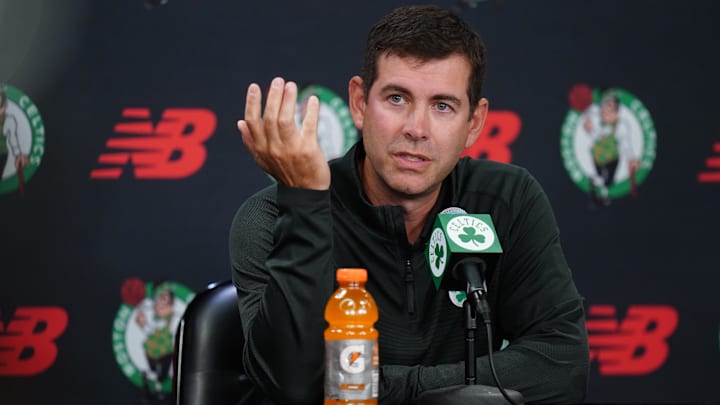
There are trades to be made, and the Celtics have tools at their disposal and the technical ability to do a lot at the deadline. But each possibility has to be examined for its probability. Each thing they CAN do comes with ramifications. And Brad Stevens is on the record as saying he’s open to doing something, but not if it is too damaging to the long-term goal of building a sustainable contender.
“We will not put a ceiling on this group,” he told reporters the last time he spoke to the media in December. “If it makes sense for us to look for things that can help us, we certainly will. But it all has to be within good deals, and it all has to be within the ultimate goal, which is the North Star of retooling so we're in a position to compete for what we want to compete for.”
So here’s a look at what the Celtics assets and how they might possibly approach the trade deadline.
(All cap information courtesy Spotrac.com)
THE ASSETS: PLAYERS
Derrick White: $28.1 million salary. Under contract for three more seasons. Age 31.
I do not think they are trading White, however, it’s not out of the question. We know how many things he can do, how much of a defensive monster he is at the guard position, and he’s been a pretty consistent fourth quarter performer. And with Tatum coming back, he can go back to his catch-and-shoot role where he has thrived in Boston.
At the same time, he’s 31, and it’s not unfair to question how many more years he has of playing at that level. Again, I’m not saying they will or suggesting they should. I’m just listing the potential assets they have, and there's no doubt teams in win-now situations who are talking trade with Boston will be asking about White. He’s close to untouchable, but not completely untouchable.
Anfernee Simons: $27.7 million salary. Expiring contract. Age 26.
The most likely of the trade candidates because of his expiring contract. Bird Rights travel with a player in trades, so a team acquiring Simons will be able to go over their cap and/or aprons to sign him, so that could make him attractive to a team above the cap looking to add a good player they might otherwise not be able to afford.
Of course, his recent play has made some fans weary of giving him up. He’s proving some things in Boston, but that could also increase his trade value and, depending on the deal, reduce how many other sweeteners, like draft picks, would have to be included.
Sam Hauser: $10 million salary. Under contract for three more seasons. Age 28.
He has a very good salary to help with matching purposes. Every team needs a mid-level-ish salary to get within the tighter matching rules.
Obviously, Hauser’s 3-point shooting is extremely valuable, and he’s proven that he can expand beyond that if needed. He’s a reliable defender and smart player, so he can be played in most situations. Teams will want to poach him if they can.
Payton Pritchard: $7.2 million salary. Under contract for two more seasons. Age 28.
I doubt he’s going to get moved, but at $7.2 million, teams will ask. Boston would have to get a ball-handler back in whatever deal he’d be included in. Regardless, this falls under the “probably not, but he’s not untouchable either” umbrella.
Hugo Gonzalez: $2.7 million salary. Under rookie scale contract for three more seasons (with two team options). Age 19.
Included because I’m extremely high on his potential, so I think teams looking for young talent out of Boston would be asking about him. His youth, European pro experience, and coachability enhance the obvious talent on the floor. There's no doubt teams will want him as a potential future rotation player.
I didn’t include everyone else, but the rest of the roster makes between $2.6 and $2.2 million, and the only guy I think Boston would fight to keep is Neemias Queta. I think everyone else on the roster is easily included in deals if necessary.
THE ASSETS: DRAFT PICKS
- Boston owes a 2028 pick swap to the San Antonio Spurs.
- Boston owes a conditional 2029 first round pick to either Portland or Washington. Per RealGM: “Portland will receive the most and least favorable of its 2029 1st round pick, Boston's 2029 1st round pick and Milwaukee's 2029 1st round pick and Washington will receive the second most favorable of the three.”
- Boston owes a conditional 2026 second round pick to Atlanta or Memphis.
- Boston owes a conditional 2027 second round pick to Utah or Orlando.
- Boston owes a second round pick to OKC in 2029.
- Boston will receive the most favorable of Orlando, Detroit, or Milwaukee second round pick this year.
- Boston will receive the most favorable of Minnesota, New York, New Orleans or Portland second round pick this year.
There are a couple of second rounders going out and coming in past 2029 but I stopped here because it’s already enough.
Boston owns their own first rounders this year and next. Because of the Stepien Rule, which prevents teams from trading consecutive first round picks, if they agree to move this year’s pick then they can’t trade the 2027 pick. They CAN trade the 2027 pick because 2028 is a swap, and that's not prohibited by Stepien. Because their 2029 pick is committed Portland or Washington, the next first rounder they can trade is 2031.
To summarize: Boston can trade either the 2026 or ‘27 first round pick and then 2031.
THE ASSETS: EXCEPTIONS
- Taxpayer Mid-Level: $5.685 million (expires end of season)
- Jaden Springer Traded Player Exception: $4 million (expires 2/6)
- Kristaps Porzingis Traded Player Exception: $22.5 million (expires 7/7
- Jrue Holiday Traded Player Exception: $4.7 million (expires 7/7)
The Celtics can use any of these exceptions to acquire a player without sending a player out.
A reminder when it comes to Traded Player Exceptions (TPEs), they can be split to acquire multiple players, but they cannot be combined to acquire a more expensive player.
So Boston can trade for a player making $10 million and a player making $12 million and use the Porzingis TPE to acquire both. Those players do not have to be acquired in the same trade. They can get a $10 million player from one team and a $12 million player in a separate trade from another team and use the Porzingis TPE to do both.
Boston cannot combine the Porzingis and Holiday exceptions to acquire a player making $27 million dollars.
Most TPEs expire without being used. When they expire, they just go away. There's no extending them.
FINANCIAL SITUATION
Salary: $206.6 million, over First Apron by $4 million. Room to second apron: $7.8 million.
This is very important to consider when talking about exceptions. Acquiring a player with an exception allows a team to make a trade without matching salaries, but that also just adds to the payroll. Using the Porzingis exception to bring in someone making more than $7.8 million would put the Celtics over the second apron and subject them to all the restrictions of being above that line.
Here’s a great primer on what the limitations of each apron are:
I'm just gonna redrop the chart here, because a lot of people are talking about what teams can and can't do at the various aprons. Hopefully this helps! pic.twitter.com/sbe22gcqIK
— Keith Smith (@KeithSmithNBA) December 31, 2024
Is it out of the question that the Celtics would go over the second apron this season in the right situation? No, it’s not, but that situation would have to virtually guarantee a title. Whatever you might be cooking up, one of the first questions need to ask yourself is “does this put Boston over the second apron?” If the answer is “yes,” the your flowchart should bring you to “they probably won’t do this trade.”
BOSTON’S APPROACH
Trades have gotten tougher in the second apron era. The salary matching rules make it very difficult to move an expensive player unless a team has cap room or a massive exception that it can use without repercussion.
This is by design, and it’s an important element in trade deadline discussion. The CBA is built to eventually tear down good, expensive teams and have those expensive salaries go to the teams with cap space and younger, tradeable players and picks. Celtics co-owner Wyc Grousbeck explicitly said so.
“I was the committee that really wrote these new rules … to make it much more tough to just go and buy a championship,” he said before the season began. “We have to have teams competing on a basically even financial keel, no matter who owns them and then have the best front office and the best good luck probably as well … As long as these rules are in the league, teams are going to pop up as best they can and then they are going to be so strangled on purpose.”
As much as we’d like to say “just go get [player],” the rules might make it tougher than it used to be. The net effect of this is one-for-one trades, or straight trades between two teams become more difficult. Sure, Trae Young was dealt to Washington in a straight trade, but he was a distressed asset and Washington is … ahem … okay with that.
So we can put together a bunch of fake trades between the Celtics and a team with a player they might want, but chances are it’s going to be tough.
All this is to say Boston might have to get more creative in their approach. Maybe they aren’t the aggressors in a deal, but rather the third team who has money to offer in order to facilitate a deal, and they get a good player in return for their troubles.
“I think there is definitely an increased awareness every day about the aprons, the effect of the aprons and the trade restrictions that are a part of that,” Stevens said last month. “It becomes much more difficult just to do a one-for-one. And it's always been difficult when you start including third, fourth, fifth teams. So I think that's a real thing.”
POTENTIAL TARGETS
Ivica Zubac: The most popular name out there for the Celtics and for good reason. He is a two-way center who has averaged a double-double the past two seasons while making an All-Defensive Team last year. He makes $18 million this season and is under contract for two more years, so he’d be under team control until his early 30s. He fits exactly what Boston is looking for at a reasonable price.
The problem is the Clippers are hard-capped at the first apron, so they can’t just do a straight swap with a little filler. They need to match almost exactly, so they’d need to add Brook Lopez in a deal involving Simons, which would complicate things. Boston doesn’t want Lopez and he’s their only other center. A third team would have to get involved, maybe to take Bogdan Bogdanovic off their hands, so the Clippers would have to do some maneuvering, and the Celtics would have to start sending draft picks to multiple teams to grease the skids.
It’s tough, but the smart people upstairs can figure it out. It’s not unreasonable to think that Stevens can make this deal happen if the Clippers are indeed interested in Simons as some rumors suggest.
Jaren Jackson, Jr.: In a vacuum, sure, JJJ would be great next to Brown, Tatum, White, and Pritchard. The defense would be off the charts, and Jackson could space the floor for everyone to drive, giving Boston the best of both worlds.
Also off the charts would be Boston’s payroll. The Celtics could find a way to match the $35 million Jackson, Jr. is owed this year to acquire him, but his massive extension kicks in next season, pushing his salary to $49 million. Assuming White sticks around in that deal, acquiring JJJ would mean he, White, Tatum, and Brown alone would make about $185 million. They alone would be $20 million over the cap and less than $20 million away from the second apron.
I don’t see a path to Jackson, Jr. unless Stevens is willing to make some very tough, very big deals in conjunction with this move. And even if Stevens is open to having that kind of discussion, JJJ isn’t the guy to have them about.
Daniel Gafford: Considering the price, $14.4 million this season, and a three-year extension starting at $17.3 million next season, you get good production at less than half the price of Jackson, Jr. So he’s an intriguing target. The flip side is that his production right now is similar to Neemias Queta, who is playing for the minimum.
This trade comes with its own hurdles. The Celtics can’t just take Gafford for Simons because it would hard cap the Mavs at the first apron and they’d be over. The Celtics can’t bring back more players for Simons because THEY would be hard capped and be over as well.
So again, it would take multiple teams to make this happen.
The question ultimately becomes would you rather have Gafford and Queta with Tatum next season, or would you rather have Simons and Queta? An argument can be made either way, but that being the case, but considering the hurdles Boston would have to clear to get this done, it feels unlikely.
Day’Ron Sharpe: This is a player in Boston’s wheelhouse because he makes $6.25 million this year and next (team option). He’s a good rebounder and passer, so he could give the Celtics a solid one-two punch at center without creating a financial burden.
So how do the Celtics acquire him? Would Hauser be enough for the Nets? They have other centers and they're currently 24th in 3-point shooting percentage, so it could be a way for both teams to address structural weaknesses.
It would be tough for Boston to lose that kind of shooter, but they’d keep Simons in this scenario, and he’d probably just slide into Hauser’s minutes. For now, before Tatum returns, the Celtics could just split the remaining minutes between the wings they have, but that issue would go away after Tatum comes back.
The question, as always, is would Brooklyn do this deal? If they would, then I’m not ruling this out. It wouldn’t give Boston the most dominant front court ever, but Queta’s progression and the strength of the perimeter players would give a deal like this some merit.
One potential hurdle: The Celtics would probably have to have some assurance that Simons will want to stick around next season at a number that works for the team. They can’t trade Hauser for Sharpe and then lose Simons as well.
Wild card target - Santi Aldama: I’m including this one because it represents the kind of “we’ll help you make this trade, but we want something of value” deal I mentioned before.
If the Grizzlies want to move Ja Morant, they might need a little help to make things work. Maybe it’s financial, or maybe they want a big haul for him. The Celtics are there and able to help facilitate something if the Grizzlies are willing to part with Aldama to make it happen.
He’s 25, he’s seven feet tall, he’s an okay shooter that would give Boston some spacing, and he’ll grab a few rebounds.
But this isn’t specifically about Aldama, per se. It’s about looking at the big names potentially on the market and wondering if Boston’s involvement can snag them a center that might not have been in the original conversation.
IN CONCLUSION
Stevens always has tricks up his sleeve. If he does make a deal, it’ll probably be for someone no one has mentioned. Some of the calculus has changed since the beginning of the season because keeping Simons feels like more of a possibility now that he’s exhibited a comfort in his role and with this system. If the Celtics feel good about keeping him next year, then his inclusion in trades would have to bring back a slam dunk win of a deal. The evolution of this team and who is playing well has certainly shaped how the team will operate moving forward.
“(If) it makes sense with another team that's willing to do something, which is very complicated, then we always listen, and we always look, and we're always pursuing that,” Stevens said. “There's nothing holding us back necessarily from that. But at the same time, there's a lot of things that have to go right in a deal … there's a balance with all that. But the North Star is the North Star, and we'll keep it that way.”
 Add us as a preferred source on Google
John Karalis is a 20-year veteran of Celtics coverage and was nominated for NSMA's Massachusetts Sportswriter of the Year in 2019. He has hosted the Locked On Celtics podcast since 2016 and has written two books about the Celtics. John was born and raised in Pawtucket, RI. He graduated from Shea High School in Pawtucket, where he played football, soccer, baseball, and basketball and was captain of the baseball and basketball teams. John graduated from Emerson College in Boston with a Bachelor of Science degree in Broadcast Journalism and was a member of their Gold Key Honor Society. He was a four-year starter and two-year captain of the Men’s Basketball team, and remains one of the school's top all-time scorers, and Emerson's all-time leading rebounder. He is also the first Emerson College player to play professional basketball (Greece). John started his career in television, producing and creating shows since 1997. He spent nine years at WBZ, launching two different news and lifestyle shows before ascending to Executive Producer and Managing Editor. He then went to New York, where he was a producer and reporter until 2018. John is one of Boston’s original Celtics bloggers, creating RedsArmy.com in 2006. In 2018, John joined the Celtics beat full-time for MassLive.com and then went to Boston Sports Journal in 2021, where he covered the Celtics for five years. He has hosted the Locked On Celtics podcast since 2016, and it currently ranks as the #1 Boston Celtics podcast on iTunes and Spotify rankings. He is also one of the co-hosts of the Locked on NBA podcast.
Follow John_Karalis