%22%3E%0A%3Cpath%20d%3D%22M0%2018.4127V18.3656C0%2013.7589%203.58931%2010.3203%208.19606%2010.3203C11.5875%2010.3203%2013.8862%2011.9689%2015.1863%2014.3336L10.9281%2016.8206C10.3534%2015.7184%209.54323%2014.9459%208.13012%2014.9459C6.38728%2014.9459%205.24736%2016.4627%205.24736%2018.3185V18.3656C5.24736%2020.3723%206.43438%2021.7854%208.13012%2021.7854C9.58092%2021.7854%2010.4005%2020.994%2011.0411%2019.8447L15.2899%2022.247C13.9898%2024.5362%2011.8325%2026.411%207.99823%2026.411C3.7212%2026.411%200%2023.1985%200%2018.4127Z%22%20fill%3D%22white%22%2F%3E%0A%3Cpath%20d%3D%22M16.2412%2010H21.2436V15.6619C22.0161%2014.6727%2023.2314%2013.7683%2024.9272%2013.7683C27.4613%2013.7683%2029.044%2015.4452%2029.044%2018.1584V26.0907H24.0416V19.7693C24.0416%2018.733%2023.4293%2018.1395%2022.6756%2018.1395C21.9219%2018.1395%2021.2436%2018.733%2021.2436%2019.7693V26.0907H16.2412V10Z%22%20fill%3D%22white%22%2F%3E%0A%3Cpath%20d%3D%22M30.0811%2022.671V22.6239C30.0811%2020.2216%2031.8616%2018.8744%2034.669%2018.8744C35.6864%2018.8744%2036.9865%2019.0911%2037.514%2019.3172V19.1194C37.514%2018.0171%2036.8263%2017.3765%2035.2907%2017.3765C34.0566%2017.3765%2033.0203%2017.6403%2031.9652%2018.0548L31.0797%2014.7293C32.4645%2014.2017%2034.0566%2013.8438%2036.148%2013.8438C38.5974%2013.8438%2040.1801%2014.3525%2041.2352%2015.4076C42.1396%2016.312%2042.4882%2017.4802%2042.4882%2019.223V26.0719H37.4858V24.8566C36.6473%2025.761%2035.5263%2026.3545%2034.0284%2026.3545C31.7108%2026.3545%2030.0811%2025.0356%2030.0811%2022.6522V22.671ZM37.5517%2021.6347V21.126C37.2691%2021.013%2036.8263%2020.9282%2036.4024%2020.9282C35.4132%2020.9282%2034.8574%2021.5217%2034.8574%2022.2753V22.3224C34.8574%2023.029%2035.3661%2023.4906%2036.0067%2023.4906C36.8923%2023.4906%2037.5517%2022.7841%2037.5517%2021.6441V21.6347Z%22%20fill%3D%22white%22%2F%3E%0A%3Cpath%20d%3D%22M43.9854%2014.0509H48.9878V16.4721C49.6755%2014.8423%2050.7683%2013.7872%2052.7561%2013.8719V19.1853H52.2285C50.1088%2019.1853%2048.9878%2020.3534%2048.9878%2023.0195V26.0813H43.9854V14.0509Z%22%20fill%3D%22white%22%2F%3E%0A%3Cpath%20d%3D%22M53.7549%2010H58.7573V26.0907H53.7549V10Z%22%20fill%3D%22white%22%2F%3E%0A%3Cpath%20d%3D%22M60.0104%2020.1084V20.0613C60.0104%2016.6698%2062.8272%2013.7588%2066.7934%2013.7588C70.7595%2013.7588%2073.5386%2016.6227%2073.5386%2020.0142V20.0613C73.5386%2023.4528%2070.7218%2026.3638%2066.7462%2026.3638C62.7707%2026.3638%2060.001%2023.4999%2060.001%2020.1084H60.0104ZM68.734%2020.1084V20.0613C68.734%2018.8743%2067.8485%2017.9228%2066.7462%2017.9228C65.644%2017.9228%2064.8056%2018.8743%2064.8056%2020.0142V20.0613C64.8056%2021.2483%2065.6911%2022.1998%2066.7934%2022.1998C67.8956%2022.1998%2068.734%2021.2483%2068.734%2020.1084Z%22%20fill%3D%22white%22%2F%3E%0A%3Cpath%20d%3D%22M75.46%2022.0491V17.904H74.0469V14.0415H75.46V11.0269H80.4624V14.0415H83.2415V17.904H80.4624V20.9469C80.4624%2021.8513%2080.8769%2022.181%2081.6777%2022.181C82.1393%2022.181%2082.6669%2022.0491%2083.1944%2021.8042V25.6667C82.4031%2026.0812%2081.2067%2026.345%2080.0008%2026.345C77.0521%2026.345%2075.46%2024.979%2075.46%2022.0491Z%22%20fill%3D%22white%22%2F%3E%0A%3Cpath%20d%3D%22M85.3799%2022.0491V17.904H83.9668V14.0415H85.3799V11.0269H90.3823V14.0415H93.1615V17.904H90.3823V20.9469C90.3823%2021.8513%2090.7968%2022.181%2091.5976%2022.181C92.0592%2022.181%2092.5868%2022.0491%2093.1144%2021.8042V25.6667C92.323%2026.0812%2091.136%2026.345%2089.9207%2026.345C86.972%2026.345%2085.3799%2024.979%2085.3799%2022.0491Z%22%20fill%3D%22white%22%2F%3E%0A%3Cpath%20d%3D%22M93.6709%2020.1367V20.0896C93.6709%2016.5003%2096.2522%2013.7683%2099.8603%2013.7683C104.137%2013.7683%20106.116%2016.7453%20106.116%2020.4005C106.116%2020.6643%20106.116%2020.9752%20106.097%2021.239H98.3624C98.711%2022.2941%2099.5495%2022.8499%20100.633%2022.8499C101.537%2022.8499%20102.281%2022.4354%20103.082%2021.6158L105.767%2023.7543C104.58%2025.2993%20102.884%2026.3733%20100.284%2026.3733C96.337%2026.3733%2093.6709%2023.8862%2093.6709%2020.1367ZM101.556%2019.0345C101.443%2017.8852%20100.765%2017.2257%2099.8792%2017.2257C98.9936%2017.2257%2098.4472%2017.9323%2098.2871%2019.0345H101.547H101.556Z%22%20fill%3D%22white%22%2F%3E%0A%3Cpath%20d%3D%22M113.134%2010.6594H118.287V16.1046H123.007V10.6594H128.16V26.0812H123.007V20.5512H118.287V26.0812H113.134V10.6594Z%22%20fill%3D%22white%22%2F%3E%0A%3Cpath%20d%3D%22M129.507%2020.1084V20.0613C129.507%2016.6698%20132.324%2013.7588%20136.29%2013.7588C140.256%2013.7588%20143.035%2016.6227%20143.035%2020.0142V20.0613C143.035%2023.4528%20140.218%2026.3638%20136.252%2026.3638C132.286%2026.3638%20129.507%2023.4999%20129.507%2020.1084ZM138.23%2020.1084V20.0613C138.23%2018.8743%20137.345%2017.9228%20136.243%2017.9228C135.14%2017.9228%20134.302%2018.8743%20134.302%2020.0142V20.0613C134.302%2021.2483%20135.188%2022.1998%20136.29%2022.1998C137.392%2022.1998%20138.23%2021.2483%20138.23%2020.1084Z%22%20fill%3D%22white%22%2F%3E%0A%3Cpath%20d%3D%22M144.251%2014.0509H149.253V16.4721C149.932%2014.8423%20151.034%2013.7872%20153.022%2013.8719V19.1853H152.494C150.374%2019.1853%20149.253%2020.3534%20149.253%2023.0195V26.0813H144.251V14.0509Z%22%20fill%3D%22white%22%2F%3E%0A%3Cpath%20d%3D%22M153.973%2014.0509H158.975V15.7278C159.748%2014.7386%20160.953%2013.7683%20162.659%2013.7683C165.193%2013.7683%20166.775%2015.4452%20166.775%2018.1584V26.0907H161.773V19.7693C161.773%2018.7331%20161.161%2018.1395%20160.407%2018.1395C159.653%2018.1395%20158.975%2018.7331%20158.975%2019.7693V26.0907H153.973V14.0604V14.0509Z%22%20fill%3D%22white%22%2F%3E%0A%3Cpath%20d%3D%22M167.896%2020.1367V20.0896C167.896%2016.5003%20170.478%2013.7683%20174.086%2013.7683C178.363%2013.7683%20180.341%2016.7453%20180.341%2020.4005C180.341%2020.6643%20180.341%2020.9752%20180.322%2021.239H172.588C172.937%2022.2941%20173.775%2022.8499%20174.858%2022.8499C175.763%2022.8499%20176.516%2022.4354%20177.308%2021.6158L179.993%2023.7543C178.806%2025.2993%20177.11%2026.3733%20174.51%2026.3733C170.563%2026.3733%20167.896%2023.8862%20167.896%2020.1367ZM175.791%2019.0345C175.678%2017.8852%20175%2017.2257%20174.114%2017.2257C173.276%2017.2257%20172.682%2017.9323%20172.531%2019.0345H175.791Z%22%20fill%3D%22white%22%2F%3E%0A%3Cpath%20d%3D%22M182.471%2022.0491V17.904H181.058V14.0415H182.471V11.0269H187.473V14.0415H190.252V17.904H187.473V20.9469C187.473%2021.8513%20187.888%2022.181%20188.688%2022.181C189.15%2022.181%20189.678%2022.0491%20190.205%2021.8042V25.6667C189.414%2026.0812%20188.227%2026.345%20187.012%2026.345C184.053%2026.345%20182.471%2024.979%20182.471%2022.0491Z%22%20fill%3D%22white%22%2F%3E%0A%3Cpath%20d%3D%22M190.601%2024.6304L192.296%2021.7854C193.747%2022.6898%20195.386%2023.1325%20196.752%2023.1325C197.233%2023.1325%20197.478%2023.0195%20197.478%2022.7369V22.6898C197.478%2022.4448%20197.261%2022.2941%20196.046%2021.9832C193.003%2021.2296%20191.128%2020.4194%20191.128%2017.9323V17.8852C191.128%2015.2379%20193.248%2013.7683%20196.376%2013.7683C198.363%2013.7683%20200.323%2014.277%20201.774%2015.1532L200.191%2018.1301C198.91%2017.4236%20197.374%2017.0091%20196.357%2017.0091C195.876%2017.0091%20195.65%2017.1409%20195.65%2017.3859V17.433C195.65%2017.6779%20195.914%2017.8287%20197.129%2018.1395C200.172%2018.8838%20202%2019.7222%20202%2022.1905V22.2376C202%2024.8565%20200.04%2026.3827%20196.781%2026.3827C194.444%2026.3827%20192.325%2025.7892%20190.61%2024.6399L190.601%2024.6304Z%22%20fill%3D%22white%22%2F%3E%0A%3Cpath%20fill-rule%3D%22evenodd%22%20clip-rule%3D%22evenodd%22%20d%3D%22M211.368%204.36764C217.191%20-1.45588%20226.632%20-1.45588%20232.456%204.36764C238.279%2010.1912%20238.279%2019.6324%20232.456%2025.4559L221.912%2036L211.368%2025.4559C205.544%2019.6324%20205.544%2010.1912%20211.368%204.36764ZM214.009%207.55761C213.948%207.86849%20213.916%208.39718%20213.916%209.14566V10.4189C213.916%2011.1832%20213.948%2011.7198%20214.013%2012.0267C214.078%2012.3317%20214.278%2012.6168%20214.617%2012.8762C214.956%2013.1376%20215.403%2013.3316%20215.958%2013.4623C216.512%2013.593%20217.1%2013.6584%20217.837%2013.6584C218.573%2013.6584%20219.217%2013.591%20219.769%2013.4524C220.322%2013.3158%20220.761%2013.1178%20221.086%2012.8604C221.411%2012.6029%20221.605%2012.3178%20221.666%2012.0069C221.728%2011.6961%20221.759%2011.1674%20221.759%2010.4189V9.14566C221.759%208.38134%20221.728%207.84473%20221.662%207.53781C221.597%207.23287%20221.397%206.94971%20221.058%206.68834C220.72%206.42696%20220.272%206.23291%20219.718%206.10223C219.163%205.97154%20218.536%205.90619%20217.839%205.90619C217.102%205.90619%20216.459%205.97352%20215.906%206.11213C215.352%206.24875%20214.914%206.44677%20214.589%206.70418C214.265%206.9616%20214.071%207.24673%20214.009%207.55761ZM219.276%2024.8638C222.876%2024.8638%20224.557%2024.2064%20224.557%2021.862V21.858V21.3155C224.557%2019.6581%20223.516%2018.971%20220.252%2018.3136C219.278%2018.1136%20218.908%2017.9136%20218.908%2017.3136V16.9414C218.908%2016.6543%20219.177%2016.5117%20219.413%2016.5117C219.749%2016.5117%20219.918%2016.7137%20219.918%2016.9414V18.1136H224.391V17.3988C224.391%2015.4563%20223.347%2014.4266%20219.177%2014.4266C216.15%2014.4266%20213.896%2015.3414%20213.896%2017.3711V17.7433C213.896%2019.5155%20214.805%2020.3155%20218.201%2021.0303C218.28%2021.0472%20218.355%2021.063%20218.427%2021.0781C219.329%2021.2674%20219.647%2021.3341%20219.647%2021.9174V22.2897C219.647%2022.6619%20219.546%2022.8045%20219.142%2022.8045C218.67%2022.8045%20218.637%2022.5471%20218.637%2022.262V21.2897H213.894V21.7471C213.894%2024.149%20215.476%2024.8638%20219.276%2024.8638ZM225.424%2024.5569H229.925V14.7355H225.424V24.5569ZM226.955%2013.5019H229.925V6.06064H227.092V9.411L225.193%206.06064H222.359V13.5019H225.193V10.1199L226.955%2013.5019ZM218.269%2012.152C218.204%2012.2688%20218.055%2012.3262%20217.825%2012.3262L217.827%2012.3282C217.604%2012.3282%20217.459%2012.2767%20217.398%2012.1758C217.336%2012.0748%20217.305%2011.8074%20217.305%2011.3758V7.90068C217.305%207.51852%20217.352%207.28684%20217.445%207.20962C217.538%207.13239%20217.675%207.09279%20217.851%207.09279C218.059%207.09279%20218.198%207.14031%20218.265%207.23734C218.332%207.33239%20218.366%207.55416%20218.366%207.90068V11.3203C218.366%2011.7579%20218.334%2012.0352%20218.269%2012.152Z%22%20fill%3D%22white%22%2F%3E%0A%3C%2Fg%3E%0A%3Cdefs%3E%0A%3CclipPath%20id%3D%22clip0_15229_1752%22%3E%0A%3Crect%20width%3D%22237%22%20height%3D%2236%22%20fill%3D%22white%22%2F%3E%0A%3C%2FclipPath%3E%0A%3C%2Fdefs%3E%0A%3C%2Fsvg%3E%0A)
What Will Brandon Miller's Next Contract Look Like, and Will He be Worth it?
In this story:
Since the beginning of the decade, the Charlotte Hornets have had ten first-round picks. Going back to the start of 2010, they have had 21 first-round picks.
Of those 21 players who wore a Hornets hat while shaking the commisioner's hand on stage, just four of them have received a second contract in Charlotte: Kemba Walker, Michael Kidd-Gilchrist, PJ Washington, and LaMelo Ball.
This struggle with finding players in the draft and rewarding them with a high-paying contract is what has kept the Charlotte Hornets out of the postseason for over a decade. This only gets worse with the fact that each of those four players' third contract was given by another team.
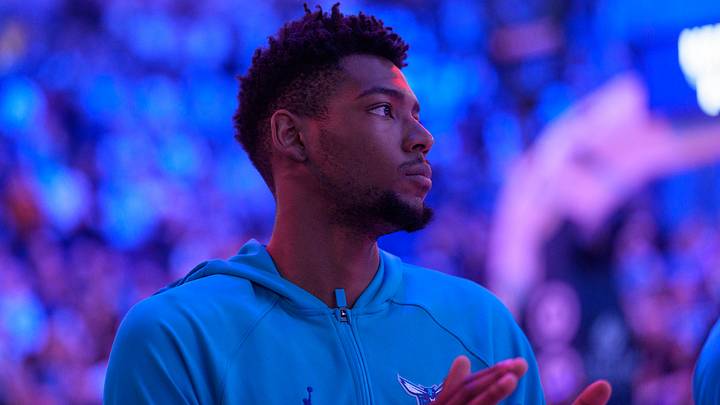
In the 2026 offseason, the Charlotte Hornets were presented with a contract situation regarding their second overall pick in the 2023 NBA Draft, Brandon Miller. After a stellar 2025-26 season, where Miller was a near All-Star and played a pivotal role for the Hornets second-half turnaround, the former Alabama star was up for a rookie-scale extension.
Miller became eligible on July 1 to receive a five-year extension worth up to $275 million. The $55 million per year that he would be owed would see him make more money per year than Luka Doncic, Steph Curry, Victor Wembanyama, Kawhi Leonard, and many other notable names.
Of course, the Hornets do not need to give him the maximum deal, and could look to find a compromise around the contract that Amen Thompson received from the Houston Rockets (5 years, $208 million). With the second-apron changing the way teams give out contracts to younger players, and Miller not showing the signs that he should be one of the highest paid players in the sport yet, the deal that Thompson received could be beneficial to both sides.
So, the question must be asked: should the Hornets pay Brandon Miller, and if so, what should they look to give him?
Five quarters into the 2025-26 season, Miller headed to the locker room holding his left shoulder. He went on to miss a month, and played the remainder of the season with a wrap around his shoulder.
Just a season prior, Brandon missed a significant portion of the season after undergoing surgery on his wrist. His 2025 offseason was spent on healing his wrist, and then barely into his third season he had to deal with rehabbing his shoulder.
In May, Miller underwent successful surgery to address left shoulder instability, and was expected to make a full recovery. So headed into his fourth, and arguably most important season, Miller would spend his time undergoing rehab on his shoulder. Of course, this was something I wrote about when the surgery was announced.
The Hornets are familiar with this surgery, as a little under a year ago Josh Green underwent the same surgery as Miller. Green eventually made his return to the lineup in the middle of December, and the surgery typically takes 6-12 months to return to full strength. With Brandon receiving his surgery a month before where Green did, it's possible he could make his return before the season begins, but a November return is more likely at this point.
Charlotte was 7.4 points better than their opponent (per 100 possesions) last season with Brandon Miller on the floor. Dean Oliver's Four Factors of basketball success (shooting, turnovers, rebounds, and free throws) can be viewed both offensively and defensively. Of the eight different aspects, the only statstic where the Hornets were worse with Miller on the floor was opponent turnover percentage, where the Hornets were 0.5% worse.
So, the Hornets are a better team with Miller on the floor. That was obvious enough to see. But how much of that impact can actually be attributed to Miller himself?
To get a better understanding of that, we need to look beyond just traditional box-score statistics and team-level on/off numbers. Certain impact metrics such as DPM, 1-Year RAPM, and TimeDecayRAPM will attempt to measure the influence on winning that a player has while accounting for the other players on the court.
Offensive (rank) | Defensive (rank) | Total (rank) |
|---|---|---|
50 | 352 | 100 |
190 | 156 | 165 |
54 | 24 | 24 |
Miller's numbers, shown above, paint an interesting picture. His offensive impact is much stronger than his defensive impact in DPM, however RAPM paints a significantly different picture of his defense.
That discrepancy is worth digging into.
On the surface, DPM suggests to us that Brandon is a player who provides a signficant amount of value offensively, while giving much of that value back defensively. RAPM tells us that his overall defensive impact may be considerably stronger than his individual defensive statistics would indicate.
There is another way to separate Miller's impact from the talent around him.
Last season, the Hornets "big three" revolved around Miller, LaMelo Ball, and Kon Knueppel. When all three were on the court together, the Hornets were beating their opponent by 15.7 points. When Miller and Ball shared the floor without Knueppel, they were beating teams by less, but still were plus-5.7 points.
The most encouraging number for Charlotte came when Miller was on the floor without the other two. The Hornets were plus-7.1 points per 100 possessions in those minutes.
Brandon Miller was not just a product of playing alongside one of the best offensive engines in basketball in LaMelo Ball. Even when he was off the floor, the Hornets continued to thrive with Miller on the court.
So, what is Miller doing to create that impact?
Of players at his position, Miller is in the 87st percentile of creation TSA. This is a stat that measures the shot attempts that a player takes specifically on self-created shot types like isolations, pick-and-roll ball handler possessions, and post-ups. In that same breath, Miller was in the 71st percentile for creation TS%, meaning not only was he taking a high amount of self-created shots, he was making 53% of them.
Any player who relies on making shots is valuable, but a player who has the ability to create advantages for himself and others is difficult to replace. Brandon's ability to attack closeouts, get downhill, and create shots off the dribble will ultimately determine how high his ceiling could be.
That being said, Miller still has room to improve when attacking the rim. He ranked 83rd in the NBA in drives per game last season, trailing players such as Grayson Allen, Steph Curry and Ben Saraf. More concerning is what happened when Miller did get downhill. He shot just 45.1% on drives, ranking around 800th in the NBA in field-goal percentage on those attempts.
For a player with Miller's size and shooting ability, becoming more efficient as a driver could be the next step in his offensive development. Defenses are already forced to respect his ability to shoot from the perimeter, but consistently attacking closeouts and finishing at the rim would give him another way to create offense when teams take away his jumper.
After a deal in June that saw LaMelo Ball get dealt to the Minnesota Timberwolves, the Hornets would be without their offensive engine. Ball was the primary playmaker in the Hornets offense, and it was something that Brandon Miller was able to benefit off of.
Miller saw an increase in his TS% and +/- (per 75 possessions) in his 1226 minutes on the floor with Ball this season. More importantly, in 684 minutes without Ball, Brandon saw increases in points, rebounds, assists, free-throw attempts, and three-point percentages.
With Ball gone now, though, more playmaking duties will be tasked upon Miller. If there was one part of his on the floor game that we can point to as a looming negative, it is Brandon's playmaking abilities. Of players at his position, Miller was in the 31st percentile for PASSTOV, 49th for AST EFG%, and 68th in rim assists.
All that being said, he still is 78th in potential assists. He will have the ball in his hands more this season than he has at any point in his career, making 2026-27 a true test of whether he can make the playmaking leap necessary to become a true offensive centerpiece
The biggest question surrounding Miller's impact numbers comes on the defensive end. His 352nd ranking in DDPM suggests he still has plenty of room to improve defensively, while his 24th-place ranking in D1YRAPM paints a much more favorable picture. The difference between these two metrics make it almost impossible to definitively label Miller as either a plus or minus defender, but it shows us an area where he still has something to prove.
After all this, let's talk about the contract situation. The Hornets don't have to decide whether Brandon Miller is worth paying. They have to decide how much he is worth paying.
As mentioned above, the easiest place to start is the contract that the Rockets just handed to Amen Thompson. This is a recent, high-paying deal that gives Charlotte an example of what a team is willing to commit to a young player who has shown significant potential.
Miller's case is much different, though. While neither player has established himself as an All-Star just yet, Amen has solidified himself as one of the best defensive players in the sport today. Already being an elite defensive player gives Thompson a much higher floor than Miller, where Miller could have a much lower floor due to his production coming on the offensive side of the floor. If Miller's offense does not develop as expected, there are more questions about what his overall value looks like.
The second case for Thompson comes from his durability. To this point, he has played nearly fifty more games than Miller over their three seasons in the league. While Brandon has played two seasons with 60+ games, there has been a clear struggle with his durability at times, something that has hindered him in multiple offseasons now. Thompson, meanwhile, is coming off a season where he just played 79 games and averaged 37.4 minutes a night (second in the entire NBA).
The impact numbers also favor Thompson. With his DPM ranked 60th in the entire NBA, Thompson's projected value comes out to roughly $42-55 million per year over the next few seasons. Miller, meanwhile, has a much lower DPM while playing 65 games and averaging 30 minutes a night. Based on just those numbers, his projected value comes out to roughly $26-32 million per year.
This gap does not tell the entire story. The offensive production that Miller provides, with the upside that he has, makes it much more difficult to capture who he is in a single metric. The question comes down to whether or not Miller's offensive ceiling is high enough to justify paying him above what the numbers suggest.
The problem for the Hornets right now is that there are not many strong comparisons to this situation with Miller.
The NBA's apron rules have changed the way that teams approach handing out contracts, especially once a team reaches the dreaded second apron. With the restrictions that come with operating above the aprons, teams have become more cautious about handing out these massive deals/
This makes Amen's contract even more relevant. Rather than trying to find Brandon's twin, Charlotte can use the $208 million extension that Houston handed out as a baseline for the next contract for Brandon Miller. Miller's offensive production gives him a case to be paid above Thompson, while Amen's defensive impact and durability give the Rockets reasons to value him more highly.
So, at the end the question must be asked: what should the Charlotte Hornets give Brandon Miller?
Based on everything that Miller has shown so far in his career, the answer should fall somewhere between the $208 million extension that Amen Thompson received, and the $275 million maximum that Miller is now eligible to receive. Though he does not have the defensive abilities that Thompson does to give him a high floor, his offensive upside, and opportunity to become Charlotte's top offensive player make paying him a significant amount of money a worthy investment.
Charlotte should look to land Miller on a five year, $225 million deal. This deal would give Brandon an average salary of $45 million, which would reward him as not only one of the most important young players in the franchise, but would also make him the highest paid player in Hornets history.
Brandon Miller still has much to prove. His defense, playmaking, and durability remain questions, and this upcoming season will provide an important piece of the evaluation of his abilities. Charlotte does not need him to be a finished product to justify this extension, though. They just need to believe that the player he becomes over the next five years will be worth paying this price today.
 Add us as a preferred source on Google
A Boston native and product of Elon University, Owen brings a fresh perspective to the Charlotte sports scene. He joined Charlotte Hornets On SI in 2024, providing in-depth coverage of all areas of the organization, from the draft, free agency, trades, and on scene at games.