%20%20--%3E%0A%3Csvg%20version%3D%221.1%22%20id%3D%22Layer_1%22%20xmlns%3D%22http%3A%2F%2Fwww.w3.org%2F2000%2Fsvg%22%20xmlns%3Axlink%3D%22http%3A%2F%2Fwww.w3.org%2F1999%2Fxlink%22%20x%3D%220px%22%20y%3D%220px%22%0A%09%20width%3D%2239px%22%20height%3D%2240px%22%20viewBox%3D%220%200%2039%2040%22%20enable-background%3D%22new%200%200%2039%2040%22%20xml%3Aspace%3D%22preserve%22%3E%0A%3Cpath%20fill%3D%22%23FFFFFF%22%20d%3D%22M38.5%2C7H28.2v26h10.3V7z%22%2F%3E%0A%3Cpath%20fill-rule%3D%22evenodd%22%20clip-rule%3D%22evenodd%22%20fill%3D%22%23FFFFFF%22%20d%3D%22M26.1%2C25.5c0%2C5.8-4.1%2C7.5-12.9%2C7.5C3.9%2C33%2C0%2C31.2%2C0%2C25.2v-1.1h11.6%0A%09v2.4c0%2C0.7%2C0.1%2C1.4%2C1.2%2C1.4c1%2C0%2C1.2-0.4%2C1.2-1.3v-0.9c0-1.6-0.9-1.6-3.5-2.2C2.2%2C21.7%2C0%2C19.7%2C0%2C15.3v-0.9C0%2C9.3%2C5.5%2C7%2C12.9%2C7%0A%09c10.2%2C0%2C12.8%2C2.6%2C12.8%2C7.4v1.8h-11v-2.9c0-0.6-0.4-1.1-1.2-1.1c-0.6%2C0-1.2%2C0.4-1.2%2C1.1v0.9c0%2C1.5%2C0.9%2C2%2C3.3%2C2.5%0A%09c8%2C1.6%2C10.5%2C3.3%2C10.5%2C7.5V25.5z%22%2F%3E%0A%3C%2Fsvg%3E%0A)
How Basketball Hall of Famer Amar’e Stoudemire Found a Second Act As a Police Officer
In this story:
Members of his 2002 draft class (Jay Williams, Matt Barnes) and colleagues from his various All-Star Games (Dwyane Wade, Dirk Nowitzki, Grant Hill, Shaquille O’Neal) are in hair-and-makeup gigs, now members of the basketball media. He has former teammates coaching and in front offices.
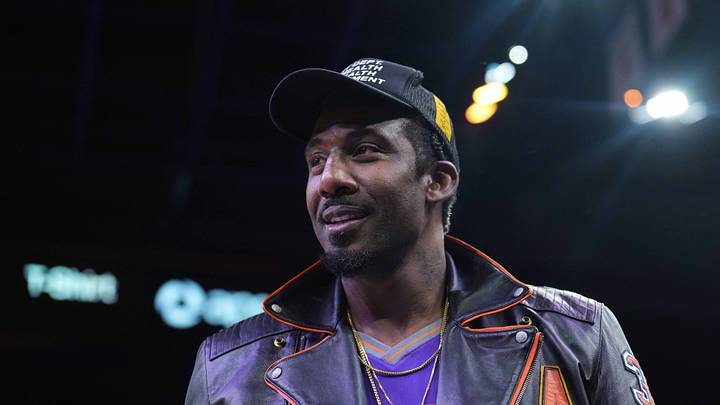
But starting this week, Amar’e Stoudemire will begin his days in a more vital, if less remunerative, field. He will put on a uniform, strap on his tactical belt and, on some days, a load-bearing vest. And he will go to work as a Miami police officer.
This past August, Stoudemire, a six-time All-Star and five-time All-NBA selection, was inducted into the Naismith Basketball Hall of Fame. He didn’t tell anyone at the time, but he’d spent the days before and after at the Miami-Dade police academy, learning everything from CPR to conflict de-escalation. After passing a series of tests, Stoudemire graduates Wednesday, and will begin career 2.0 as a police officer.
It’s an unlikely pivot for a celestially talented basketball player, one who made more than $167 million over his 14-year NBA career with the Suns, Knicks, Mavericks and Heat. And yet it’s thoroughly on-brand. After Stoudemire’s last NBA game in 2016, he ventured to Israel, where he converted to Judaism, began studying Torah and once hosted an intrepid sportswriter for a memorable dinner. Having gone directly from high school to the NBA, he surreptitiously took college courses. His business interests run from movie production to kosher wine. When he wasn’t writing middle-grade chapter books, he was running a fashion line or collecting art.
“I just go to what I have passion for,” he says. “You know, my passion drives me in directions that only I can follow.”
Fair enough. Still, that’s a long jumper away from putting on bulletproof attire, packing heat and pursuing law and order. The day before his graduation, Stoudemire explained his latest career move to Sports Illustrated, the first interview he’s given on the topic.

This interview has been edited for brevity and clarity.
Sports Illustrated: Explain this career transition.
Amar’e Stoudemire: It’s something I always wanted to do since I was a kid. I remember back when I was in grade school, elementary school. They asked you on career day, “What do you want to be when you grow up?” And my initial response was a police officer. It runs in the family. My uncle was a captain. His brother was a deputy. My cousin is a captain. My sister’s in the academy. So, it’s a family tradition, basically.
SI: NBA training camp is this month. How does police training compare?
AS: Yeah, it was a little bit [more] challenging actually because now I’m running a lot more than I had before. Obviously, in the NBA you run short distances, right? And the police academy, you’re running more long-distance mileage. You cover a lot of mileage in your training, a lot of push-ups, a lot of barracks crawls, a lot of squats, a lot of lunges. You have to cover a certain requirement as far as physical training, so you have to make sure you beat your times.
SI: Do you have a sense of what life’s going to look like for you as a police officer?
AS: I don’t quite know exactly what it’s going to be as far as the job, what the job entails. I know what my responsibilities are. But as far as what the schedule is, I know you have in-house training to start out with. And then you have FTO, which is your field training officer. So you would be somewhat teamed up with a FTO for about a month or two to make sure you’re ready to take on a job and to patrol by yourself.
SI: You know, you’re not the first athlete to make this transition. Everyone knows about Shaq, but I see Laveranues Coles [is an officer] in Jacksonville… Ronnie Coleman—remember Ronnie Coleman, Mr. Olympia? What do you make of this transition from athlete to law enforcement?
AS: It’s a similar situation where you have to have discipline. You gotta have a sense of professionalism. You have to be able to communicate properly. I think as an athlete, all those things also are important. Being able to communicate with your fans and the media, but more so, as an officer, you communicate with the community. So I will be able to help steer the next generation in the proper way and catch them before they get in trouble and try to provide some guidance there.
SI: This is honorable work. It’s also dangerous work. What does the family make of this?
AS: My wife at first was a little bit concerned because obviously being a police officer, there’s some danger to it. But if you are well-trained and you understand your policies and procedures, you’re able to somewhat have officer safety, which is very important, and that’s the goal.
6x NBA All-Star.
— NBA (@NBA) August 15, 2026
5x All-NBA.
2003 Kia NBA Rookie of the Year.
Amar'e Stoudemire is presented his @Hoophall orange jacket 👏 pic.twitter.com/65bRGtT7by
SI: Tell me what academy training was like.
AS: So I was in the academy for 10 1/2 months. Started out as prime military. So we would start out by taking the flag down in the formation. We’ll march to the flag. We’ll stand in formation. We’ll take the flag down. We’ll do 25, motivational push-ups. Some days we’ll have PT, physical training. So we have to run a mile and a half, or two miles, or three miles. We have to do X amount of push-ups and lunges. We run the stadium to keep physically fit. Everything’s in formation.
And then we have a lot [in the] classroom setting. We sit down and go over each chapter in the book. We have a law enforcement handbook, which is about 700 pages, about 18 chapters, and you have a book that covers first aid, defensive tactics, vehicle operation and these things.
SI: You had none of this, right? Any first aid or any weapons training or anything before this?
AS: No. I actually went through a little bit of an auxiliary program back when I was with the Miami Heat that no one knew about. But I went back overseas to play in Israel for four more years. Then I coached in Brooklyn for two years, so my qualification expired. And so I went back through the academy to do it the proper way.
SI: You’re 6'10" and an NBA Hall of Fame player. Have you thought about what’s going to happen when you get recognized in this new line of work?
AS: Yeah, I thought about that. I spoke to my family member who is also in law enforcement and a few other officers, and they mentioned that what will happen is at first, word will get out that I’m a police officer. It could be surprising. But over time people get used to it. It will be a matter of time for that comfortability, for the public to be used to me being a police officer.
SI: What should people appreciate about law enforcement that they might not know or consider?
AS: Well, it’s a real job. It’s a community-oriented job where our first line of business is to protect and serve the community, and that’s what drew me to the field the most because we’re able to somewhat help protect the community that really needs help and wants protection, and wants to live a comfortable lifestyle. And so, for me, that helped me to want to get involved, and also being able to teach the children. To be hands-on with the young youth, and to steer them in the right direction, not only from an athletic standpoint, but also just from a successful, professional entrepreneur standpoint. And also coming from a law enforcement perspective, I’ve had a lot of law enforcement role models in my life growing up. My JV coach was in law enforcement. My uncle, who’s my favorite uncle, was, I mentioned before, also [in] law enforcement, and these are all positive influences that steer me in the right direction.
SI: When you’re an NBA player, it’s: I want to make an all-star team. I want to win a title. What does success look like in this new career?
AS: Being the best and most professional person and officer that I can be, you know, the motivation is still quite the same. I often, you know, joke about me being able to find a second passion. A lot of players who retire have a hard time finding that second that same act, right? And for me, this is something that I’ve really embraced. I mean, I went through 848 hours of training in the academy, and then taking the state exam. The state exam consists of 200 questions. You have three hours, and you’re covering first aid to vehicle ops to law to legal, and you have to answer these questions correctly. You can’t get below 80% or you fail. So it was a serious approach.

SI: Is there one thing you were especially good at? One thing that you had to work extra hard to master?
AS: I learned so much. I think one thing that I was naturally good at was just command presence. Being 6'10", 270 pounds, give or take, command presence was a given. But just learning how it works, how being a law enforcement officer works, what it means to really be professional and how important it is to know the job. And I think for me, I [took] a humble approach. I didn’t ask for any celebrity handouts. I was there with my regular classmates. We did everything together. We learned together. We got frustrated together. We studied and took every test together. So I really took the approach of trying to learn from a ground-up standpoint.
SI: So tomorrow you’re going to graduate.
AS: So now I’m an official officer, right? Graduation is tomorrow. So now we walk across the stage, and we have our ceremony, and then from there I go right into in-house training with the Miami-Dade School Police Department.
SI: That's awesome. And do you know what your title will be?
AS: Well, I’ll be a police officer.
 Add us as a preferred source on Google
Jon Wertheim is a senior writer for Sports Illustrated and has been part of the full-time SI writing staff since 1997, largely focusing on the tennis beat, sports business and social issues, and enterprise journalism. In addition to his work at SI, he is a correspondent for “60 Minutes” and a commentator for The Tennis Channel. He has authored 11 books and has been honored with two Emmys, numerous writing and investigative journalism awards, and the Eugene Scott Award from the International Tennis Hall of Fame. Wertheim is a longtime member of the New York Bar Association (retired), the International Tennis Writers Association and the Writers Guild of America. He has a bachelor’s in history from Yale University and received a law degree from the University of Pennsylvania. He resides in New York City and Paris with his wife, who is a divorce mediator and adjunct law professor. They have two children.
Follow jon_wertheim