%20%20--%3E%0A%3Csvg%20version%3D%221.1%22%20id%3D%22Layer_1%22%20xmlns%3D%22http%3A%2F%2Fwww.w3.org%2F2000%2Fsvg%22%20xmlns%3Axlink%3D%22http%3A%2F%2Fwww.w3.org%2F1999%2Fxlink%22%20x%3D%220px%22%20y%3D%220px%22%0A%09%20width%3D%2239px%22%20height%3D%2240px%22%20viewBox%3D%220%200%2039%2040%22%20enable-background%3D%22new%200%200%2039%2040%22%20xml%3Aspace%3D%22preserve%22%3E%0A%3Cpath%20fill%3D%22%23FFFFFF%22%20d%3D%22M38.5%2C7H28.2v26h10.3V7z%22%2F%3E%0A%3Cpath%20fill-rule%3D%22evenodd%22%20clip-rule%3D%22evenodd%22%20fill%3D%22%23FFFFFF%22%20d%3D%22M26.1%2C25.5c0%2C5.8-4.1%2C7.5-12.9%2C7.5C3.9%2C33%2C0%2C31.2%2C0%2C25.2v-1.1h11.6%0A%09v2.4c0%2C0.7%2C0.1%2C1.4%2C1.2%2C1.4c1%2C0%2C1.2-0.4%2C1.2-1.3v-0.9c0-1.6-0.9-1.6-3.5-2.2C2.2%2C21.7%2C0%2C19.7%2C0%2C15.3v-0.9C0%2C9.3%2C5.5%2C7%2C12.9%2C7%0A%09c10.2%2C0%2C12.8%2C2.6%2C12.8%2C7.4v1.8h-11v-2.9c0-0.6-0.4-1.1-1.2-1.1c-0.6%2C0-1.2%2C0.4-1.2%2C1.1v0.9c0%2C1.5%2C0.9%2C2%2C3.3%2C2.5%0A%09c8%2C1.6%2C10.5%2C3.3%2C10.5%2C7.5V25.5z%22%2F%3E%0A%3C%2Fsvg%3E%0A)
James Dolan Is Gambling. It Could Cost The Knicks More Than He Thinks.
In this story:
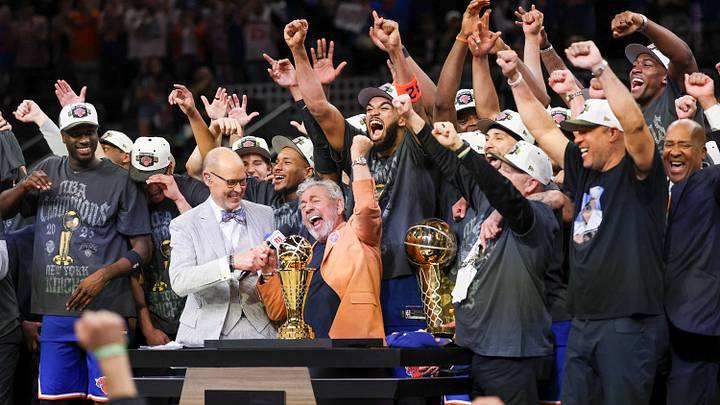
The Knicks have figured out a championship formula after 53 long years of New York fans starving for a title.
With the starting five of Jalen Brunson, Karl-Anthony Towns, OG Anunoby, Mikal Bridges and Josh Hart all under contract next season, this offseason was never slated to bring too much change to the defending champions’ roster. Even if the title-winning core remained intact, New York was always slated for some sort of summer roster revision, just like every other NBA squad.
No change is bigger than the loss of backup big man Mitchell Robinson, who signed a three-year, $47.4 million contract to join the rival Celtics. Third-string center Ariel Hukporti, who showed flashes as a defender and an improved free-throw shooter last season, went to the 76ers on a one-year, $3.4 million deal. On the flip side, the Knicks retained sharpshooter Landry Shamet and depth piece Jordan Clarkson. Trade-deadline acquisition Jose Alvarado and emerging wing Mohamed Diawara were brought back on team-friendly contracts, too.
There was bound to be a casualty of an increasingly expensive roster, especially with Towns and Hart currently eligible for extensions. New York’s difficult roster decisions became especially true when owner James Dolan proclaimed that his team “cannot go into the second apron” in an interview with WFAN the day before the Knicks’ championship parade.
Dolan’s stance isn’t outlandish—NBA teams take every measure possible to avoid the dreaded second apron, which imposes severe restrictions for roster building. The Nuggets are currently the only team over the second apron, which prevents them from aggregating players in a trade and acquiring players via sign-and-trade. It also freezes their first-round picks from seven years out (if they are still a second apron team at the end of the regular season). And that’s just to name a few of the penalties. Teams over the second apron are limited to re-signing their own free agents, signing draft picks and veteran minimum players, plus one-for-one trades where equal or lesser salary comes back.
In most cases, it’s smart to avoid the second apron at all costs, but the Knicks might be an exception coming off their first championship in over a half-century.
Could James Dolan’s unwillingness to go into the second apron eventually hurt the Knicks?

Last season, New York was just below the second apron. Currently, the franchise is $3.3 million clear of the threshold with two open roster spots, per Spotrac. Dolan’s reluctance to cross into the treacherous waters isn’t to say he’s cheap. It’s the opposite.
The Knicks were well over the luxury tax threshold last season, which brought an estimated $44.4 million tax bill and that’s after the team’s $207.4 million payroll. He’s looking at a considerable tax bill this season, too, with mostly the same roster in tow.
It’s a strategic move to avoid a threshold he considers “suicidal” in the NBA world. "I'll write as big of a check as possible, but I can't write a check into the second apron," Dolan told WFAN in June. That process impacted the roster immediately as it thwarted the team’s ability to bring back both Robinson and Shamet, who were each due for a raise after solid playoff performances.
Robinson ended up as the one headed elsewhere, getting a slight increase from his $13 million salary last season to join the Celtics. Experienced big man Andre Drummond was brought to New York on a much more reasonable veteran minimum contract. Even at 33 years old, Drummond had a strong last season with the Sixers and helps the Knicks on the glass with New York’s previous center depth headed elsewhere.
However, Robinson was critical last season and especially in the NBA Finals when he helped execute Mike Brown’s defensive plan to minimize Spurs superstar Victor Wembanyama. With Hukporti elsewhere, too, Drummond and Towns are the only big men on New York’s roster. Is that enough?
Yes, Robinson had his health issues and remains a poor free-throw shooter (Drummond has improved from the start of his career, but still isn’t great either). It’s understandable to not limit the entire franchise into the second apron for that player. On the other side of the spectrum, he’s a better defender and was critical to New York’s dominant run to the title.
Beyond the immediate roster impact, the decision to let Robinson walk plays a part in the Knicks maintaining future flexibility with possible extensions for Towns and Hart on the horizon. If Towns gets a max deal, or something within the range (Towns is eligible for a four-year, $272 max extension with the Knicks, according to The Athletic’s James Edwards III), it doesn’t make much sense to put a significant amount beyond that into the center position. You saw something similar happen in Detroit this offseason when the Pistons traded Isaiah Stewart to the Grizzlies and handed that role to Paul Reed, whose salary is $10 million less per year.
Should Towns get the max and Brunson get a pay bump two seasons ahead, it would be ridiculously difficult to avoid the second apron without a serious shakeup. Brunson took a huge discount with his four-year, $156.5 contract extension signed in 2024 which has put the team in the shiny position it’s in. That could go away if the Finals MVP opts out of his $43.3 million player option for 2028–29 and asks for max money.
That’s a further out problem compared to extensions for Towns and Hart, plus extension-eligible bench guard Deuce McBride. The Knicks have yet to go over the second apron, which the NBA implemented in 2023 (the Cavs were the only team over the threshold last season). With Dolan’s directive, that won’t change any time soon.
Although the owner’s stance sure feels like a mandate, it should be fluid. The Knicks didn’t go over the second apron this offseason, which led to losing Robinson. Should the thought process eventually lead to losing a member of its championship core or less money available for Brunson’s future extension, Dolan should reconsider—even with the restrictions that come into play.
That’s not to say the Knicks should live above the second apron. If a team finishes over the second apron in two out of four seasons, the frozen draft pick seven years out slides to the end of the first round. If New York needs to go into the second apron, it could adjust the roster elsewhere to pop back out. Of course, the roster moves to accomplish that would be heavily restricted. That’s an unlikely path forward with the owner’s stance, but it’s worthy of consideration at the very least. It shouldn’t be a total non-starter, especially if any starter’s future with the team is on the line.
For now, the defending champs will thread the needle. In the not-too-distant future, that won’t be so easy.
Listen to SI’s NBA podcast, Open Floor, below or on Apple and Spotify. Watch the show on SI’s YouTube channel.
 Add us as a preferred source on Google
Blake Silverman is a writer at Sports Illustrated, primarily covering the NBA and WNBA. Before joining SI in November 2024 as a breaking/trending news writer, he covered the WNBA, NBA, G League and college basketball for numerous sites, including Winsidr, SB Nation and A10Talk. He’s an alum of both Michigan State and St. Bonaventure University, receiving a master’s degree from the Bonnies’ sports journalism program. Outside of work, he’s a husband, father, yogi and fairly mediocre tennis player who’s open to any tips on how to play defense in EA Sports College Football.
Follow blakesilverman