
3 Points of Emphasis That'd Help Knicks Get Revenge Win vs. Cavs
In this story:
Wednesday marks the third matchup of the season between the Knicks and the Cavaliers. I always enjoy taking a deep dive into these premier Eastern Conference opponents, given the high likelihood of seeing them in a potential playoff series.
Evan Mobley will reportedly sit out Wednesday with a sprained toe, a major bummer considering what a massive cog he is for Cleveland’s defense. Even without him, however, the Cavaliers let little up on the offensive end with both James Harden and Donovan Mitchell anchoring their backcourt.
With that in mind, let’s examine how the Knicks can slow down Cleveland's star backcourt, and what to look for when New York has the ball.
1. Relax the coverage on Donovan Mitchell
OG Anunoby’s injury status remains up in the air at the moment, meaning any evaluation of potential point-of-attack defenders has to exclude him, even though he has barely guarded Donovan Mitchell or James Harden on the ball this season. According to my tracking data, Anunoby has defended the point of attack on just 9.6% of Mitchell’s pick-and-roll possessions and only 8.6% against Harden.
That does not mean his potential absence won't sting, however; Anunoby serves as the ultimate catalyst on New York’s back end whenever they deploy high coverages, and the Knicks will almost certainly play up at the level or higher against both Cleveland handlers.

New York has notably used heavy blitz coverage against Donovan Mitchell this season, more than against any other high-volume handler they have played, and it has rarely yielded positive results. Across 63 actions last season, blitzing Mitchell surrendered a staggering 1.60 points per action (PPA) at a 19% usage rate, which again, is relatively high.
This season, that blitz frequency has doubled to 38% while still coughing up 1.30 PPA. Simply put, trapping him has not worked. The Knicks have fared far better soft hedging or playing up at the level, coverages that held Mitchell to 0.80 PPA last season and 0.29 PPA so far this year, albeit on low volume.
2. Eyes on personnel
Even if New York dials back its blitzes on Donovan Mitchell, both Cleveland guards will still and should command tremendous attention in ball-screen actions, creating plenty of kick-out opportunities for surrounding Cavaliers.

- Red Lines: Ideally, do not help or tag off these shooters unless it's necessary.
- Yellow Lines: Tag off with caution, rotate hard, and prioritize running them off the three-point line.
- Green Lines: Willingly concede the three-point shot to these players over Cleveland's primary threats, stay disciplined on the drive and avoid hard close outs.
That makes back-end personnel awareness critical for the Knicks. New York must know exactly who it wants to funnel shots toward, and Cleveland’s rotation features a distinct tier of players that they should be far more comfortable letting shoot compared to others.
3. Attacking a potential cross-match head on
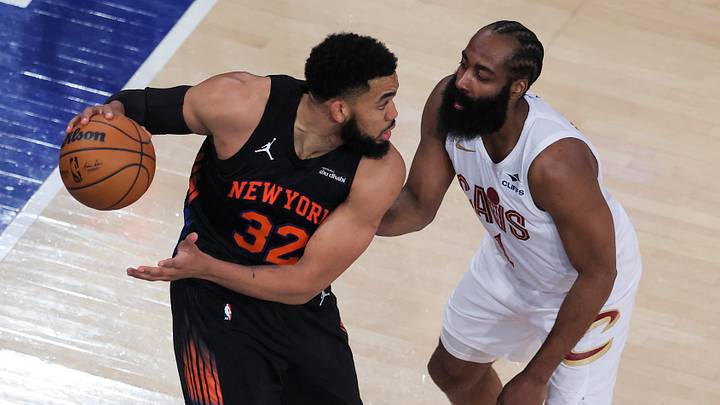
Over the years, the Cavaliers have shown a strong willingness to cross-match their centers onto Josh Hart whenever Karl-Anthony Towns shares the floor. New York must actively exploit any potential cross-match by heavily featuring Towns in the offense.
If Cleveland insists on parking its bigs on Hart, it will be forced to lean on smaller defenders like Mario Hezonja, Peyton Watson, or even James Harden, who has taken on that assignment in the past. It works squarely to New York's advantage to make those perimeter players battle in the post or see Towns punish them on the glass.
One of my favorite new plays this year is this reverse Post Split out of their motion alignment
— Shax (@ShaxNBA) November 24, 2026
Stagger Twirl action with Towns in the post sees just one help defender weak-side the action
A lot of pressure points here vs teams that want to cross-match https://t.co/ktpFnBPoXE pic.twitter.com/WV30StwJRW
A highly effective set New York has deployed against Cleveland is its post-split progression. Very simply, this action serves as a way to feed Towns on the low block for a post-up while simultaneously occupying and weeding out potential help defenders. As seen in the clip above, the off-ball split action unfolding during Towns' post touch isolates the defense, leaving just a single helper available against his post up.
As noted earlier, crashing the offensive glass offers another reliable way to punish any cross-match, especially with Towns sealing smaller defenders inside. Across their first two meetings with Cleveland, New York posted a 37% half-court offensive rebound rate in the win compared to just 18% in the loss.
The Cavaliers controlled the boards on both ends in their last matchup, so it is critical that the Knicks reassert their physicality on the glass this time around.
Get Knicks On SI straight to your inbox: sign up for our free newsletter here.
 Add us as a preferred source on Google

Shaz Ally (Shax) is a freelance contributor who digs into NBA data analytics and offense/defense strategy, with a heavy focus on the New York Knicks. Shaz pairs original data work, shot quality metrics, tracking studies, film breakdowns, with editorial writing that explains what the numbers mean on the floor.
Follow ShaxNBA