
Analyzing All 92 Minutes of the Spurs' Three Guard Lineup
In this story:
SAN ANTONIO -- How good can the Spurs be with their four best players on the court?
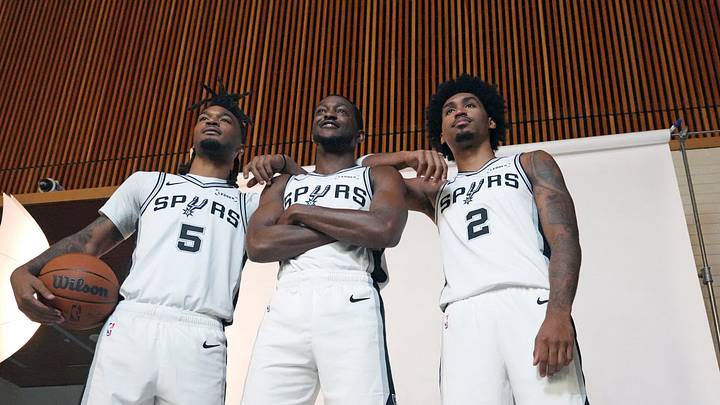
Mitch Johnson will be starting San Antonio's much-discussed three-guard lineup to begin the season, bringing added intrigue to the most exciting team in basketball. De'Aaron Fox, Dylan Harper and Steph Castle are all starters until further notice, surrounding Victor Wembanyama with tons of talent but questions about fit and role redundancy. Johnson's pondered every angle of it, but he keeps coming back to talent on the floor.
"I understand the narrative around it, I always land on the same reasoning at the very end of it: they're three of our better players," Johnson said.
That's simple enough to understand. The skill level and star power is undeniable, but the advanced analytics from last year don't reflect favorably on lineups that included all three guards. The anemic offensive rating of 89.2 and porous defensive rating of 116.2 yield an abysmal net rating of -26.9 points per 100 possessions in the regular season.
Some may see those numbers and ask why the Spurs would want to double down on a personnel group that turned a tremendous amount of scoring talent into an offense that was orders of magnitude less efficient than the worst team in the league last year. If the numbers say this lineup is 19 points per 100 possession worse offensively than the 30th ranked Brooklyn Nets, and the Nets are just 13 points per 100 possessions behind the top-ranked Nuggets, that sounds pretty damning.
It also sounds a little fishy, like the raw numbers might not be telling the whole story. A detailed analysis of play-by-play data from last regular season through the playoffs and this preseason shows fascinating context for how much the guard trio has grown in importance and effectiveness in that short time.
Limited, Interesting Usage Last Regular Season
Mitch Johnson wasn't kidding when he said this group didn't share the floor much at all last year. Over the course of an 82-game regular season, this trio only totaled 25 minutes in tandem.
They debuted in the NBA Cup semifinal against the Thunder when they played the final eight seconds of the first half. We didn't see it again until 10 days later, again facing the Thunder, again for a short time at the end of a period as they got the final 26 seconds of the third quarter.
The next time Johnson went to this group was to close out the final 2:29 against Indiana, starting with an eight-point advantage and extending for the win. The day after that against Portland he gave them the final three minutes of the first quarter, as well as the last possession of the second and third quarters. The next week they closed the first quarter and opened the second against Memphis.
The next game against the Thunder deviated from the pattern a bit, as the group played two stints in the middle of quarters. Victor Wembanyama joined them, but for less than a minute with the game already out of reach. The four of them got their first real burn together in a game against Houston in January where Wemby finished with 28 and 16.
The lineup of Fox, Harper, Castle, Vassell, and Wembanyama closed the final minute of the first half against Dallas on February 7. Two weeks later, that group assembled to lock down the final few seconds of a comeback win in Toronto.
While it's clear that the Spurs experimented intentionally with this group in high-leverage situations and against good opponents, most of these stints didn't last long and some no more than a possession or two. The average stint took 1:09, and no stint longer than 3 minutes. They played a half a game worth of minutes across two dozen splinters spread across 82 games, outscored by 18 in those minutes.
If it was a priority to develop this group together, they wouldn't have put the players in a lineup that forces them out of their comfort zone with scattered deployment and no long stretches to work out the kinks. It isn't exactly surprising or meaningful that the numbers don't look great.
Playoff Battle Tested
When the postseason came around Johnson leaned on his best players more, and as the rotation shortened his trust in the guard trio grew.
He had to adjust on the fly after Wembanyama got knocked out of Game 2 against the Trail Blazers in the first round. He took his young team to Portland, for most of them their first road playoff game, and they stole a win behind 78 combined points from Fox, Harper and Castle. Harper exploded off the bench with 27 points and 10 rebounds, and Castle led the way with 33.
The three of them shared the floor for the final five minutes to close it out, their longest stint together ever. Wembanyama returned for Games 4 and 5, and he played with the guard trio and Vassell for a minute or so in the fourth quarter of each contest.
Against Minnesota, Johnson mainly used the guard trio with Wembanyama off the floor. He went to it for a short burst in the first quarter of Game 2 after Wemby put up a quick seven points out of the gate, a good way to keep talent on the floor and the foot on the gas pedal.
After Wemby's ejection in Game 4, Johnson had to go with his three guards and Vassell for almost five minutes, mostly late in the fourth. Kornet started that stretch as the fifth, and Champagnie closed. A one-point deficit ballooned to seven, and the Timberwolves scraped and clawed for a win they absolutely needed in front of their home crowd.
Between injuries to Fox and Harper the guard trio didn't see the floor together again until the last three minutes of Game 7 of the Western Conference Finals. They closed out the defending champion Thunder in their house.
Johnson went to the foursome of Fox, Castle, Harper and Wemby in all five games in the Finals. In Game 1, they got four minutes across three stints with Julian Champagnie. In Game 2, all three minutes came in the fourth quarter alongside Vassell instead of Champagnie.
The guard trio got over 10 minutes together in the must-win Game 3 at Madison Square Garden closing the second, third, and fourth quarters of the team's only Finals victory. In those stretches the Spurs shot 6-17 from the floor and got outscored by 12 points, but they held on to the rope just enough to win.
In Game 4 of the Finals, most of the lead building of the first half and lead squandering of the second half happened with other units on the floor. By the time the five of Fox, Harper, Castle, Vassell and Wembanyama were out there together with under three minutes left, San Antonio's lead had evaporated from 29 down to just four. They may as well have stood in front of a fully-loaded freight train carrying the mandate of heaven and the Wu Tang Clan. They missed both of their shots, and turned it over twice, and got outscored by five points, and gave up an offensive rebound of some significance.
The Spurs built another big lead in Game 5 at home, but the 16-point advantage dwindled to nothing and then less as the fourth quarter got late. Jalen Brunson made three free throws to put New York up a point, energizing the New Yorkers in the crowd and stunning the Spurs fans. A few seconds later Castle subbed in for Champagnie to make it all three guards on the floor. The Spurs shot 2-8 from the floor to close it out, and the season ended right there.
The advanced numbers weren't all bad in the playoffs. The defensive rating for the guard trio of 105.1 was better than the top-rated regular season defense of Oklahoma City. The problem was the offense: under 82 points per 100 possessions for a group with three guys who could each trip and fall into 20 points. But again, the raw numbers make more sense considering the context.
More than half of the 44 minutes the guard trio played in the postseason came in the Finals with De'Aaron Fox battling a high ankle sprain and the Knicks on a generational heater. There were four stints of three minutes or longer: one on the road the game after Wemby smashed his face for a huge win, one on the road where Wemby got kicked out early, and twice in the only game they won in the Finals, and the only game the Knicks lost in a 15-1 stretch to close out one of the most dominant championship runs ever.
By game 105 of 2025-26 Mitch Johnson clearly felt he had to prioritize getting all of that talent on the floor at once to have a shot at winning, even if the fit wasn't seamless. Between Wembanyama's availability and Fox's injury we never really saw the top four at full strength in the playoffs, and we almost always saw them fighting in the most intense situations possible. The results didn't always go their way, but the experience will stay with them and help them grow as a group.
Plan A: Preseason And Beyond
A summer of discourse about the rise of Dylan Harper culminated in the announcement that the second-year superstar will start alongside Castle and Fox, raising questions about how San Antonio's rotation will work moving forward.
Mitch Johnson started to answer that question in the final two preseason games when all three of them were available. It's clear that this lineup is not a gimmick, it's not something being done for novelty or politics, it's something they believe in on a basketball level. He isn't rolling with this group because they played great last year; he's doing it so that build enough experience together to play much better this year, especially when it matters most.
Informed by last year's playoffs when they needed their best guys on the floor together and had to figure stuff out on the fly, they know how important that chemistry will be when spring comes around. They've committed to exploring and refining this look as much as possible before then. The average stint for this group in the preseason lasted 4:30, and across two games they logged more three-minute stints (five) than they did across last regular season and postseason combined.
"They are extremely dynamic and talented," Johnson said. "It's as much of allowing them to be on the court and learn how to complement and play with each other (as it is) us as a staff ... to put them in situations and environments to be successful."
The focused attention seems to be paying off as they're playing efficiently and cohesively. The spacing looks good with Dylan Harper taking a leap there, and the Spurs shot 40% from deep with the guard trio on the floor. The ball moved well as the playmakers activated the defender blender, dishing 14 assists to just 7 turnovers. They've outscored opponents by 26 points in the over 22 minutes they've played together, making their net rating approximately one bajillion.
Okay fine, let's actually do the math.
66 team points in 52 possessions works out to about 127 points per 100 possessions on offense, which would be easily the most efficient offense of last year. 40 points against in 52 possessions works out to about 77 points allowed per 100 possessions. A net rating of +50 is the NBA equivalent of approximately one bajillion. 16 of the minutes had the guards sharing the floor with Wembanyama and Vassell, and those numbers look even more lopsided in favor of the Spurs.
Lopsided efficiency data with a small sample size isn't reason enough to make a lineup decision. If it was, the Spurs never would've let this three-guard lineup thing get as far as it has.
The Spurs organization has a lot more data points on their players than the general public does, and this young team more than any other has to be aware of and responsive to rapid developments from these stars under the age of 25. They've built a consistent rotation over the last 365 days with minimal roster turnover and maximum internal growth, individually and as a group.
"Corporate knowledge and continuity is very important," Johnson said. "It allows you to probably grow to building blocks and evolution a little bit quicker... these guys have a much better feel and handle on the program that our staff has put in right now versus this time last year for obvious reasons."
Some would ask why rock the boat for a young team that made the Finals last year and looks to be on a good path? Mitch Johnson would tell them that the goal is and always will be to improve continually. The growth of the players on his team, and the mountain of shared experience they've built in a short time, provides the opportunity to improve faster and more creatively than most.
"It is a combination of reestablishing that foundation, that base, that identity, and style of play that we established last year, and then also continuing to push forward and evolve," he said. "That's a little bit of a healthy tension and push-pull effect that we acknowledge and understand."
 Add us as a preferred source on Google

Tom Petrini has covered Spurs basketball for the last decade, first for Project Spurs and then for KENS 5 in San Antonio. After leaving the newsroom he co-founded the Silver and Black Coffee Hour, a weekly podcast where he catches up on Spurs news with friends Aaron Blackerby and Zach Montana. Tom lives in Austin with his partner Jess and their dogs Dottie and Guppy. His other interests include motorsports and making a nice marinara sauce.
Follow RealTomPetrini