
How Damian Lillard Has Helped Transform the Blazers Offense
In this story:
The Portland Trail Blazers have been one of the league’s best offensive teams this season.
Yes, the same Portland Trail Blazers that couldn’t throw a brick in the ocean a year ago have become one of the league’s best at putting the ball in the basket.
In the 2025-26 season, the Blazers ranked 29th in field goal percentage (45.3), 27th in three-point percentage (34.3) and 30th in turnovers per game (16.5).
Just seven games into this season, Portland ranks in the top 10 in all three categories. And for advanced statistics nerds like myself, the Blazers are among the top five in nearly every offensive metric you can think of, from offensive rating to effective field goal percentage.
Long story short, not many teams are putting that orange ball in the basket better than Portland.
Portland head coach Micah Nori told reporters after the win against the Phoenix Suns on the road that despite the team's offensive success, the praise belongs to his players.
“I’m not trying to be overly humble, but I’m getting way too much credit for putting really good players in good positions. That’s just playing them to their strengths. That’s all it is,” Nori joked.
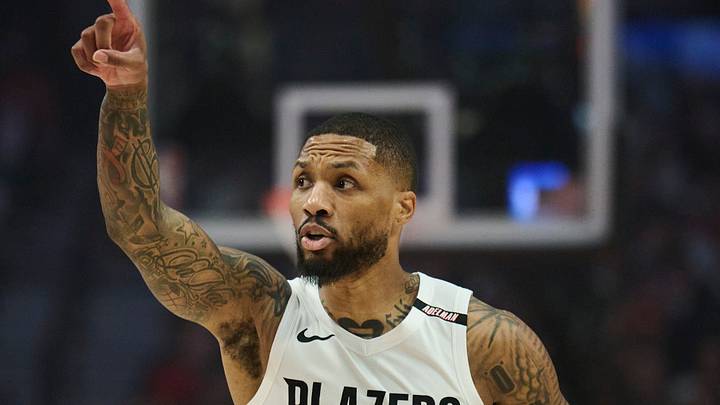
The Blazers are definitely utilizing their roster to each player’s strengths, but none more than the likes of Damian Lillard, who is providing all the offensive improvement he was expected to upon rejoining this team.
Let's take a dive into how Lillard is engineering Portland’s success, even when he doesn’t intend to.
The Lillard Magnet

With the ability to make an entire crowd believe every shot he takes is destined to find nylon, Lillard is as gifted as they come on the offensive end.
However, coming off an Achilles tear and at age 36, Lillard has adapted his play style in a way that not only benefits himself but also provides an even greater benefit to the teammates around him.
You see it in almost every sport. When an athlete’s athleticism begins to fade, you’re truly able to appreciate the talents and skills they possess beyond their physical gifts.
In Lillard’s case, especially coming off the type of injury he suffered, his ability to quickly burst past defenders or operate with the same explosiveness he once had hasn’t completely disappeared, but it has certainly been limited.
Yet there’s one part of his game that will remain timeless, and Nori knows it.
“The good thing is that he didn’t hurt his wrist or his elbow, because he doesn’t miss,” Nori said on media day.
And that isn’t just the opinion of his head coach. It’s likely the consensus on every scouting report across the league. You still can’t let Lillard shoot.
That thought alone has created so many different actions and looks for the Blazers to utilize.
For a team that ranked third-to-last in three-point percentage last season, opposing defenses could consistently afford to leave players open on the perimeter, knowing they weren’t necessarily a threat to make them pay.
That game plan is long gone, as it simply isn’t practical to leave a perimeter shooter of Damian Lillard’s caliber open.
“If you think of the solar system like you think of the sun, gravity and all that, that's the way he is. He just pulls everything together.” Nori said before Portland played the Suns.
Take this play—albeit it stems from the Phoenix Suns' early season incompetence—for example.
I wouldn’t even call it a flare or any particularly sophisticated action. It’s a simple brush screen to create space while Jrue Holiday and Robert Williams III initiate a pick-and-roll.
You can even hear Blazers commentator Lamar Hurd uttering, “That’s a scary situation,” because it is.
Just last season, that pick-and-roll would have been the center of attention, as kicking the ball out to the perimeter would likely have meant putting it in the hands of a subpar three-point shooter.
Now, it’s landing in the palms of Damian Lillard, a player who should never find that much open space on the perimeter.
And when a defensive team finally clues in and guards Lillard the way they are supposed to, they run into the likes of Deni Avdija using the space created to do what he does best.
“Guys don't want to leave him [Lillard], which opens up more people, which opens up more space. And then when you have a guy like Deni [Avdija], that can get himself downhill in the manner that he can, I think that it's a perfect combination.”
Micah Nori loves utilizing this dribble handoff action between Lillard and Avdija.
It entices the defense into a perfect defensive possession; otherwise, they end up with either one of the league's best shooters open or one of the premier rim attackers in the world with a full head of steam.
Avdija has been sensational so far this season—both as a scorer and a passer—and a lot of that stems from how easy these type of plays have formulated.
That’s the duality of having Lillard on your roster. His impact as a shooter was always going to be an immediate benefit, but the gravity he commands—forcing defenses to account for his whereabouts constantly—has made life significantly easier for Ja Morant and Avdija alike.
Lillard is averaging some of his lowest stats since his rookie year; his minutes (29.7) and points (20.1) are unheard of for a player of his quality.
Yet even without the same shot volume as years prior, this is the best Portland has looked offensively in years, and that is largely due to his unselfish approach and the gravity he will continue to draw from defenses night in and night out.
 Add us as a preferred source on Google

Sahal Arwo is a soon-to-be graduate of Carleton University with a Bachelor's in Commerce, concentrating in Economics. He began his writing journey as an independent writer covering the Portland Trail Blazers. He has played soccer at the collegiate and semi-professional level.
Follow ArwoNBA