%20%20--%3E%0A%3Csvg%20version%3D%221.1%22%20id%3D%22Layer_1%22%20xmlns%3D%22http%3A%2F%2Fwww.w3.org%2F2000%2Fsvg%22%20xmlns%3Axlink%3D%22http%3A%2F%2Fwww.w3.org%2F1999%2Fxlink%22%20x%3D%220px%22%20y%3D%220px%22%0A%09%20width%3D%2239px%22%20height%3D%2240px%22%20viewBox%3D%220%200%2039%2040%22%20enable-background%3D%22new%200%200%2039%2040%22%20xml%3Aspace%3D%22preserve%22%3E%0A%3Cpath%20fill%3D%22%23FFFFFF%22%20d%3D%22M38.5%2C7H28.2v26h10.3V7z%22%2F%3E%0A%3Cpath%20fill-rule%3D%22evenodd%22%20clip-rule%3D%22evenodd%22%20fill%3D%22%23FFFFFF%22%20d%3D%22M26.1%2C25.5c0%2C5.8-4.1%2C7.5-12.9%2C7.5C3.9%2C33%2C0%2C31.2%2C0%2C25.2v-1.1h11.6%0A%09v2.4c0%2C0.7%2C0.1%2C1.4%2C1.2%2C1.4c1%2C0%2C1.2-0.4%2C1.2-1.3v-0.9c0-1.6-0.9-1.6-3.5-2.2C2.2%2C21.7%2C0%2C19.7%2C0%2C15.3v-0.9C0%2C9.3%2C5.5%2C7%2C12.9%2C7%0A%09c10.2%2C0%2C12.8%2C2.6%2C12.8%2C7.4v1.8h-11v-2.9c0-0.6-0.4-1.1-1.2-1.1c-0.6%2C0-1.2%2C0.4-1.2%2C1.1v0.9c0%2C1.5%2C0.9%2C2%2C3.3%2C2.5%0A%09c8%2C1.6%2C10.5%2C3.3%2C10.5%2C7.5V25.5z%22%2F%3E%0A%3C%2Fsvg%3E%0A)
You Played These Guys on 82–0—Here’s What the Stats Don’t Show About Their Careers
In this story:
The NBA Finals are underway, but the biggest star of the past week in basketball may not be on the floor.
A basketball-centric, algorithmic-driven game called 82–0 hit the interwebs and has taken sports fans by storm with developers quickly working to replicate the simple, and somewhat frustrating, pleasure across other major leagues.
The premise of the game is simple: You go to 82-0.com, hit spin and you receive a random team and a random era. You pick a player from your draw (with stats either shown or hidden to test elite ball knowers) and fill out a starting five from there. The goal is to go 82–0, or maybe 0–82 if you’re a true sicko.
Ok this game is extremely addictive pic.twitter.com/FH4YGJpQkW
— Mitch Goldich 🐙 (@mitchgoldich) June 3, 2026
What has followed is endless rounds by countless individuals who are probably staying up way too late to achieve perfection. Maybe a diversion away from the endless scrolling of TikTok feeds isn’t a bad thing, though.
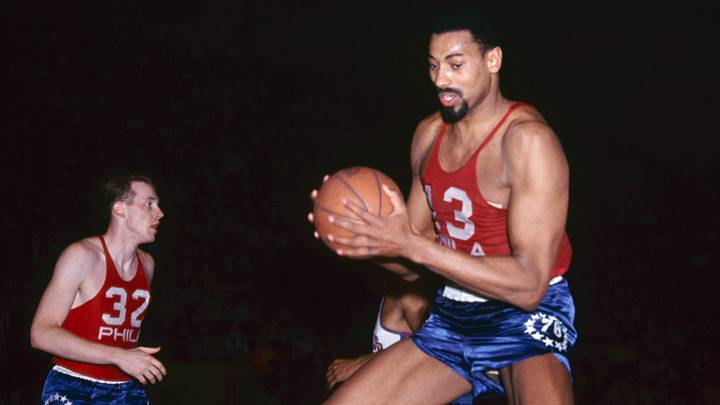
Players quickly noticed a trend as they played round after round. There are a few players who automatically beef up your score and that you almost need for any shot at the coveted 82–0 mark: Wilt Chamberlain’s silly numbers with the Warriors in the 1960s, Russell Westbrook with the Wizards when he set the triple-double record and Michael Jordan from his best decade with the Bulls. Funny enough, Chicago guard Josh Giddey isn’t a bad piece for the game with his stocky assist and rebound numbers, but I digress.
And before we get any further, I must address the elephant in the room: Yes, I’ve achieved 82–0.
I’d ballpark that took hundreds of tries and I may even be inching near 1,000 now, especially after the player-specific research that went into this story. Putting together an 82–0 team without Chamberlain became a status symbol for 82–0 players because of how his disproportionate numbers hit the algorithm.
The other elephant in the room: No, I have not gotten a perfect lineup without Chamberlain.
Shame.
But there is one funny wrinkle: My 82–0 lineup included Ben Simmons. Feast your eyes on what was the product of hours upon hours at an ungodly time:

The true beauty of the game’s emergence, though, is that it’s brought some fun names and true NBA legends back into the limelight. Players who shined in an era where the internet wasn’t close to born, now trending in Google search. It’s not just the superstars and legends of yesteryear, either. It’s the role players who have interesting names that you’ve never heard of before. And each of those names has a story that you don’t see when only looking at numbers on a finely coded website.
So we mapped out some of the players who’ve popped up through the virality for one reason or another. Here’s a list of players we’ve tracked through our endless 82–0 spins and some fun facts about each, those you wouldn’t see by just looking at a name and a stat line:
World B. Free (PG, ‘80s Clippers)
Stats (per 82-0.com): 30.2 ppg, 3.5 rpg, 4.2 apg

Free, who’s a good piece on 82–0 with his 30.2 points per game All-Star season in 1980, hilariously saw a spike on Google due to the viral game.
World B. Free is benefiting greatly from 82-0 pic.twitter.com/aJJh3TPq6I
— Jays Propaganda (@JaysPropaganda) June 4, 2026
That’s presumably because of his name, which wasn’t given at birth. He was born Lloyd Bernard Free and legally changed his name to World B. Free in 1981 because he could do a 360-dunk as a teenager and the name fit because he “could go ‘round the world.” The middle initial “B.” stands for “just ‘B’,” he said.
Fat Lever (PG/SG, ‘90s Nuggets)
Stats (per 82-0.com): 18.3 ppg, 9.3 rpg, 6.5 apg
Lever’s given first name isn’t Fat, either. He was born Lafayette Lever in 1960 and he was nicknamed Fat by his younger brother who couldn’t say all the syllables in his first name. He made two All-Star appearances over his 11-year NBA career, and his No. 12 jersey is retired by the Nuggets and Arizona State, his alma mater. He was a great rebounder and defender for a guard, which made his astronomical rebounding average into a bit of a cheat code on 82–0.
Flynn Robinson (PG/SG, ‘60s Bucks)
Stats (per 82-0.com): 20.3 ppg, 3.6 rpg, 4.9 apg
Robinson was a star guard for the Bulls and Bucks in the late ‘60s, but he’s perhaps most known for his role on the title-winning Lakers in ‘72. He was a backup guard behind Jerry West and Gail Goodrich on one of the best teams of all time, which had Wilt Chamberlain and Elgin Baylor in the frontcourt. Robinson averaged just below 10 points per game on that loaded squad which still holds the record for the longest winning streak in NBA history at 33 games.
Bob Pettit (PF/C, ‘60s Hawks)
Stats (per 82-0.com): 27.6 ppg, 16.7 rpg, 3.3 apg

Pettit is one of the better-known names on this list and for good reason. He won the NBA’s first MVP award in 1956 and won it again two years later after Bob Cousy and Bill Russell grabbed the hardware. Pettit made All-NBA first team 10 times and was an 11-time All-Star that won the All-Star game MVP four times. His No. 9 is retired by the Hawks and his No. 5 is retired by LSU.
He’s made each of the NBA’s anniversary teams (25th, 35th, 50th and 75th) as one of the most dominant big men the game has ever seen. After basketball, he co-founded a financial consulting company and still lives at 93 years old today.
Joe Barry Carroll (C, ‘80s Warriors)
Stats (per 82-0.com): 20.4 ppg, 8.3 rpg, 1.9 apg
Carroll was the first pick in the 1980 draft out of Purdue, but he’s made the biggest impact in his efforts off the floor. At just 26 years old, he established a foundation to enhance programs that serve lower income groups and individuals in communities of color. Carroll and his BroadView foundation have established college scholarships, funded afterschool programs and elder care to name a few.
He became an author and a painter, and in 2014, he received the Hank Aaron Champion for Justice award from the Atlanta Braves and the National Center for Civil and Human Rights to recognize his ongoing philanthropy and activism.
Sleepy Floyd (PG/SG, ‘80s Warriors)
Stats (per 82-0.com): 17.7 ppg, 3.3 rpg, 6.7 apg

Alright, Floyd isn’t the most popular pick on 82–0 but his name jumps off the screen any time it pops up. He was born Eric Floyd and received the nickname “Sleepy” when playing baseball in the fourth grade when someone in the stands yelled, “get that kid out of the game, he’s sleeping!”
Per The Wall Street Journal, he accompanied Dennis Rodman with a group of fellow former teammates on a trip to North Korea in 2014 for an exhibition game honoring the country’s supreme leader, Kim Jong Un. Rodman’s perceived strong relationship with Kim Jong Un caused plenty of uproar and less than a day into the trip, Floyd regretted the trip as he felt misled.
Tiny Archibald (PG, ‘70s Kings)
Stats (per 82-0.com): 25.2 ppg, 2.8 rpg, 8.1 apg
Archibald is a New York City hooper who had a storied NBA career with six All-Star appearances, three All-NBA first team nods and a title with the Celtics in 1981 where he starred alongside Larry Bird and Robert Parish. He was a superstar with the Kings to start his career, but he was traded to the New York Nets and then the Buffalo Braves a season later. He tore his Achilles and never played a regular-season game for Buffalo and was then dealt to Boston. He got off to a rocky start with the Celtics as he showed up 20 pounds overweight, but he bounced back and became a key piece in the early ‘80s.
Spencer Haywood (PF, ‘70s OKC/Seattle SuperSonics)
Stats (per 82-0.com): 24.9 ppg, 12.1 rpg, 2.4 apg

If you roll Haywood in 82–0, it will be with OKC after the franchise moved from Seattle and became the Thunder in 2008. He won the MVP award in the ABA as a rookie with the Rockets as he led the league in scoring with 30.0 points per game and rebounding at 19.5 boards a night. He joined the NBA with the SuperSonics the next season after a long court case that eventually allowed high school and college players eligible for the NBA draft without waiting until four years after high school.
He joined the Lakers for the 1979–80 season and was dismissed from the team by coach Paul Westhead during the NBA Finals for falling asleep during practice due to his struggles with drug addiction. He played the next season overseas in Italy before he returned to the NBA for his final two seasons with the Washington Bullets. After his career, he became an advocate for retired players to receive health benefits and pensions. He was enshrined in the Naismith Basketball Hall of Fame in 2015.
Guy Rodgers (PG/SG, ‘60s Bulls)
Stats (per 82-0.com): 17.6 ppg, 4.2 rpg, 11.0 apg
Rodgers played for the Bulls in their first season of existence where they also made the playoffs, the first and only expansion team to do so. Although the history and true creator of the alley-oop is murky, Rodgers is one of the early adopters, if not the inventor. A baseline cut that led to a lob and a slam dunk Rodgers executed with teammate Don Kojis was Chicago’s most popular play that year. Whether they were the first to do it or not isn’t fully clear, but the play certainly helped beef up his assist numbers.
Elvin Hayes (PF/C, ‘60s Rockets)
Stats (per 82-0.com): 28.4 ppg, 17.1 rpg, 1.4 apg

If you don’t get Chamberlain, Hayes is one of your next best bets. He was a 12-time All-Star but never won an MVP award, mostly because his career overlapped with a guy named Kareem Abdul-Jabbar. Hayes was the first pick in the 1968 draft by the Rockets and led the entire league in scoring in the next season. A considerable amount of his career was spent with the Bullets, but he started and finished his professional career with the Rockets, who retired his No. 44 jersey in 2022. His nearby alma mater of the University of Houston did the same.
Truck Robinson (PF, ‘70s Jazz)
Stats (per 82-0.com): 23.2 ppg, 14.9 rpg, 2.0 apg
Robinson was a force on the glass, which is saying something in the era of elite big men he played in as a forward at 6’7". He led the NBA in rebounding in 1978 when he grabbed 15.7 boards per game, more than legends like Abdul-Jabbar, Hayes, Moses Malone, Bob McAdoo and Artis Gilmore. Robinson’s teammate Dennis DuVal is said to have given him the nickname of “Truck” because, well, he played and was built like one.
Willie Naulls (SF/PF, ‘60s Knicks)
Stats (per 82-0.com): 22.7 ppg, 12.6 rpg, 2.3 apg
Naulls entered the league with the Hawks and spent most of his career with the Knicks, but he won three straight titles with the Celtics after he was traded to Boston following a brief stint with the Warriors. In 1964, he stepped into Boston’s starting lineup due to an injury and formed the NBA’s first all-Black starting lineup with Bill Russell, K.C. and Sam Jones and Satch Sanders.
More NBA from Sports Illustrated
Listen to SI’s NBA podcast, Open Floor, below or on Apple and Spotify. Watch the show on SI’s YouTube channel.
 Add us as a preferred source on Google
Blake Silverman is a writer at Sports Illustrated, primarily covering the NBA and WNBA. Before joining SI in November 2024 as a breaking/trending news writer, he covered the WNBA, NBA, G League and college basketball for numerous sites, including Winsidr, SB Nation and A10Talk. He’s an alum of both Michigan State and St. Bonaventure University, receiving a master’s degree from the Bonnies’ sports journalism program. Outside of work, he’s a husband, father, yogi and fairly mediocre tennis player who’s open to any tips on how to play defense in EA Sports College Football.
Follow blakesilverman