%20%20--%3E%0A%3Csvg%20version%3D%221.1%22%20id%3D%22Layer_1%22%20xmlns%3D%22http%3A%2F%2Fwww.w3.org%2F2000%2Fsvg%22%20xmlns%3Axlink%3D%22http%3A%2F%2Fwww.w3.org%2F1999%2Fxlink%22%20x%3D%220px%22%20y%3D%220px%22%0A%09%20width%3D%2239px%22%20height%3D%2240px%22%20viewBox%3D%220%200%2039%2040%22%20enable-background%3D%22new%200%200%2039%2040%22%20xml%3Aspace%3D%22preserve%22%3E%0A%3Cpath%20fill%3D%22%23FFFFFF%22%20d%3D%22M38.5%2C7H28.2v26h10.3V7z%22%2F%3E%0A%3Cpath%20fill-rule%3D%22evenodd%22%20clip-rule%3D%22evenodd%22%20fill%3D%22%23FFFFFF%22%20d%3D%22M26.1%2C25.5c0%2C5.8-4.1%2C7.5-12.9%2C7.5C3.9%2C33%2C0%2C31.2%2C0%2C25.2v-1.1h11.6%0A%09v2.4c0%2C0.7%2C0.1%2C1.4%2C1.2%2C1.4c1%2C0%2C1.2-0.4%2C1.2-1.3v-0.9c0-1.6-0.9-1.6-3.5-2.2C2.2%2C21.7%2C0%2C19.7%2C0%2C15.3v-0.9C0%2C9.3%2C5.5%2C7%2C12.9%2C7%0A%09c10.2%2C0%2C12.8%2C2.6%2C12.8%2C7.4v1.8h-11v-2.9c0-0.6-0.4-1.1-1.2-1.1c-0.6%2C0-1.2%2C0.4-1.2%2C1.1v0.9c0%2C1.5%2C0.9%2C2%2C3.3%2C2.5%0A%09c8%2C1.6%2C10.5%2C3.3%2C10.5%2C7.5V25.5z%22%2F%3E%0A%3C%2Fsvg%3E%0A)
Albert Breer: New NFLPA Director JC Tretter Circling the Wagons to Prep for Battles Ahead
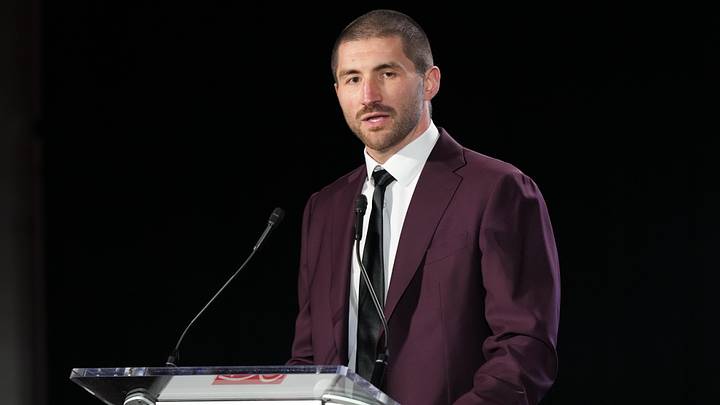
The first thing you need to know about NFLPA executive director JC Tretter, now three months into the job leading the players union, is that he’s not going to rush into anything.
That doesn’t mean he isn’t acting with urgency in carrying out his duties.
He already has spent the better part of this spring punching the gas in building relationships, reconstructing a fractured office and starting to map out a plan. But when it comes to the owners wanting to get all their initiatives pushed through—things like 18 games and continuing to grow the league’s footprint internationally—his plan is to flip the script on them. And to do that, his focus is on figuring out what the players, not their bosses, want.
“I know this immediately goes to 18 games, right?” Tretter said over the phone on Friday morning. “I’ve been clear to the guys, this can’t all be based around what the league wants. Like, we as players need to figure out what we want, period. And I don’t think we’ve done a good job of truly knowing exactly what our guys want. My job is to go and figure that out and make sure I know, we know and player leadership knows exactly where our membership stands, both as an entire group but also as individuals.
“We have 2,500 members that are all going to have their own priorities. Patrick Mahomes is going to have very different priorities or issues than a practice squad player. That’s just reality. And that’s one of the tough things about the job is understanding we have a very wide range of membership and issues. And we have to understand where each of them stand and what each of them care about. That way we’re delivering for them individually.”
So, for now, that’s where Tretter’s work has been. And with the NFL winding down into its summer break, for this week’s MMQB lead, I figured this was a good time to check in with the NFLPA’s executive director to see where things stand on a number of hot-button topics.
One key takeaway: Any major structural changes to the CBA will have to wait a while.
Tretter, as he alluded to, is in the building phase of his tenure as the NFLPA’s leader. Part of the job, for now, is rebuilding an operation that has hit very choppy waters since DeMaurice Smith’s departure two years ago. To that end, he still must find a chief of communications, a chief administrative officer, a player affairs leader and a general counsel to succeed Tom DePaso, whom, Tretter jokes, “has been trying to retire … I’ve got him duct-taped in his office.”

The other piece is information gathering, and that’s underway in earnest. Tretter has already done visits with the Bills, Patriots, Ravens, Giants, Eagles, Commanders, Vikings and Rams, in conjunction with other parts of the job. He popped in with the Vikings, for example, when he was in Minnesota for the AFL-CIO national convention. He saw the Giants as part of a visit to see owner John Mara, who is the head of the NFL management council’s executive committee. He visited the Eagles because they didn’t have a voting rep at his election.
And in the fall, he’ll visit all 32 teams, in an effort, again, to figure out what they want.
“Based on those meetings I think that the players just want a plan, and want to have a strategy and a path forward that keeps them involved, keeps them at front of mind,” he said. “And a lot of that is laying out what I think it should look like. I’ve been here a while now, I’ve been involved with the union, different capacities for a while. And I’ve seen things that I think we’ve done well, and things I think we could do better. And I’ve been pretty transparent with the guys about that.”
The headline here would be, again, that this is all going to take time, and it’ll be at least 2027 before the NFLPA can dive in on big-picture topics such as 18 games—Tretter doesn’t want to put an end date on it, but before he sees all the teams, there’s no plan to move into any serious discussions on those sorts of changes.
And we’ll circle back on that in a minute. But first, Tretter and I did have a chance to work through some of those topics. Here’s his perspective on them as he continues to gather the perspective of the players he’ll serve …
• The first thing Tretter and I dove into was the checkered recent history of the union, and his involvement in it. He was the NFLPA president when Smith walked away and was replaced by Booz Allen Hamilton executive Lloyd Howell Jr., and was later hired as chief strategy officer for the controversial Howell. As such, he understands that his and the union’s first job will be to reestablish trust with the rank-and-file players.
“Organizationally, our job is to work on behalf of the guys, and I think we have to start performing for them,” Tretter said. “I think that’s how you build trust, you put in work that is impactful to the players. And once you do that, the thing about trust is, it takes a ton of time to build up, and it’s really quick to lose it. That has to be understood, that that’s something that can happen.”
• The 18-game discussion is one Tretter wanted to reframe—mostly because, publicly, it has been seen as an inevitability, and he doesn’t think players should see it that way at all.
“No one would volunteer for 18 games, right? Like no player’s saying, ‘Hey, you know what I’d love to do? Play another one,’” Tretter said. “So it’s not a thing guys want to do. My job is to figure out what guys want. And I kind of want to get out of the world of talking about 18 games, because I think it then shapes the entire conversation. And I think that’s one of the issues for the union. The league is very good about putting out exactly what they want. And [NFL commissioner] Roger (Goodell) has done it. The owners have done it. They’ve been very clear publicly and privately.
“They want 18 games. They want 16 international games. They want to lower our revenue share. They want to have us pay for more of the costs of operating the business—socializing costs, privatizing profits. They’ve said all these things publicly at this point. And that’s a long list of really sh---y things for players. … Play more, travel more, get less money, take or cover the costs of billionaires’ businesses and then not have upside to make as much money as you can, like, that is a list where everything goes in the wrong direction.”
As such, Tretter continued, he’s looking to cease having the conversation that references 18 games as an inevitability, where he’s simply looking for a giveback as the train rolls down the tracks.
“For me,” he added, “this really isn’t a discussion to have anytime soon.”
• As for one thing he knows players want, yes, Tretter has paid attention to the World Cup, and how seven NFL stadiums installed natural grass for the event. The playing-surface fight is one Tretter was passionate about in his previous roles at the NFLPA, and he had a good story for me that really illustrated his feelings on the topic.
When he was still a player, one year in training camp, he was trying to come back for the Browns’ opener from a meniscus injury, and he and the team were working on a tight, three-and-a-half-week timeframe. Early on, when he just got back to running, it rained. So the trainers discussed a plan with him.
“They’re like, ‘We’d rather skip a day than have you run indoors on turf, so we’ll just punt this day.’ And it’s, like, we had a 24-day ramp up to get ready to play a game. … It was like, O.K., you told me something here.”
“It’s not where I stand, it’s where our guys stand—92% of our guys prefer grass,” Tretter said. “It makes it easy for where I stand … it’s hard to find 92% of people that agree on anything, and we’ve got 92% to agree on what surface they prefer. And then I think the big part of what FIFA shows is there’s always been multiple excuses made. One of which was feasibility of, Hey, it’s not possible, it’s an indoor stadium. We can’t grow grass here. It’s impossible. [The World Cup] has taken that out. It’s feasible. Now it’s really a choice.
“And that choice clearly comes down to cost. And there’s two types of costs. One is the cost of upkeep and installation. But clearly they’re O.K. doing that for this event, they just seem not O.K. doing it for the actual employees they pay. And then the other cost, which kind of frustrates guys, is it’s the trade-off cost of potentially not being able to do other outside-of-football events the teams make money off of. And the players see none of that [money].”
The other thing Tretter added was it’s not just about grass, but the quality of surface.
“If you actually look at the data, the issue is grass injuries are up. The turf injuries are pretty consistent. Which means that’s not really solving the problem. Going to us and being like, ‘Hey, grass has gotten as dangerous as turf, so this isn’t a problem anymore.’ It was like, No, it’s actually a worse problem. You had one surface that was safe that’s not as dangerous.”
• To expand on his Mahomes point, Tretter said one of his early focuses has been to take an economic model that’s clearly working at a very high level and put it to work for a greater percentage of the players. And in this case, with the union having won gains for minimum-salary players in the 2020 CBA and big-time players seeing their salaries explode over the past five years, that means a closer look at lifting up the middle class will be required.
“What the league is phenomenal at is raising revenue and driving revenue growth,” Tretter said. “And that’s the value of being in a revenue-sharing agreement with them, they are really good businesspeople, and we get to grow with them. Now, the issue is, it’s kind of like the economy, I would say, in this country, where the stock market being up does not mean the economy for every worker is great. You know, the stock kept going up, a lot of that money is driven to the stars. And it’s been great for them. You see the record-setting deals.
“And that should continue. I’m not advocating for impacting them. But it’s also looking at how do we drive increases and improvements to everybody else down the roster, too. I’ve started talking to a ton of the agent community, I think there’s a lot of questions about a shrinking middle class and that there are haves and have-nots.”
• That point underscores that while there is a lot to work on, there is plenty of good that Tretter inherited. As we talked, he mentioned that the tumultuous 12 months that the player leaders of the union have been through has steeled the group: “They had to really step up and lead this union on their own, and I think that really does strengthen our organization as a whole.” Tretter also feels like he has a lot of staff holdovers that care deeply about the well-being of the players.
“My job is to make that clearer to our players, on what we’re doing on their behalf,” Tretter said. “And I think those stories somewhat get lost and they touch you when you have a problem, you see it because you feel the push of the org to help solve your problem. But if you don’t, sometimes it’s kind of like, I don’t know what they do over there.”
And along those lines, Tretter feels like another one of his first tasks will be using these sorts of things to bring everyone back together under the NFLPA tent.
“We became too much of an isolationist organization in that if you weren’t 100% with us, we kind of pushed you aside and said, like, ‘Well, we don’t want you anywhere near us,’” Tretter said. “And that was a mistake. And that comes up with some of our former players. That comes up with our agent community. I think there’s a bunch of different people that are part of this ecosystem that have felt pushed out or looked down upon from the union.
“That’s a mistake that I want to change.”
• Finally, there’s the other relationship that’ll be important to how well Tretter does his job, and that’s the one with Goodell, with whom he already has met a few times as he has settled into his new role.
“We haven’t obviously been each other’s point of contact between the two worlds, but we’ve been in the same rooms quite a bit over the last five years as I’ve been in different capacities,” he said. “And I think that relationship is one, just with the two organizations, our job is not to always get along. Our job is to push each other. And we each have different groups that we’re representing. And I think when this whole thing works is when both groups are strong and pushing for each other.
“COVID’s a great example of that. That one was a complete crisis. We both had an end goal, which was, we need to figure out a way to play this season. And we had very different ways that we thought we should do it. And there were some things that the league wanted to do that we were adamantly against that we pushed them off. And that was a good thing. And there were some things we wanted to do that the league pushed us off. That was probably a good thing.
“In the end, I think the only way that was successful was because both sides did their job and were strong and were aligned internally with their own groups. … We had to renegotiate the entire CBA for that COVID year and a half. And I think that’s kind of the model where it wasn’t all back pats and high-fives. We went at each other a handful of times. And that’s life. That’s the job.”
Tretter, of course, is aware the Atlanta Super Bowl doesn’t have a date yet for February 2028, which has led to a league-wide perception that the owners want to go to 18 games in 2027. The clock is ticking on that—NFL EVP Peter O’Reilly said at the league’s March meetings that they’d likely have to have a date for that Super Bowl before the start of the 2026 season, which is now less than three months away.
The NFL has officially named the host of Super Bowl LXII in 2028:
— Front Office Sports (@FOS) October 15, 2024
Atlanta, GA 🏟️ pic.twitter.com/hQqHxmgztW
That brings us back around to Tretter’s tentpole principle on all this stuff. The CBA still has five seasons left on it. He’s got a lot of work to do to get the union aligned over the coming months. Making wholesale changes to the sport might not happen for a while.
“I think my focus has to be on a clean process, where in the end, I, this organization, the executive committee, the board are going to be judged on the success of that negotiation whenever we have it,” he said. “So our job is to make sure we set ourselves up for success in it. So that’s not really How do we get ready fast? It’s How do we do the right thing? And how do we make sure we know the first step of that is knowing what our players want? That’s going to happen throughout this year.
“And my hope is we have some clarity on that after I visit every team and talk to them. It may still be very separate. And then I need to go back out and talk through it more. But we can’t really move forward until we know where our guys stand, because in the end, they’re the ones this is all about, they’re the decision-makers. We need to know what we’re fighting for and what they want to fight for.”
He then reiterated, “Right now, there’s just no timeline for when we would be ready. And I’m not going to let an artificial timeline dictate that because in the end we do have a deal for another five years. So we have runway.”
Very clearly now, Tretter is O.K. using it, if that’s what’s best for the guys he’s now working for. And that’s regardless of what it might mean for their bosses.
More NFL on Sports Illustrated
 Add us as a preferred source on Google
Albert Breer is a senior writer covering the NFL for Sports Illustrated, delivering the biggest stories and breaking news from across the league. He has been on the NFL beat since 2005 and joined SI in 2016. Breer began his career covering the New England Patriots for the MetroWest Daily News and the Boston Herald from 2005 to ’07, then covered the Dallas Cowboys for the Dallas Morning News from 2007 to ’08. He worked for The Sporting News from 2008 to ’09 before returning to Massachusetts as The Boston Globe’s national NFL writer in 2009. From 2010 to 2016, Breer served as a national reporter for NFL Network. In addition to his work at Sports Illustrated, Breer regularly appears on NBC Sports Boston, 98.5 The Sports Hub in Boston, FS1 with Colin Cowherd, The Rich Eisen Show and The Dan Patrick Show. A 2002 graduate of Ohio State, Breer lives near Boston with his wife, a cardiac ICU nurse at Boston Children’s Hospital, and their three children.
Follow AlbertBreer