%20%20--%3E%0A%3Csvg%20version%3D%221.1%22%20id%3D%22Layer_1%22%20xmlns%3D%22http%3A%2F%2Fwww.w3.org%2F2000%2Fsvg%22%20xmlns%3Axlink%3D%22http%3A%2F%2Fwww.w3.org%2F1999%2Fxlink%22%20x%3D%220px%22%20y%3D%220px%22%0A%09%20width%3D%2239px%22%20height%3D%2240px%22%20viewBox%3D%220%200%2039%2040%22%20enable-background%3D%22new%200%200%2039%2040%22%20xml%3Aspace%3D%22preserve%22%3E%0A%3Cpath%20fill%3D%22%23FFFFFF%22%20d%3D%22M38.5%2C7H28.2v26h10.3V7z%22%2F%3E%0A%3Cpath%20fill-rule%3D%22evenodd%22%20clip-rule%3D%22evenodd%22%20fill%3D%22%23FFFFFF%22%20d%3D%22M26.1%2C25.5c0%2C5.8-4.1%2C7.5-12.9%2C7.5C3.9%2C33%2C0%2C31.2%2C0%2C25.2v-1.1h11.6%0A%09v2.4c0%2C0.7%2C0.1%2C1.4%2C1.2%2C1.4c1%2C0%2C1.2-0.4%2C1.2-1.3v-0.9c0-1.6-0.9-1.6-3.5-2.2C2.2%2C21.7%2C0%2C19.7%2C0%2C15.3v-0.9C0%2C9.3%2C5.5%2C7%2C12.9%2C7%0A%09c10.2%2C0%2C12.8%2C2.6%2C12.8%2C7.4v1.8h-11v-2.9c0-0.6-0.4-1.1-1.2-1.1c-0.6%2C0-1.2%2C0.4-1.2%2C1.1v0.9c0%2C1.5%2C0.9%2C2%2C3.3%2C2.5%0A%09c8%2C1.6%2C10.5%2C3.3%2C10.5%2C7.5V25.5z%22%2F%3E%0A%3C%2Fsvg%3E%0A)
Albert Breer’s Takeaways: With Joe Schoen, John Harbaugh in Lockstep, the Giants are Gaining Momentum
Jump to a topic
- New York Giants
- Los Angeles Rams
- Kansas City Chiefs
- Accelerator Program
- CBA
- New York Giants
- Pittsburgh Steelers
- What June 1 means
- Quick-hitters
Last set of takeaways for May, with some trade action expected in the next week and mandatory minicamps on the horizon.
New York Giants
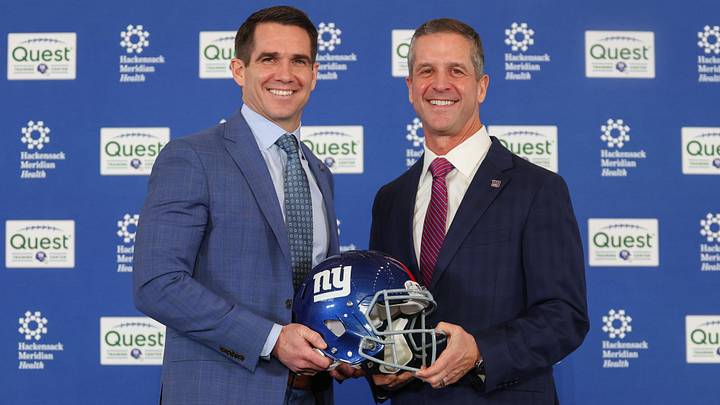
The Giants now can truly move forward. That’s because the team pushed an extension for GM Joe Schoen, who was in a contract year, over the goal line last week. It’s obviously great news for Schoen, but the organization, too, in that it aligns the timelines of John Harbaugh and Schoen neatly and gives those in the building peace of mind that the revamped football operation will now have a real shot to grow in the new coach’s first year.
It also shouldn’t come as a surprise to anyone paying close attention.
If the ownership group was ever looking to walk away from Schoen, it had a funny way of showing it. The Giants announced after firing Brian Daboll in November that the sitting GM would lead the search to replace the coach. The team then announced in early January that Schoen would be retained. Two weeks later, Harbaugh arrived and it was Schoen at the podium introducing him at the team’s press conference.
What has happened since, as I see it, is really a credit to both guys. I sat down with the two of them in March to discuss the state of the team, as well as their arranged partnership, and what was interesting to me was how easy the two native Midwesterners were playing off each other in the course of the conversation. Interestingly enough, they both said that no one did anything to force a bond there early on—they let it happen naturally.
“We just started talking,” Harbaugh said. “And that was the main thing because we were going to have to be on the same page for it to even get started. And so I’d just say, to me, it was a step-by-step process of not so much like, 'Oh, you know, we have to know each other, because we're going to be working together.' It was more like, 'Hi, how are you doing? What’s the situation?'”
Schoen’s staff was at the Senior Bowl for Harbaugh’s first week on the job and Harbaugh didn’t have a coaching staff yet, which afforded the two a ton of 1-on-1 time, through which they’d start organically forging a vision. Harbaugh wanted to infuse the building with new energy, so they flipped the training, video and football administration departments.
Another sign that Schoen was staying: the hire of Dawn Aponte, who Schoen worked with for five seasons in Miami, and the empowerment of Aponte in a new Lions–Rams style model, that would allow for Schoen to focus more on talent evaluation and roster building. And all of this positive momentum has continued since.
Now, does that mean it’ll work? It does not.
But at the very least, the Giants now know how this is all going to look going forward. Of course, if you’ve paid attention, you probably had an idea of how it would look for a while now.
Los Angeles Rams
Matthew Stafford’s new contract is what you’d expect. It’s essentially a $5 million raise that gives the team another year of control and is indicative of a player at the stage of his career, in which everything is year to year. Does it absolutely mean that he plans to play in 2027? No, but it creates the runway for him to play, and in Los Angeles.
Here are the particulars …
• Under the two-year deal he signed last year, Stafford was set to make $40 million this year ($16 million base, $24 million roster bonus). Under the terms of the new deal, he’ll bank at least $45 million. He gets $40 million in base pay, and there’s a $5 million roster bonus that’s guaranteed and due early next year, meaning it’s basically a bonus for this year that’s paid next year. That $45 million number puts him past the $44 million he made in 2025.
• There are $5 million in playoff incentives that can push his pay to $50 million.
• Stafford gets $45 million in base pay for 2027, with another $5 million roster bonus due in early 2028—none of that is guaranteed right now, but all of it will vest and become fully guaranteed in March, turning the 2028 bonus into another de facto deferred payment.
• He has another $5 million in playoff incentives for 2027 as well.
Add it up and it’s a one-year, $55 million extension, which puts Stafford in line with what quarterbacks such as Justin Herbert, Jordan Love and Tua Tagovailoa got a couple summers ago. And if Stafford maxes out the deal, it’ll be a two-year, $115 million contract. So while this isn’t quite a “nothing to see here” situation, it’s more an update to the deal the Rams gave Stafford last year after allowing him to explore a trade than it is any kind of big splash.
It also will allow for the Rams to take their time with 2026 first-round pick Ty Simpson. Plus, Simpson’s presence will allow the team to be creative with future picks to keep building their team.
That makes for a good situation.
Kansas City Chiefs
The Chiefs can’t trust Rashee Rice. The drug test Rice failed wasn’t a drug test. It was an intelligence test. Rice knew the tests were coming. He knew what was on the line. Now he must deal with the fallout.
This isn’t, to be clear, about the marijuana he tested positive for. It’s about the reputation he had coming out of college at SMU, and the 2025 hit-and-run that landed him the 30-day sentence the positive drug test triggered in the first place. It’s about him allegedly punching a photographer less than two months later, and how he has slipped up again—regardless of how it went down or what it was for.
He knew he had to walk the straight and narrow, yet somehow, here we are again.
It’s a shame, too, because internally, the Chiefs view Rice as capable of being a top-five or top-10 receiver. Last year, a six-game suspension and concussion symptoms that ended his season prematurely limited the budding star to eight games. In those contests, he had 53 catches for 571 yards and five touchdowns. If you project those numbers out to 17 games, it's 113 catches for 1,213 yards and 11 touchdowns.

If he gets there, and he cleans up his act off the field, we’re probably talking about the Chiefs paying Rice somewhere around $30 million per year.
Instead, Kansas City’s best bet is probably to see where things go this year and, if it works out, franchise-tag him next year to get another look at whether he truly has turned the corner. And maybe look for some veteran insurance at receiver so they're ready for the chance of a suspension (that wouldn’t be about the weed, either, but violating his probation). Maybe that’s Stefon Diggs. Maybe it’s circling back on A.J. Brown.
Regardless, it’s fine for the Chiefs to hope for Rice to make it back, and obviously they do.
They just can’t count on Rice anymore.
Accelerator Program
The NFL’s revamped Accelerator Program got a good response from its participants last week in Orlando. It was less formal than in the past and a little shorter, but it seemed like the guys took that as a good thing, with most really loving the chance to mix with their coaching or front-office peers, meeting people from the other side they could someday pair with.
There was one speaker who seemed to make a big impact on everyone, and that was former CIA operative Jamie Winship, who told stories from working in conflict mediation in some of the most volatile places in the world, and also gave the coaches and front-office folks the baseline for what he called resilience training. As most in the room explained it, Winship brought tools to build qualities that are usually seen as innate.
“Mr. Winship, I can't speak on what he does or where it came from, but he kept me up last night with some of the things that he challenged us with,” Falcons DC Jeff Ulbrich told me. “And he really put the words to and articulated some stuff that's always been innate to me and other coaches I've been around, to really give us tangible, applicable ways to build resiliency in players. And we speak on that, but a lot of times I think it's just fairy dust.
“And it's like, we want them to be this—well, how do we get from A to B? And then, crickets. He gave us some real meat on the bone to the process to create a more resilient player or coach. Or for myself, even from a life perspective. It was awesome.”
Ulbrich called it “life-changing stuff” that he plans to apply in Atlanta right away. That was a real bonus considering the sessions were more meant to build the future of the people in those rooms, to go with all the new friendships and phone numbers the group of coaches and rising execs walked away with.
Detroit Lions
Jack Campbell’s fifth-year option situation benefitted him in the same way that Tyler Linderbaum’s helped the new Raider over the past year. Their situations were similar. Linderbaum was a first-rounder out of Iowa in 2022, while Campbell was the same in 2023, and both had their option numbers calculated in a way that folded different (and more expensive) types of players in.
In Linderbaum’s case, because offensive linemen are grouped together for the purposes of the math, the All-Pro center was put at a tackle-generated number. With Campbell, because edge players who line up in two-point stances on base downs are classified as linebackers, his math was done with some of the game’s top-of-the-line pass rushers factored in. And in both cases, their teams declined to pick up the fifth-year option, which was great for both guys.
The Ravens didn’t get Linderbaum re-signed. He played out the final year of his deal, the team couldn’t franchise him—basically for the same reason it declined the option—and he hit free agency and moved the top of the market a staggering 50%, getting $27 million per year to anchor the Raiders’ line.
The Lions, meanwhile, were more aggressive, making Campbell the third off-ball linebacker ever to crack the $20 million-per-year barrier, signing him to a four-year, $81 million extension after his third season in Detroit.
Our All-Pro linebacker is here to stay pic.twitter.com/ffdJDF5pE3
— Detroit Lions (@Lions) May 21, 2026
I do remember, at the time of each guy having his option declined, people on social media bemoaning the quirk in the rules that allowed for it to happen.
Seems to me like it worked like a charm for these guys. And excuse me if I don’t feel bad for teams who’ve weaponized the rules in this sort of way for more than three decades.
CBA
It’s worth explaining a little unknown nuance to the collective bargaining agreement here, one that came to light at the owners meetings. On Tuesday, the owners passed a proposal to allow for 10 league-run international games in 2027, which pushed the max, if you include the Jaguars’ separate deal with Wembley, to 11.
But what few people knew ahead of that—I’ll raise my hand here—is that the CBA dictates that the NFL needs the NFLPA to sign off on going past 10 global games in a year.
So why should we care? Well, the NFL wouldn’t be voting to go to 10 games on their own, and 11 with the Jaguars’ help, if they didn’t want to get to that number—and there are untapped markets in Italy, Japan and the Middle East they’d like to explore. And if they’re motivated to get there, then that means the players should get something of value back.
As for what that something could be, I do have a thought. The players should ask for whatever offseason concessions (time off, dead periods in the calendar, practice rules, etc.) they want now so they don’t have to do it in the next CBA talks.
The reality: The owners have used these offseason giveaways, which they couldn’t care less about (and some actually probably like because it means they can shut off the lights for another couple weeks), to get what they want economically. So if you bargain for offseason time now in order to get that 11th international game, which isn’t as big of a deal to you as it is to them (the reverse of the issue of offseason/practice time breaks), then you can focus on other things when the time to bargain comes.
Anyway, just a thought.
New York Giants
The Jaxson Dart—Abdul Carter dustup probably says more about everyone else than it does those two. On Friday, the Giants quarterback introduced President Donald Trump at a rally in New York. The next morning, the team’s other 2025 first-rounder, Carter, posted on X: “thought this s--- was AI, what we doing man.” Then, later in the day, he followed up, posting, “Me & JD6 are good! We spoke earlier as Men. Yall can keep yall narratives.”
So my thoughts are pretty simple. Dart has every right to support whatever political party he wants to support—and do that publicly if he sees fit. Similarly, Carter has a right to voice his opposition to his teammate’s position—and do it publicly if he sees fit. If both go public with their feelings, then both are subject to whatever fallout comes from their comments.
The larger point worth making here, as I see it, is how we all view these things.
It’s May. These guys are still more than two months away from putting pads on for practice, and more than three months away from playing in a real game. And people are operating on the assumption that these back-and-forth actions are creating some sort of divide in an NFL locker room that can’t be fixed in that time.
What happened to us? An NFL locker room is a melting pot. Different religions. Different political affiliations. Different ideology. The place where the kid from the inner city on the West Coast or East Coast builds a lifelong bond with the farmboy from Middle America. The place where those differences don’t necessarily melt away, but aren’t seen as insurmountable hurdles to clear as everyone works together toward a common goal.
Dart was on that podium for less than a minute. Carter tweeted nine words.
Everyone needs to get a grip.
Pittsburgh Steelers
My last thought on the week Aaron Rodgers reported—the swing factor in his final season—is one few folks are discussing. And that’s the state of the Steelers’ offensive line, which I think has a chance to be really good, but is also facing a number of variables.
Here’s a synopsis of the group:
• Three guys, as I see it, are cemented as starters: former first-round pick Troy Fautanu, and 2024 rookies Zach Frazier and Mason McCormick. Frazier is one of the best centers in football, and new head coach Mike McCarthy is moving Fautanu and McCormick to the left side to protect Rodgers’s blindside.
• The right tackle spot is a question mark. Broderick Jones’s neck injury created enough uncertainty for the Steelers to spend a third first-round pick in four years on a tackle, tabbing Max Iheanachor with the 21st pick. Pittsburgh also has veteran Dylan Cook, who started four games for them at left tackle last year after Jones was hurt, as a right tackle option.
• Then there’s the right guard question after the loss of left guard Isaac Seumalo. Third-year man Spencer Anderson and third-round picks Gennings Dunker will battle for playing time there.
There’s a lot of good young talent if they can put all of that together: a burgeoning cornerstone at center, who’s just 24, three first-round tackles and a promising young guard, with a couple of other young guys battling at the other guard spot. All of it could wind up looking really good. And if it does, Rodgers will have a much better chance at a grand finale to his illustrious NFL career.
What June 1 means
A week ahead of June 1, which is "A.J. Brown Day" in New England and Philly, and a day that could bring another big trade or two, I figured this would be a good time to explain the rules on this. And the best way to do it would be to give you a fake contract with simple numbers rather than digging through the complicated Brown deal.
So let’s say Johnny Utah (old movie buffs will get the reference) signed a four-year, $60 million deal in free agency, with a $20 million signing bonus. The bonus, per the rules, would be spread out over the four years, counting $5 million against the cap each year. Let’s say then that things went poorly in the first year, so the team was looking to cut or trade Utah.
That would leave $15 million in cap charges (the three remaining $5 million bonus charges) for the team to deal with. If the team cut Utah before June 1, all of that would hit the team’s cap immediately. But if the team waits until after June 1, then it would have the option of taking the current year charge ($5 million) immediately, and pushing the rest ($10 million) off to the following year.
Now, the team also would have the option to cut Utah with a post-June 1 designation in March or April or May—and then would have to carry the $15 million charge on its cap until June 1, at which point it then would be spread out over the two years. But you can’t do the same in the case of a trade.
So, per the NFL’s internal system, if Brown were traded today, his cap number would jump to $43.515 million for 2026. If he’s dealt next week, then the Eagles can take $16.353 million of it now (which is the past bonus proration set to hit the cap this year), and $27.162 million next year. With his Philly cap number sitting at $23.393 million, that means it’s either add $20 million to this year’s cap or save $7 million and push the rest off.
As for where he’s going, it always made sense for the Eagles to wait to “agree to terms” until the last minute because things can change elsewhere (and already have with the Rice situation in Kansas City). But the Chiefs, Chargers, Bills and Rams all had their shot at this already, and I think the final result will be what everyone’s treating as a fait accompli, and that’s Brown reuniting with Mike Vrabel in New England.

Quick-hitters
Let’s wrap up the holiday weekend with a few interesting nuggets …
• Loved Bears QB coach J.T. Barrett’s quote (to the Chicago Sun-Times) on wanting Caleb Williams to “do less” in 2026. That sounds antithetical.
• Good get by the Titans in landing Dave Gardi to oversee the operations side for the team. To me, this creates a setup like the old Eagles’ setup, where Andrew Berry and Joe Douglas were reporting to Howie Roseman before those two got the Browns and Jets GM jobs. In this case, Gardi would be Berry and assistant GM Dave Ziegler would be Douglas.
• The Vikings’ second round of GM interviews will run Tuesday through Thursday of this week, with Broncos assistant GM Reed Burckhardt, Bills assistant GM Terrance Gray, Rams assistant GM John McKay and Seahawks assistant GM Nolan Teasley joining interim GM Rob Brzezinski as finalists. Gray spent 11 years (2006 to 16) working for the Vikings in college scouting, overlapping for eight seasons there with Burckhardt, who spent 13 years in pro scouting (2009 to 2021) with Minnesota. Both, obviously, know Brzezinski well.
• It’s interesting to see the MLS' Chicago Fire breaking ground on McDonald’s Park in the city at a time when the Bears say there isn’t a viable site in its coty limits. My thought? I think these suburban stadiums have more to do with owners’ aspirations as real-estate developers—and developments around stadiums allow for them to bring in money that they don’t have to share with players—than they do a city’s willingness to work with teams.
• I really don’t understand how Georgia players, and now alumni—in case you missed Eagles pass rusher Nolan Smith’s incident)—keep getting busted for the same thing over and over again. Not sure how it’s that hard to slow down a little, and that’s coming from a guy who has a lead foot.
• Re: Joe Burrow’s comments … I’ve always thought Burrow has a great feel for whatever his locker room needs to hear. And I’d take what he said as putting a little urgency on a group that he thinks is good enough to chase a championship. Remember, after making consecutive AFC title games in Burrow’s second and third years, the Bengals have missed the playoffs five consecutive years.
• Two games of contractual chicken to watch as to who goes first and sets the floor for the other guy: Jahmyr Gibbs and Bijan Robinson at running back, and Christian Gonzalez and Devon Witherspoon at cornerback.
• The Jacoby Brissett situation in Arizona is interesting in that Brissett missing reps in a new offense now, as OTAs keep rolling, could open the door for Gardner Minshew II to swoop in and steal the job. Yes, Arizona told Brissett that he’s the starter. But that’s not a lifetime appointment, and Minshew showing something could have an impact on Arizona’s thinking.
• Klint Kubiak said last week that the Raiders are working to challenge running back Ashton Jeanty within the offense, which is good news—mostly because having a great back can really help in the development of a young quarterback. Ezekiel Elliott and Dak Prescott in Dallas a decade ago would be a good example, as well as former Rams Todd Gurley and Jared Goff around the same time, is another.
• Hope everyone who’s served—or is serving—had a peaceful and pleasant Memorial Day weekend. I know the day can be a tough one for troops both past and present, and I hope they all can find peace in the memories of those now gone.
More NFL on Sports Illustrated
 Add us as a preferred source on Google
Albert Breer is a senior writer covering the NFL for Sports Illustrated, delivering the biggest stories and breaking news from across the league. He has been on the NFL beat since 2005 and joined SI in 2016. Breer began his career covering the New England Patriots for the MetroWest Daily News and the Boston Herald from 2005 to ’07, then covered the Dallas Cowboys for the Dallas Morning News from 2007 to ’08. He worked for The Sporting News from 2008 to ’09 before returning to Massachusetts as The Boston Globe’s national NFL writer in 2009. From 2010 to 2016, Breer served as a national reporter for NFL Network. In addition to his work at Sports Illustrated, Breer regularly appears on NBC Sports Boston, 98.5 The Sports Hub in Boston, FS1 with Colin Cowherd, The Rich Eisen Show and The Dan Patrick Show. A 2002 graduate of Ohio State, Breer lives near Boston with his wife, a cardiac ICU nurse at Boston Children’s Hospital, and their three children.
Follow AlbertBreer