%20%20--%3E%0A%3Csvg%20version%3D%221.1%22%20id%3D%22Layer_1%22%20xmlns%3D%22http%3A%2F%2Fwww.w3.org%2F2000%2Fsvg%22%20xmlns%3Axlink%3D%22http%3A%2F%2Fwww.w3.org%2F1999%2Fxlink%22%20x%3D%220px%22%20y%3D%220px%22%0A%09%20width%3D%2239px%22%20height%3D%2240px%22%20viewBox%3D%220%200%2039%2040%22%20enable-background%3D%22new%200%200%2039%2040%22%20xml%3Aspace%3D%22preserve%22%3E%0A%3Cpath%20fill%3D%22%23FFFFFF%22%20d%3D%22M38.5%2C7H28.2v26h10.3V7z%22%2F%3E%0A%3Cpath%20fill-rule%3D%22evenodd%22%20clip-rule%3D%22evenodd%22%20fill%3D%22%23FFFFFF%22%20d%3D%22M26.1%2C25.5c0%2C5.8-4.1%2C7.5-12.9%2C7.5C3.9%2C33%2C0%2C31.2%2C0%2C25.2v-1.1h11.6%0A%09v2.4c0%2C0.7%2C0.1%2C1.4%2C1.2%2C1.4c1%2C0%2C1.2-0.4%2C1.2-1.3v-0.9c0-1.6-0.9-1.6-3.5-2.2C2.2%2C21.7%2C0%2C19.7%2C0%2C15.3v-0.9C0%2C9.3%2C5.5%2C7%2C12.9%2C7%0A%09c10.2%2C0%2C12.8%2C2.6%2C12.8%2C7.4v1.8h-11v-2.9c0-0.6-0.4-1.1-1.2-1.1c-0.6%2C0-1.2%2C0.4-1.2%2C1.1v0.9c0%2C1.5%2C0.9%2C2%2C3.3%2C2.5%0A%09c8%2C1.6%2C10.5%2C3.3%2C10.5%2C7.5V25.5z%22%2F%3E%0A%3C%2Fsvg%3E%0A)
Albert Breer’s Notes: Brendan Sorsby’s Next Steps if He Loses Injunction
In this story:
NFL organized team activities are in full swing and there’s plenty of other news to get to in this week’s notes, so let’s dive in.
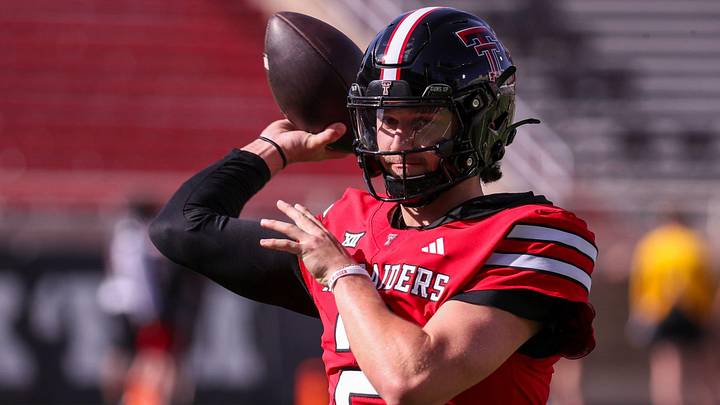
Brendan Sorsby
The Brendan Sorsby affair hit another critical point Monday with the NCAA denying his request to have his eligibility restored for the 2026 season. Texas Tech’s lawyers plan to appeal the decision, while Sorsby’s lawyers work toward Monday’s hearing in Lubbock County, Texas, on an injunction that may be the quarterback’s final swing at staying in college football.
The NCAA has already informed Sorsby’s legal team that it will not negotiate a settlement to get Sorsby back on the field, per sources. Getting the injunction would mean Sorsby could play while his case is in court. But to land it, his lawyers will have to prove a likelihood that he’d win the case, and the rules around NCAA athletes and gambling are pretty black and white here (and they have Sorsby’s admission).
If the court denies the injunction, I’d expect Sorsby to enter the NFL’s supplemental draft ahead of the league’s June 22 deadline to apply.
As we reported last week, the NFL has given Sorsby’s camp a window of July 5 to 12 to work out for teams should he enter the supplemental draft. The expectation would then be that he’d have a pro day in the Dallas area and perhaps do a couple of private workouts for teams that show interest. The draft would be in late July.
This is only getting more interesting, especially with a number of teams that didn’t spend top-50 picks on quarterbacks in April having their eyes on the 2027 class, and a few, like the Steelers and Colts, still could take a swing here.
If Sorsby is in the supplemental draft, another question will be whether the NFL takes any action against him, like it did against Terrelle Pryor in 2011.
Minnesota Vikings
The Vikings’ GM search is reaching its final stages, with interim GM Rob Brzezinski and Bills assistant GM Terrance Gray having interviewed on Tuesday, and Seahawks assistant GM Nolan Teasley, Broncos assistant GM Reed Burckhardt and Rams assistant GM John McKay scheduled for Wednesday and Thursday. After that, it’ll be decision time.
One thing that’s been ruminated on is the potential that the Vikings could go to a Lions and Rams type of model, essentially splitting the job, with Brzezinski running the operations side (like Mike Disner in Detroit or Tony Pastoors in Los Angeles), and one of the external candidates running the scouting side (like Brad Holmes in Detroit or Les Snead in Los Angeles). But there is a complication with that.
Somewhere along the line, the Vikings would have to declare who ultimately is in charge of the primary football operation. So, say Minnesota wants to promote Brzezinski to president of football ops and tab a GM from that pool of four candidates. If that made Brzezinski the primary football exec, then those candidates could, theoretically, be blocked by their current teams from going to Minnesota. I don’t think those teams would do that, but they could.
I’d also add that I think communication with ownership is going to be key for whomever winds up in charge. The Wilfs live in New Jersey and want someone they can trust who will serve their best interests in heading up the team. Which is one area where Brzezinski, who has worked for the team since before the Wilfs bought it in 2005, has an edge, and why the family would almost certainly want to keep him aboard in a prominent role, regardless of the structure.
A.J. Brown
We touched on the looming A.J. Brown trade in the takeaways Monday, with the expectation it’ll come next week.
And I still believe the throughway to satisfying the Eagles’ desire for a first-round pick is pushing that return into 2028. Philadelphia GM Howie Roseman has been amenable to such compromises in the past—he took a 2026 third-rounder for Haason Reddick in March 2024—because he has the job security to do so. Also, such a compromise was already discussed between the Eagles and a team other than the Patriots a couple of months ago, at which point Philly would’ve been accepting a pick three drafts away.
It’s a small difference, but the 2028 first-rounder is now two drafts away, which creates a parallel to what the Jets received for Quinnen Williams—the Cowboys centered their package for Williams, in fall 2025, around a 2027 first-round pick—that Roseman was using as a trade comp in the first place.
Anyway, Roseman has been smart and patient, allowing time to smoke out any suitors over the past couple of months in case unforeseen circumstances arise elsewhere. But I think in the end, as I said in the Monday column, this will wrap up the way we all expect it to.

Cleveland Browns
I was asked on Cleveland radio again on Tuesday about the possibility of the Browns trading Myles Garrett. The breadcrumbs have been there for a while. Two months ago, the team and Garrett’s camp agreed to delay the execution of a $29.2 million option bonus from late March to a week before the regular season begins, making a trade more feasible in that Cleveland got more runway to send the entirety of his 2026 compensation away with him. Then, last week, Todd Monken told reporters that he hadn’t yet met with Garrett.
Obviously, you can add those two realities to the fact that, come June 1, the cap damage can be spread over two years, and you might think something is up.
I wouldn’t rule anything out. And I’ve said this before, I think it makes sense for Cleveland to move Garrett now. He’s still a great player, and he’d bring a massive haul. But his timeline doesn’t really align with those of the 2025 and 2026 draft classes that Cleveland hopes will lay the foundation for the franchise moving forward. Which means the Browns have to be honest with themselves about where they are, and how likely it is that those guys come of age, and a quarterback is entrenched, while Garrett’s still in his prime.
Where you don’t want to be is in a place where Garrett falls off, or his trade value tumbles because you waited too long, just as all the young talent comes together. So I’d look at it, for sure. And I wouldn’t be stunned if, quietly, they have.

NFL schedule
I agree with Jason Kelce’s take on the sanctity of Sunday football, and believe the NFL needs to be careful about deconstructing Sunday afternoons as aggressively as it has.
First, I’ll give you the numbers. In the afternoon windows, there are 13 total games in only two of the 18 weeks of the season. There are 12 games in the two windows on four occasions, 11 on six occasions, 10 on four Sundays, and then nine (Week 12) and eight (Week 17) on the two holiday weekends. By comparison, in 2006, 11 games were the low-water mark, and it was only that low twice. Fans got 12 afternoon games on nine of the 17 Sundays, with two weeks of 13 and four of 14.
Then, there’s the reality that better games are going to Monday and Thursday nights now than was the case then (2006 was the year that Sunday Night Football became the bigger ticket package than MNF), better games are going to the holidays, and you have flex scheduling used primarily to enhance the appeal of standalone games.
That’s how you end up with this on the Sunday after Christmas: Patriots at Jets, Browns at Ravens, Chargers at Dolphins, and Cardinals at Saints at 1 p.m. ET; and Titans at Raiders, and 49ers at Chiefs (I do like that one) at 4-ish p.m. ET, with the two least appealing games to fall out of a Saturday grouping into this Sunday slate.
So why am I with Kelce on this? I learned to consume the NFL a certain way, and remember coming home from mass on Sunday to a buffet of games at 1 p.m. ET, knowing that I’d get John Madden and Pat Summerall on Joe Montana’s 49ers or an NFC East showdown later. Maybe I’m drunk on nostalgia, but I think that formula works, because if you get stuck with a bad game (or a good matchup that turns into a bad game) on Sunday afternoon, there’d always be another one to turn to. Tear that down, and you risk people changing their viewing habits.
And excuse me if I’m missing something, but I’m not so sure the NBA or NHL having a game on every night ever gave them an edge over the NFL that had scarcity on its side. I’d actually argue that it did the opposite. So, as someone who cares about the health of football, from my humble perch, I’d say: be careful, NFL, about simply clearing every nickel off the table.
Los Angeles Chargers
Chargers safety Derwin James’s three-year, $75.6 million extension is well-deserved, and for more than one reason.
First, James has been the tip of the spear for Jim Harbaugh as he’s built his sort of culture in Los Angeles the past couple of years. I remember being at Chargers camp two summers ago, and the running joke was that Harbaugh wanted everyone to do as Derwin would because he saw in James what he wanted in a football player. So program-wise, he’s an incredible fit.
Second, as a player, and scheme-wise, he’s what Kyle Hamilton’s become in Baltimore, and what Nick Emmanwori was in the playoffs for Seattle—the freakish, supersized safety that effectively allows the Chargers to treat their nickel as a base defense. In the Super Bowl, the Seahawks, in another Ravens-style scheme, had three safeties on the field for 70 or 71 snaps, because, with Emmanwori out there as a hybrid, the Patriots couldn’t run them out of the scheme. James gives the Chargers that sort of edge every week.
Third, and this is more of a personal thing—given the catastrophic injuries James had in college, it’s just really cool to see him get to a third contract on the doorstep of his 30th birthday. Fighting through what he has to make it, to me, is another good sign that this money, way above what any other safety has made, will prove to be very well-spent.
Tennessee Titans
I’ve seen some buzz around Titans rookie Carnell Tate, and I can add a little something to it. I had someone there tell me something to the effect of, “Either he’s really, really good, or we’re in trouble at receiver.” Yeah, the comment was made a little tongue-in-cheek. But it also reflects a real belief that Tate should become a focal point in Brian Daboll’s passing game, and for Cam Ward, relatively quickly.

Green Bay Packers
Obviously, the allegations against Josh Jacobs are very serious and go well beyond football. But there is a football component to this, and absent Jacobs, the Packers’ leading returning rusher from last year would be Jordan Love. The rest of the running backs on the roster combined for 106 yards on 27 carries without a touchdown, and all of that production belonged to fourth-year man Chris Brooks.
Kansas City Chiefs
I loved seeing Patrick Mahomes back on the practice field. I know that doesn’t mean he’s close to being cleared to play in a game. But there’s more than three months for him to get there. And the visual does affirm everything you’ve heard about how hard he’s working to get back on the field for his 10th NFL season.
Travis Kelce
And while we’re there, congrats to Travis Kelce on becoming a minority owner of the Cleveland Guardians. I have a lot of college buddies from Northeast Ohio, and they’re all fiercely loyal to (and, yeah, sometimes defensive of) where they’re from. So it doesn’t surprise me in the least that Kelce would look to do something meaningful back home.
More NFL from Sports Illustrated
 Add us as a preferred source on Google
Albert Breer is a senior writer covering the NFL for Sports Illustrated, delivering the biggest stories and breaking news from across the league. He has been on the NFL beat since 2005 and joined SI in 2016. Breer began his career covering the New England Patriots for the MetroWest Daily News and the Boston Herald from 2005 to ’07, then covered the Dallas Cowboys for the Dallas Morning News from 2007 to ’08. He worked for The Sporting News from 2008 to ’09 before returning to Massachusetts as The Boston Globe’s national NFL writer in 2009. From 2010 to 2016, Breer served as a national reporter for NFL Network. In addition to his work at Sports Illustrated, Breer regularly appears on NBC Sports Boston, 98.5 The Sports Hub in Boston, FS1 with Colin Cowherd, The Rich Eisen Show and The Dan Patrick Show. A 2002 graduate of Ohio State, Breer lives near Boston with his wife, a cardiac ICU nurse at Boston Children’s Hospital, and their three children.
Follow AlbertBreer