%20%20--%3E%0A%3Csvg%20version%3D%221.1%22%20id%3D%22Layer_1%22%20xmlns%3D%22http%3A%2F%2Fwww.w3.org%2F2000%2Fsvg%22%20xmlns%3Axlink%3D%22http%3A%2F%2Fwww.w3.org%2F1999%2Fxlink%22%20x%3D%220px%22%20y%3D%220px%22%0A%09%20width%3D%2239px%22%20height%3D%2240px%22%20viewBox%3D%220%200%2039%2040%22%20enable-background%3D%22new%200%200%2039%2040%22%20xml%3Aspace%3D%22preserve%22%3E%0A%3Cpath%20fill%3D%22%23FFFFFF%22%20d%3D%22M38.5%2C7H28.2v26h10.3V7z%22%2F%3E%0A%3Cpath%20fill-rule%3D%22evenodd%22%20clip-rule%3D%22evenodd%22%20fill%3D%22%23FFFFFF%22%20d%3D%22M26.1%2C25.5c0%2C5.8-4.1%2C7.5-12.9%2C7.5C3.9%2C33%2C0%2C31.2%2C0%2C25.2v-1.1h11.6%0A%09v2.4c0%2C0.7%2C0.1%2C1.4%2C1.2%2C1.4c1%2C0%2C1.2-0.4%2C1.2-1.3v-0.9c0-1.6-0.9-1.6-3.5-2.2C2.2%2C21.7%2C0%2C19.7%2C0%2C15.3v-0.9C0%2C9.3%2C5.5%2C7%2C12.9%2C7%0A%09c10.2%2C0%2C12.8%2C2.6%2C12.8%2C7.4v1.8h-11v-2.9c0-0.6-0.4-1.1-1.2-1.1c-0.6%2C0-1.2%2C0.4-1.2%2C1.1v0.9c0%2C1.5%2C0.9%2C2%2C3.3%2C2.5%0A%09c8%2C1.6%2C10.5%2C3.3%2C10.5%2C7.5V25.5z%22%2F%3E%0A%3C%2Fsvg%3E%0A)
Albert Breer’s Notes: Why the Jaylen Waddle Trade Makes Sense for the Broncos
In this story:
Jump to a topic
Your Tuesday NFL notes are a day late, on a Wednesday, but we have plenty to dive into with wave one of free agency in the rear-view mirror.
Denver Broncos
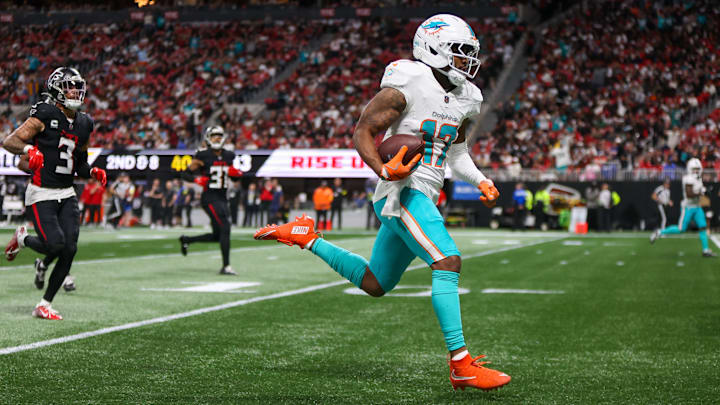
The Jaylen Waddle trade makes all kinds of sense for the Broncos. They gave up the 30th and 94th picks, and moved their fourth-rounder up from 130th to 111th. Add up the value of the picks going out (on the chart, 620, 124, 42) and subtract the one coming in (72), and you wind up with the Dolphins netting 714 points, which is roughly the value of the 25th pick (the exact value of that is 720 points).
So, to game this out, I looked at the receivers taken within two slots of that pick (Nos. 23 to 27) over the past decade. Here’s the list: Matthew Golden, Brian Thomas Jr., Jordan Addison, Rashod Bateman, Brandon Aiyuk, Hollywood Brown, DJ Moore, Calvin Ridley and Laquon Treadwell. There are good players there, for sure. And what the Broncos are giving up in age and contract, they’re getting in the certainty Waddle brings.
The contract’s not exactly a backbreaker, either. Waddle has three years and $68.6 million left. That’s an APY of $22.9 million. That, for context, is slightly less than what Denver is paying Courtland Sutton. Which means the Broncos are getting their top two receivers for a little more than what Ja’Marr Chase is making in Cincinnati.
The Broncos are now in a position where they don’t have gaping holes to fill. Their defense is rock solid, without a real weakness to speak of. The O-line is among the best in football, and the skill group is full of good, complementary pieces. What the team lacks, with quarterback Bo Nix on a rookie deal, is the type of weapon who can carry coverage. We’ll see if Waddle, now away from Tyreek Hill, can be that for the Broncos.
To me, it was worth taking the shot to find out.
Miami Dolphins
As for the Miami side of the deal, the Dolphins needed to build up their war chest of picks. GM Jon-Eric Sullivan and coach Jeff Hafley were hired to build a Packers-style draft-and-develop machine after a four-year stretch in which Miami had fewer picks than any team in football, and the talent pool eroded. As part of that effort, the Dolphins have made it known that they’d listen to trade offers on any player.
Waddle was their most valuable trade asset. Adding the third-round pick they got for Jaelan Phillips into the equation, Miami heads into the draft loaded, with seven picks in the first three rounds. The trick will be hitting on those.
And as for how Malik Willis fits into all this, I’d say that Hafley still has to find a way to give his players a chance in 2026. Willis’s signing shows an effort to do that.

Mike Evans
The NFL will tell you where a player stands with money, and that’s the case with Mike Evans as he heads into his 12th season, and first with the 49ers.
He got $12 million to sign, and another $1.3 million in base salary for this year, with another million based on him showing up for the offseason program and playing in the games ($150,000 workout bonus, $850 in per-game roster bonuses. That adds to $14.3 million for this year. His base pay for 2027 is $14.5 million. It’s $13.65 million for 2028).
That’s right around where Cooper Kupp landed, which makes sense given that they’re both older receivers moving into more complementary roles. It’s also a pretty good indication that his camp telling teams they had a one-year, $27 million offer from someone during the height of free agency was probably the bluff teams figured it to be.
Romeo Doubs
Romeo Doubs’s contract in New England is another example of a player reaching a compromise by taking less, but with a shot to reach the target his camp set for him.
Doubs aimed to get to $20 million per year. He wound up with a four-year, $68 million deal with the Patriots, with $35 million (essentially the first two years) fully guaranteed. And then, he got an incentive package that maxes out at $3 million per year. So if he evolves into a real No. 1, and stays healthy (there’s $1.7 million in per-game roster bonuses each year), the deal could get to $80 million.
Maxx Crosby
Maxx Crosby laid the lumber to the Ravens on his podcast, The Rush, on Tuesday. He explained that Baltimore flew him into D.C. for his visit and that he didn’t see coach Jesse Minter until five hours into his visit, and GM Eric DeCosta until thereafter. So there was indeed a cost for the Ravens in how players perceive the organization. It’s also a tough blow to an organization that has prided itself on being first-class in the resources it provides.
Carson Towt
Notre Dame power forward (yes, you read that right), Carson Towt, signed with the Colts this week, after finishing his college basketball career, and my first question was why he didn’t have to go into the draft like everyone else. Turns out, if an athlete doesn’t play college football for four seasons after entering college, he automatically becomes eligible for the draft. So Towt, who played seven (!) college seasons—with a redshirt, a medical redshirt, and the COVID-19 season giving him extra years—was eligible in 2023.
It also officially makes me a member of the 2002 draft class.
Remaining free agents
Some big names remain on the market: Joey Bosa, Jadeveon Clowney, David Njoku, Taylor Decker and Stefon Diggs are a few. And those guys can afford to be patient now, with the rush done, cap and cash budgets spent, and rosters a little more settled.
Quarterbacks like Kirk Cousins, Joe Flacco and Russell Wilson face a different dynamic, because there are only a finite number of jobs at the position.
More NFL from Sports Illustrated
 Add us as a preferred source on Google