%20%20--%3E%0A%3Csvg%20version%3D%221.1%22%20id%3D%22Layer_1%22%20xmlns%3D%22http%3A%2F%2Fwww.w3.org%2F2000%2Fsvg%22%20xmlns%3Axlink%3D%22http%3A%2F%2Fwww.w3.org%2F1999%2Fxlink%22%20x%3D%220px%22%20y%3D%220px%22%0A%09%20width%3D%2239px%22%20height%3D%2240px%22%20viewBox%3D%220%200%2039%2040%22%20enable-background%3D%22new%200%200%2039%2040%22%20xml%3Aspace%3D%22preserve%22%3E%0A%3Cpath%20fill%3D%22%23FFFFFF%22%20d%3D%22M38.5%2C7H28.2v26h10.3V7z%22%2F%3E%0A%3Cpath%20fill-rule%3D%22evenodd%22%20clip-rule%3D%22evenodd%22%20fill%3D%22%23FFFFFF%22%20d%3D%22M26.1%2C25.5c0%2C5.8-4.1%2C7.5-12.9%2C7.5C3.9%2C33%2C0%2C31.2%2C0%2C25.2v-1.1h11.6%0A%09v2.4c0%2C0.7%2C0.1%2C1.4%2C1.2%2C1.4c1%2C0%2C1.2-0.4%2C1.2-1.3v-0.9c0-1.6-0.9-1.6-3.5-2.2C2.2%2C21.7%2C0%2C19.7%2C0%2C15.3v-0.9C0%2C9.3%2C5.5%2C7%2C12.9%2C7%0A%09c10.2%2C0%2C12.8%2C2.6%2C12.8%2C7.4v1.8h-11v-2.9c0-0.6-0.4-1.1-1.2-1.1c-0.6%2C0-1.2%2C0.4-1.2%2C1.1v0.9c0%2C1.5%2C0.9%2C2%2C3.3%2C2.5%0A%09c8%2C1.6%2C10.5%2C3.3%2C10.5%2C7.5V25.5z%22%2F%3E%0A%3C%2Fsvg%3E%0A)
An Exercise in Exorcisms: Seahawks Are Super Bowl Champs Again
In this story:
After what seemed like a lost season, in which Sam Darnold threw only 46 passes and watched Super Bowl LVIII from the 49ers’ sideline, he met with his private coach for their typical exit interview in early 2024. Five years of disappointment, ghosts and J-E-T-S had led to the apprenticeship in San Francisco. This marked a significant step. But toward where, exactly?
Darnold knew he could start in the NFL. His 21–34 record in those seasons lacked context but said otherwise. He also knew what 49ers coaches had tried to keep private. They loved their starting quarterback, Brock Purdy. He led them to that Super Bowl. He would earn—and sign—one of the largest contracts in NFL history. Still, that adoration hadn’t ended a season-long debate. Many at team headquarters didn’t view Darnold as an above-average backup. They saw him as a starter. And some saw him as the better option.

Darnold sat down in Jordan Palmer’s office, and they spoke for hours, charting the path few outside that room, on that day, saw coming. It had taken six seasons for Darnold to morph into the best possible version of the quarterback he’d always known he could be. Others had seen the vision, too. Like those Jets, who drafted Darnold with the third pick in 2018. And those Niners; one season, that changed everything, wearing a headset rather than a helmet.
Before the year in Minnesota and this season in Seattle, inside that office, Palmer asked Darnold what he’d learned. He wound to the part that mattered then and matters more now, because Darnold is back in a Super Bowl. Only, this time, he’s the starter. No debate.
“The biggest thing,” he told Palmer that day, “was how nothing changed in the playoffs.”
Purdy approached those games the same as all the others. He didn’t watch extra tape. He didn’t take extra reps. If anything, his blood pressure might have dropped in January.
Palmer adored that answer, in part, because the Niners’ roster marked the first time in Darnold’s career where the best players on his team bought in more than anybody else. He knew what a Super Bowl team looked like, which meant he also knew that he could lead a team to one.
“One day,” Palmer told Darnold, “you’re going to draw on that experience.”
Consider this Seahawks season an exercise in exorcisms. Darnold infamously said he saw “ghosts” in a 2019 blowout loss to New England, his opponent in Super Bowl LX. In Seattle, a city known for its heightened paranormal activity, the locals understood.
Keith Linder had some advice for the football team he follows. In 2011, he moved from Austin to Seattle. He rented a house in Bothell, northeast of downtown. At that point, neither Linder nor his girlfriend, Tina, knew anything about paranormal activity.
“We got baptized,” Linder said.
The strange started on May 1, 2012. They started hearing this sound, like a baby coughing, incessantly. Car keys mysteriously vanished, along with silverware. Then the knocking started. Then a potted plant levitated off the ground, spun in a full circle and dropped back in place. A “demonic drawing” suddenly appeared on one wall, upside down.
Linder came to believe his house was haunted. He chose, at that moment, to do what many Seahawks players and coaches have done for the past 11 years: live with ghosts. Perhaps then he could understand them. “I was trying to rationalize [my experience],” Linder said. “Darnold must have felt like that. He was there. He couldn’t make sense of it. But [facing ghosts] builds you, internally.”
Linder no longer lives in what’s now known as the Bothell Hell House. It’s located on—get this—Stafford Way. The Seahawks vanquished their rival, the Rams, twice in the past five games. Another ghost, busted. Just like the symbols of stick figures that showed up on Linder’s walls, drawn but upside down, Linder could flip “Way” and get close to Maye, as in Drake, the Patriots’ quarterback. That’s the ghost ahead. Those Patriots. That Super Bowl interception that still reverberates after more than 4,000 days.
That is the story of this Seahawks season: An exercise in exorcisms.

At Seahawks practice on Wednesday, their do-everything, play-anywhere safety, Nick Emmanwori, landed funny, spraining the same right ankle he injured earlier this season. “It was pretty bad,” Emmanwori tells Sports Illustrated in the victorious home locker room, cigar smoke swirling all around. “Definitely had me scared.”
His first thought, as he went to see the doctors: “Am I going to be able to play?”
His status was uncertain at first. Worse yet, he saw fear in his teammates’ eyes. For him, sure, but also for their season. By Wednesday night, Emmanwori says he had made his decision. He had one choice. He would play. “I gotta put my best foot forward, no pun intended. They would have had to cut my foot off to not play.”
Still, when Emmanwori woke up Sunday, his ankle was sore—and not just sore, but more sore than he expected. Then, defensive tackle Jarran Reed broke down the defensive huddle, same as always, and Emmanwori banished the very thought of pain from his mind.
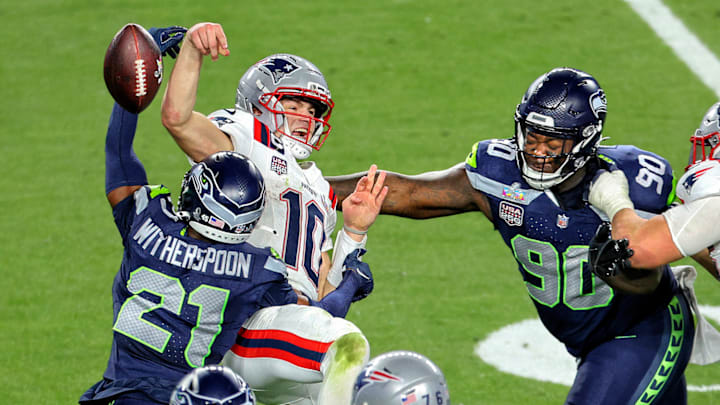
What happened next was a defensive performance among the greatest in Super Bowl history. The stat sheet says New England scored 13 points and gained 331 yards. Don’t believe it. Those numbers are accurate but wildly misleading. As Emmanwori said afterward, these Seahawks cut off New England’s water supply and turned the Patriots’ lights off. The Dark Side, as Seattle’s defense is monikered, didn’t even wait until sunset. “We showed the world exactly what we already knew,” Emmanwori says.
The Dark Side sacked Maye six times and forced three turnovers. The Patriots gained 51 yards—in the entire first half. Yes, this marked one of the few Super Bowls over the past three decades without a quarterback with the last name Manning, Brady or Mahomes. Seattle’s defense subbed in and seized the starpower. Bad Bunny moved the ball better than the Patriots during his halftime performance.
Pick a number. Any number: 17, wins for head coach Mike Macdonald, the most by any head coach, ever, under 40; the No. 1 scoring defense, with its -246 point differential and 27 consecutive games without allowing a 100-yard rusher. That’s the fascinating part of Macdonald’s schemes. Seattle played five or more defensive backs on 92.5% of its defensive snaps this season. Macdonald also kept both safeties deep, primarily. That the Seahawks also played the run better than any defense speaks to how all these things work together—Emmanwori, as the moveable piece; a defensive line that can create pressure and stop running backs without any extra help; six rushers who registered at least 40 rushes this season; and Devon Witherspoon, one of the best cornerbacks in football. This type of defense, Emmanwori says, does not have a precedent in football lore.
How John Schneider became the first NFL general manager to win a Super Bowl, turn over an entirely new roster, swap head coaches and come back to win another one … start there. How Darnold obliterated doubt … start there. Why these Seahawks were shadowboxing on their Saturday walk-through … start there. This defense was predicting its performance, an ode to Wu-Tang’s “special technique of shadowboxing.”
“We’re one of the best defenses in NFL history,” cornerback Riq Woolen tells SI afterward.
When did he know that?
“Right about now.”
The NFL should have seen this coming. It should have recognized the pattern. Three new popes have been elected this century. And, in each of those years, the Seahawks made the Super Bowl. In 2005 (Benedict XVI). And in ’13 (Francis). And now ’25 (Leo LIV).
It sure didn’t look that likely this time last year. Before coach Mike Macdonald’s second season, Seattle wanted, as much as possible, to pivot toward shaping his vision. Star wideout DK Metcalf didn’t believe he fit the culture and, according to two sources, went to Pete Carroll for guidance, still, rather than Macdonald. Seattle traded him to Pittsburgh two days after shipping quarterback Geno Smith to Las Vegas.
Addition by subtraction gave way to needs. The Seahawks didn’t have many. The most prominent: veteran players who knew how championship teams operated.
GM John Schneider had always admired Cooper Kupp, the Rams’ version of Jaxon Smith-Njigba when L.A. won the Super Bowl in 2021. He’d wanted to draft Kupp in ’17, but waited one round too long, as the Rams selected him in the third. It was the same deal with Puka Nacua, another Seahawks target the Rams drafted.
Kupp started 2022 the same way he had finished ’21—as if defenses couldn’t guard him, regardless of talent, players or schemes. But in Week 10, he sustained a dreaded high ankle sprain. Kupp elected to have surgery, hoping to return later that season. “His body,” said his father, Craig, “didn’t respond [to the procedure] well.”
He missed the rest of L.A.’s season, then the first four games of 2023 and five more in ’24. Freak, unavoidable injuries exacerbated existing ones, as the football scientist confronted the first calculus he couldn’t solve. “He was searching,” said his trainer, Ryan Sorensen.
Still, Kupp wasn’t thinking about retirement. When COVID-19 shut down sports in 2020, Sorensen and Kupp turned the wideout’s backyard into a nerdier Muscle Beach. Kupp toiled atop his living room rug outside—at least until no one could stand the stench.
His future with the Rams grew increasingly messy, creating a divide between those who believed Kupp could still play—and lead, like inviting Nacua, then a rookie, to train him for an entire offseason—and those betting that he’d peaked. The final answer came last March, delivered via X. Kupp was at Sorensen’s gym when his phone began blinking as if it wanted to move to Vegas.
He then repeated the exact phrase. Not good. Not good. Not good.
Schneider saw both a No. 2 receiver and the ideal mentor for JSN, who led the NFL in receiving yards this season. The GM wouldn’t get cute this time. Ernest Jones IV, the Seahawks’ elite linebacker and another former Ram, jumped in, wooing his former teammate over text messages. “This place,” he wrote, “is what you’re looking for.”
Kupp signed with Seattle. Before he headed north, he got in one final workout. Only this time, they were joined by Nacua, Matthew Stafford and Andrew Whitworth. Kupp meant that much to them.

The Seahawks also added Darnold and another pass rusher in DeMarcus Lawrence. By the draft, Schneider had minimal needs to fill. He picked the best players on the board. He drafted a guard in the first round, Grey Zabel, who had turned down NIL money to remain at North Dakota State. Zabel’s bona fides came with a gold jacket recommendation from the best guard in franchise history, Steve Hutchinson, a Hall of Famer who spearheaded Seattle’s first Super Bowl run and urged Schneider in recent years to develop an offensive line with the wrecking-ball mentality his group held.
Six years ago, Zabel didn’t weigh even 250 pounds. But in the past year, after adding around 75 in between, he won the FCS national title, played for coaches noted for developing offensive linemen, visited the White House with his fellow Bison, met President Donald Trump and continued toiling on the family farm, preparing for his next career before his first one really started: growing corn, soybeans and oats.
The Seahawks assigned Zabel a locker next to left tackle Charles Cross. A football team known for its perpetual O-line issues soon had the best offensive line in Schneider’s tenure. Another ghost, then, busted.
In Seattle, the quarterback’s father agreed with what Sam saw—a tailored fit for once. He had already developed a relationship with JSN at the Pro Bowl. The Seahawks, who signed Darnold to a three-year, $100.5-million contract, happened to win football games, a lot of them, with only three losing seasons under Schneider, each with a respectable seven wins.
Palmer, Darnold’s private coach, lives a five-minute drive away. They’re close-close because they spend a ton of time together. They met when Darnold was 14. When he watches Darnold play, Palmer cares, like when he watched his brother, Carson. Palmer points to one surprise birthday party for his client. Palmer, his wife and their three kids wore unbuttoned flannels with the sleeves rolled up and Vans. When Darnold walked in, he laughed so hard that he keeled over.
It’s all very professional and not. Darnold’s a San Clemente kid at his core. He doesn’t suffer from FOPO, Palmer’s term, or Fear of Other People’s Opinions, which is part of his presentation to draft prospects. Not caring, Palmer says, is Darnold’s “superpower.” All he does is work and endure unbuttoned flannel jokes.
As a draft prospect and early into his career, Darnold was a fumbler. He listened to coaches who told him to keep both hands on the ball. But he also moved, first, with his upper body, leaning forward and stepping behind himself to change direction. When players run that way, their hands separate, naturally. Darnold changed how he moved. Palmer says he hasn’t taken his left hand off the ball, other than to ward off defenders, even once in two seasons.
Last year, after a 5–0 start in Minnesota, Palmer compiled Darnold’s “bad balls” from the torrid start. Far and away, he missed most often on outbreaking routes to the right. A full 24.6% of his worst passes were on those routes. Palmer noticed an alignment issue in Darnold’s left shoulder. He was drawing it as he started throwing. Palmer gave him homework: curl a golf club with both biceps, with the club sticking out from his left side. When he did this, Darnold could see where his front shoulder should be. Then he stuck pieces of athletic tape on his left shoulder pad, as a reminder that would flash through his peripheral vision. “And since the bye week,” Palmer said, “he still has not missed on an outbreaking route to the right.”
Schneider saw promise, but false narratives clouded it. Many were grounded in truth, but all those began with the premise that Darnold could not do what he really hadn’t had many chances even to attempt. The Seahawks hired Klint Kubiak, who coached Darnold in San Francisco, to reimagine their offense.
For Tom Brady, that marked a critical yet straightforward distinction. “Quarterbacks need places and coaches to put them in positions to succeed,” the veteran of 10 Super Bowls said. “[Teams] just turn over things so quickly because of impatience, social media culture and the intense pressure to win. The mental toughness of the organization and the willingness to continue are super important.”

The offseason maneuvering yielded a fuller buy-in, which Macdonald reinforced with the Seahawks’ newest slogan: M.O.B Ties, or Mission over B.S. Cross, the left tackle, could tell before training camp, when the vast majority of players showed up for voluntary workouts.
JSN returned home from one practice and told his brother, Canaan, “Man, Sam is throwing it like that.” Schneider agreed. He saw Darnold, absent arrogance and still a leader, trying to shape Seattle into what Darnold had seen in San Francisco.
“It looks,” Mike Darnold thought then, “like this year might be a year.”
The Kubiak-designed offense wasn’t just Darnold. It featured him, ran through JSN and deployed two running backs in contrasting ways. Doug Baldwin, the Seahawks legend, saw a lot of Marshawn Lynch in Kenneth Walker III. Darnold’s timing made Baldwin “mad.” JSN, Baldwin says, played like the best receiver in the world.
Darnold’s story resonated the most with Baldwin. Perpetually doubted and internally motivated could be the title of his memoir. He saw the same authenticity as Schneider. “[Darnold’s] a good dude, and he’s not buying into his own hype,” Baldwin said. “At least not yet. And he’s also not out there selling nanobubbles, right?”—that last bit, a dig at Russell Wilson, who insisted those bubbles could help prevent concussions.
The reconfigured offense powered Seattle through the first half of this season. Darnold played one of his best games against Tampa Bay on Monday Night Football, but his 341 passing yards, four touchdown passes and nifty escape on fourth-and-2 still morphed into a come-from-ahead defeat. The Seahawks’ defense had looked shaky, especially late in games. But that owed, in large part, to several injuries to starters.
Darnold ranked among league leaders in all statistical categories. He led two game-winning drives in the first quarter of the season. In Week 6, the run game stalled, and he spearheaded a road win in Jacksonville. Lawrence registered two sacks and five quarterback hits. Kupp caught a touchdown pass. The Seahawks, in other words, beat the Jaguars this past offseason. Darnold torched Washington in Week 8 with a first-half line of 16-of-16, 282 passing yards and four touchdowns, which would best his tally of three incompletions all game.
Pundits began to regard the Seahawks as better than expected. But while perennial contenders struggled or sank, an NFL season without a clear favorite really had two of those all along. Seattle started 7–3 and hasn’t lost since. New England reeled off 10 consecutive wins and also finished 14–3. But while the Patriots played consistently throughout 2025, the first half of the Seahawks’ season hinted at only what they might become. By regular season’s end, they wouldn’t look—or play—like the same team.

At the 2025 NFL scouting combine, Emmanwori turned in perhaps the best-ever performance in the Underwear Olympics—from his 40-yard dash time (4.38 seconds) to his broad jump (11'6") to his vertical jump (43 inches, the best mark, ever, by any player who weighed more than 200 pounds). That combination for a safety marked a first.
That’s the thing, though. Emmanwori isn’t really a safety. He’s much more than that. He only received one Division I scholarship offer from nearby South Carolina. He had already played maybe a dozen different positions—running back, all types of linebacker, all types of safety, receiver, gunner, edge rusher, Wildcat quarterback.
The Gamecocks recruited him as a middle linebacker. But Clayton White, SC’s defensive coordinator, took one look at Emmanwori’s frame and salivated. He saw a safety.
Emmanwori’s parents had emigrated from Nigeria, then his dad studied mechanical engineering at West Virginia. Learning came naturally to him. In fact, White and his hybrid star spent part of one offseason studying the NFL’s most versatile safety, Kyle Hamilton, who starred for Baltimore. His defensive coordinator: Mike Macdonald.
Both saw the NFL becoming more like the NBA; becoming, in other words, more and more positionless. Case in point: The Seahawks’ new No. 3—Russell Wilson’s old jersey number—played nickel, field safety and boundary safety for the Gamecocks. He made first-team All-American as a junior and first-team All-SEC. Only three FBS players logged 300 snaps at safety, 100 at corner, 100 at middle linebacker and 100 at outside linebacker that season.
Emmanwori watched Hamilton and thought, “I can do that.”
He liked Schneider; they’d hit it off in the speed-dating round in Indy. He knew, too, that Macdonald needed a Hamilton-like player to bring over his defense. Before the first pick, he sent a text to his family’s group chat.
It read: The Seahawks are gonna get me.
They did, with the 35th pick. Why they selected him was revealed in the first four snaps of his rookie season, when Emmanwori notched two QB pressures and one tackle for a loss. But he injured his right ankle on the fourth one and didn’t return until Week 5. He calls this a “minor inconvenience”—before reinjuring the same ankle, although less severely, in the week before LX.
Macdonald unlocked his versatility, Emmanwori said, giving both a “cheat code; like, honestly, what can’t I do?” The delay didn’t diminish that, nor the Seahawks’ defensive transformation, which started when Emmanwori returned to the lineup.
Macdonald’s defense took shape over the second half of the season, with Emmanwori at the center, edges and all over the field. Macdonald gave Emmanwori a nickname, The Avatar. Seattle’s pass rush—scary, with Leonard Williams, Byron Murphy II, Derick Hall, Uchenna Nwosu and Boye Mafe—started to chase quarterbacks as one. Cornerback Devon Witherspoon eliminated No. 1 wideouts.
The Seahawks lost to the Rams at home on Nov. 16. They haven’t lost since. Their wins, though, came less from Darnold’s arm and more from their power run game and a defense that shut down every offense except the Rams from Week 13 onward.
Seattle’s D demanded another era-defining nickname. But what? There’s some chicken-or-the-egg in how that nickname formed. Some believe it started in the defensive meeting room, midway through this season. Lawrence told his teammates they needed an identity. “Something with the darkness, as far as mindset,” he said, brainstorming.
“I like going to a dark place,” Emmanwori said.
It was settled. Now the Dark Side, these Seahawks aim to turn off the lights for opposing offenses, their ethos a quiet yet menacing, inevitable force. It even matched the weather.
In an October conversation, Schneider noted one significant difference between these Seahawks and their near-dynastic predecessors: speed. He wanted to add more of that, if possible, and did, swinging a trade at the deadline.
In came Rashid Shaheed from the Saints. Speed got him to the NFL. Speed made him something of a household name. Speed was part of carrying the family name. Dad (Haneef) competed in sprints for Arizona State. Mom (Cassondra) became a hurdler at San Diego State. Both of Rashid’s sisters competed in college track. Rashid could have, too; he won the San Diego sectionals in high school in both the 200 and 400 meter dashes.
Like Darnold, Rashid needed “a team that really showcases his ability,” Haneef said.
Rashid hit the jackpot with the Seahawks. He still FaceTimes with his parents before each game, right before he tugs on his helmet and bounds onto a field. (Shaheed confirms he did this on Sunday, too.) He calls and says, “I love you.” He waves at them in the stands. Haneef always salutes him. Seattle’s newest speedster changed not just games but this season, elevating the Seahawks’ ceiling.
He returned a kickoff 100 yards for a touchdown against Atlanta (Week 14). His 58-yard punt return score sparked the Seahawks’ comeback victory over the Rams (Week 16). He stole the 49ers’ soul in 13 seconds in the divisional round, taking the opening kickoff 95 yards for another TD, en route to a 41–6 rout. In the NFC championship game, also against the Rams, his 51-yard catch from Darnold helped stake the Seahawks to an early lead.
Shaheed or no Shaheed, the Seahawks have made “special teams” a phrase absent any irony. Two special teams touchdowns against the Saints (Week 3), including the longest punt return in franchise history (Tory Horton, another 2025 Schneider draft pick, 95 yards). Six made field goals against the Colts (Week 15), including the longest game-winner (65 yards) in franchise history from Jason Myers. A muffed punt recovery that shifted momentum back in Seattle’s favor (NFC championship). And don’t forget punter Michael Dickson, who was named second-team All-Pro. He could have won MVP in LX, too. So many Seahawks could have. Which was kind of the point.
The NFC championship doubled as an exorcism chamber. In the stands at Lumen Field, Chris Darnold started to worry about the pressure, as moms tend to. Mike reminded his wife of the same story he always pulls out in moments like these: third grade, All-Stars basketball, Sam, at a tournament in Las Vegas. God, that seemed like the Olympics, didn’t it? Stakes on top of stakes. He still made the game-tying free throw. Which meant he didn’t feel the pressure, at least not how they internalized it.
Darnold beat the Rams to advance to the Super Bowl, despite an oblique injury that had lingered for over a week; the pain was still sharp enough to keep him out of practice almost entirely. He had become the first QB from his vaunted 2018 draft class—alongside Josh Allen, Lamar Jackson and Baker Mayfield—to reach the season’s final game.
Mike dropped a few tears at Lumen Field. He found his son hours after the game ended. Pulled him close. “You earned this,” he told him.
“And,” Mike said later, “maybe there’s a little vindication.”
Palmer would break down a “perfect game” for both in the days that followed.
Baldwin called his old coach after the NFC championship. He saw so much of Carroll’s influence, alongside so many players he drafted and developed in these Seahawks. Schneider tells SI he often thought about his former football partner in the week before LX, too. “We did it together, man,” Schneider said. “We did some really cool s---.”
Asked if a win or a loss would bring more healing for those Seahawks, Baldwin paused for about five seconds. “I don’t know,” he says. “That’s a good question. I’ll tell you after the game.”
The answer: “Healing. Bruh, I got a big smile on my face. I am really happy for those guys. That’s an awesome feeling. I needed that lmaoo.”

As stadium workers waited to wheel the celebratory stage onto the field, a dozen Seahawks employees waited to join the celebration. The game clock stopped once more, late in the fourth quarter.
It read: 0:12.
This franchise, the one that waited 11 years for this very moment, could wait an appropriate number of seconds longer. The stage went out. So did the Seahawks who had gathered. So did the coaches, who sprinted onto the field, yelling and pumping their fists.
Onstage, Darnold smiled. Macdonald’s eyes welled with tears. And, as the defeated Patriots walked through the same tunnel, they turned right, to the buses and their offseason, several Legion of Boom era Seahawks turned left, intent on joining the celebration. They wanted to toast Kenneth Walker III, whose 161 yards from scrimmage earned him the Super Bowl MVP award, becoming the first running back to win that honor since Terrell Davis in 1998. And the Dark Side. And Jason Myers, who kicked five field goals. And Dickson, who averaged 47.9 yards per punt and pinned three inside the 20. And Darnold, who dealt with his ghosts, via overcoming them.
Michael Bennett waited with these Boom-ers in the corridor. He says many former players were at the NFC championship game, watching together, from a suite. He describes the mood that night as subdued. Perhaps those players didn’t know how to feel. On Sunday night, they did.
“So much healing,” Bennett says. “They did what we couldn’t do, what we should have done. We should have got it right the first time.”
When this game ended, these Boom-ers gathered in a circle, moved closer together and shared a group hug 11 years in the making. “Emotional,” Bennett says of the moment.
The arc’s circle had nearly closed, with so many ghosts eradicated. But that’s the thing with spirits, says the software engineer who moved into a Hell House. “It’s their duty to test you,” Linder says. “The Seahawks have embraced their tests. That’s why they’re in this Super Bowl.”
How does an organization face its ghosts, live with them, exorcise them and move forward absent the weight it carried? Together. With a lost season that pointed a way forward. The Hell House. Stafford Way. A new pope. A draft prediction. A new No. 3. A clean break. A golf club nestled between two biceps. A farmer.
And the general manager who doubles as an organizational bridge. Back in 2010, Schneider set out to build a dynasty with a defensive-minded head coach widely respected throughout football. In 2025, something similar is happening. Wouldn’t that be wild? After enduring the Seahawks’ struggles between Super Bowl XLIX and Super Bowl LX, the one person remaining, Schneider completes what they started with a new partner and team.
They ain’t afraid of no ghosts.
More Super Bowl on Sports Illustrated
 Add us as a preferred source on Google
Greg Bishop was a senior writer for Sports Illustrated and has covered every kind of sport and every major event across six continents for more than two decades. He previously worked for The Seattle Times and The New York Times. He is the co-author of two books: Jim Gray’s memoir, “Talking to GOATs”; and Laurent Duvernay Tardif’s “Red Zone”. Bishop has written for Showtime Sports, Prime Video and DAZN, and has been nominated for eight sports Emmys, winning two, both for production. He has completed more than a dozen documentary film projects, with a wide range of duties. Bishop, who graduated from the Newhouse School at Syracuse University, is based in Seattle.
Follow GregBishopSI