%20%20--%3E%0A%3Csvg%20version%3D%221.1%22%20id%3D%22Layer_1%22%20xmlns%3D%22http%3A%2F%2Fwww.w3.org%2F2000%2Fsvg%22%20xmlns%3Axlink%3D%22http%3A%2F%2Fwww.w3.org%2F1999%2Fxlink%22%20x%3D%220px%22%20y%3D%220px%22%0A%09%20width%3D%2239px%22%20height%3D%2240px%22%20viewBox%3D%220%200%2039%2040%22%20enable-background%3D%22new%200%200%2039%2040%22%20xml%3Aspace%3D%22preserve%22%3E%0A%3Cpath%20fill%3D%22%23FFFFFF%22%20d%3D%22M38.5%2C7H28.2v26h10.3V7z%22%2F%3E%0A%3Cpath%20fill-rule%3D%22evenodd%22%20clip-rule%3D%22evenodd%22%20fill%3D%22%23FFFFFF%22%20d%3D%22M26.1%2C25.5c0%2C5.8-4.1%2C7.5-12.9%2C7.5C3.9%2C33%2C0%2C31.2%2C0%2C25.2v-1.1h11.6%0A%09v2.4c0%2C0.7%2C0.1%2C1.4%2C1.2%2C1.4c1%2C0%2C1.2-0.4%2C1.2-1.3v-0.9c0-1.6-0.9-1.6-3.5-2.2C2.2%2C21.7%2C0%2C19.7%2C0%2C15.3v-0.9C0%2C9.3%2C5.5%2C7%2C12.9%2C7%0A%09c10.2%2C0%2C12.8%2C2.6%2C12.8%2C7.4v1.8h-11v-2.9c0-0.6-0.4-1.1-1.2-1.1c-0.6%2C0-1.2%2C0.4-1.2%2C1.1v0.9c0%2C1.5%2C0.9%2C2%2C3.3%2C2.5%0A%09c8%2C1.6%2C10.5%2C3.3%2C10.5%2C7.5V25.5z%22%2F%3E%0A%3C%2Fsvg%3E%0A)
At the moment Athan Kaliakmanis’s life changed, most of his family was asleep somewhere outside of Piscataway, N.J., 3,500 miles away. Kaliakamanis’s older brother, Dino, is a wide receiver for Rutgers, and the Scarlet Knights had a Saturday night game against Indiana on Oct. 3 that had kept his parents and younger sister out late.
So it was on maternal intuition—or maybe the staccato fire of text messages—that Athan’s mom, Colleen, flung out of bed the next morning and turned on the TV to check on her son, a backup quarterback for the Commanders playing in London, only to see him putting on a helmet and entering the game. Marcus Mariota, the starter that day because Jayden Daniels was out with an injury, had sprained his knee on the team’s second offensive possession. Kaliakmanis, a rookie seventh-round draft pick, was next in line.
Kaliakmanis says the day began like any other, with earbuds blasting a mix of 1980s metal that puts him in the correct headspace: Def Leppard, Metallica and Van Halen. At the time he had two nicknames related to his ethnic background (the Greek Rifle and the Baklava Bomber). He would soon add a third: Throwdysseus.
As Mariota left the field, Kaliakmanis began taking snaps on the sideline. Quarterbacks coach D.J. Williams came over and told him to simply be himself. Wide receiver Stefon Diggs grabbed him close and said: “I got your back.” Three plays in, he threw his first NFL pass, a three-yard completion to tight end Chigoziem Okonkwo. Twenty-three plays in, his first NFL interception, a throw on the move that was picked off by Colts linebacker Jaylon Carlies. And then, on his 28th play, with his feet just beyond the edge of the NFL logo at midfield, Kaliakmanis ripped a ball down the left sideline to Treylon Burks for a 47-yard touchdown. A wave of crowd noise built throughout the throw and hit its crescendo as Kaliakmanis made his way toward the end zone—a moment in time that does not currently exist in his mind.
“I’m pretty sure I blacked out,” he says. “I don’t remember anything until I got to the sideline.”

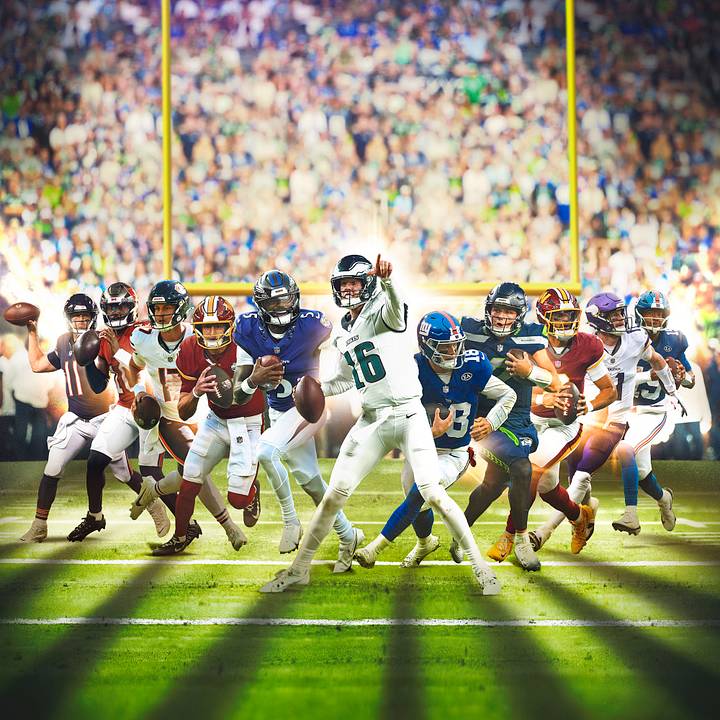
If you enjoyed this piece of football theater—complete with a Kevin Costner–esque moment where Kaliakmanis told himself before he walked on the field that he wasn’t sure he’d ever get this chance again and to “cut it loose”—you’re in luck. This is the Year of the NFL Backup. Kaliakmanis was the 52nd quarterback to take a snap in 2026—and that was only Week 4. The following week, the NFL saw its 41st different starting QB of the season, one below the non-strike year record for the opening five weeks of the season. Through 10 weeks of the season, 50 different starting quarterbacks have taken the field. With Drake Maye’s injury, that number will increase again next week. This comes on the heels of four teams keeping four quarterbacks on their initial 53-man rosters (plus the Browns stashed a fourth QB on injured reserve). They were seemingly aware of the increased chance that some or all might need to play or become valuable trade assets to other teams facing an inevitable shortfall.
The backup quarterback is a fascinating weather vane for the NFL, pointing both to where the league is headed and where it came from. No one has figured out yet how to keep starters healthy. Practice time is more condensed than ever. Collegiate schemes remain mostly incongruent with modern NFL offenses, especially as more pro teams push quarterbacks out of the shotgun to take more snaps under center. It all leaves teams grasping for ways to get more backups ready to play. (Yes, that includes artificial intelligence.) It has also brought to the forefront the efficacy of strategies employed by people like former Packers general manager Ron Wolf, who believed in taking a QB every year in the draft regardless of how his starter was performing, and the Shanahan family: Mike selected Robert Griffin III and Kirk Cousins in the same draft for Washington in 2012; Kyle picked Trey Lance and Brock Purdy in consecutive seasons starting in 2021.
Peyton Manning’s legendary offensive coordinator Tom Moore once said that he didn’t give his backups many reps because “if [Peyton] goes down, we’re f-----. And we don’t practice f-----.” A quarter century later, f----- seems to be the default operating mode for more than half of the NFL every single season.
“Gone are the days of, oh, well, the backup quarterback is in there, it’s O.K. if they don’t win,” says Vikings coach Kevin O’Connell, whose team is tied for the league high with nine starting quarterbacks since 2023, and brought one of them, Kirk Cousins, back to Minnesota at the trade deadline. “The expectation is you’re going to be asked to go in there, do your job and help the team win.”

The rise of the backup quarterback is, like many major societal changes, partially rooted in a dense legal document that this generation’s forebears signed and would likely not be around to see the consequences of.
Brian Hoyer, who played for eight teams between 2009 and 2023, remembers being with Patriots offensive coordinator Josh McDaniels after a new CBA was announced in 2020. Hoyer thought McDaniels was being hyperbolic when he said, “The quality of football is about to go drastically down because of this.” Hoyer now points to that moment as a sea change in the way quarterbacks could be developed in the NFL and the genesis of some alarming statistical trends.
The CBA cleared a path forward for the NFL to expand the regular season to 17 games; there are now 60 more minutes in which a quarterback can get hurt. But the labor deal’s biggest impact on QBs might be the limits it places on their preparation time. There is a hard 2½-hour cap on certain practices during training camp; a mandatory five-day ramp-up period at the beginning of camp that eliminates opportunities for more substantive workouts; and a rule that prevents players from being in the facility for more than 11 hours a day during the preseason. Already in place were dense restrictions when it came to on-field work immediately before and after the draft. Some coaches have taken to canceling some of the non-helmeted, non-padded practices altogether because of their potential for soft tissue injury versus their relative uselessness as teaching tools.
These handcuffs make it more difficult to get QBs up to speed and to prepare them to run offenses the way McDaniels and his longtime quarterback Tom Brady did. The same can be said for the offenses piloted by Manning and Aaron Rodgers which, while different schematically, also asked the quarterback to possess a wealth of information before the snap and have, to a high degree of certainty, an idea of where the ball would be thrown based on several indicators. If the throw isn’t there, the QB checks down to a running back or tosses the ball away. It’s a quick decision.
Some quarterbacks, like Rodgers for example, have been notoriously resistant to more en vogue offenses run by the likes of Kyle Shanahan which ask the QB to sacrifice some presnap autonomy and work through prescribed progressions after the ball is snapped. This approach can keep the ball in the quarterback’s hand longer, increasing the risk of hits in the pocket. The advantage, of course, is that the marriage of the run and the pass game more effectively disarms modern defenses with a mixture of presnap motion and run action, helping a quarterback undress looks that have become increasingly amoebic. Over his 23 NFL seasons Brady missed significant time due to injury in only one year. The offense he ran, far more than his penchant for healthy fats and vegetables, helped keep him healthy.
Being a presnap quarterback is also more difficult in this era, thanks to the rise of blitz-heavy defenses and more chaotic-looking fronts and what coaches estimate is a much higher volume of coverages that defensive coordinators play as opposed to a decade ago. (Brady occasionally struggled against Rex Ryan’s Jets defense, which is an ideological grandparent to the types of schemes we see more of today.) But one cost of moving away from presnap offenses is obvious. Modern QBs are more likely to hold onto the football longer, or use their legs to try to extend plays when the look they are waiting for doesn’t materialize.
According to Pro Football Focus data, the average snap-to-throw time in the NFL has risen steadily every single season from 2020 onward. Quarterbacks went from taking 2.7 seconds on average to throw the ball to a high of 2.86 seconds last season. (Presnap era quarterbacks, like Rodgers and current Bengals backup Joe Flacco, have decreased their snap-to-throw times over that same span.) Coincidentally, since 2020, there has not been a year in which more than 14 Week 1 NFL starters have made it through an entire season. For reference, between 2013 and 2020, the league saw 14 or more healthy starters six of the eight seasons in that sample size. Per data from the football analytics firm Sumer Sports, quarterback hits per 100 dropbacks reached a four-year high in 2025 at 14.58, and through the first six weeks of the 2026 season, defenses were pacing close to a full hit per 100 dropbacks ahead of that average. This, of course, doesn’t count hits on scrambles. Quarterback scrambles are—you guessed it—also at all-time highs in recent seasons. Says one AFC general manager: “Getting rid of the ball when plays break down or getting down as a runner are important qualities that need to be coached.”
Of course, this is easier said than done when college coaches are dealing with historic rates of turnover at the position thanks to limitless transfer opportunities, which means a lack of cohesion and the inability to build on an offense’s complexity year over year. As the position shifts toward more athletic builds and running becomes a more acceptable down-to-down solution for quarterbacks, there is a pipeline of quarterbacks whose instinct is to run first and are rarely in a place long enough to get caught up on the nuances of the position.
“Don’t get me started,” says one former NFL coach with a primary expertise in the quarterback position. “College coaches can’t teach them anything, they’re less prepared when they come into the league and their best chances to play are if they have mobility so they can escape their problems. You’re on bad teams and you’re playing from behind, and in known passing situations the defensive line is better than the offensive line. If you’re down two scores and you have to throw, the coverages get harder, the pass protection gets leaner and you’re going to get smoked.”

As a player, O’Connell, the Vikings’ head coach and former NFL backup, lived for the moments when he’d be watching film and noticed the way a safety lined up differently if he was going to move toward the line of scrimmage after the snap or back into a center-field type of position. It was one of the fastest ways to prove valuable in the quarterback room.
He found those efforts made him more comfortable on game day. What he saw the starters going through on the field was what he understood from his study. It made the prospect of entering a game less daunting.
As a coach, O’Connell structures a system that devotes attention to all the quarterbacks on the roster to help them feel more secure. Minnesota assistant QB coach Jordan Traylor spends time going through the game calls and practice play script with all of the backups, gathering a horde of practice squad players to round out an 11-man outfit suitable for game-like simulation. O’Connell even asks his backups to identify their favorite plays in the game plan and keeps that information in highlighted segments on his call sheet. If a backup has to enter the game, the coach can turn to familiar plays to help the QB establish a rhythm.
Some teams have offices that contain turf atop the carpeting and a projection screen that connects to a virtual reality film database. A 360-degree camera placed behind the starter creates a visual guide for the No. 2 and No. 3 quarterbacks, who can run through all of a game’s plays with a live look at the same defense and progressions the starter saw. The Colts, according to passing game coordinator Alex Tanney, another former NFL backup, send planned play calls and anticipated opponent coverages to a German virtual reality company that incorporates the information into a video game-style simulation in which a QB can go through an entire play script in a stadium identical to wherever the game is being played (down to the placement of the scoreboard and play clocks and the correct opponent uniform). The virtual defense will behave the way the team anticipates based on a wealth of available tracking data and the team’s own knowledge of its coverage and front structures.
“It’s pretty incredible,” Tanney says. “Even our starter [Daniel Jones] takes extra reps on it Friday and Saturday. The only way you get better at playing quarterback is taking reps and that’s really hard to do when you’re not the starter in season. It’s a way to steal reps.”
In Minnesota, O’Connell says the team has been “dabbling in different types of AI technology which we’re pretty excited about” with “layers of study tools that could be generated, there’s layers of tying in the film with the game plan and being able to get some extra reps that way.” Several experts in the sports artificial intelligence field say there is a budding arms race to use AI in similar ways, though efforts are fiercely guarded and proprietary to a team’s own language and terminology. Kollin Kincaid, who runs an AI-football startup called Athletic Dynamic Intelligence, says even some high school teams have 24-hour localized AI running on servers. He half-jokingly suggests that one day NFL teams could have their own data centers.
Anything, it seems, to support the four-dimensional mental gymnastics required of one of the most unusual jobs in sports. Backup quarterbacks are asked during the week to mimic the opposing starter for the scout team while also preparing as if they are the starter of their own team, only to be told seconds before they hit the field to simply be themselves. During film sessions, coaches ask the room to identify the coverage and the corresponding play concept but prevent the starter from answering. Their assistants’ assistants will show up in the black pre-dawn to meet with anyone who would like to walk through the call sheet one last time.
For Hoyer, it never quite eliminated the dull stomachache and his tendency to crane his neck toward the field every time the starter went down. For O’Connell and Kaliakmanis, everything is just tools to trick yourself into believing you’re still the starter.
“You never know,” Kaliakmanis says. “You are truly one play away.”
On a recent Thursday, Ravens quarterback Tyler “Snoop” Huntley was walking out of a Fox broadcast meeting not quite sure if he or an injured Lamar Jackson would be starting on Sunday. It was an hour after the news broke that the Eagles had discovered superficial blood clots in the leg of starter Jalen Hurts, who would cede duties to Tanner McKee. The same day that Caleb Williams told reporters he wasn’t sure if his hamstring injury would allow him to return, or if Case Keenum and Tyson Bagent would handle the gig for the Bears. In two weeks, Huntley would sustain a turf toe injury, knocking him out for the remainder of the season. Joe Fagnano, undrafted out of UConn, was Baltimore’s first option to spell Huntley. The Ravens (Jacoby Brissett) and Vikings (Cousins) would both end up trading for new starters at the deadline. Brissett, before replacing Huntley in Baltimore, was benched for Gardner Minshew II. Minshew, in his first full start of the season, tore his UCL two quarters into a Cardinals game, then was spelled by rookie Carson Beck.
Huntley said his process over seven years—more than 30 appearances, never more than five starts in a season—is one of comfortable simplicity. He sits alone in his “man cave,” hearing himself call the plays. He finds the VR misleading, and prefers his iPad, his notes and extra game film.
He says he once played in a cold game against the Browns in which he didn’t warm up, forever changing his concept of readiness. After so many unexpected playing opportunities, they stop becoming little Hollywood movies, you know. And Huntley, moving coolly onto the next phase of his day without much idea of what the future would hold, had more than made peace with that reality.
“Just try and stay ready,” he says.
 Add us as a preferred source on Google

Conor Orr is a Senior Writer for Sports Illustrated with more than 15 years of experience covering the NFL. His work has been cited in Best American Sportswriting and has won a PFWAA award. Prior to Sports Illustrated, he covered both the Giants and Jets for The Star-Ledger. Conor lives in New Jersey with his amazing wife and three children.
Follow author