%20%20--%3E%0A%3Csvg%20version%3D%221.1%22%20id%3D%22Layer_1%22%20xmlns%3D%22http%3A%2F%2Fwww.w3.org%2F2000%2Fsvg%22%20xmlns%3Axlink%3D%22http%3A%2F%2Fwww.w3.org%2F1999%2Fxlink%22%20x%3D%220px%22%20y%3D%220px%22%0A%09%20width%3D%2239px%22%20height%3D%2240px%22%20viewBox%3D%220%200%2039%2040%22%20enable-background%3D%22new%200%200%2039%2040%22%20xml%3Aspace%3D%22preserve%22%3E%0A%3Cpath%20fill%3D%22%23FFFFFF%22%20d%3D%22M38.5%2C7H28.2v26h10.3V7z%22%2F%3E%0A%3Cpath%20fill-rule%3D%22evenodd%22%20clip-rule%3D%22evenodd%22%20fill%3D%22%23FFFFFF%22%20d%3D%22M26.1%2C25.5c0%2C5.8-4.1%2C7.5-12.9%2C7.5C3.9%2C33%2C0%2C31.2%2C0%2C25.2v-1.1h11.6%0A%09v2.4c0%2C0.7%2C0.1%2C1.4%2C1.2%2C1.4c1%2C0%2C1.2-0.4%2C1.2-1.3v-0.9c0-1.6-0.9-1.6-3.5-2.2C2.2%2C21.7%2C0%2C19.7%2C0%2C15.3v-0.9C0%2C9.3%2C5.5%2C7%2C12.9%2C7%0A%09c10.2%2C0%2C12.8%2C2.6%2C12.8%2C7.4v1.8h-11v-2.9c0-0.6-0.4-1.1-1.2-1.1c-0.6%2C0-1.2%2C0.4-1.2%2C1.1v0.9c0%2C1.5%2C0.9%2C2%2C3.3%2C2.5%0A%09c8%2C1.6%2C10.5%2C3.3%2C10.5%2C7.5V25.5z%22%2F%3E%0A%3C%2Fsvg%3E%0A)
Inside the Kirk Cousins Trade, and How the Vikings and Raiders Both Won
In this story:
With less than a week left until the NFL trade deadline, Kirk Cousins was second in the NFL in touchdown passes last week, third in yards and seventh in passer rating. The Raiders were 4–4, coming off their first win in over a month. No. 1 pick Fernando Mendoza’s development was accelerating. The whole situation was complicated.
So the 15-year vet called his agent, Mike McCartney, to ask, “Am I getting traded?”
McCartney said it was possible, but unlikely. Cousins said he wanted to make it clear that he wasn’t looking to be traded. He liked playing for Klint Kubiak, who he’d been with in Minnesota from 2019 to ’21. He liked the organization and being a team leader in a ground-up program build. He added that he knew Mendoza would get a call eventually because, he said to McCartney, he’s ready. Then, Cousins said, “If I get traded, I prefer Minnesota.”
Days later, his preferred destination in a trade became reality.
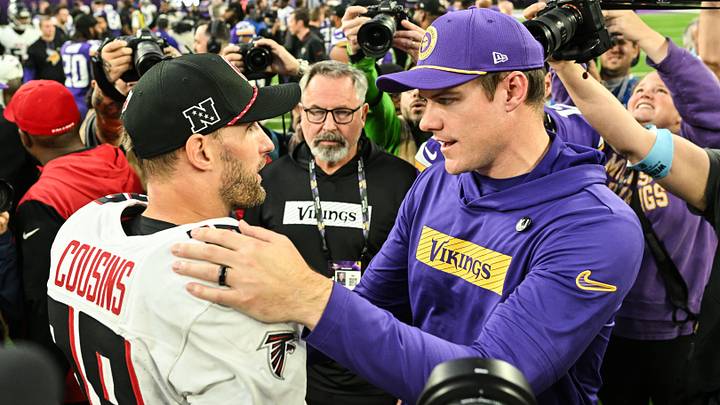
Cousins is a Viking again, some 32 months after departing for Atlanta in free agency in March 2024. The Raiders traded the quarterback to Minnesota on Tuesday, just before the deadline, for a third-round pick, clearing the way for Mendoza to become their starter, and for Cousins to pursue a championship in a very familiar place.
How it came to be is the result of two organizations in very different places, a frenzied amount of communication as those teams came down to the wire at 4 p.m. ET Tuesday (3 p.m. in Minneapolis, 1 p.m. in Vegas), and weeks of preparation on both ends toward what Raiders GM John Spytek and Vikings GM Nolan Teasley wound up agreeing to.
For the Vikings, it started with their new front office doing a mountain of research ahead of the deadline, all of which resulted in a singular, momentous acquisition.
Teasley, EVP of football operations Rob Brzezinski and advisor Ryan Pace worked over the top, with assistant GMs Trent Kirchner and Andrew Healy, Teasley hires from the spring, captaining the scouting and football quantitative methods efforts, respectively. They used artificial intelligence to organize likely trade candidates, based on teams’ performance and depth charts. Like most teams, honed in on positions of need—running back, interior offensive line, interior defensive line—and made exploratory calls to every other NFL team.
As the season evolved, it became clear that the Vikings had a defense that was playing at a borderline historic level, and enough talent on offense to make a real run. The larger question became what to do at quarterback.
Meanwhile, the Raiders started 3–0, then lost four straight before beating the Jets on Nov. 1. They’d gotten trade calls, and Spytek and his staff tried to keep a realistic view of where the team was after the sugar high of September. They’d played four good teams in October, all of whom had made conference championship games within the past two years, and competed hard, but lost to all of them. Cousins was playing well, and he was the reason they were in those games. Yet, it was getting harder to deny that Mendoza was ready to play.
Which put the Raiders in an awkward spot, with the proverbial good problem to have.

Raiders didn’t want to trade Cousins
No one in Vegas was looking to move Cousins. Making the playoffs for the first time in five years would be great for Kubiak’s program, of course, and a great reward for loyal veterans like Maxx Crosby and Kolton Miller, and Cousins would certainly help give those guys the best chance to chase that. But increasingly, it looked like Mendoza could, too.
Then, late in the Vikings’ first loss of the year, as the Raiders beat the Jets, Kyler Murray pulled up with a grade 2 hamstring strain, adding another layer of uncertainty and furthering the conversation internally in Minnesota on pursuing a quarterback.
What made the situation even more complex was that the Vikings were playing Monday night, leaving the team less than 24 hours to react to how things played out against Buffalo. Backup Carson Wentz, for his part, had a fantastic week of practice—and the Vikings were legitimately excited to see him play against the Bills. Still, as Teasley and O’Connell talked through it, they knew they needed to cover themselves, just in case.
So Teasley called the Raiders about Cousins on Monday, before the Vikings’ game, to gauge their interest in trading the quarterback. By then, Minnesota had identified Cousins, through all that research, as the clear best trade option at the position.
Meshing the scouts’ and coaches’ analysis, they saw Cousins as still possessing a live arm and deadly accuracy and having returned to the baseline of athleticism he set before tearing his Achilles in 2024, evidenced on tape in the keeper game that’s essential to Kubiak’s scheme. The Vikings’ analytics guys, meanwhile, put together the historical market for such a player and the objective data on how Cousins was playing, to set a value on him, even though it wasn’t yet time to make an offer.
Spytek told Teasley, flatly, that he wasn’t looking to trade his starting quarterback, and that, “You’ll have to make us an offer that moves us.” Teasley then told Spytek that the Vikings wanted first to see how the Bills game went first, and they’d be in touch.
The Vikings lost 23-6, gaining just 178 yards and nine first downs on offense. It wasn’t all the fault of Wentz, who was 8-of-25 for 81 yards and two picks. But Minnesota was caught off-guard by the offense’s performance. And with Murray’s injury murky—a hamstring can be especially problematic for a quarterback who plays the way Murray does—and the deadline looming, Minnesota had to make a decision, one way or the other.
Teasley and O’Connell didn’t wait until Tuesday to discuss it. They dove right in after the game. By morning, O’Connell had doubled back over Cousins’s tape. It was time.

Raiders left trade decision in Cousins’s hands
The Vikings had inquired, through their rounds of calls, about a wide range of quarterbacks. They discussed bringing back Daniel Jones, and they did reach out to the 49ers on Mac Jones. But by the time Teasley texted Spytek at 8 a.m. in Minneapolis, 6 a.m. in Vegas, it was clear Cousins was their best option—and their deadline target.
The Vikings initially put a fifth-rounder on the table that could become a third. The Raiders balked, wanting a hard third-rounder, knowing Minnesota had its own and one it acquired from the Eagles for Jonathan Greenard. The GMs traded calls and texts.
The Vikings moved toward Vegas, knowing the opportunity that was in front of them with the defense they had, and the Raiders agreed to take Minnesota’s slotted third-rounder, rather than Philly’s pick, which figures to be the higher of the two. The Vikings agreed to take on the $10 million roster bonus Cousins is due in March. The return for the Raiders, in the end, wound up being the second-highest for a quarterback in-season over the past decade—with only the Patriots having gotten more for Jimmy Garoppolo in 2017.
And that left the human part of it.
Spytek called Cousins to tell him that the sides had agreed to compensation, but out of respect for what the quarterback had done for the Raiders, “If you don’t want this, we won’t do it.” Cousins asked if he could talk to the Vikings. Spytek gave the Vikings permission to reach out to the quarterback. O’Connell did.
The two had spoken earlier in the year, as Cousins became available in the offseason and was looking for a new home. Both knew, months later, there were things everyone had to work through—after all both sides had been through with one another.
So the coach and his old quarterback talked. They reminisced about the year they spent together in Washington in 2017, when O’Connell came in under Jay Gruden, and O’Connell’s first two years in Minnesota. They remembered all the momentum Cousins and the team had before he blew out his Achilles in 2023. They went through the breakup that led to Cousins signing with the Falcons. They discussed what Cousins was doing in Vegas compared to what he’d do in Minnesota, and how they’d handle the next steps.
It was a good, real conversation that lasted almost an hour, even with the clock ticking on getting the trade done. By the end, both were excited about what was next.
Cousins called the Raiders to give them the go-ahead. O’Connell called Murray to tell him.
The 38-year-old quarterback, three years younger than his new/old coach, had moved his family to Vegas. He’d invested in helping Kubiak build a program, and Mendoza build a career. And by 11 p.m. CT, hours after that call wrapped up, he’d be back on the ground in the city he’d left, he thought, for good, nearly three years ago.

Vikings, Raiders both came out winners
Wednesday morning, Cousins arrived at the Vikings’ facility to work one-on-one with O’Connell, and get caught up on where his new team had been through nine weeks, and where it was going.
To say he wouldn’t have expected to be sitting there a week ago was an understatement.
But somehow, through all this work, so many people came out winners.
The Vikings had an accomplished, four-time Pro Bowler coming at the game’s most important position, one who’s demonstrated he can run O’Connell’s system over and over again, with the ability to elevate other players, like Justin Jefferson and Jordan Addison, who were maximized in that scheme when he was the quarterback.
The Raiders, meanwhile, got seven months of Cousins for less than $1 million, which gave them a mentor and the patience to develop Mendoza, and a program leader for Kubiak through his first nine games. They didn’t need to go through an awkward, undeserved benching to give Mendoza his shot. And they got a third-round pick at a point in their rebuild when they need as many picks as they can get.
As for Cousins, he gets the chance to compete for a Super Bowl, with an elite defense, and play in a system with players that made him a Pro Bowler under O’Connell in 2022.
In a way, everyone got a happy ending after a whirlwind few days.
And now, the rest of us get to see how long the feeling lasts for all of them.
 Add us as a preferred source on Google

Albert Breer is a senior writer covering the NFL for Sports Illustrated, delivering the biggest stories and breaking news from across the league. He has been on the NFL beat since 2005 and joined SI in 2016. Breer began his career covering the New England Patriots for the MetroWest Daily News and the Boston Herald from 2005 to ’07, then covered the Dallas Cowboys for the Dallas Morning News from 2007 to ’08. He worked for The Sporting News from 2008 to ’09 before returning to Massachusetts as The Boston Globe’s national NFL writer in 2009. From 2010 to 2016, Breer served as a national reporter for NFL Network. In addition to his work at Sports Illustrated, Breer regularly appears on NBC Sports Boston, 98.5 The Sports Hub in Boston, FS1 with Colin Cowherd, The Rich Eisen Show and The Dan Patrick Show. A 2002 graduate of Ohio State, Breer lives near Boston with his wife, a cardiac ICU nurse at Boston Children’s Hospital, and their three children.
Follow AlbertBreer