
Less Mobile Caleb Williams Faces Seahawks and How Bears Benefit
In this story:
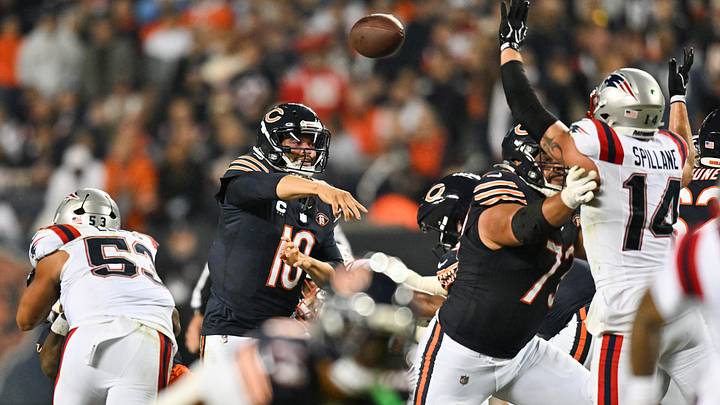
The Bears coaching staff has continued walking the tight rope all year.
It's a constant battle between keeping quarterback Caleb Williams in the pocket or being so restrictive with his movement that they impede one of his greatest weapons — mobility.
It's possible the hamstring injury he had actually helped their cause and benefited the offense.
Williams has seemed to do a better job of staying with the pass play the last two weeks since returning from injury, according to what's been clocked on his time to throw. The question is whether this can continue against Seattle's Super Bowl champion defense on Monday night. It's possible there is irony at work here and that is his hamstring actually helping his game by keeping him from excessive and hasty running. Both Williams and coach Ben Johnson sees it as something else, though.
Caleb Williams supporting a children ran lemonade stand in Madison Wisconsin before the USC Wisconsin game this past Saturday pic.twitter.com/r5FkEMpDG9
— Imaad (@someonesaveusc) October 29, 2026
Another possible reason
Bears coach Ben Johnson doesn't necessarily see it as the injury helping them and identified another reason.
“It's the same story that it's been for the last year and a half," Johnson said. "He's got a lot of time-on-task with some of these (offensive) concepts. Certainly, there's some things in each game plan that are a little bit unique for that particular defense, but we try to keep it consistent to where all these banked reps and the things that he's seen each play against coverage-wise.
"It does accelerate his ability to go through a progression and check the ball down if primary or No. 2's not there. We talk every week. We watch the tape, and we're looking at it. Were we able to stay in the pocket just a tick longer and deliver the ball, or did we need to break it there? Those are things that we have a good back-and-forth on because we've been pretty consistent as a coaching staff."
I owe you honesty. Chicago would be my pick to come out of the NFC today. Can’t apologize for it.
— Marc Ryan (@MarcRyanOnAir) October 23, 2026
Ben Johnson is in his bag, and Caleb Williams may be the most talented QB in the conference. I just lost likability points, didn’t I? pic.twitter.com/ekMBq5kqGi
Johnson does realize the benefits of a mobile QB at this point, even if it sometimes doesn't allow plays to be run the way he'd like.
"We don't want to take that magic out of his play whatsoever, and yet I do think you're seeing just a tick more of him playing on-time and on-rhythm, and I think that allows our pass catchers to come alive also," Johnson said. "We've got some dangerous weapons for him, but I think he's doing a good job finding those open guys right now."
The difference hasn't been huge and Williams is at 3.22 seconds to throw now, according to NFL NextGen Stats. That's slow but still down from earlier this season.
The Seattle Seahawks Defense just SHUT DOWN Patrick Mahomes and Kenneth Walker - completely dominating this offense.
— Swift Sports Network (@SwiftyNetwork) October 26, 2026
This will be the biggest test of Caleb Williams and Ben Johnsons young careers. BIG TIME GAME COMING pic.twitter.com/gk8gStMJBK
Maybe the greatest proof of benefits from getting the ball out for Williams is how yards after catch on throws have gone up from 5.6 last year to 6.4 this year. His percentage of on-target throws have increased dramatically from 69.8% to 79.6% per Pro Football Reference. It suggests he's throwing from a stationary position more often than trying to throw on the move outside the pocket.
Williams isn't so sure the hamstring has bottled up him in the pocket. He's just crediting teammates for making his job easier and letting him avoid running as much.
Caleb Williams is playing out of his mind this year and we all saw that last night. We’ve always seen the flashes with Caleb, but there’s been so much inconsistency. That is not the case this year. He is displaying elite QB play drive to drive. Top 5 QB in the NFL soon. pic.twitter.com/eZrMX3ffHq
— Jason Lewis (@Jasonlewis54) October 23, 2026
Is pass blocking worse?
Better blocking lets him stay put and get it away to receivers.
"I've felt good after our games," he said. "Obviously, I haven't maybe moved as much, so shout out to the O-line and running backs and everybody for blocking; wide receivers getting open.
"I haven't had to move as much, but I mean I've felt good moving and so these past couple days (off) have been nice, but glad to be getting back into it.”
The number of sacks Williams absorbed this year has been greater than last year through seven games, but this doesn't necessarily say his pass blocking is worse. He played in four of the seven games and has taken 12 sacks. He didn't reach the 12th sack taken until the seventh game in 2025.
This can indicate more willingness to stay with the pass play and throw from the pocket instead of getting out and running at first sign of pressure.
The bottom line has been bigger plays downfield. Averaging a career-best 8.2 yards per pass attempt puts him in elite company. Only Josh Allen (8.8), Drake Maye (8.3) and Brock Purdy (8.3) are averaging more.
It's amazing how much better numbers can look if a quarterback gets the ball in his playmakers' hands instead of his own for whatever reason.
Dan Orlovsky finally admits to being wrong about Jayden Daniel’s over Caleb Williams. 👀 #DaBears #Bears pic.twitter.com/cHrEwiGBje
— Clay Harbor (@clayharbs82) October 23, 2026
 Add us as a preferred source on Google

Gene Chamberlain has covered the Chicago Bears full time as a beat writer since 1994 and prior to this on a part-time basis for 10 years. He covered the Bears as a beat writer for Suburban Chicago Newspapers, the Daily Southtown, Copley News Service and has been a contributor for the Daily Herald, the Associated Press, Bear Report, CBS Sports.com and The Sporting News. He also has worked a prep sports writer for Tribune Newspapers and Sun-Times newspapers.