
Vernon Davis Q&A: Jayden Daniels, Redskins Homecoming and Life After Football
In this story:
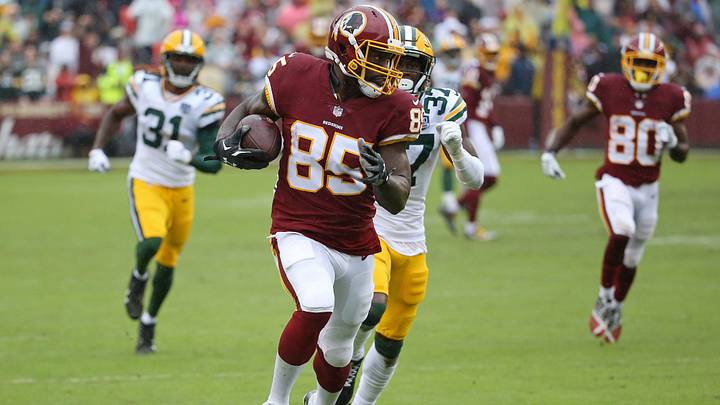
Vernon Davis spent much of his NFL career away from Washington, but that's where his football story began. He grew up in the city, played at Dunbar High School and Maryland, and eventually returned home to finish his career in a Redskins uniform. Between those stops came the sixth overall pick in the 2006 NFL Draft, two Super Bowl appearances, and a championship with Denver.
There is plenty of football to talk about, including how much the tight end position has changed, what Davis sees in Jayden Daniels, and what he learned during his years in Washington. But retirement hasn't exactly slowed him down. These days, Davis is acting, producing films, and pursuing an entirely different kind of career.
In a Q&A interview with Commanders On SI, Davis answered questions about his NFL career, the modern game, his retirement, and his work in Hollywood. Here is the full exchange, organized by topic.
In This Interview
- How the Tight End Position Has Changed
- Vernon Davis on the Commanders and Jayden Daniels
- Washington, the Super Bowl and Lessons From His NFL Career
- Retirement and Life After Football
- Acting, Producing and What Comes Next
How the Tight End Position Has Changed
Philip Hughes: You came into the NFL as the sixth overall pick at a time when taking a tight end that high was unusual. When you watch the position in today's NFL, what has changed the most from the position you entered in 2006?
Vernon Davis: When I came into the league in 2006, the tight end position was still viewed primarily as a guy who could block and make plays in the passing game when his number was called. I was fortunate to come in with the mindset that I could do both, but I also knew I was part of a changing position.
The biggest difference today is how much the tight end has become a featured weapon in an offense. Teams are moving tight ends around the formation, lining them up in the slot, out wide, in the backfield—basically treating them like oversized receivers who can also block. The athleticism at the position has really taken off.
When I watch today’s game, I see tight ends being asked to do things that weren’t as common when I entered the league. They’re creating mismatches against linebackers and safeties, stretching the field vertically and becoming major parts of the passing game. The position has evolved tremendously.
That’s something I’m proud to have been a part of. When I was drafted sixth overall, there was a lot of discussion about whether a tight end should go that high. Today, I think people have a much better understanding of the impact an elite, versatile tight end can have on an offense.
Philip Hughes: Your combination of size and speed was considered unusual when you entered the league. If a 22-year-old Vernon Davis entered the NFL today, how do you think an offensive coordinator would use him differently?
Vernon Davis: I’d be a matchup problem every single week. They’d move me all over the formation and force defenses to decide how they wanted to cover me. If you put a linebacker on me, I’d take advantage of the speed. Put a safety on me, I’d use my size. The goal would be simple: create mismatches and get the ball in my hands.
Philip Hughes: We hear so much now about tight ends being "matchup weapons," but the position still requires players to block defensive ends and linebackers. In your mind, what separates a great receiving tight end from a truly complete tight end?
Vernon Davis: To me, a great tight end is somebody who can catch the ball and make big plays. But a complete tight end is somebody who can do it all. You’ve got to be willing to put your face in there and block a defensive end, block a linebacker, do the dirty work—even when you know you’re not getting the ball. That’s what separates you. You have to be a football player first. If you can block, catch, run and create mismatches, you’re a complete tight end.
Philip Hughes: Which tight ends playing today do you enjoy watching most, and what specifically do you see in their games that you appreciate as someone who played the position?
Vernon Davis: I love watching George Kittle. That guy plays with an attitude. He’s physical, he’ll block, he’ll catch the ball, and when he gets it in his hands, he’s looking to make something happen. I see a lot of the things I loved about playing the position in him.
I also like Trey McBride. He’s got that toughness and versatility you want in a tight end. He’s not just out there trying to catch passes—he’s willing to do the dirty work, too. As a former tight end, that’s what I appreciate. I like watching guys who play the position like football players, not just big receivers.
Philip Hughes: Defenses have become faster and more versatile since you played. Has that made life harder for tight ends, or has the way offenses create mismatches actually made the position more valuable?
Vernon Davis: I think it’s made the tight end more valuable. Defenses are faster and more versatile, but that just creates more opportunities for a tight end who can do it all. If you can run, catch, and block, you’re a problem. Every time you line up, the defense has to make a decision—and that’s where you create the mismatch.
Philip Hughes: From a tight end's perspective, what can the position provide a quarterback that a wide receiver or running back simply can't?
Vernon Davis: I think it’s the versatility. As a tight end, you can help your quarterback in a lot of different ways. You can stay in and block, you can protect him, or you can release and go make a play down the field. And because you’re bigger than a receiver but can still run, you can create some real problems for a defense. When your quarterback knows you can do whatever the play needs, that’s a big advantage.
Vernon Davis on the Commanders and Jayden Daniels
Philip Hughes: Washington currently has different types of tight ends in Chig Okonkwo, John Bates, Ben Sinnott and Colson Yankoff. How valuable is it for an offense to have tight ends with complementary skill sets instead of asking one player to do everything?
Vernon Davis: I think it’s huge. You don’t have to have one guy trying to do everything. You can have a guy who’s really good at blocking, another guy who can go make plays in the passing game, and guys who can do a little bit of both. That gives your offense a lot of flexibility and makes it harder for the defense to know what’s coming. When you have a tight end room like that, everybody has a role, and you can play to each guy’s strengths.
Philip Hughes: Okonkwo is an explosive athlete whose ability after the catch is one of the strengths Washington wants to utilize. When you have a tight end with that kind of speed, what are the best ways to create favorable matchups for him?
Vernon Davis: You’ve just got to find ways to get him in space. Move him around, put him in the slot, motion him, line him up outside—make the defense figure out who’s going to cover him. Once he catches the ball, just let him do what he does. Get it in his hands and let him make a play.
Philip Hughes: Ben Sinnott is now in his third NFL season. Tight end has traditionally been considered one of the more difficult positions to learn. Why can development take longer there, and what tells you that a young tight end is beginning to put everything together?
Vernon Davis: It takes time because you’re really learning two positions at once. You’ve got to learn how to block, how to read defenses, how to run routes, and understand the timing with your quarterback. It’s a lot.
For me, you know a young tight end is putting it together when the game starts slowing down for him. He’s not thinking about every little thing anymore—he’s just playing. He knows his assignment, he’s confident, and he starts making plays without having to think so much. That’s when you know he’s starting to get it.
Philip Hughes: What does playing with two tight ends do to a defense before the snap? From a player's perspective, why can 12 personnel create problems even when neither tight end actually gets the football?
Vernon Davis: When you put two tight ends out there, the defense has to think a little more. They’ve got to figure out what you’re doing—are you blocking, are you releasing, are you going in motion? You’re making them make a decision before the ball is even snapped.
And that’s what makes it tough. We don’t even have to get the ball to have an impact. If we’re blocking, we can open up the run game. If the defense is worried about us catching the ball, that can open things up for the receivers. As a tight end, you want the defense to have to account for you every single play. Even if you don’t touch the ball, you can still change the play.
Philip Hughes: When you watch Jayden Daniels, what stands out to you about him from a tight end's perspective, and what kind of relationship can a quarterback with his skill set develop with the position?
Vernon Davis: Jayden can make things happen when the play breaks down. He can throw it, he can run it, and he can extend plays with his legs. As a tight end, you love playing with a quarterback like that because you know the play is never really over.
You just have to keep working for him. You get a feel for where he’s going to move, where he wants you to get to, and you keep finding ways to get open. When you have that kind of connection with your quarterback, it can make a big difference.
Philip Hughes: People usually judge tight-end involvement by catches and targets. What are some things you would look for on film to determine whether an offense is actually using its tight ends well even when they're not putting up big receiving numbers?
Vernon Davis: I look at the things that don’t show up in the stats. Are you blocking? Are you opening holes? Are you pulling defenders away? You can go a whole game without catching a pass and still have a big impact. That’s the beauty of playing tight end—the film tells the real story.
Washington, the Super Bowl and Lessons From His NFL Career

Philip Hughes: You grew up in Washington, went to Dunbar and Maryland, and then eventually finished your NFL career playing for Washington. What did putting on that uniform mean to you that playing for another franchise couldn't have meant?
Vernon Davis: Washington is home for me. I grew up there. I still live in the area. To have played at Dunbar and Maryland, and then to come back and finish my career in the burgundy and gold—it meant everything. I wasn’t just playing for myself when I put that jersey on—I was playing for my family, my friends, and my community. I played for other teams and had great experiences, but finishing my career at home was something special.
Philip Hughes: You were still producing at a high level well into your 30s. What did you have to change physically or mentally as you got older to remain effective at a position that demands so much from the body?
Vernon Davis: As I got older, I just had to take better care of my body. Recovery became a big part of my routine, and I had to listen to my body and be smart about how I trained.
The mental part was experience. I knew the game, I knew how to prepare, and I knew how to get myself ready to play. You might lose a little physically as you get older, but you gain so much from experience. You learn how to work smarter, not harder.
Philip Hughes: You caught passes from quarterbacks with very different styles over your career — Alex Smith, Colin Kaepernick, Peyton Manning, Kirk Cousins, and others. What did playing with that variety teach you about what a tight end has to do to earn a quarterback's trust?
Vernon Davis: Every quarterback is different, so you’ve got to learn how they play and what they expect from you. But one thing never changes—you have to be dependable. Know your assignment, be where you’re supposed to be and make the play when the ball comes your way.
Quarterbacks trust guys who do their job every time. Once they know they can count on you, they’re going to keep coming back to you.
Philip Hughes: You've written about Mike Singletary's famous 2008 postgame comments as a turning point in your life and career. Looking back now, what did you understand after that moment that the younger Vernon Davis hadn't understood yet?
Vernon Davis: I think I just realized I had to grow up. I had the talent, but I didn’t fully understand what it took to be great every day. Coach Singletary’s words were tough, but they made me look in the mirror. After that, I started focusing less on proving people wrong and more on putting in the work and becoming the best version of myself.
Philip Hughes: You experienced both sides of the Super Bowl — losing one with San Francisco and later winning Super Bowl 50 with Denver. What did winning the championship teach you that you couldn't have understood after losing one?
Vernon Davis: Losing the first one hurt, but winning one taught me how special that moment really is. You spend your whole career chasing that feeling, and when you finally get there, you realize it’s bigger than the game. It’s about the people you went through it with, the sacrifices, and knowing you did it together. That’s something you can’t really understand until you’ve experienced it.
Philip Hughes: Your years in Washington included coaching changes, quarterback changes, and plenty of organizational uncertainty. What did that period teach you about the difference between having talented players and actually building a winning culture?
Vernon Davis: Having talent is one thing, but you have to have everybody pulling in the same direction. In Washington, I saw how much coaching, leadership, and consistency matter. You can have great players, but if everybody isn’t bought in and holding each other accountable, it’s hard to win. A winning culture starts with the people and the mindset, not just the talent.
Retirement and Life After Football
Philip Hughes: Your final NFL season ended after a concussion, and you announced your retirement a few months later. How much did that injury factor into the decision, and when did you know you were genuinely ready to stop playing?
Vernon Davis: The concussion definitely made me think about it, but I’d already been feeling like I was getting close. I had been playing for a long time, and I just felt like my body was telling me it was time. I had nothing left to prove to myself. I gave football everything I had, and once I felt good about that, I knew it was time to move on.
Philip Hughes: Players often say they miss the locker room more than the games after retirement. What was the hardest part of NFL life to replace once football was no longer your everyday routine?
Vernon Davis: Honestly, I missed the guys more than anything. You’re around your teammates every day for so many years, and you build these relationships and go through a lot together. Then one day, you’re not in that locker room anymore. I missed the brotherhood, the laughs, the competition—just being around the guys.
Vernon Davis, Bryant Young and Frank Gore on hand for 49ers-Cowboys pic.twitter.com/ThSwvs1KLy
— David Lombardi (@LombardiHimself) October 8, 2023
Acting, Producing and What Comes Next
Philip Hughes: You had already begun exploring acting before your NFL career was over. When did acting stop being something interesting to try and become something you believed could be your second career?
Vernon Davis: At first, acting was just something I was curious about. I wanted to try something different and see if I could do it. But the more I got into it, the more I enjoyed the process and realized I could really see myself doing this after football. Once I started getting some opportunities and seeing that I could make it work, that’s when I started taking it seriously as my second career.
Philip Hughes: You've played in front of 70,000 people with the outcome of a game riding on a play. How does the pressure of performing on a movie set compare with the pressure you felt on an NFL field?
Vernon Davis: Football was definitely a different kind of pressure. You’ve got all those people watching, your teammates depending on you, and sometimes everything comes down to one play. With acting, you have a little more room to make mistakes and figure it out. I think football just taught me not to panic when things get intense.
Philip Hughes: You've moved beyond acting into producing and developing your own projects. What kinds of stories do you want to tell when you have some control over the project rather than simply being handed a character to play?
Vernon Davis: I want to tell stories about people who have had to fight for something. I know what it’s like to have a dream, have people doubt you, and still keep working until you get there. So, I’m interested in stories about overcoming adversity, second chances, and people finding their way. If I have the opportunity to help create a project, I want it to be something that means something to me and hopefully makes people feel something too.
One of my latest projects is Diamond, a coming-of age short film that follows 17-year-old basketball phenom fighting to escape the cycle of trauma threatening to consume his future. With his father behind bars and his mother spiraling deeper into heroin addiction, the young man shoulders the weight of a broken home while clinging to the hope of a Division I scholarship.
I’m particularly proud of this film because I not only starred in it, but also executive produced it. And it’s now making waves on the 2026 film festival circuit and picking up major recognition along the way.
With additional festival opportunities ahead, the team and I are seeking a wider streaming release for the film across the country.

Philip Hughes: You've said your goal is to appear in hundreds of films — even mentioning 400 as a target. Is that still the goal, and when you picture the acting career you ultimately want to have, what would make you feel like you truly succeeded at this the way you succeeded in football?
Vernon Davis: Yeah, that’s still a goal. I know that sounds like a big number, but I’m competitive, and when I put my mind to something, I want to see how far I can take it. But for me, success isn’t just about how many movies I’m in. I want to build a body of work that I’m proud of, keep getting better, and have people see me as an actor who earned his place. That’s what I did in football—I worked, I stayed consistent, and I proved to myself that I belonged. I want to do the same thing with acting.
Follow us on Facebook for the latest Washington Commanders news, injury updates, analysis, and more from Commanders on SI.
 Add us as a preferred source on Google

Philip Hughes covers the Washington Commanders with a focus on daily news, film analysis, roster construction, player development, and the fan culture surrounding one of the NFL’s most scrutinized teams. A longtime sports writer and content creator, Hughes has spent more than 20 years building football audiences across the interwebs and following the daily beat of the NFC East. email: hailbng+si@gmail.com
Follow NFLFanzone