%20%20--%3E%0A%3Csvg%20version%3D%221.1%22%20id%3D%22Layer_1%22%20xmlns%3D%22http%3A%2F%2Fwww.w3.org%2F2000%2Fsvg%22%20xmlns%3Axlink%3D%22http%3A%2F%2Fwww.w3.org%2F1999%2Fxlink%22%20x%3D%220px%22%20y%3D%220px%22%0A%09%20width%3D%2239px%22%20height%3D%2240px%22%20viewBox%3D%220%200%2039%2040%22%20enable-background%3D%22new%200%200%2039%2040%22%20xml%3Aspace%3D%22preserve%22%3E%0A%3Cpath%20fill%3D%22%23FFFFFF%22%20d%3D%22M38.5%2C7H28.2v26h10.3V7z%22%2F%3E%0A%3Cpath%20fill-rule%3D%22evenodd%22%20clip-rule%3D%22evenodd%22%20fill%3D%22%23FFFFFF%22%20d%3D%22M26.1%2C25.5c0%2C5.8-4.1%2C7.5-12.9%2C7.5C3.9%2C33%2C0%2C31.2%2C0%2C25.2v-1.1h11.6%0A%09v2.4c0%2C0.7%2C0.1%2C1.4%2C1.2%2C1.4c1%2C0%2C1.2-0.4%2C1.2-1.3v-0.9c0-1.6-0.9-1.6-3.5-2.2C2.2%2C21.7%2C0%2C19.7%2C0%2C15.3v-0.9C0%2C9.3%2C5.5%2C7%2C12.9%2C7%0A%09c10.2%2C0%2C12.8%2C2.6%2C12.8%2C7.4v1.8h-11v-2.9c0-0.6-0.4-1.1-1.2-1.1c-0.6%2C0-1.2%2C0.4-1.2%2C1.1v0.9c0%2C1.5%2C0.9%2C2%2C3.3%2C2.5%0A%09c8%2C1.6%2C10.5%2C3.3%2C10.5%2C7.5V25.5z%22%2F%3E%0A%3C%2Fsvg%3E%0A)
Albert Breer’s Takeaways: How the Dexter Lawrence II Trade Came Together
In this story:
We cover a lot of ground on the draft in my annual team draft column, which comes out later today, but now it’s time for my Monday takeaways …
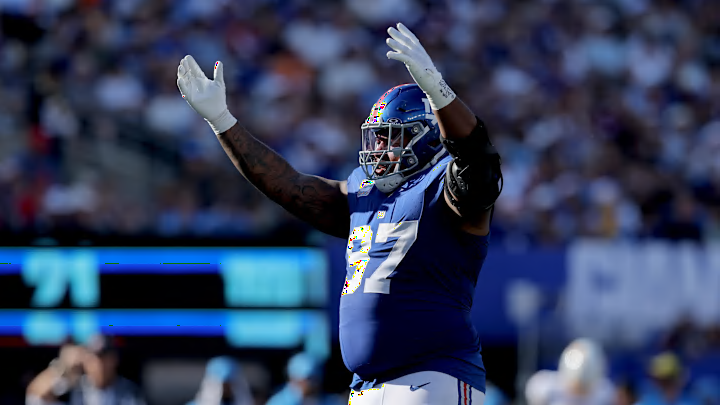
Dexter Lawrence II trade
The Giants tried to find middle ground with Dexter Lawrence II, and the timeline for this weekend’s blockbuster trade shows it. The Bengals didn’t just put the 10th pick in the draft on the table. It had, in fact, been there for about a week when the deal was consummated. And that’s because, even with that sort of pick offered, they wanted to keep their star defensive tackle, who had been at odds with the team over his contract for more than a year.
So New York, behind GM Joe Schoen and new head coach John Harbaugh, took that final run at keeping Lawrence. Only when that failed did the Giants go ahead with the deal.
That’s why I get this move for both parties.
For the Giants, it’s pretty simple. The last time a team gave up a top-10 pick clean (without givebacks) for a veteran player was 21 years ago—when the Vikings moved Randy Moss to the Raiders for the seventh pick in that April’s draft, a seventh-rounder and linebacker Napoleon Harris. Simply put, this sort of offer for a vet isn’t normal. On the flip side, the Giants’ hesitancy in accepting the deal shows how much value the Bengals are getting here.
With that as the backdrop, here’s a little more on how the deal went down.
• Lawrence’s camp, led by agent Joel Segal, first raised issues with his contract at the 2025 combine. It was following the big man’s career year—he was squarely in the running for Defensive Player of the Year, despite the team’s struggles, until suffering a season-ending elbow injury in December 2024. The Giants wouldn’t budge on altogether reworking his deal and told his camp the reason why is due to the precedent doing that with three years left would set with other players. Yet they were open to finding middle ground.
• That kind of compromise was reached just before training camp in July, with the Giants giving Lawrence $3 million in achievable incentives. Lawrence, in a down year, wound up getting $1 million of them on top of his $17 million base pay. And with his guarantees up after 2025, the Giants knew full well Lawrence would be back at the table in 2026.
• Lawrence’s camp approached the Giants later in 2026 compared to last offseason; it was after the first week of free agency, with a lot of the cash and cap budget spent as Schoen and Harbaugh worked to reshape the roster. That led to some frustration on the team side, but work began toward finding a solution.
• News of Lawrence’s trade request broke, via ESPN’s Adam Schefter, on April 6. The Bengals engaged the Giants the next day, with an agreement that the two would continue to work on terms as New York worked to rectify the problems Lawrence had, as frustration grew on his end on the difficulty he had getting a market correction on the deal he did in 2023.
• The Bengals, as they discussed the deal, looked at what they’d get with the 10th pick, likely someone such as Ohio State S Caleb Downs or LSU CB Mansoor Delane if they were fortunate enough to have one of those two fall to them. And they determined what the likelihood was they’d be picking someone that they had a mid-to-late first-round grade on at No. 10, based on the makeup of the draft class. It’s a sentiment I’ve heard from other teams, too, in the aftermath of the deal. “There’s nobody of [Lawrence’s] talent in this year’s draft,” said one rival GM. “I would take him over every defensive player in this draft.” Which, ultimately, explains why, by the end of that week, they’d wind up offering that pick clean to the Giants for him.
• Cincinnati also did some digging on Lawrence, calling around to old Giants coaches to put together more on the sort of player they’d get—and knowing they had some of Lawrence’s guys from New York (B.J. Hill) and Clemson (Tee Higgins, Myles Murphy) already on their roster. They also saw the opportunity to turn their defensive tackle group, which was a weakness in 2025, into one of the league’s best, with Lawrence and Hill as starters, Jonathan Allen as the third guy, T.J. Slaton Jr. as their fourth and former second-rounder Kris Jenkins Jr. fifth.
• Another element here was the demonstrated history of defensive tackles performing at a high level deep into their careers—with Aaron Donald a dominating force through 10 seasons and past his 32nd birthday, and Chris Jones still a guy who wrecks offenses’ game plans around 10 years in and approaching his 32nd birthday. Lawrence, a guy who routinely draws and defeats double teams, is entering his eighth season and doesn’t turn 29 until November.
• All that, of course, is why the Giants continued to work on keeping Lawrence, even after the Bengals offered the 10th pick. By the end of last week, though, it became clear that the sides weren’t close on structure as it related to guarantees.
• So on Saturday at about noon ET, the Giants called the Bengals back and told them that if the offer was still the 10th pick, then they’d have permission to talk with Segal about a contract. The Bengals and Segal had to work around the 12-month rule, which restricts what you can do for a year after restructuring, but ultimately struck a deal that would add a year and $28 million to the two years and $42 million remaining on Lawrence’s 2023 deal (making his contract with the Bengals, effectively, a three-year, $70 million deal).
• At 6:30 p.m. on Saturday, with the coaches fully on board, the Bengals’ front office called the Giants to tell them that a deal had been reached with Segal, and to send over the paperwork to be signed. Once it was, Cincinnati called Lawrence to give him the news, and soon enough Murphy, Hill and Higgins were among those sending celebratory texts to the Bengals’ brass. Hill, in fact, wound up hopping on the plane with Lawrence (they live 40 minutes apart) to come to Cincinnati on Sunday.
And thus, the second big swing of draft season—if you’re counting the Broncos dealing for Jaylen Waddle as the first—was taken. For now, for all the reasons above, it really does make sense for both sides. We’ll see if that’s still the case two or three years from now.
First-round trades
If there’s something that really moves the needle in the first round this year from a trade standpoint, I think it’s how the tackles come off the board. I think there’s a better chance than not that seven tackles will be selected in the first round: Miami’s Francis Mauigoa, Utah’s Spencer Fano and Caleb Lomu, Alabama’s Kadyn Proctor, Georgia’s Monroe Freeling, Clemson’s Blake Miller and Arizona State’s Max Iheanachor. After those guys are gone, it feels like the league consensus is that the dropoff is pretty significant.
With so many teams having a need at the position, and the position being of such great value, my guess is that the well running dry could provoke some movement.
The alley of picks where it could happen, as I see it anyway, is Baltimore at 14, Detroit at 17, Carolina at 19, Pittsburgh at 21, Phiadelphia at 23, Cleveland at 24 and Chicago at 25. If, say, after 13 picks, Mauigoa and Fano are gone and the five others are left, and you have these seven teams looming as potential suitors, it’s possible we’ll see a little game of leapfrog going.
And teams like the Buccaneers (No. 15) and Jets (No. 16) could be beneficiaries of that.
CB Jermod McCoy
If there’s one player who might tumble, I think it’s Tennessee CB Jermod McCoy. And I feel terrible for him, because this one is beyond his control—and I said a week ago I think he has a chance to go in the top 10. Since then, every team I’ve talked to—every last one of them—has said that the knee he tore up in January 2025 remains a major concern.
Without getting into all the ins and outs of the medicals, the question isn’t whether he’ll be ready to go when he joins his new team next week. It’s more centered on his longevity, making his case similar to—maybe a little worse than—Will Johnson’s last year.
A two-time All-American at Michigan and the Defensive MVP of the CFP title game for the Wolverines in 2023, Johnson was widely seen as a lock to go in the top half of the first round, even with some concern over his top-end speed, coming out of the 2024 college season. But when teams got a closer look at his medicals, the wear on his knee raised questions over how long he’d last as a pro. He wound up falling all the way to the middle of the second round, where the Cardinals snapped him up with the 47th pick.
He quickly became a starter in Arizona, but also missed five games due to injury.
The positive on McCoy is that he’s seen by many as a better prospect than Johnson was, and he sparkled at his pro day after missing all of 2025 with the knee injury—posting a 40-yard dash in the 4.3s, a 38" vertical and 10'7" broad jump. He also feels great right now, I’m told, and will be ready to roll for the team that drafts him. But that, again, isn’t the question. The question is more about how long he lasts.
That’s why I’d say right now a best-case scenario for him would be that a playoff team sees a potential No. 1 corner, even if he doesn’t make it to a second contract, as a better value than what’s available at the end of the first round. I’d also say it’s possible he’ll fall out of the first round like Johnson did a year ago. Of course, it takes just one team to see this whole thing a little differently—and for this guy’s sake, you’d hope someone does.
Cornerback class
Jermod McCoy’s status makes the corner position a bit of a murky one. It does, for one, help Mansoor Delane, whom I’d bet will go in the top 10 now. But after Delane and absent McCoy, there’s a pretty big dropoff to the next guy, which I would say is McCoy’s Volunteers teammate Colton Hood.
After that, you’re looking at: Clemson’s Avieon Terrell, who may be just a nickel; San Diego State’s Chris Johnson, who’s checking a lot of boxes this spring but faces a big jump in competition going to the NFL; and South Carolina’s Brandon Cisse, who’s seen as a good-maybe-not-great prospect. I don’t think many teams see those three as first-round corners, but they may wind up sneaking in the bottom of the first round due to this dynamic.
Who knows when these guys come off the board. But I do think it’s one of the real wild cards Thursday night, with plenty of teams with needs at the position, from the Bucs at No. 15 on down, that will be picking with Delane long gone.
Wide receiver class
Opinions definitely vary on the receivers. I think five or six will go in the first round. My guess is Ohio State’s Carnell Tate and Arizona State’s Jordyn Tyson are comfortably in the first half of the first round, with USC’s Makai Lemon having a good chance of going in that range, too, and Indiana’s Omar Cooper Jr. and Texas A&M’s KC Concepcion picked somewhere on Thursday night, and Washington’s Denzel Boston being the sixth name on the list.
How those half-dozen are stacked is an open question. I talked to one exec who said Concepcion may be the most exciting guy in the group, with an explosiveness after the catch that has some calling him a bigger version of Zay Flowers. I know Cooper is the second guy at the position for some teams. Some even prefer Tyson’s upside to Tate’s—though I do think most teams have Tate as the best one.
There’s also depth at the position, with playmakers like Georgia’s Zachariah Branch and Tennessee’s Chris Brazzell II (a raw, uber-talented prospect who’s facing off-field questions from teams) likely to be taken Friday, creating a dynamic in which teams might make the decision to wait on the position and address other needs Thursday.
This does seem like the zillionth year that there are a ton of good receivers available. It’s a real trend in the sport, with the best athletes gravitating to the position in a way they used to gravitate to running back.
In this particular year, it has created some uncertainty in how guys will come off the board. That should make for an intriguing couple of days watching it happen.
Carnell Tate
While we’re there—I do have a follow-up note on Tate. The other day, I was talking to an AFC exec who told me the 40 time his team was working off of for the Ohio State star was 4.44. So I checked with a couple of other teams. One had him at 4.44 to 4.46. Another had him at 4.47 to 4.49. A third had him in their reports as a 4.48.
All of which caused me to go back and revisit the stir that was caused with reporting over his 40 time in February, officially recorded as 4.53 at the combine.
I was like a lot of other people, trusting that the electric time was right, because it’s as close as we have to apples-to-apples numbers when comparing guys, and because it would seem there’s a lot less margin for error with the lasers than with handheld stopwatches.
What I learned is that only half the electric time is actually electric. The start for the players is triggered by someone pressing a button, the same way it is on a stopwatch. The end, of course, is done by laser. It actually used to be that the front end was triggered by the player taking his hand off the ground, but the combine stopped going by that as players figured how to game the system on it, which is why it’s now done by hand.
That, in turn, makes the combine’s official number a little more subjective, though with less variance than you’d probably see with fully hand-held testing.
Anyway, I just thought that was interesting in how teams are assessing Tate.
QB Ty Simpson
Ty Simpson is going to be one of the stories of draft night. I’m working through my annual story with coaches assessing the quarterbacks now, and I can say this: For some teams, there’s a pretty big dropoff from Simpson to the next guy, be it LSU’s Garrett Nussmeier, Penn State’s Drew Allar or Miami’s Carson Beck. As such, I think there’s a chance Simpson and presumed first pick Fernando Mendoza will be the only ones picked before Saturday. And I do think there’s a bit of an effect to that, in how people view Simpson.
I haven’t run into a lot of folks who think he’s a first-round quarterback, or a long-term answer at the position for some team. But that doesn’t mean there’s not a lot to like.
Simpson has tape that shows him to be NFL-ready in how he’s able to command the offense at the line, throw into tight windows and with anticipation and, with as sketchy as Alabama’s run game and protection was last year, put a team on his back and carry it to victory.
So let’s say you’re the Jets at 33 or the Cardinals at 34. Would he be worth the swing? As I see it, if your owner’s on board, you could say, “We get a year with him in the building, and maybe he becomes the answer.” If by some stroke of luck he is, then you go into a loaded 2027 draft in a big position of strength, building around a quarterback rather than trying to find one. If he’s not, then you have a long-term backup, and get your quarterback in 2027.
It’s not all that rare to see this sort of thing play out. The Browns took Notre Dame QB DeShone Kizer in the second round the year before taking Baker Mayfield first overall. The Panthers took another Irish QB, Jimmy Clausen, in the second round the year before they landed Cam Newton with the first pick. In both cases, one pick didn’t prevent the other, nor did it do some sort of harm to the franchise—and the teams got two swings at the position.
And maybe it’s just me, but it’s not a terrible idea to take as many of those as you can, given how important the position is.
Running back class
The running back class is very shaky. And while that probably won’t change the fate of Jeremiyah Love much—he’d be a high pick in any year—I do think it’ll help his Irish teammate Jadarian Price.
The reason why? Some teams looking at the position may look at Price late in the first round or somewhere in the second as their last chance to get a sure-fire starter.
That’s not to say there aren’t guys with potential. Arkansas’s Mike Washington Jr. has impressive physical traits. Nebraska’s Emmett Johnson is uber-productive, if not some sort of physical marvel. And Penn State’s Nicholas Singleton and Kaytron Allen were seen as higher-end guys before a disastrous season for everyone in Happy Valley. As I see it, the likelihood is all those guys will go early on Day 3.
But as sure things go, there aren’t many this year. Love is seen as one. Price is easily the next closest thing to one at a position that has seen its value rebound a bit the past couple of years.
Defensive tackle class
Defensive tackle is another spot that’s a bit “buyer beware.” There, you have: Clemson’s Peter Woods, who was seen as a top 10-ish guy before a tough final year; Ohio State’s Kayden McDonald and Georgia’s Christen Miller, who’ll have to prove that they’re more than just two-down players; and Florida’s Caleb Banks, who is outrageously talented but comes with a host of football-character questions.
I’d be surprised if any of them go among the first 20 picks.
That would be the first time that’s happened, by the way, since 2021, when no defensive tackle was taken in the first round. Christian Barmore was the first to go that year, taken 38th by the Bill Belichick–led Patriots. Barmore, by the way, is still in New England, as a key piece of the defensive front for Mike Vrabel. And three third-round defensive tackles that year were Alim McNeill, Milton Williams and Osa Odighizuwa. So this still could certainly all work out for Woods, McDonald, Miller and Banks, and the teams that take them.
2027 draft
Finally, the presence of the 2027 draft will be felt this weekend. I’d expect on all three days, and especially Friday and Saturday, you’ll be hearing about teams trying to move picks to next year. Part of that is because of the quarterbacks that could be available then, of course. But it’s more than that. Next year’s class has the sorts of prototypes (like Ohio State WR Jeremiah Smith, South Carolina DE Dylan Stewart and Notre Dame CB Leonard Moore) that this year’s class lacks.
So I’d bet GMs with the job security to look forward a year with their strategy will try to work the GMs that aren’t working with that luxury.
That said, what this year’s draft lacks in quality at the top, I think it has in volatility, because there may not be a massive gap from picks in the first round to picks in the third round—which I believe will make everything less predictable. And pretty fun for those of us who love the draft like I do. And I love the draft just like I did when I used to sit in my parents’ living room all day on Saturday and Sunday following it on ESPN in the 1980s and ’90s.
Can’t wait to see how it all plays out!
More NFL on Sports Illustrated
 Add us as a preferred source on Google
Albert Breer is a senior writer covering the NFL for Sports Illustrated, delivering the biggest stories and breaking news from across the league. He has been on the NFL beat since 2005 and joined SI in 2016. Breer began his career covering the New England Patriots for the MetroWest Daily News and the Boston Herald from 2005 to ’07, then covered the Dallas Cowboys for the Dallas Morning News from 2007 to ’08. He worked for The Sporting News from 2008 to ’09 before returning to Massachusetts as The Boston Globe’s national NFL writer in 2009. From 2010 to 2016, Breer served as a national reporter for NFL Network. In addition to his work at Sports Illustrated, Breer regularly appears on NBC Sports Boston, 98.5 The Sports Hub in Boston, FS1 with Colin Cowherd, The Rich Eisen Show and The Dan Patrick Show. A 2002 graduate of Ohio State, Breer lives near Boston with his wife, a cardiac ICU nurse at Boston Children’s Hospital, and their three children.
Follow AlbertBreer