%20%20--%3E%0A%3Csvg%20version%3D%221.1%22%20id%3D%22Layer_1%22%20xmlns%3D%22http%3A%2F%2Fwww.w3.org%2F2000%2Fsvg%22%20xmlns%3Axlink%3D%22http%3A%2F%2Fwww.w3.org%2F1999%2Fxlink%22%20x%3D%220px%22%20y%3D%220px%22%0A%09%20width%3D%2239px%22%20height%3D%2240px%22%20viewBox%3D%220%200%2039%2040%22%20enable-background%3D%22new%200%200%2039%2040%22%20xml%3Aspace%3D%22preserve%22%3E%0A%3Cpath%20fill%3D%22%23FFFFFF%22%20d%3D%22M38.5%2C7H28.2v26h10.3V7z%22%2F%3E%0A%3Cpath%20fill-rule%3D%22evenodd%22%20clip-rule%3D%22evenodd%22%20fill%3D%22%23FFFFFF%22%20d%3D%22M26.1%2C25.5c0%2C5.8-4.1%2C7.5-12.9%2C7.5C3.9%2C33%2C0%2C31.2%2C0%2C25.2v-1.1h11.6%0A%09v2.4c0%2C0.7%2C0.1%2C1.4%2C1.2%2C1.4c1%2C0%2C1.2-0.4%2C1.2-1.3v-0.9c0-1.6-0.9-1.6-3.5-2.2C2.2%2C21.7%2C0%2C19.7%2C0%2C15.3v-0.9C0%2C9.3%2C5.5%2C7%2C12.9%2C7%0A%09c10.2%2C0%2C12.8%2C2.6%2C12.8%2C7.4v1.8h-11v-2.9c0-0.6-0.4-1.1-1.2-1.1c-0.6%2C0-1.2%2C0.4-1.2%2C1.1v0.9c0%2C1.5%2C0.9%2C2%2C3.3%2C2.5%0A%09c8%2C1.6%2C10.5%2C3.3%2C10.5%2C7.5V25.5z%22%2F%3E%0A%3C%2Fsvg%3E%0A)
Joe Burrow Had Pointed Message for Fans Criticizing NFL Refs Over Controversial Calls
In this story:
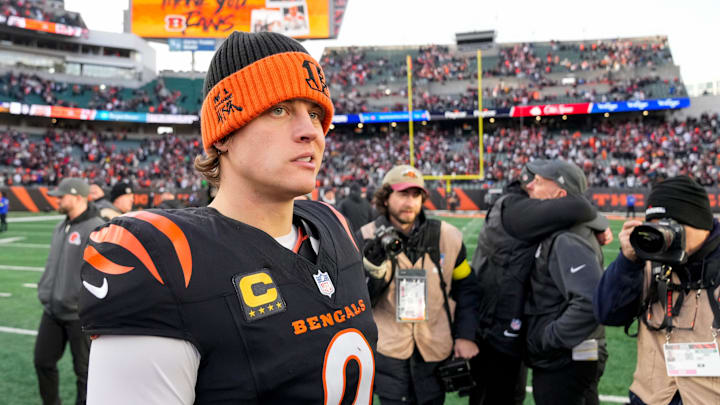
According to Joe Burrow, the NFL's recent officiating controversy—you know, the one that began with a Josh Allen interception on Saturday and continued with a Davante Adams catch on Sunday—shouldn't be much of a controversy at all.
“The amount of ppl that don’t understand what a catch is in the rule book flabbergasts me,” Burrow wrote in a rare post on X (formerly Twitter) on Monday night. “And it’s not the officials. The two plays yesterday were not difficult calls, and they got them both right.”
The amount of ppl that don’t understand what a catch is in the rule book flabbergasts me. And it’s not the officials. The two plays yesterday were not difficult calls, and they got them both right.
— Joey Burrow (@JoeyB) January 19, 2026
Although he wrote “yesterday” in the tweet, it would seem the Cincinnati QB is referencing a controversial play from Saturday’s Bills-Broncos game and another from Sunday’s Rams-Bears tilt.
On Saturday, the Bills missed out on what could have been a game-winning score when the refs ruled that a possible Brandin Cooks catch was, in fact, an interception on the part of Josh Allen. The play divided fans online, especially because it essentially decided the game.
Then, on Sunday, refs awarded Rams receiver Davante Adams the catch on a play that looked eerily similar to the one in the Bills-Broncos game, down to the way the ball was ripped out of Adams’s hands.
Onlookers were left scratching their heads as a result—does anyone know what a catch is at this point?
Brandin Cooks didn’t have possession.
— Nic Costello (@costello_nic) January 19, 2026
Davante Adams did.
Make it make sense. pic.twitter.com/RDrtC6fglF
Well, Burrow thinks he does. And he thinks the officials do, too.
Speaking with pool reporters after Saturday's game, lead referee Carl Cheffers explained the rationale behind the first of the weekend’s vexing calls.
“The receiver has to complete the process of a catch,” Cheffers said. “[Cooks] was going to the ground as part of the process of the catch and he lost possession of the ball when he hit the ground. The defender gained possession of it at that point. The defender was the one who completed the process of the catch, so the defender was awarded the ball.”
The crew chief added that the ball did not hit the ground before the Broncos defender—Ja'Quan McMillian—had possession.
As for what was different about Adams’s grab on Sunday, we did not get an answer there. It might just be one of those plays that’s called differently every time ... as unsatisfying an answer as that might seem.
What is the definition of a catch?
Here is the definition of a completed or intercepted pass, per the NFL rule book:
A player who makes a catch may advance the ball. A forward pass is complete (by the offense) or intercepted (by the defense) in the field of play, at the sideline, or in the end zone if a player, who is inbounds:
(a) secures control of the ball in his hands or arms prior to the ball touching the ground; and
(b) touches the ground inbounds with both feet or with any part of his body other than his hands; and
(c) after (a) and (b) have been fulfilled, clearly performs any act common to the game (e.g., extend the ball forward, take an additional step, tuck the ball away and turn upfield, or avoid or ward off an opponent), or he maintains control of the ball long enough to do so.
Notes:
(1) Movement of the ball does not automatically result in loss of control.
(2) If a player, who satisfied (a) and (b), but has not satisfied (c), contacts the ground and loses control of the ball, it is an incomplete pass if the ball hits the ground before he regains control, or if he regains control out of bounds.
And here is a look at what happens if two players catch the ball at the same time:
If a pass is caught simultaneously by two eligible opponents, and both players retain it, the ball belongs to the passers. It is not a simultaneous catch if a player gains control first and an opponent subsequently gains joint control. If the ball is muffed after simultaneous touching by two such players, all the players of the passing team become eligible to catch the loose ball.
More NFL on Sports Illustrated
 Add us as a preferred source on Google
Brigid Kennedy is a writer for the Features and Franchises team at Sports Illustrated. Before joining SI in November 2024, she covered political news, sporting news and culture at TheWeek.com before moving to Livingetc, an interior design magazine. She is a graduate of Syracuse University, dual majoring in television, radio and film (from the Newhouse School of Public Communications) and marketing managment (from the Whitman School of Management). Offline, she enjoys going to the movies, reading and watching the Steelers.