%20%20--%3E%0A%3Csvg%20version%3D%221.1%22%20id%3D%22Layer_1%22%20xmlns%3D%22http%3A%2F%2Fwww.w3.org%2F2000%2Fsvg%22%20xmlns%3Axlink%3D%22http%3A%2F%2Fwww.w3.org%2F1999%2Fxlink%22%20x%3D%220px%22%20y%3D%220px%22%0A%09%20width%3D%2239px%22%20height%3D%2240px%22%20viewBox%3D%220%200%2039%2040%22%20enable-background%3D%22new%200%200%2039%2040%22%20xml%3Aspace%3D%22preserve%22%3E%0A%3Cpath%20fill%3D%22%23FFFFFF%22%20d%3D%22M38.5%2C7H28.2v26h10.3V7z%22%2F%3E%0A%3Cpath%20fill-rule%3D%22evenodd%22%20clip-rule%3D%22evenodd%22%20fill%3D%22%23FFFFFF%22%20d%3D%22M26.1%2C25.5c0%2C5.8-4.1%2C7.5-12.9%2C7.5C3.9%2C33%2C0%2C31.2%2C0%2C25.2v-1.1h11.6%0A%09v2.4c0%2C0.7%2C0.1%2C1.4%2C1.2%2C1.4c1%2C0%2C1.2-0.4%2C1.2-1.3v-0.9c0-1.6-0.9-1.6-3.5-2.2C2.2%2C21.7%2C0%2C19.7%2C0%2C15.3v-0.9C0%2C9.3%2C5.5%2C7%2C12.9%2C7%0A%09c10.2%2C0%2C12.8%2C2.6%2C12.8%2C7.4v1.8h-11v-2.9c0-0.6-0.4-1.1-1.2-1.1c-0.6%2C0-1.2%2C0.4-1.2%2C1.1v0.9c0%2C1.5%2C0.9%2C2%2C3.3%2C2.5%0A%09c8%2C1.6%2C10.5%2C3.3%2C10.5%2C7.5V25.5z%22%2F%3E%0A%3C%2Fsvg%3E%0A)
The Kyle Shanahan You Don’t Know and His Value to the 49ers
In this story:
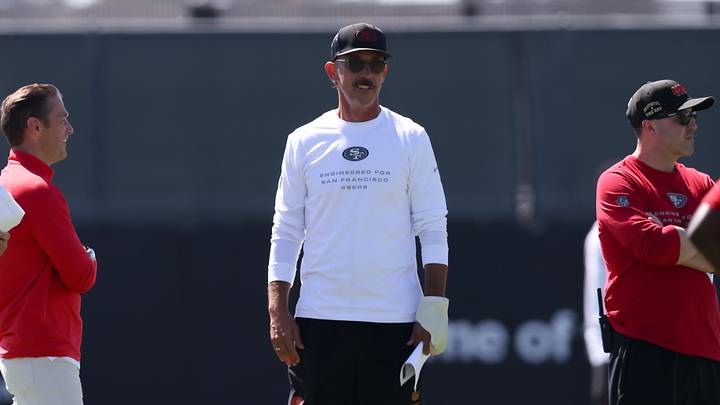
SANTA CLARA, Calif.—When the world found out about Kyle Shanahan’s July 14 car accident, most images blasted across social media or television were of him with a headset on and a playsheet in hand.
For good reason. That image of the offensive mastermind is the one most folks have of him.
It turns out, since then, the 49ers’ players and staff have mostly missed everything else.
The Shanahan that has been revered in San Francisco over the last decade—and before that by folks in the know—is indeed one of the top play-callers and designers of his generation. But there’s always been more to the 46-year-old as a coach. In a roundabout way, his temporary absence from the 49ers has painted a perfect illustration of that.
It’s the Kyle Shanahan you don’t know that has left the void over the past couple of weeks. Had this happened in September, for obvious reasons, it’d be different. The loss of play-calling expertise can be managed in July and August by most competent NFL staffs. The rest of the coach Shanahan has become over the past couple of decades is, at this early point in the pro football calendar, tougher to replicate.
“When I first got here, I was like, All right, this dude’s calling the plays, so is he an offensive coordinator that’s a head coach?” his quarterback, Brock Purdy, said. “But over the years, he’s proven to me time and time again, like, this dude understands personalities; he understands how teams need to work. And I feel like from his dad, from all the experiences, the places that he’s been, from [Jon] Gruden to Houston and Cleveland, he’s taken all these little bits and pieces and has come up with his own coaching style.
“And he’s real about it. He doesn’t have any secrets. He’s pretty black-and-white to players when they want to hear the truth. So that’s the culture he’s built. And now that he’s out, obviously, it’s sad, but he’s built it to where he’s brought in the right players, the right coaches. This thing can run when he’s not here for a little bit. Obviously, we want him here.”
And to all of these guys, a small silver lining in a bad situation that could’ve been much worse is that they can tell these stories.
You can start with Shanahan’s roots, which were planted at his dad’s side when he was a kid—and Mike was with the Broncos, Raiders, Broncos again, 49ers and then Broncos a third time, that time as the head coach—and bloomed in his 20s as he built his own career.
Raheem Morris, his defensive coordinator and one of Shanahan’s best and longest-held friends in the NFL, was there for that. He remembers being the young defensive assistant opposite an entry-level version of his buddy. And he remembers how Shanahan’s search for knowledge didn’t come close to stopping at the exit of the offensive meeting room.
In an era with less-organized offseasons, Tampa’s defensive players would pop in to work out—“Ronde [Barber] would show up with like six DBs,” Morris explains—and the coaches would meet them out on the fields. Pretty early on, Shanahan started to ask if he could join the defensive coaches for that.
“So he comes to a workout, and he’d watch what it meant to make movements, and watched what it felt like to be pushing weight, and we talked about how it looked to be a hole player, and a middle-field player, and what you were taking away, and who had spots to aim for, and be able to take those things,” Morris explained. “So he got all the little details from teaching individually. And then we’d do the same thing with Rod Marinelli up front.”
In turn, the defensive guys—Morris, Mike Tomlin and Joe Barry—would pin him down on the old Broncos keeper system, and outside zone, and how the run and pass were married up.
That carried over, with Shanahan and Morris, to Washington and later Atlanta.
It started, according to Morris, because of the tone Gruden set from a work-ethic standpoint, and because, as the Niners DC says, “it was a bunch of obsessed dudes.” The result, over time, became a guy who could coach about any position and also explain his opponent’s rules, on offense and defense, to his players, so that they could break them.
“That’s where he’s unique,” Morris said. “His ability to walk in any room here, or be able to bring you in his room, and just kind of speak your language.”
As a 20-something, he was taking in as much football as he could.
He was also, knowingly or not, filling his head-coaching toolbox.
Two decades later, his defensive players in San Francisco have benefited from it, the same way the guys in Atlanta, Cleveland or Washington have with the information he could help to try and push his players to get the 360-degree view of the game he had. It’s in the specifics that he can help those guys with before a game, of course. It’s also part of an overall philosophy for how a defense should play, regardless of who his coordinator on that side of the ball is.
“It seems simple, but just how every yard matters in terms of a play-caller,” Nick Bosa says. “Like when he talks about leaky yardage is one thing. When you allow a running back to wiggle his way for a couple more, it opens up a whole other page or two to his call sheet. So that’s something I wouldn’t have thought of. And then, just a mindset thing, where if you run to the ball and you punish the offense, he’s really good at pointing it out throughout the game—those guys don’t want to get hit like that.
“And they won’t focus on the ball when it’s coming over the middle; the running back won’t try and get those leaky yards, because they know previously in the game that shot from the D-lineman who ran to the ball earlier in the game, they’re looking for it. And that ends up being a play where they don’t get a first down. And that ends up being the game.”

Gruden’s team meetings could sometimes morph into history lessons, as 49ers GM John Lynch remembers from his playing days—“We’re gonna run 376 drag slant … and then he’s got film of Jerry Rice.” Lynch was also there for Shanahan’s dad’s meetings, which most often laid out the day, or explained, in one way or another, an aspect of protecting the team.
Kyle saw those, too. And when he was a new head coach, Lynch tried to emphasize to him that the key to both sets of those was that Gruden and his dad made them their own.
There came a time in their first year together when Shanahan went to Lynch to tell him that he wanted to call an all-hands meeting for the organization to lay out its collective vision. Lynch could sense he was a little nervous. He also knew that the young coach was at his most comfortable in the front of a room when he had a clicker in his hand and film to show.
“Andy Reid will have his script, his speeches, [Robert] Saleh would have all 17 speeches done in August,” Lynch said. “Kyle does them like 10 minutes before. I remember that day, two hours before, he’s like, What am I going to do? And I’m like, Kyle, here’s the deal: You’re comfortable with the clicker in your hand. So in front of the whole thing, we’re going to put a clicker in your hand, you’re going to show them film, because then you start flowing.”
Sure enough, he did. And quickly, team meetings became his strength.
In fact, a lot of guys will tell you that, right now, it’s what they miss most.
“There is something cool where we’re all together, and Kyle explains the scenario of a practice, or a theme at practice, and can show clips from years past, or way back, that, This is football, this is how it is, these are the concepts that haven’t changed,” Purdy says. “He paints a picture really well of what we’re all trying to get out of the day.
“He’s explaining how Fred [Warner] is seeing the defense, and Fred’s responsibilities. And I’m sitting there learning. And then, same when he explains my position to the whole team. It’s just cool that he can do that on both sides of the ball in front of everybody.”
In some cases, it helps the Niners crush a practice. In others, it helps them win a game.
Oftentimes, the contents of the meeting might mirror what he says to a guy one-on-one, because the lesson for that player is something that’d be good for the whole team to hear.
Purdy recalled Shanahan going back over Seattle’s defense with him, and explaining how he may have to check the ball down 50 times in the game—but also know when to take advantage of the one or two shots they’d give him to make a big play. Or how before the team played against Cleveland in November, Shanahan said, “They got a tough defense, it’s gonna be a lot of man coverage, you got Myles Garrett, the weather’s gonna be trashy. So this game is how can we protect the ball, capitalize on a couple drives, get some field goals? We’re gonna win.”
The Niners had no turnovers, Purdy threw for an efficient 168 yards, the defense got a couple of takeaways, and San Francisco cruised to a 26-8 win to get to 9–4.
In each case, Shanahan knew what tone to set, which is what his meetings are about.
“I do miss the team meetings already,” Bosa says. “It’s something obviously I got used to over the years. I remember as a rookie being in there and being blown away and nervous and all of the above sitting in those meetings. And over the years, you want your name to be called in there. You want him to appreciate you. It’s that type of thing.”
The Niners have put the meetings on ice altogether for the time being while Shanahan heals. In that hole in the schedule now, OC Klay Kubiak will meet with the offense and Morris the defense. It’s not that those guys or assistant head coach Chris Foerster couldn’t take the baton. They could. But it wouldn’t be the same. So they’ll wait.

The underlying thing, from his knowledge of the game through everyone’s eyes to his messages for the group as a whole, is that he always seems to know what his team needs.
That was especially the case last summer after an offseason cap purge.
“He got all the older guys together at his house, and he goes, Hey, we have a young team, we’re not gonna be doing what we’ve done the last couple years in terms of just steamrolling teams and come fourth quarter, you guys are all out of the game and we have our backups in,” Purdy remembered. “He’s like, We’re gonna need to fight for every win. This is the NFL. We have the type of young team where we’re gonna need to go and have you guys step up and go win games for us in the fourth quarter.
“And sure enough, last year, that’s exactly how the season played out. He has that. He knows what the future is gonna look like because he’s been around the block.”
Purdy then paused and said, “So, for me, as a quarterback, dude, I love it.”
Slowly, Shanahan’s working his way back to being that guy again.
At a practice last week, he was stationed behind the action, like a personnel man would be, watching practice with Lynch. Soon thereafter, Morris was over there with them. And not long after that, a steady stream of players were coming by to check in.
He has had to be careful not to overdo it. He trusts the guys he has put in place and, again, if there’s a time to be without him—or with a reduced version of him—this isn’t the worst time.
“He’s very likable, such a good dude,” Lynch said. “And so people genuinely miss him out there. He’s standing back there with me, but now a couple of days in? I think early on, it was, Guys, don’t inundate him. He’s coming back. Now, they can’t help themselves. They’re all coming out because they miss him. He’s fun to be around. He’s funny.
“But, yeah it’s a testament to what he’s built, and what he’s built in that it doesn’t feel like we’re missing a beat. Over time, we would. This would be a lot more difficult if it’s during the season and we’re going to play a game.”
That, of course, is where all of this, offensive acumen included, comes together. And missing all the other stuff may suck regardless. But at least they don’t know it probably won’t be too much longer until they get all of Shanahan back.
 Add us as a preferred source on Google
Albert Breer is a senior writer covering the NFL for Sports Illustrated, delivering the biggest stories and breaking news from across the league. He has been on the NFL beat since 2005 and joined SI in 2016. Breer began his career covering the New England Patriots for the MetroWest Daily News and the Boston Herald from 2005 to ’07, then covered the Dallas Cowboys for the Dallas Morning News from 2007 to ’08. He worked for The Sporting News from 2008 to ’09 before returning to Massachusetts as The Boston Globe’s national NFL writer in 2009. From 2010 to 2016, Breer served as a national reporter for NFL Network. In addition to his work at Sports Illustrated, Breer regularly appears on NBC Sports Boston, 98.5 The Sports Hub in Boston, FS1 with Colin Cowherd, The Rich Eisen Show and The Dan Patrick Show. A 2002 graduate of Ohio State, Breer lives near Boston with his wife, a cardiac ICU nurse at Boston Children’s Hospital, and their three children.
Follow AlbertBreer