%20%20--%3E%0A%3Csvg%20version%3D%221.1%22%20id%3D%22Layer_1%22%20xmlns%3D%22http%3A%2F%2Fwww.w3.org%2F2000%2Fsvg%22%20xmlns%3Axlink%3D%22http%3A%2F%2Fwww.w3.org%2F1999%2Fxlink%22%20x%3D%220px%22%20y%3D%220px%22%0A%09%20width%3D%2239px%22%20height%3D%2240px%22%20viewBox%3D%220%200%2039%2040%22%20enable-background%3D%22new%200%200%2039%2040%22%20xml%3Aspace%3D%22preserve%22%3E%0A%3Cpath%20fill%3D%22%23FFFFFF%22%20d%3D%22M38.5%2C7H28.2v26h10.3V7z%22%2F%3E%0A%3Cpath%20fill-rule%3D%22evenodd%22%20clip-rule%3D%22evenodd%22%20fill%3D%22%23FFFFFF%22%20d%3D%22M26.1%2C25.5c0%2C5.8-4.1%2C7.5-12.9%2C7.5C3.9%2C33%2C0%2C31.2%2C0%2C25.2v-1.1h11.6%0A%09v2.4c0%2C0.7%2C0.1%2C1.4%2C1.2%2C1.4c1%2C0%2C1.2-0.4%2C1.2-1.3v-0.9c0-1.6-0.9-1.6-3.5-2.2C2.2%2C21.7%2C0%2C19.7%2C0%2C15.3v-0.9C0%2C9.3%2C5.5%2C7%2C12.9%2C7%0A%09c10.2%2C0%2C12.8%2C2.6%2C12.8%2C7.4v1.8h-11v-2.9c0-0.6-0.4-1.1-1.2-1.1c-0.6%2C0-1.2%2C0.4-1.2%2C1.1v0.9c0%2C1.5%2C0.9%2C2%2C3.3%2C2.5%0A%09c8%2C1.6%2C10.5%2C3.3%2C10.5%2C7.5V25.5z%22%2F%3E%0A%3C%2Fsvg%3E%0A)
Why the Raiders’ 3–0 Start is For Real, But the 49ers’ May Not Be
In this story:
The designer statistic is the NFL’s silent assassin. Seemingly every outlier performance, both good and bad, is accompanied by a computer-generated information nugget that lets us know that teams in a similar position are a combined 987–1 when leading by three touchdowns in late September, when the temperature crests 72°, and the crescent moon hangs over the meadow. The songbirds sing of lovers’ past, with your idiot team being the only one that has lost in that situation. I never know what to do when I see those, and also is anyone else with a supercomputer fact-checking these? I’m not saying the computer is wrong, but it would be pretty easy for me to drop a stat like this into the ether, and everyone else would be like, Yeah, that sounds right.
Anyway, this one is infinitely more verifiable but similarly useless. I don’t know what to do with the information that Klint Kubiak is the first head coach to begin the season 3–0 after his team had the No. 1 pick the previous season since Vince Lombardi. Similarly, I don’t know what to do with the information that the previous two Raiders coaches to start their first season 3–0 were John Madden, who went to the AFC title game in that 1969 season, and Bill Callahan, when the Raiders made it to the Super Bowl in 2002.
Which is why I think a post on assessing the “surprise” teams through three weeks of the 2026 season is due. We can snack on AI-generated tidbits all we want about Kubiak and the Raiders, but we should dive into the circumstances by which this came to be a surprise and, through that exploration, decide whether it matters all that much. Along with the Raiders, we’ll get into a few other teams in similar circumstances, though they won’t all be 3–0.
I’m going to rate each team by the highly scientific “realness” rating. These teams are either “extremely real,” “pretty darn real,” “a perfectly normal amount of real,” “not all that real,” or—gasp—“not real at all.” Indeed, people who read this article all the way to the end boast a 68.7% chance of experiencing a moment of immense personal joy.
Onward …
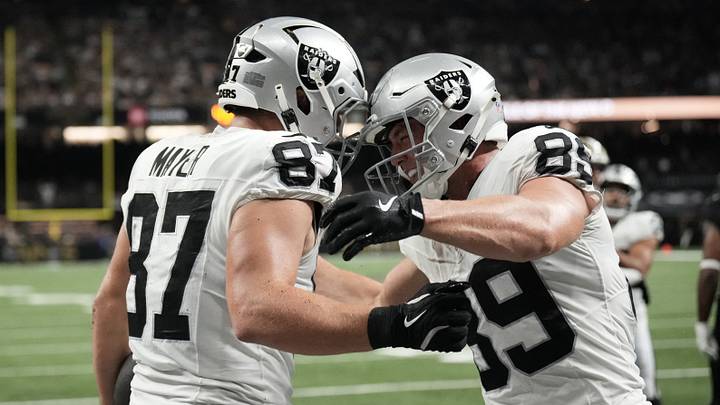
Las Vegas Raiders (3–0)
Realness: Pretty darn real
Why: Here’s a wild statistic about the Raiders that I think matters. The Raiders’ defense has forced eight fumbles and recovered one. That kind of luck differential doesn’t seem to matter for a team that is maximizing its drives better than almost any other team in the NFL. Through three weeks, the Raiders have punted only 12 times, with a handful of those coming in garbage time. The Raiders have also scored on two of their three scripted drives at the beginning of the game. Las Vegas is one of the 10 teams most likely to end its drive in a touchdown so far this year, and while we’re still operating with an incredibly small sample size and one of the Raiders’ wins was against the Dolphins, a team that overwhelmingly has the highest odds to attain the No. 1 pick in 2027, what we saw on Sunday against a more formidable Saints team looks to be the Raiders we’ll be getting for a majority of the year.
In Sunday’s win, the Raiders became a 12-personnel team (one running back, two tight ends). That isn’t all that surprising given that Brock Bowers returned and, if two of your five best offensive players are tight ends, you’ll want them on the field together. But the Raiders won a game (Week 1) in which they were a majority 21-personnel team (a two-back, typically fullback-oriented offense) and a Week 2 game in which they were primarily an 11-personnel team (one running back, one tight end and three wideouts). Now that Bowers is on the field, and he played primarily as a wide receiver against the Saints, it gives the Raiders a kind of peak-49ers-like versatility that makes the team very difficult to prepare for. At the very least, we now know the Raiders aren’t going to be run over. Having come into the week with the league’s best pass-block win rate, Kirk Cousins will remain relatively comfortable in the pocket and, all of a sudden, projecting six wins out of the team’s remaining schedule (without any real upsets) doesn’t seem ridiculous whatsoever. The Raiders still have games with the Titans, Cardinals, Jets, Browns and the limping Patriots, and, oh by the way, the calling card of a true Kubiak tree offense—the ground game—hasn’t even found its footing yet.
Defensively, the Raiders remind me of the 2025 Bears’ offense in that they’re enjoying health and peak performance from a handful of newly imported free agents. The Raiders’ remake of their linebacking corps has been nothing short of transformative.
Pittsburgh Steelers (2–1)
Realness: A perfectly normal amount of real
Why: The Steelers are 2–1, and while we cannot in the same breath celebrate the Raiders’ win over the Dolphins and completely discount a narrow Steelers victory over the Falcons in the opener, we can point out two very different circumstances in those games. Pittsburgh, for one, needed a miraculous defensive play to edge a really bad Cooper Rush–led Falcons team. The Steelers deserve immense credit for dressing down a Bengals defense that came into this game in the top five in sacks, touchdowns allowed, passing touchdowns allowed, yards per game allowed and turnovers created. But we saw what is still possible—and the defining upside—of the Aaron Rodgers–Mike McCarthy–era Steelers: creating embarrassing coverage busts against the Bengals. The Cincinnati secondary was on ice skates, though I’m almost certain Rodgers will never have pocket time like this again. Rodgers averaged a season-high 3.19 snap-to-throw time Sunday, and Jaylen Warren gouged the Bengals for 7.5 yards per carry. That allowed Rodgers to be more effective in play-action, which the Steelers used on more than 20% of his dropbacks for a 1.14 EPA per play. To McCarthy’s credit specifically, some of the concepts he’s been playing with—like a Rams-ian, Seahawks-ian Ben Skowronek insert concept that created an open touchdown—shows that the old ball coach can still dig into his bag and dial up some impressive shots.
DK Metcalf appearing to get over whatever was bothering him over the first two weeks of the season—Pittsburgh had lost the most EPA per play to drops in the NFL to that point—is also a major upgrade.
The debut of Max Iheanachor was encouraging, with the rookie offensive tackle allowing the lowest pressure percentage of any of Pittsburgh’s offensive linemen on Sunday. If Iheanachor turns into a great drop-back anchor tackle, I may increase my optimism levels because giving the most arm-talented quarterback of his generation light-years of time in the pocket is a sound strategy if it’s replicable.
I’m a little more muted in my praise at the moment because I want to see what a very old Steelers team looks like on short rest against a division rival in a suddenly-hostile environment (we’ll get to that Week 4 game against the Browns in a moment) and then a matchup against a Colts team that could test Pittsburgh’s so-far mediocre run defense, which is allowing above a 40% success rate to opponents this season.
That should give us a better sense of whether the perceived strengths of this team—again, an offensive line that could be very, very good, and a pass rush that, so far, has a success rate about as high as the vaunted Vikings—can hold up over a long period of time.

Cleveland Browns (2–1)
Realness: Not all that real (yet)
Why: I need to, for a moment, separate two things. The young core of this roster is potentially great. Mason Graham showed as much on Sunday in a win over the Panthers in which he was virtually unblockable. He registered seven pressures and two sacks, equally as masterful in the stunt game as he was against double teams. We can continue to go on and on about how Harold Fannin Jr., Austin Barber, Spencer Fano and Denzel Boston are making the leap, and we should. Todd Monken has done about as much weathering the team’s existing culture woes and navigating some less-than-savory personnel situations than any coach I can remember (although we need to be careful, having once written similar odes to Mike Pettine, and other previous Browns head coaches).
I also think it’s fair to both acknowledge that we are coming off probably two of Deshaun Watson’s three best games as a Brown—which, you know, says something—and wonder if this is a harbinger of what’s to come, or a result of the Browns having not played a ton of teams particularly skilled pressuring the quarterback. Browns fans are going to accuse me of moving the goalpost on Watson, which is fair and true. Watson made a handful of tough plays on Sunday and, again, is looking more like the kind of quarterback Cleveland thought it was getting from Houston in the first place—a willing play-extender who can escape a muddy pocket and get the ball to an open wide receiver, or, in a worst-case scenario, use his legs as an escape hatch.
But Cleveland is still in the top 10 in percentage of drives ending in a turnover and in the bottom seven in percentage of drives that result in at least one first down.
Over the first three weeks of the season, the Browns faced Carolina (24th), Jacksonville (25th) and Tampa Bay (26th), three of the lowest quarterback-pressure teams in the NFL. The Buccaneers blitz a lot, but the defense is disastrous and ineffective when it comes to actually getting home.
While I don’t know that Pittsburgh poses any more of a challenge on that front—Joe Burrow was sacked once Sunday, and the Steelers are 18th in pressure percentage—Thursday night will be the kind of game, given its magnitude, stand-alone nature, and opponent, that will either prop up or undress the Watson comeback narrative over the long term.
It’s also fair to wonder how much success Watson can have if he’s asked to be the team’s most consistently explosive rusher, too. Cleveland is operating at about a 4% rate of explosive runs this season, with the running game looking more in its developmental phase.
Again, this is not to take anything away from what Monken has accomplished. Sunday was supposed to be a statue-crumbling reckoning for a Browns fan base that was at its bitter end with Watson as a quarterback. Monken has made him watchable and, very specifically in terms of the on-field product, tolerable.
Minnesota Vikings (3–0)
Realness: A perfectly normal amount of real
The Vikings are 3–0 and just logged a victory in Kyler Murray’s first real game. Murray was … not great. The good? He can start stretching the field for the Vikings, who pushed the ball downfield a bit more than they did in the prior two games with Carson Wentz. We also don’t exactly know what he can be, given that Justin Jefferson missed most of the game with an ankle injury. I don’t want to point out Murray’s passer rating on Sunday being in the bottom tier of his career starts to say it’s a sign of bad things to come. However, I do want to point it out to say that a majority of Murray’s sample size is much higher and the Vikings can probably count on better quarterback play in the coming weeks. Murray’s nonchalance when addressing that at the podium, while not really a solid indicator beyond his personal confidence, was somewhat assuring.
That’s why some of the statistics on Minnesota’s outlier victory over Tampa Bay don’t bother me. The two in particular, via Kevin Seifert of ESPN: The Vikings did not take a snap in the red zone on Sunday and won, the first time that happened to the team since 2007. And, the Vikings currently have a minus-244 net yard differential, the second-worst ever for a team that started the season 3–0. The other being the 2020 Seahawks who won 12 games and were ousted in the first round of the playoffs by the Rams.
The Vikings, though, are balancing an offense that is in limbo with the best defense in the NFL and one of the top special teams units in the NFL as well. Minnesota has gotten massive plays out of the special teams game, is holding opponents well below the 35-yard line for average drive start and consistently has one of the better starting field positions in the NFL. Will Reichard has been nails—perfect on all field goals and extra points so far this season. As much credit as DC Brian Flores gets, special teams coordinator Matt Daniels is less talked about despite turning a unit that was among the worst in the NFL into a perennial top squad. The Vikings were 11th in EPA added via special teams in 2024, third in 2025 and are currently fifth.
Unlike the Steelers, for example, I still think we’re buying low on the Vikings because it would be difficult to imagine the Vikings’ offense finishing as one of the six worst in the NFL after typically resting more toward the middle of the pack in the Kevin O’Connell era.
San Francisco 49ers (3–0)
Realness: Not all that real
It pains to say this: San Francisco’s 3-0 start has seen a first-quarter MVP-caliber performance from Brock Purdy, even though San Francisco is becoming concerningly thin at nearly every important position. Nick Bosa, Trent Williams, Mike Evans and Dre Greenlaw are all now being evaluated for various injuries, though you could say that Williams returned to the sideline but was held out as a precaution and Greenlaw did come back into the game before being pulled again. Again, I loathe to do this, but it’s so hard to view the 49ers as stable when Sunday’s win over the Cardinals showed us how one bad week can wipe out nearly all of the remaining talent on this roster. With games against the Broncos and Seahawks upcoming, the idea that San Francisco can, in effect, hover around playoff contention until later in the season when Bosa can return and Evans will be healthy feels like a difficult projection to make. Through the first three weeks of the season, the 49ers have the highest third-down conversion rate over expected in the NFL. The team has been lights out in the red zone as well, and one would have to imagine both of those numbers returning to a median.
It’s also hard to factor in the caliber of the opponent. The 49ers started the season against a Rams team hell-bent on not taking the Australia trip seriously, followed by matchups against the team that currently has a 47% chance of attaining the No. 1 pick, and a team in Arizona that is three rungs below Miami, with the fourth-highest projected odds of earning the No. 1 pick.
With Evans out, we’ll see what happens to the offense’s structure. As I wrote during free agency, grabbing Evans was a calculated dart throw on a player who could take defenses out of loaded boxes and give Christian McCaffrey more room to run. With their top receiving threat now being Deebo Samuel, how much respect can they command from two of the best defensive opponents they’ll face all year? And that’s the other thing: San Francisco’s rushing offense has been pretty good but not the lifeblood of the team. Again, Purdy is posting nearly double the total EPA added as the next best quarterbacks in the NFL. The 49ers’ EPA per dropback is twice as good as Josh Allen and the Bills, thanks to an uncharacteristically bad Allen performance against the Chargers in Week 3. We have to expect that number to come back to earth, and with it, the reality that San Francisco will only continue to be as dominant as the injury report allows.
Kansas City Chiefs (3–0)
Realness: Extremely real
So, yes, I was the guy before the season started who told you the Chiefs were not a Super Bowl contender. I’m not running from this take, no matter how embarrassing it looks right now, because I’m at peace with how I arrived at the answer (again, even if the answer is embarrassingly wrong). That doesn’t mean I shouldn’t be held accountable; it just means that, through my offseason calls, there was so much emphasis put on how teams could diversify the running game, and I didn’t think adding Kenneth Walker III to a stale offense would make much of a difference.
As it turns out, Kansas City’s new Eric Bieniemy offense is very different. I imagine Kansas City will end up with its heaviest usage of 12-personnel in the recent Mahomes era, which was back in 2024 when the team lived in the two-tight-end formations about 34% of the time. Kansas City is tracking under that rate right now thanks to a clobbering of the Dolphins this week in which the Chiefs used a lot of fullback-adjacent personnel to grind out a victory on the turf, leaving their two-tight-end formations to sit on ice.
But the two main reasons I think this team is “extremely” real are as follows: One, it’s impossible to ignore how wildly different Travis Kelce looks in 2026. This was not on my bingo card. While I was crafting thoughts on the Chiefs being a nine-win-type team in 2026, I was imagining a world where Bieniemy would need to run away from Kelce on most downs. But, through three weeks, he’s tracking alongside the Steelers’ Darnell Washington in run-blocking proficiency. Kelce’s pass blocking doesn’t look as good, but when he is this explosive, he shouldn’t be blocking in the first place.
The second is how well this secondary shrugged off the losses of two of the best cornerbacks in the NFL. The Chiefs are in the top five in EPA against the pass through three weeks despite facing a Broncos team in the season opener that, I thought, with a new play-caller and the addition of Jaylen Waddle, had a chance to knife open a Kansas City team that had no tape to fall back on. Similarly, while the Chiefs were ground down in the running game against the Colts in Week 2, Jonathan Taylor averaged fewer than 3.5 yards per carry and registered just one explosive rush of 20 yards or more. If the Chiefs are good enough to contain each opponent’s best offensive traits, and the offense has differentiated itself enough from years past to become dangerous again, there is absolutely no reason to believe the Chiefs aren’t for real. Again, much to my chagrin as someone who called his shot at this being a developmental year for the bottom half of Andy Reid’s roster.
 Add us as a preferred source on Google
Conor Orr is a Senior Writer for Sports Illustrated with more than 15 years of experience covering the NFL. His work has been cited in Best American Sportswriting and has won a PFWAA award. Prior to Sports Illustrated, he covered both the Giants and Jets for The Star-Ledger. Conor lives in New Jersey with his amazing wife and three children.
Follow author