%20%20--%3E%0A%3Csvg%20version%3D%221.1%22%20id%3D%22Layer_1%22%20xmlns%3D%22http%3A%2F%2Fwww.w3.org%2F2000%2Fsvg%22%20xmlns%3Axlink%3D%22http%3A%2F%2Fwww.w3.org%2F1999%2Fxlink%22%20x%3D%220px%22%20y%3D%220px%22%0A%09%20width%3D%2239px%22%20height%3D%2240px%22%20viewBox%3D%220%200%2039%2040%22%20enable-background%3D%22new%200%200%2039%2040%22%20xml%3Aspace%3D%22preserve%22%3E%0A%3Cpath%20fill%3D%22%23FFFFFF%22%20d%3D%22M38.5%2C7H28.2v26h10.3V7z%22%2F%3E%0A%3Cpath%20fill-rule%3D%22evenodd%22%20clip-rule%3D%22evenodd%22%20fill%3D%22%23FFFFFF%22%20d%3D%22M26.1%2C25.5c0%2C5.8-4.1%2C7.5-12.9%2C7.5C3.9%2C33%2C0%2C31.2%2C0%2C25.2v-1.1h11.6%0A%09v2.4c0%2C0.7%2C0.1%2C1.4%2C1.2%2C1.4c1%2C0%2C1.2-0.4%2C1.2-1.3v-0.9c0-1.6-0.9-1.6-3.5-2.2C2.2%2C21.7%2C0%2C19.7%2C0%2C15.3v-0.9C0%2C9.3%2C5.5%2C7%2C12.9%2C7%0A%09c10.2%2C0%2C12.8%2C2.6%2C12.8%2C7.4v1.8h-11v-2.9c0-0.6-0.4-1.1-1.2-1.1c-0.6%2C0-1.2%2C0.4-1.2%2C1.1v0.9c0%2C1.5%2C0.9%2C2%2C3.3%2C2.5%0A%09c8%2C1.6%2C10.5%2C3.3%2C10.5%2C7.5V25.5z%22%2F%3E%0A%3C%2Fsvg%3E%0A)
This Week’s Referee Suspensions Are Hiding the NFL’s Real Officiating Problem
In this story:
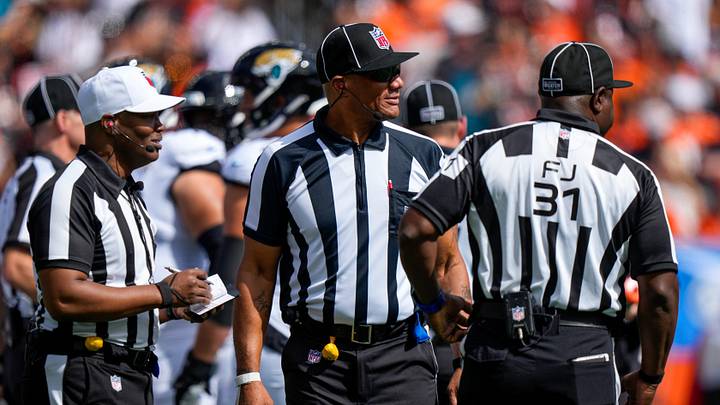
NFL officials, like kindergarten teachers finally hitting the one-month mark of a new year and reaching a stimulation overload after a kid named Liam jammed the pencil sharpener with Goldfish crackers, collectively spazzed on Sunday. One official flagged Mike Vrabel for saying the f-word—which, my brother, if you’ve ever watched a game from the sideline, is not a rare occurrence—and another, Adrian Hill, flipped out at Vikings linebacker Eric Wilson, who was pushed into Hill and was trying to help the referee to his feet. Jeff Seeman, already under some unspoken NFL punishment by virtue of officiating Cardinals-Giants, said F--- you to Trey McBride three times all within view of a CBS camera.
The referee who flagged Vrabel wasn’t punished, though Vrabel called him soft in public, which, honestly, may have been worse. Both officials were suspended on Monday: Hill for one game, and Seeman, who used the mother of all curse words, will be out for two weeks. We cannot confirm if he had his mouth washed out with a bar of soap.
NFL official suspensions are rare and, historically, stem from embarrassing conduct related to not knowing the rules, or dealings with the general public. Back in 1968, a crew belonging to Norm Schachter simply lost track of downs during a Rams-Bears game, which feels like something that would only have happened to Sean Payton. Jack Fette was suspended in the 1980s for an interaction with fans that, if you’ll get a look at Jack Fette, was presumably wild.
That changed when Roy Ellison hit the scene, calling likely future Hall of Famer Trent Williams a “garbage a-- motherf-----,” in 2013, and, again in 2018, when Ellison allegedly called Bills defensive end Jerry Hughes a b----, and Hughes went after Ellison in the tunnel.
Monday’s news felt like the pound of flesh that was a long overdue as tensions between officials and players have reached a fevered pitch. The bad vibes stemmed from the revelation that the officials botched a call last week in a high-profile spot between the Broncos and Rams, admitted they were wrong and then tattled on Sean McVay for tattling on the officials for admitting they were wrong (the kindergarten comparison remains apt). I think we can understand that punishing both Seeman and Hill was a momentary leveling of the playing field by attempting to even out the ridiculous disparity in accountability between officials and players. One group gets a wrist slap in private, while the other has to answer to dozens of reporters, hundreds of teammates and staffers and millions of fans.
Now we’re cool. Right?
For me, not quite. And here’s where I’ll admit that I am the son of both a teacher and a referee (basketball, not football), so my view on the entire situation and my sympathies for rule-bearers attempting to manage a fleet of younger and more agile people might be a little bit warped. By normalizing suspending referees for acting in a manner commensurate with someone whose job absolutely sucks instead of using technology to help referees get more calls consistently correct and, thus, less at odds with the players they deal with, I think we’re getting further away from the heart of the problem.
This kind of behavior from an official towards a player is unacceptable. Players are consistently held accountable when the roles are reversed. We expect the NFL to hold officials to the same standard. pic.twitter.com/vawHA8Jrlt
— JC Tretter (@JCTretter) October 4, 2026
Obviously, there’s a respect factor here that I want to address. Seeman should not have said what he said, and NFLPA president JC Tretter was right to point that out. Anything purposely derogatory, racist, misogynistic or outwardly hurtful or disrespectful should be reported, flagged and dealt with through proper channels. There’s a way to tell a player who has been complaining about calls all night to pipe down that is both appropriately spicy and within the realm of acceptable human reaction.
But in both cases, the officials felt, to me, to be positively worn down and caught up in the same frustrations that grip players after dropped passes, or coaches after the special teams coordinator lines up 13 men on a field goal attempt. Refereeing is increasingly impossible. As I’ve written countless times, teams create plays that shield officials from discerning illegal picks. There is a loophole for false starts among offensive linemen—loopholes for what constitutes offsides. No crew is consistent on whether, if you’re in the act of throwing a forward pass, a free ball is not a fumble unless it is. Unless it is not. To clarify rules, we create more rules on top of the rules. We add points of emphasis that have to be called in one mercifully awful spot to get the attention of the rest of the league. You have to be a walking dictionary at light speed, well into your fifth, sixth and seventh decade on earth and never miss a critical second. And, of course, all of this is set against the backdrop of a referee labor dispute that was resolved months before the season began.
Vrabel admitted that he’s told an official that he made a “horrible f------ call” in the 70s (he has coached 128 career games, so I’m guessing he’s off by a few). Is it really so ridiculous when an official turns around and responds, “Hey, f--- you, too?” I’ll get ahead of the counterargument that, if officials don’t like to be berated, they should quit by reminding you that they did kind of all quit recently and it was an absolute disaster. As Father John Misty once said: “I hate to say it, but each other’s all we got.”
We have sentient AI apparently powerful enough to wipe out all of humanity but not capable of linking with an official’s earpiece and notifying them in something close to real time that the pass interference penalty flag can probably be picked up. Or that, yikes, there was one heck of a facemask the officials missed, and before the start of the next play they have to blow the whistle and correct an error that all of America is now discussing. By adding about 10 minutes to the average football game, we could wipe away a large percentage of devastating calls that formed the basis of this stormy environment to begin with.
Instead, we’re continuing to shroud officials in a papal veil, which feeds conspiracy theorists who believe they are nothing more than tools to satisfy the whims of sportsbooks and broadcast partners, and it feeds players who see them as a protected class. We’re also punishing officials for human reactions, which ultimately leads to apathy on the field and, I’m guessing, more bad calls or fewer good ones. We’re upset when they miss calls and now, more upset than ever that officials, through four weeks of this season, have nullified a boatload of touchdowns and are chucking more flags than ever before.
We’re adding more kids to the classroom. We’re adding more pathways to contact the teachers outside of school hours. We’re letting the kids bring fidget spinners out of their lockers, and you know damn well those things are just going to go flying the minute the teacher turns their back. Liam, it’s not even snack time; why do you even have Goldfish by the pencil sharpener?
Everyone is beat. Everyone is worn out. Now is the time to come together, hate the people who created this system and refused to improve it, instead of alternating punishment between the scores of humans running around out there attempting to make sense of the chaos.
 Add us as a preferred source on Google
Conor Orr is a Senior Writer for Sports Illustrated with more than 15 years of experience covering the NFL. His work has been cited in Best American Sportswriting and has won a PFWAA award. Prior to Sports Illustrated, he covered both the Giants and Jets for The Star-Ledger. Conor lives in New Jersey with his amazing wife and three children.
Follow author