%20%20--%3E%0A%3Csvg%20version%3D%221.1%22%20id%3D%22Layer_1%22%20xmlns%3D%22http%3A%2F%2Fwww.w3.org%2F2000%2Fsvg%22%20xmlns%3Axlink%3D%22http%3A%2F%2Fwww.w3.org%2F1999%2Fxlink%22%20x%3D%220px%22%20y%3D%220px%22%0A%09%20width%3D%2239px%22%20height%3D%2240px%22%20viewBox%3D%220%200%2039%2040%22%20enable-background%3D%22new%200%200%2039%2040%22%20xml%3Aspace%3D%22preserve%22%3E%0A%3Cpath%20fill%3D%22%23FFFFFF%22%20d%3D%22M38.5%2C7H28.2v26h10.3V7z%22%2F%3E%0A%3Cpath%20fill-rule%3D%22evenodd%22%20clip-rule%3D%22evenodd%22%20fill%3D%22%23FFFFFF%22%20d%3D%22M26.1%2C25.5c0%2C5.8-4.1%2C7.5-12.9%2C7.5C3.9%2C33%2C0%2C31.2%2C0%2C25.2v-1.1h11.6%0A%09v2.4c0%2C0.7%2C0.1%2C1.4%2C1.2%2C1.4c1%2C0%2C1.2-0.4%2C1.2-1.3v-0.9c0-1.6-0.9-1.6-3.5-2.2C2.2%2C21.7%2C0%2C19.7%2C0%2C15.3v-0.9C0%2C9.3%2C5.5%2C7%2C12.9%2C7%0A%09c10.2%2C0%2C12.8%2C2.6%2C12.8%2C7.4v1.8h-11v-2.9c0-0.6-0.4-1.1-1.2-1.1c-0.6%2C0-1.2%2C0.4-1.2%2C1.1v0.9c0%2C1.5%2C0.9%2C2%2C3.3%2C2.5%0A%09c8%2C1.6%2C10.5%2C3.3%2C10.5%2C7.5V25.5z%22%2F%3E%0A%3C%2Fsvg%3E%0A)
Roger Goodell’s Comments on an International NFL Team May Be Leverage or Strategy. But They’re Certainly Wrong.
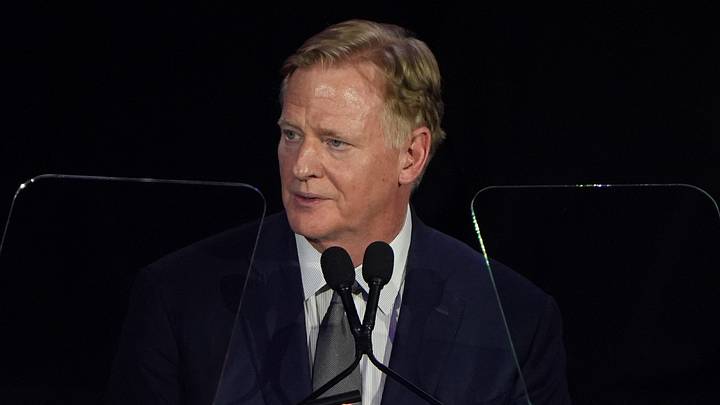
One of my worst habits is adopting insider industry parlance when speaking to professionals in different walks of life and using it incorrectly. When there’s a doctor around, I have the strange urge to say the words blunt force trauma and, more regularly than I’d like to admit, I toss out the phrase habeas corpus around my lawyer friends (“gimme that corpse,” as the attorneys say). So, it surprises me that I cannot immediately summon a business-y jargon-snacking term to describe what Roger Goodell was doing this week when he told a German media outlet that “I have no doubt” there will be “NFL teams [plural]” outside of the United States.
Help me out here. I’m looking for a word that stretches beyond the confines of naked ploy for leverage. It has to also mean this is not true and is a bit hollow in nature and strategic for some reason other than what we can fully grasp at this moment.
While we marinate on that, let’s get one thing clear: There is absolutely no way the NFL will expand to Europe, Asia, Africa, South America, Australia or Antarctica in Goodell’s lifetime. There are three main reasons for this, the first of which being the most basic reason Goodell would want to establish a world where London, São Paulo, Berlin or Melbourne are actually viable options.
The Browns are set to open a new stadium in 2029. The Chiefs will open theirs in 2031. The Bills just unveiled (or veiled, I guess, depending on where you’re sitting), their new home. The Titans are moving into the new Nissan Stadium next season. If you are an NFL team playing anywhere except Green Bay and you have a stadium that was constructed within the same basic timeframe as any of those teams’ old homes, but not one made to maximize year-round usage (read: a dome that can hold concerts, Monster Jam, boat shows and fantasy football drafts for the uber-wealthy during the offseason without fear of inclement weather delaying the event), at a point in the NFL’s evolution when private equity is clawing its way into the sport, you’re about to start looking for one.
That means Chicago—more on that in a minute—Miami (last renovated in 2017 to make it more of a multi-use facility), Carolina (in the process of a renovation set to be completed in 2030), Jacksonville (a renovation project called stadium of the future is set to be completed in 2028), Baltimore (the Ravens just completed a $500 million renovation project), Tampa Bay (the Buccaneers are attempting to secure a billion dollars for renovations and are approaching a lease deadline in January), Cincinnati (recently renovated with a lease through 2036) and Philadelphia (a lease expiration in 2032), among others, not to mention the almost immediate obsolescence of MetLife Stadium after its completion in 2010 that will almost surely have to be addressed at some point.
The Bears are going through a strange, psychedelic journey in which the franchise is dually buttering up the Indiana legislature while trying to motivate Illinois to do something—anything—to stop the Chicago Bears from moving out of the state in which Chicago is located. It paints a modern picture of how increasingly complex and political these leverage plays are going to get without the emergence of large, shiny objects elsewhere to serve as landing pads.
The NFL pulled the trigger on Los Angeles in 2016 and Las Vegas in 2020. What remains in the United States is a mishmash of San Antonio and/or returning to a site that has already been robbed of its franchise, such as St. Louis or San Diego. The Glazer Family, which owns both the Buccaneers and a majority stake in Manchester United, is in a city staring down not only the barrel of an NFL stadium renovation but a new stadium for the Tampa Bay Rays and the arm wrestling for public funding (as Pro Football Talk writes about here). It is undeniably better in these situations to have a world where London exists as a pseudo-realistic option when you’re trying to absorb as much taxpayer money as humanly possible.
As an aside here, there is still a honeymoon period—I feel—between the league and other world governments. The red carpet that is rolled out for the NFL by Dublin, London, Berlin and Australia may not be so plush and inviting once a team is there on a daily basis and needs to interrupt civic life for more than just a few days a year.
The second reason the NFL won’t do this any time soon? Goodell’s NFL has done a few things exceptionally well. The top, in my opinion, has been learning in real time how to let others make mistakes for you. Goodell’s costliest error was inadvertently wading into the culture wars a decade ago, underestimating its scope and impact, shortly after he tried to speed himself out of public scrutiny and attempt to gain a stranglehold on disciplinary issues. From that point forward, in business or in a public setting, the NFL has allowed other professional sports leagues—including spring football leagues—to attempt something, try, fail and succeed before attempting to do so itself.
My guess would be that the NFL wants either the NBA, MLS, MLB or NHL to attempt to deal with the rigors of a truly international (not just Canadian) franchise before even considering the logistics for itself. If an international franchise is to come about in expansion and not as a new location for an existing franchise, Goodell has plenty of incubator test cases for this as well. The WNBA is moving to 18 teams by 2030. The MLS added roughly a team per season for about 20 years between 2005 and 2025. The NHL has added three teams in the past decade and, in 2024, revealed a short list of cities that may also be interested in jumping aboard. The NBA’s future in Seattle and Las Vegas is also pending at the end of this decade.
There is no reason for Goodell to even begin the groundwork of this process until he understands fully both the pitfalls of having a team that is, at the very least, a 7.5-hour flight away from its nearest franchise and in a time zone where Sunday Night Football would begin locally at 1:15 a.m. This, in addition to seeing how the global economy greets a massively oversaturated sports market and the glut of new franchises popping up overnight. An examination process like this will take more than a decade, notwithstanding the prospect of shaking up the league’s divisional alignment once again and bundling its global ambitions with the already unrealistic expectation that players endure 18-plus games per season.
Which brings us to our final point. The NFL is having a hard enough time getting free agents to commit to the Cardinals. Taking a family nine months out of the year to a different country would be a nonstarter for many top free agents in the NFL and a massive competitive disadvantage. The same goes for acquiring top head coaches and fielding a staff of assistants who, far more than you might think, are motivated by the needs of their immediate families, proximity to schools and environments where the spouses are already comfortable. Imagine trying to lure the next Sean McVay into your building by showing him a Google photo montage of the Schlossplatz.
It is very neat and fun to imagine a truly global football league but the reality is that Europe, or any other continent, will be lucky to nab a relevant flag football outfit that catches the tailwind of the 2028 Olympic Games to become a broader part of the American football universe. In any other sense, pretending that there’s an inevitability to everyday football outside the U.S. and Canada is, well, oh right, I think I came up with the word: bulls---.
 Add us as a preferred source on Google
Conor Orr is a Senior Writer for Sports Illustrated with more than 15 years of experience covering the NFL. His work has been cited in Best American Sportswriting and has won a PFWAA award. Prior to Sports Illustrated, he covered both the Giants and Jets for The Star-Ledger. Conor lives in New Jersey with his amazing wife and three children.
Follow author