%20%20--%3E%0A%3Csvg%20version%3D%221.1%22%20id%3D%22Layer_1%22%20xmlns%3D%22http%3A%2F%2Fwww.w3.org%2F2000%2Fsvg%22%20xmlns%3Axlink%3D%22http%3A%2F%2Fwww.w3.org%2F1999%2Fxlink%22%20x%3D%220px%22%20y%3D%220px%22%0A%09%20width%3D%2239px%22%20height%3D%2240px%22%20viewBox%3D%220%200%2039%2040%22%20enable-background%3D%22new%200%200%2039%2040%22%20xml%3Aspace%3D%22preserve%22%3E%0A%3Cpath%20fill%3D%22%23FFFFFF%22%20d%3D%22M38.5%2C7H28.2v26h10.3V7z%22%2F%3E%0A%3Cpath%20fill-rule%3D%22evenodd%22%20clip-rule%3D%22evenodd%22%20fill%3D%22%23FFFFFF%22%20d%3D%22M26.1%2C25.5c0%2C5.8-4.1%2C7.5-12.9%2C7.5C3.9%2C33%2C0%2C31.2%2C0%2C25.2v-1.1h11.6%0A%09v2.4c0%2C0.7%2C0.1%2C1.4%2C1.2%2C1.4c1%2C0%2C1.2-0.4%2C1.2-1.3v-0.9c0-1.6-0.9-1.6-3.5-2.2C2.2%2C21.7%2C0%2C19.7%2C0%2C15.3v-0.9C0%2C9.3%2C5.5%2C7%2C12.9%2C7%0A%09c10.2%2C0%2C12.8%2C2.6%2C12.8%2C7.4v1.8h-11v-2.9c0-0.6-0.4-1.1-1.2-1.1c-0.6%2C0-1.2%2C0.4-1.2%2C1.1v0.9c0%2C1.5%2C0.9%2C2%2C3.3%2C2.5%0A%09c8%2C1.6%2C10.5%2C3.3%2C10.5%2C7.5V25.5z%22%2F%3E%0A%3C%2Fsvg%3E%0A)
Paralympian Ezra Frech Didn’t Expect to Do This Well on ‘Dancing with the Stars’
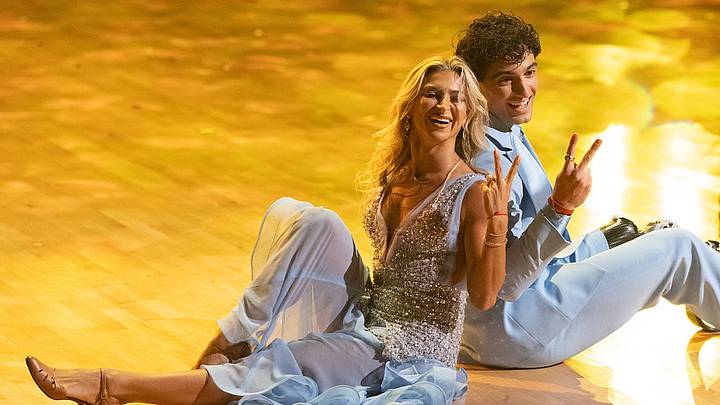
If Ezra Frech has yet to text you back, don’t take it personally—he’s doing the best he can.
“It’s like if you had 10 birthdays at once and all the texts from 10 different days came through on one day,” he tells Sports Illustrated, referring to the state of his phone. “And it was so overwhelmingly sweet, and you loved getting that love from your family and friends, but then you felt bad because you’re like, ‘Oh my gosh, I didn’t respond to everyone!’ That’s how I feel.”
To be fair, you would probably be overwhelmed, too, if you were a 21-year-old Paralympic high jumper on Season 35 of ABC’s Dancing with the Stars; if your star had suddenly risen to a point where you were getting recognized on the streets of Los Angeles, despite competing on the international stage for years. And you would also probably miss some texts if you were spending hours every day perfecting tangos, foxtrots and cha-chas with ballroom’s best, carefully sidestepping this way and that so that your partner won’t trip over your blade or bang her knee into your prosthetic (which has happened, by the way).
But you’re not, so you’ll just have to understand. Frech hopes you will, anyway.
“I have so many unread messages, and this exacerbated the problem, for sure,” he continues, with a laugh. “I have not gotten close to responding to everybody. But the people who love me know I love them [...]. I try to respond to as much as I can, and I’m trying to start to go back and go through everything, but it is beautifully overwhelming, the love that I’ve received.”
All in all, it’s a good problem for the two-time Paralympic gold medalist to have. It means that he’s doing well on DWTS, a show not exactly catered to athletes with congenital limb differences; Frech, a single-leg amputee, was born without a left knee, left fibula, and four fingers on his left hand. Moreover, it accurately suggests that he has become quite the fan favorite in his short but so far impactful run, especially after his high-energy cha-cha to Flo Rida’s “Low” in Week 2.
“My family and friends are leaning in 100%, and have become the biggest, die-hard Dancing with the Stars fans ever,” Frech says. “They’re talking about intricate details and moves and ‘This person’s routine!’ and ‘This was killer!’ and ‘The way that they did this!” I’m like, ‘Guys, where is this coming from?’ They’re just so invested and it’s the sweetest thing.”
So far, Frech’s experience in the ballroom has been full of surprises. Although he expected to be somewhat of a decent dancer, he is nonetheless shocked at just how well he has done out there—he and partner Daniella Karagach have yet to score below 20 total points for a single dance, which is quite the accomplishment for any contestant, let alone one using a fake leg. The L.A. native also thought he would be competing using his walking prosthetic—which offers added stability, plus a foot that fits inside a ballroom shoe—but has instead opted for his running blade thus far. (Poetically, this happens to be the same blade he wore to win his medals in Paris.)
“When I’m in my running blade, my ability to travel and move around the floor is great. When I put on my walking leg, that gets reduced by, like, 50%,” he explains. “And so I just felt awkward, and I just didn’t have the same confidence. I didn’t feel like the same dancer.”
Interestingly enough, Frech might be making things harder for himself by using the blade, which offers little room for error, considering how just a few centimeters of its surface make contact with the ground on every step. His technical adviser, a fellow above-the-knee amputee who competed on the German version of DWTS, was flabbergasted to see him perform with it.
“He called me after Week 1, and he said, ‘You’re doing the tango on your running blade? You’re crazy!’ I'm like, ‘Why?’ He’s like, ‘One mistake and you fall immediately. You’re crazy!’ And that was after Week 1,” he laughs. “Then I did a cha-cha on it, and now I did a foxtrot, and the rest is going to be history.”
For Frech and Karagach, each week on DWTS begins the same: with movement. Karagach runs her partner through a litany of side-steps, shifts and progressions, taking stock of which look clunky, which look smooth, and which might need further adaptation. Once that’s done, she gets to work choreographing the routine, which the pair then continue to tweak and tighten as the week goes on.
“There’s room for us to figure out if I do this, is it smoother? If I do this, is it a little bit better? And that’s part of just the process of trial and error,” Frech says.
Crucially, an adjustment does not mean that Frech can’t do a certain movement or step; rather, it’s meant to make the routine look as effortless as possible—no small feat under the circumstances (and the point of the show, after all). His blade is designed to absorb energy then return it, which means the powerful steps required for ballroom can quickly become choppy and unwieldy. To keep things under control, the high jumper is learning how to reabsorb that force in his hip and his right leg, lest he bounce all over the place. This also presents a welcome challenge for Karagach, who has to plan and plot the dance with these limitations in mind.
In last week’s foxtrot, for instance, “we have different movements where, every step I’m taking, every time I’m rising, it has to be on the left, and then every time I fall, it has to be on the right,” he recounts. “And so that’s just a challenge for her to choreograph that she’s never had to deal with before. But I’m so grateful that she is excited about the whole process.”
On Tuesday, Frech and Karagach will be dancing a rumba to “Anytime You Need a Friend” in honor of “Mariah Carey Night.” And if all goes according to plan, they’ll be returning in Week 5 for “Super Bowl Night,” then again for Week 6’s “Dedication Night,” an always emotional affair for dancers and viewers alike.
Whatever happens, though, the amiable Frech is just happy to be hanging with another world-class athlete.
“It’s so much fun. I mean, when else do you get the opportunity to commit yourself to such a beautiful craft, lean in entirely [and] learn from the best in the world?” he muses. “Literally. I’m privileged to learn from someone who is genuinely one of the greatest dancers to ever grace this earth. … I get Daniella Karagach by my side, a part of every step of the journey, and then we get to put on dances together every week. It’s, like, oh my gosh, what a beautiful opportunity that is.”
 Add us as a preferred source on Google
Brigid Kennedy is a writer for the Features and Franchises team at Sports Illustrated. Before joining SI in November 2024, she covered political news, sporting news and culture at TheWeek.com before moving to Livingetc, an interior design magazine. She is a graduate of Syracuse University, dual majoring in television, radio and film (from the Newhouse School of Public Communications) and marketing managment (from the Whitman School of Management). Offline, she enjoys going to the movies, reading and watching the Steelers.