%20%20--%3E%0A%3Csvg%20version%3D%221.1%22%20id%3D%22Layer_1%22%20xmlns%3D%22http%3A%2F%2Fwww.w3.org%2F2000%2Fsvg%22%20xmlns%3Axlink%3D%22http%3A%2F%2Fwww.w3.org%2F1999%2Fxlink%22%20x%3D%220px%22%20y%3D%220px%22%0A%09%20width%3D%2239px%22%20height%3D%2240px%22%20viewBox%3D%220%200%2039%2040%22%20enable-background%3D%22new%200%200%2039%2040%22%20xml%3Aspace%3D%22preserve%22%3E%0A%3Cpath%20fill%3D%22%23FFFFFF%22%20d%3D%22M38.5%2C7H28.2v26h10.3V7z%22%2F%3E%0A%3Cpath%20fill-rule%3D%22evenodd%22%20clip-rule%3D%22evenodd%22%20fill%3D%22%23FFFFFF%22%20d%3D%22M26.1%2C25.5c0%2C5.8-4.1%2C7.5-12.9%2C7.5C3.9%2C33%2C0%2C31.2%2C0%2C25.2v-1.1h11.6%0A%09v2.4c0%2C0.7%2C0.1%2C1.4%2C1.2%2C1.4c1%2C0%2C1.2-0.4%2C1.2-1.3v-0.9c0-1.6-0.9-1.6-3.5-2.2C2.2%2C21.7%2C0%2C19.7%2C0%2C15.3v-0.9C0%2C9.3%2C5.5%2C7%2C12.9%2C7%0A%09c10.2%2C0%2C12.8%2C2.6%2C12.8%2C7.4v1.8h-11v-2.9c0-0.6-0.4-1.1-1.2-1.1c-0.6%2C0-1.2%2C0.4-1.2%2C1.1v0.9c0%2C1.5%2C0.9%2C2%2C3.3%2C2.5%0A%09c8%2C1.6%2C10.5%2C3.3%2C10.5%2C7.5V25.5z%22%2F%3E%0A%3C%2Fsvg%3E%0A)
2026 World Cup to Introduce Drastic Rule Changes
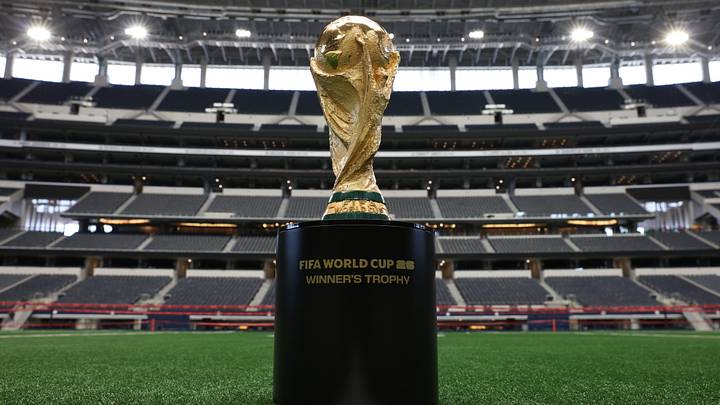
The International Football Association Board (IFAB) has confirmed a whole host of rules changes which will be implemented at the 2026 World Cup.
Across the globe, refereeing controversies have plagued the past 12 months of soccer, and so IFAB called a special meeting to set the record straight in time for this summer’s festivities across the United States, Canada and Mexico.
‘Anti-Arsenal’ VAR Powers

Among the biggest changes is one the vast majority of Premier League fans will be relieved to see, so much so that many on social media have claimed the rule has been tweaked specifically to counter Arsenal.
Under the new guidelines, VAR has the power to intervene if a foul is spotted before a corner or free kick is taken, such as if an attacker is seen blocking a defender—a tactic Mikel Arteta will admit played a significant role in Arsenal’s success this season.
That being said, it was not Arsenal that were mentioned as examples of what would now constitute a rule breach. Instead, FIFA refereeing chief Pierluigi Collina highlighted England as a guilty party.
Collina looked at England’s goal in a March friendly against Uruguay, in which Ben White—ironically, an Arsenal player—scored a header after Crystal Palace midfielder Adam Wharton was seen blocking off a defender.
“We try to solve this and let’s see what can be next,” Collina explained. “It would only be for fouls committed by an attacker. I don’t think any of you would be happy with a goal scored as a result of a foul being committed and the reason why the VAR can’t intervene is that the protocol says that.
“There is a clear foul committed against the [Uruguay] defender. The attacker clearly goes and illegally blocks the opponent; his only objective is to prevent the defender from being able to defend against his opponent.
“We are convinced that this goal cannot stand, it is completely unfair. We want the VAR to intervene even if a foul is committed just before the ball is in play. We are convinced nobody can object to that.”
No Covering Mouths

Another of the big talking points of the 2025–26 season came in the Champions League, where Benfica midfielder Gianluca Prestianni was accused of racially abusing Real Madrid winger Vinicius Junior in February.
Complicating matters was the fact Prestianni hid his mouth under his shirt as he spoke to Vinicius, who had no video evidence of the offense which Prestianni vehemently denied.
Now, players who cover their mouths, either with a hand or a shirt, during a confrontation, will be automatically shown a red card.
Crucially, however, this rule will only apply to moments of aggression. Players regularly cover their mouths when in conversation with teammates or friends on the pitch, and these moments will not be punished.
Timewasting Punishments

IFAB has also banned what have come to be known as tactical timeouts, in which a goalkeeper receives treatment on an injury while the rest of the players head to the bench for a consultation with their managers.
Goalkeepers can still receive treatment and hold up a match while they do, but referees will have the power to ban players from heading to the sidelines for tactical discussions while the game is paused.
“We will not allow the teams going to the benches when a goalkeeper is lying on the ground injured,” Collina continued. “The goalkeeper has the right to be injured, but the players do not have the right to leave the field of play to have some sort of time out with their respective coaches.
“I’m afraid we didn’t get a shared solution [on punishments], a solution agreed by everybody. For this season, IFAB didn’t take any decision. Certainly something will be done in the future. For the time being, we rely on players’ understanding of the problem.
“We told them, ‘Be aware that we know,’ so what we can avoid is having all the players off the field of play. There are captains, there are coaches, so certainly referees will be ready to face something like this if it should happen.”
Meanwhile, referees will also use visible five-second countdowns during throw-ins and goal kicks. If play has not been restarted within the allotted time, possession will be awarded to the opposition in the form of a throw-in or a corner, depending on where the initial infraction occurred.
No Substitution Delays

Continuing the subject of timewasting reforms, players will also be warned that they have just 10 seconds to leave the pitch once being notified of their substitution, at which point they must leave by the nearest sideline.
While there will be no punishment for any specific player who takes too long to leave the pitch, the impact will be felt afterwards. The player entering the pitch will not be able to join the game at the first natural stoppage after one minute of play, leaving the guilty team without a player for what could turn into a significant period.
Other New Rules
- Red cards for any players who walk off the field in protest of a referee decision
- Managers will be shown red cards if found to be encouraging players to leave the pitch
- Teams that cause a match to be abandoned will automatically forfeit the match
- VAR can now intervene over wrongly awarded second yellow cards, but not to encourage the awarding of a second yellow that would lead to a red card
- Incorrectly awarded corners and cases of mistaken identity can also be corrected by VAR
- Players who receive on-field medical treatment must leave the pitch for at least one minute, excluding goalkeepers
- Each half of play at the World Cup will feature a three-minute hydration break, the timing of which is at the referee’s discretion
READ THE LATEST WORLD CUP NEWS, ANALYSIS AND INSIGHT FROM SI FC
 Add us as a preferred source on Google
Tom Gott is an associate editor for SI FC, having entered the world of soccer media in early 2018 following his graduation from Newcastle University. He specialises in all things Premier League, with a particular passion for academy soccer, and can usually be found rebuilding your favorite team on Football Manager.
Follow tomgott2