%20%20--%3E%0A%3Csvg%20version%3D%221.1%22%20id%3D%22Layer_1%22%20xmlns%3D%22http%3A%2F%2Fwww.w3.org%2F2000%2Fsvg%22%20xmlns%3Axlink%3D%22http%3A%2F%2Fwww.w3.org%2F1999%2Fxlink%22%20x%3D%220px%22%20y%3D%220px%22%0A%09%20width%3D%2239px%22%20height%3D%2240px%22%20viewBox%3D%220%200%2039%2040%22%20enable-background%3D%22new%200%200%2039%2040%22%20xml%3Aspace%3D%22preserve%22%3E%0A%3Cpath%20fill%3D%22%23FFFFFF%22%20d%3D%22M38.5%2C7H28.2v26h10.3V7z%22%2F%3E%0A%3Cpath%20fill-rule%3D%22evenodd%22%20clip-rule%3D%22evenodd%22%20fill%3D%22%23FFFFFF%22%20d%3D%22M26.1%2C25.5c0%2C5.8-4.1%2C7.5-12.9%2C7.5C3.9%2C33%2C0%2C31.2%2C0%2C25.2v-1.1h11.6%0A%09v2.4c0%2C0.7%2C0.1%2C1.4%2C1.2%2C1.4c1%2C0%2C1.2-0.4%2C1.2-1.3v-0.9c0-1.6-0.9-1.6-3.5-2.2C2.2%2C21.7%2C0%2C19.7%2C0%2C15.3v-0.9C0%2C9.3%2C5.5%2C7%2C12.9%2C7%0A%09c10.2%2C0%2C12.8%2C2.6%2C12.8%2C7.4v1.8h-11v-2.9c0-0.6-0.4-1.1-1.2-1.1c-0.6%2C0-1.2%2C0.4-1.2%2C1.1v0.9c0%2C1.5%2C0.9%2C2%2C3.3%2C2.5%0A%09c8%2C1.6%2C10.5%2C3.3%2C10.5%2C7.5V25.5z%22%2F%3E%0A%3C%2Fsvg%3E%0A)
The 10 Best World Cups of All Time—Ranked
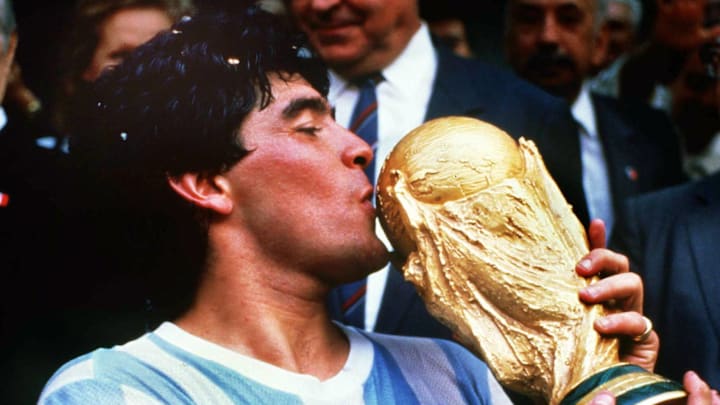
There have been 23 World Cups since 1930.
While each has been special in its own way—whether for historical significance, political context, or unforgettable individual moments—some have undeniably stood above the rest.
From breathtaking goals and jaw-dropping twists to unforgettable drama and stirring underdog stories—or, in the very best cases, all of those elements rolled into one—the World Cup at its peak represents the pinnacle of sporting history.
Here, Sports Illustrated ranks the greatest World Cups of all time.
Ranking Criteria
- Goals: This is what everyone comes to a game for.
- Memorable games: Every great tournament needs a few standout clashes.
- Iconic players: The legend of a World Cup is built on its stars.
10. 2022

The 2022 World Cup in Qatar was mired in controversy long before kickoff: Allegations of corruption in the host selection, criticism of Qatar’s treatment of foreign workers—including forced labor, poor working conditions and deaths—concerns over LGBTQ+ rights, and the unprecedented move to November to avoid extreme heat.
All of that cast a shadow over the tournament, yet on the pitch, there was little to complain about.
It became the highest-scoring World Cup in history, featured Morocco’s remarkable underdog run, stunning goals from the likes of Vincent Aboubakar and Neymar, and Lionel Messi—the greatest player in soccer history—ultimately lifting the trophy after arguably the greatest final ever.
9. 2002

Who’d have thought a single haircut could define an entire World Cup? That’s exactly what happened in 2002, when Brazil’s Ronaldo—sporting his bizarre style meant to distract from an injury—fired the Seleção to glory with eight goals, including two in the final against Germany.
Brazil’s triumph was relatively straightforward (aside perhaps from Ronaldinho’s famous looped free kick against England), but the tournament was elsewhere full of surprises.
Defending champions France, traditional powerhouses Argentina and Portugal all went out in the group stage, while South Korea stunned the world by reaching the semifinals, knocking out Italy and Spain along the way.
Türkiye claimed third place, the U.S. men’s national team reached the quarterfinals for the first time, and debutants Senegal captured hearts with a spirited run to the last eight. The only disappointment? Cameroon’s famous sleeveless jerseys were banned by FIFA. Spoil sports.
8. 1966

England fans would no doubt call 1966 the greatest World Cup ever, given it remains the Three Lions’ only triumph—and they wouldn’t be far wrong.
The final was a classic, delivering one of the most famous moments and quotes in soccer history: “They think it’s all over ... it is now,” as Geoff Hurst’s third goal—part of a historic (and still debated) hat-trick—sealed a 4–2 victory over West Germany.
The tournament had already been remarkable, though.
Two-time defending champions Brazil, led by Pelé, were eliminated in the group stage; North Korea shocked the world with a stunning win over Italy; and Portugal’s Eusébio lit up the tournament, scoring nine goals in six matches—one of the finest individual campaigns in World Cup history.
7. 2026

It‘s very rare for so many superstars to come to the fore as they did at the 2026 World Cup.
This was a tournament that threatened to be undermined by Gianni Infantino’s sycophancy for the President of the United States, and there was certainly political indecency at play.
Nevertheless, the soccer, thankfully, did much of the talking. The world’s best dominated the scoring charts, and FIFA’s top-four seeds met in the semifinals for the first time since its world rankings became a thing in 1992.
While the very latter stages lacked a true classic, even if Argentina’s triumph over England was a thrill, the early knockout stages were laden with belters. Debutants Cabo Verde gave the holders an almighty scare, as did Egypt, while Mexico and England played out an utterly captivating tie at the venerated Azteca in the last-16.
Champions Spain was an outstanding victory, conceding just once on its way to glory. Despite La Roja’s defensive sturdiness, this World Cup boasted the highest number of goals per match since 1970 (2.96)—aided by the exhibition-like third-place playoff between England and France.
6. 1974

In the summer of 1974, Total Football reached its zenith—and was then dismantled by two of Germany’s greatest ever players: Franz Beckenbauer and Gerd Müller. That storyline alone earns the ’74 World Cup its place on this list.
Johan Cruyff had led arguably the most exhilarating side in history to the final, where they faced hosts West Germany. The Dutch dazzled the world with their fluid, positional, interchangeable style, but Beckenbauer’s authority and Müller’s ruthless efficiency proved a step too far. West Germany ran out 2–1 winners, imposing their structure and steel on the sport’s great idealists as Müller scoring the decisive goal.
Though the tournament is often remembered for the Netherlands’ downfall (and their reported “pool party” just days before the final), there was plenty more to savor.
Poland finished third, defeating defending champion Brazil thanks to a goal from Grzegorz Lato, who claimed the Golden Boot. Scotland somehow exited unbeaten, even drawing with Brazil, while East Germany stunned their western neighbors in the group stage—the only time the two met in major international competition.
5. 2006

The 2006 World Cup is often remembered for Zinedine Zidane’s infamous headbutt on Marco Materazzi in the final—an unforgettable sign-off for the legendary Frenchman—as Italy lifted the trophy for the first time since 1982.
But the tournament deserves more credit than just that moment.
It featured several so-called “golden generations” battling for soccer’s ultimate prize. France boasted Zidane, Patrick Vieira and Thierry Henry; Italy had Fabio Cannavaro, Francesco Totti and Andrea Pirlo; Brazil featured Ronaldo, Ronaldinho and Kaká; and England relied on David Beckham, Steven Gerrard and John Terry.
The stars delivered. The tournament was packed with shocking moments—like Graham Poll’s infamous triple booking of Josip Šimunić—memorable goals, such as Argentina’s sweeping team strike against Serbia & Montenegro, and utterly brilliant matches, none more so than Italy vs. Germany in the semifinals.
4. 1998

The first World Cup with 32 teams, France 1998 had it all—goals, upsets and drama at every turn.
Debutants Croatia shocked the world by finishing third, thanks in no small part to Davor Šuker’s tournament-high six goals. Nigeria, featuring stars like Jay-Jay Okocha and Nwankwo Kanu, also caused a stir, topping their group ahead of Spain before eventually falling to Denmark.
England’s round of 16 clash with Argentina was thrilling: A young Michael Owen announced himself to the world with a brilliant solo goal, but David Beckham’s infamous red card for kicking Diego Simeone followed, as did the Three Lions’ exit on penalties.
The quarterfinals delivered classics, including Dennis Bergkamp’s sublime late winner as the Netherlands edged Argentina, but it was the final that brought the biggest spectacle.
Ahead of the match, Brazil’s talisman Ronaldo was mysteriously left off the first team sheet, only to reappear just before kickoff—yet he had little impact, clearly not fully fit. Hosts France triumphed 3–0, with Zinedine Zidane scoring twice and stealing the spotlight.
3. 1986

The 1986 World Cup was defined by one man: Diego Armando Maradona.
Just as he carried Napoli to two Serie A titles, Maradona propelled Argentina to their second World Cup with a series of breathtaking performances and unforgettable goals.
The quarterfinals against England produced two of the most iconic moments in soccer history. First came the infamous “Hand of God” goal—controversial yet unforgettable—followed minutes later by his mesmerizing solo run, weaving past almost the entire English defense before finishing with sublime precision.
He then added a brilliant brace against Belgium in the semifinals before assisting Jorge Burruchaga’s decisive goal in the final against West Germany—cementing his status as the most influential soccer player of his generation.
2. 1970

The 1970 World Cup in Mexico was a tournament of firsts and lasts—a transitional moment for soccer that bid farewell to its formative years and welcomed a new global dawn.
It was the first World Cup broadcast in color, the first with a Panini sticker album, the first to feature the iconic adidas Telstar ball, the first held outside Europe and South America, and the first for German legend Gerd Müller, who would go on to fire his country to the title four years later.
In terms of lasts, it marked the farewell of the Jules Rimet Trophy and several of the sport’s greats—Lev Yashin, Bobby Charlton, Bobby Moore, Uwe Seeler—and most notably Pelé, who bounced back from the disappointment of 1966 to win a third World Cup for Brazil, securing the trophy for good (though it was later stolen and never recovered).
Brazil and Pelé, of course, were the stars of the show, romping to victory and demolishing every team in their path, cementing their reputation as the greatest international side of all time and producing what many consider the greatest team goal ever in the final.
But there were other memorable moments too: Peru enjoyed an impressive run to the knockout stages, led by Teófilo Cubillas, while the “Game of the Century” saw Italy edge West Germany 4–3 in extra time after a 1–1 stalemate in regulation during the semifinals.
1. 1982

There are a few reasons why the 1982 World Cup is the greatest of all time.
First, the star power was unmatched. Diego Maradona made his World Cup debut, even if Argentina didn’t progress past the second group stage. Michel Platini led France to the semifinals, West Germany featured Karl-Heinz Rummenigge and Lothar Matthäus, England had Kevin Keegan, Scotland boasted Kenny Dalglish and Czechoslovakia had Antonín Panenka.
So brimming with talent was the tournament that even Brazil—boasting the likes of Sócrates, Zico and Falcão—didn’t even make the semifinals.
Second, the underdog stories were unforgettable. Five nations—Algeria, Cameroon, Honduras, Kuwait, and New Zealand—made their debuts. Algeria famously shocked West Germany 2–1, while Northern Ireland topped Spain in the group stage.
Third, the semifinals produced one of the greatest matches in World Cup history. The “Night of Seville” between France and West Germany ended 3–3 after extra time, with four of the goals coming in the added period, and was decided on penalties, where Horst Hrubesch calmly scored the decisive kick.
Finally, Italy’s Paolo Rossi stole the show. The tournament’s top scorer with six goals, he tore Brazil apart with a sensational hat-trick in the second group stage, then opened the scoring in the final as Italy beat West Germany 3–1. And who could forget Marco Tardelli’s iconic celebration after Italy’s second goal—pure soccer magic frozen in time.
Simply put, no World Cup before or since has ever reached the sheer brilliance of 1982.
READ THE LATEST WORLD CUP NEWS, PREVIEWS & ANALYSIS HERE
 Add us as a preferred source on Google
Barnaby Lane, better known as Barney, is a soccer writer for SI FC. With nearly a decade of experience in the industry, he has worked for a range of household-name publications in both the United States and the United Kingdom, and has interviewed some of the world’s biggest athletes—from Usain Bolt and Rafael Nadal to Christian Pulisic (though his favorite interview remains Adebayo Akinfenwa). Barney specializes in Premier League soccer, covering everything from the nostalgia of years gone by to the modern, vastly different landscape of today’s game. He also has experience reporting on La Liga and Major League Soccer, the latter of which he developed a particular affinity for during his university days at Virginia Commonwealth University in Richmond.