%20%20--%3E%0A%3Csvg%20version%3D%221.1%22%20id%3D%22Layer_1%22%20xmlns%3D%22http%3A%2F%2Fwww.w3.org%2F2000%2Fsvg%22%20xmlns%3Axlink%3D%22http%3A%2F%2Fwww.w3.org%2F1999%2Fxlink%22%20x%3D%220px%22%20y%3D%220px%22%0A%09%20width%3D%2239px%22%20height%3D%2240px%22%20viewBox%3D%220%200%2039%2040%22%20enable-background%3D%22new%200%200%2039%2040%22%20xml%3Aspace%3D%22preserve%22%3E%0A%3Cpath%20fill%3D%22%23FFFFFF%22%20d%3D%22M38.5%2C7H28.2v26h10.3V7z%22%2F%3E%0A%3Cpath%20fill-rule%3D%22evenodd%22%20clip-rule%3D%22evenodd%22%20fill%3D%22%23FFFFFF%22%20d%3D%22M26.1%2C25.5c0%2C5.8-4.1%2C7.5-12.9%2C7.5C3.9%2C33%2C0%2C31.2%2C0%2C25.2v-1.1h11.6%0A%09v2.4c0%2C0.7%2C0.1%2C1.4%2C1.2%2C1.4c1%2C0%2C1.2-0.4%2C1.2-1.3v-0.9c0-1.6-0.9-1.6-3.5-2.2C2.2%2C21.7%2C0%2C19.7%2C0%2C15.3v-0.9C0%2C9.3%2C5.5%2C7%2C12.9%2C7%0A%09c10.2%2C0%2C12.8%2C2.6%2C12.8%2C7.4v1.8h-11v-2.9c0-0.6-0.4-1.1-1.2-1.1c-0.6%2C0-1.2%2C0.4-1.2%2C1.1v0.9c0%2C1.5%2C0.9%2C2%2C3.3%2C2.5%0A%09c8%2C1.6%2C10.5%2C3.3%2C10.5%2C7.5V25.5z%22%2F%3E%0A%3C%2Fsvg%3E%0A)
Brazil’s 1998 World Cup Squad: Where Are They Now?
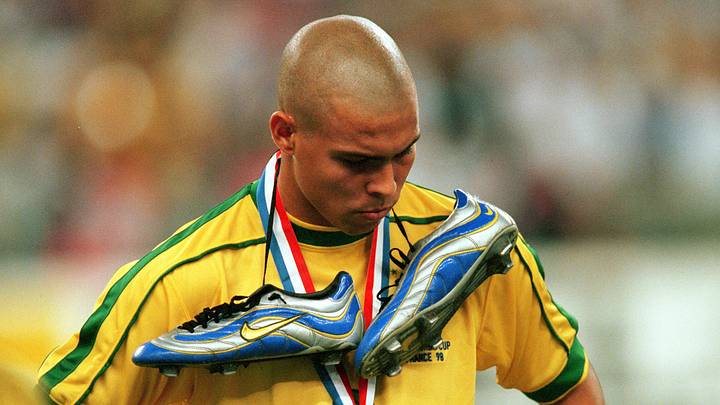
After winning the 1994 World Cup, Brazil headed to France four years later as favorite to lift the trophy once again.
Led by Ronaldo Nazário at the peak of his powers and boasting a squad packed with world-class talent—including Cafu, Roberto Carlos, Rivaldo and more—few could see anyone stopping the Seleção.
And up until the final, they largely didn’t. Brazil topped its group, although it did suffer a shock defeat to Norway in its final group match, before progressing past Chile, Denmark and the Netherlands to reach the final against the hosts. There, however, it ultimately came undone in a 3-0 defeat as France lifted the trophy for the first time.
So where are the members of that Brazil squad that came so close to glory in 1998 today? Let’s take a look.
Goalkeepers
Cláudio Taffarel

Brazil’s most-capped goalkeeper ever, Cláudio Taffarel, was the Seleção’s No. 1 at the 1998 World Cup, playing every minute of the tournament.
A two-time Copa América winner in 1989 and 1997, he also enjoyed club spells with Parma, Atlético Mineiro and Galatasaray before retiring in 2003.
Today, he has returned to the national setup as Brazil’s goalkeeping coach.
Dida

Dida’s 1998 World Cup was his first, with the 24-year-old representing Cruzeiro in Brazil at the time.
Although he did not feature in France, he went on to earn 91 caps for his country before retiring in 2015, having won the 2002 World Cup and enjoyed a hugely successful club career with AC Milan, where he spent more than a decade and lifted the Champions League twice.
He later returned to Milan as goalkeeping coach between 2020 and 2022 and remains involved with the club as an ambassador.
Carlos Germano

Another unused goalkeeper at the tournament, Carlos Germano would go on to make just nine appearances for Brazil during his career, which was spent entirely in his home country with a number of clubs, most notably Vasco da Gama, where he remains closely involved to this day, also working in the media.
Defenders
Cafu

The most-capped player in the history of the Brazil national team, and ultimately the captain who lifted the trophy in 2002, Cafu was Brazil’s starting right back at the 1998 World Cup. He featured in every match of the tournament except one—the semifinal win over the Netherlands, which he missed through suspension.
A legend at both AS Roma and AC Milan, he retired in 2008 and later dedicated much of his time to philanthropy. Through his Fundação Cafu, he works to promote social inclusion by offering educational support and sporting opportunities to underprivileged children.
Aldair

Considered one of Brazil’s greatest defenders of all time, Aldair earned 81 caps for his country and played in all seven matches at the 1994 World Cup, starting every game except the opening fixture against Russia.
At club level, he spent the majority of his career with AS Roma in Italy, where he also wore the captain’s armband and lifted the Serie A title in 2001.
While he is less frequently in the spotlight today, Aldair remains closely connected with Roma and still takes part in exhibition matches across both Europe and Brazil.
Júnior Baiano

Júnior Baiano played every minute of the 1998 World Cup at center back, mainly alongside Aldair, but he never appeared for Brazil again after the tournament.
Across his club career, he turned out in Germany, China, the United States and throughout Brazil, though he is perhaps best remembered for his short spell at Werder Bremen, which ended abruptly after his contract was terminated following an on-pitch incident in which he punched an opponent during a match.
After retiring in 2009, he had a brief spell in management before moving into youth development and media work. He has remained particularly closely involved with his former club Flamengo.
Roberto Carlos

Named in FIFA’s All-Star team for the 1998 World Cup, Roberto Carlos was another ever-present throughout the tournament, impressing with his explosive, dynamic performances at left back.
The Real Madrid legend went on to make 370 La Liga appearances for Los Blancos between 1996 and 2007, becoming one of the defining full backs of his generation.
Today, he serves as a club ambassador for Madrid, while also regularly featuring in charity matches around the world—and even turning out for a Shrewsbury pub team in January 2022, a curious postscript to a career that included a brief and largely unsuccessful spell in management.
Zé Carlos

Zé Carlos was called up to Brazil’s 1998 World Cup squad despite having never previously been named in a senior international squad, stepping in as a late replacement for Flávio Conceição.
He went on to feature in the semifinal against the Netherlands after Cafu was suspended—a match that ultimately proved to be his only appearance for his country.
After retiring in 2005, he has largely lived a quiet life, though he still occasionally laces up his boots for amateur matches at a local level.
Gonçalves

A Copa América winner with Brazil in 1997, Gonçalves was primarily a squad player at the 1998 FIFA World Cup, making appearances only against Norway and Chile.
The former Botafogo and Vasco da Gama center back retired just a year after the tournament, having earned 24 caps for his country. Today, he remains involved in the game as the executive director of Estácio de Sá, a Rio de Janeiro-based soccer club.
André Cruz

André Cruz played for several major clubs during his career, including AC Milan, Napoli, Sporting CP, Standard Liège and Flamengo, while also earning 31 caps for Brazil—though none of those came at the 1998 World Cup, where he remained an unused substitute throughout the tournament.
After retiring from professional soccer, he moved into public service and today serves as the head of the economic development office in Santa Bárbara d’Oeste, near Campinas.
Midfielders
César Sampaio

César Sampaio is remembered for scoring the very first goal of the tournament in the fourth minute of Brazil’s opening match against Scotland, as well as netting a brace in the 4-1 round of 16 win over Chile.
A defensive midfielder known for blending tough tackling with intelligent distribution, he went on to earn 47 caps for Brazil during his career.
After retiring, he moved into coaching, taking on various roles including assistant coach of the Brazil national team, as well as spells with Flamengo and Santos, his boyhood club.
Giovanni

The highly talented Giovanni enjoyed a brief but memorable international career, earning just 18 caps for Brazil—scoring six goals in the process—though he featured only once at the 1998 World Cup.
At club level, he also had a short but impactful spell at Barcelona, where at his peak he was considered one of the team’s standout performers. His time in Spain, however, ended on a sour note after a high-profile fallout with head coach Louis van Gaal, whom he famously labelled an “egomaniac,” before being sold to Olympiacos, where he would go on to become a club favorite.
These days, he remains occasionally active in the media, most notably for calling Brazil and Real Madrid star Vinicius Jr. a “limited athlete”—a reminder that even in retirement, he hasn’t lost his outspoken and controversial edge.
Dunga

Dunga captained Brazil to World Cup glory in 1994 and retained the armband for the 1998 tournament. Despite being 34 and playing club soccer in Japan at the time, he showed no signs of decline, featuring in every minute of Brazil’s campaign, providing two assists and earning a place in the tournament’s All-Star team.
He retired from international soccer immediately after the World Cup and stepped away from the game entirely in 2000.
Dunga later returned to manage Brazil across two separate spells, guiding them to Copa América success in 2007. Today, he remains involved in soccer through media work and various roles connected to FIFA.
Emerson

Emerson’s résumé is an impressive one, with the Brazilian midfielder turning out for Bayer Leverkusen, Roma, Juventus, Real Madrid and AC Milan during his playing career, collecting multiple domestic and European honors along the way.
At the 1998 World Cup, he was a late replacement for Romário following injury, although he went on to make just two substitute appearances against Denmark and the Netherlands.
He eventually ended his international career with 73 caps to his name, briefly also wearing the captain’s armband.
After retiring in 2009, he made a surprise return to the game with American lower-league side Miami Dade FC for a few years in 2015. These days, he occasionally appears in the media and has also become an investor in construction company Arbor Build Group in Florida.
Zé Roberto

Zé Roberto played just three minutes at the 1998 World Cup, coming on as a late substitute against Denmark in the quarterfinals, but that brief appearance was still enough to secure a move to Bayer Leverkusen, where he enjoyed four successful seasons before joining Bayern Munich for another six years, winning four Bundesliga titles with the Bavarians.
He retired in 2017 with 84 caps for Brazil to his name, having built a reputation as one of the most professional and durable players of his generation.
Today, he has reinvented himself as a fitness influencer in Brazil, amassing millions of followers on Instagram—and, remarkably, still looks like he could step back onto the pitch even in his 50s.
Leonardo

Former Brazil international Leonardo earned 55 caps for his country, including four appearances at the 1994 World Cup. He featured in Brazil’s opening four matches but was ruled out for the remainder of the tournament after being sent off against the United States for an elbow on Tab Ramos, an incident that left Ramos with a skull fracture and Leonardo facing a lengthy suspension.
Since retiring, he has moved into administration, working in senior roles at both Paris Saint-Germain and AC Milan, as well as taking on short managerial spells with Milan and later rivals Inter.
Doriva

Doriva earned 12 caps for Brazil during his career, with just one of those coming at the 1998 World Cup, when he made a brief appearance in Brazil’s second group match against Morocco.
The former Middlesbrough and Porto midfielder went on to have a long managerial career in Brazil after retiring, taking charge of several clubs including São Paulo, Vasco da Gama and Bahia—though with relatively limited success.
Denílson

A modern-day Real Betis legend, Denílson featured in every game of the 1998 World Cup, used both as a substitute and starter, and registered assists in matches against Norway and Chile.
After leaving Betis in 2005, his career largely tailed off, aside from a strong season with Bordeaux in 2005–06. He eventually retired in 2009 following short spells in Saudi Arabia, the United States and Vietnam.
However, he briefly returned to the pitch at the age of 44 for lower-league side Ibis Sport Club in 2022, and today works as a commentator and pundit.
Forwards
Rivaldo

Rivaldo was one of the standout stars of the 1998 World Cup, scoring three goals—one against Morocco in the group stage and a crucial brace in the 3–2 win over Denmark—and earning a place in the tournament’s All-Star team.
The former Barcelona and Olympiacos playmaker continued his club career until the age of 43, finally retiring in 2015 after spells in countries including Uzbekistan and Angola to extend his playing days.
Since hanging up his boots, he has remained active in soccer, supporting his son’s professional career, holding a shareholder role at Farul Constanța and previously serving as president of his boyhood club Mogi Mirim.
Bebeto

One of the standout figures at the 1994 World Cup, Bebeto returned four years later at the age of 34 and still played an important role for Brazil. He finished the tournament with three goals and two assists before retiring from international duty immediately after the competition.
A club legend at Deportivo La Coruña, he later transitioned into politics, serving as a state deputy in Rio de Janeiro for both the Democratic Labour Party (PDT) and later Solidarity (SD).
Edmundo

Edmundo made two substitute appearances at the 1998 World Cup, and ultimately finished his international career with 42 caps and 10 goals.
Nicknamed “O Animal” for his aggressive playing style, combative edge and well-known tendency to pick up bookings—along with his controversial personality off the pitch—he built a career that took him from Vasco da Gama to clubs including Fiorentina, Napoli and Tokyo Verdy, before retiring in 2008.
Since hanging up his boots, Edmundo has moved into media work, running his own YouTube channel, and has also, like Bebeto, ventured into politics, standing as a candidate for federal deputy in Rio de Janeiro.
Ronaldo

Ronaldo won the Golden Ball at the 1998 World Cup after scoring four goals, but it is the controversy surrounding his involvement in the final that is most often remembered.
Initially omitted from the starting lineup just over an hour before kick-off, confusion quickly spread among fans and media. Shortly before the match began, however, he was reinstated after insisting he felt fit enough to play.
His performance in the final, though, fell short of his usual standards, and it later emerged that he had suffered a seizure the night before the match. The circumstances sparked widespread speculation and debate that lingered for years.
Ronaldo would later return to the World Cup stage in 2002, where he finished as top scorer and led Brazil to the title, completing a remarkable redemption story—but the mystery surrounding that 1998 final has never fully faded.
After his retirement, Ronaldo moved into ownership, taking charge of Spanish outfit Real Valladolid for seven years between 2018 and 2025.
Manager: Mário Zagallo

Considered one of the greatest international managers of all time, Mário Zagallo coached Brazil across several different spells, most famously guiding the legendary 1970 side featuring Pelé and Jairzinho to World Cup glory.
He stepped down following Brazil’s defeat to France in the 1998 World Cup final and later had further coaching roles with Portuguesa and Flamengo, before briefly returning as Brazil’s caretaker manager in 2002 ahead of his retirement from coaching.
Zagallo passed away on Jan. 5, 2024, aged 92.
READ THE LATEST WORLD CUP NEWS, PREVIEWS & ANALYSIS HERE
 Add us as a preferred source on Google
Barnaby Lane, better known as Barney, is a soccer writer for SI FC. With nearly a decade of experience in the industry, he has worked for a range of household-name publications in both the United States and the United Kingdom, and has interviewed some of the world’s biggest athletes—from Usain Bolt and Rafael Nadal to Christian Pulisic (though his favorite interview remains Adebayo Akinfenwa). Barney specializes in Premier League soccer, covering everything from the nostalgia of years gone by to the modern, vastly different landscape of today’s game. He also has experience reporting on La Liga and Major League Soccer, the latter of which he developed a particular affinity for during his university days at Virginia Commonwealth University in Richmond.