%20%20--%3E%0A%3Csvg%20version%3D%221.1%22%20id%3D%22Layer_1%22%20xmlns%3D%22http%3A%2F%2Fwww.w3.org%2F2000%2Fsvg%22%20xmlns%3Axlink%3D%22http%3A%2F%2Fwww.w3.org%2F1999%2Fxlink%22%20x%3D%220px%22%20y%3D%220px%22%0A%09%20width%3D%2239px%22%20height%3D%2240px%22%20viewBox%3D%220%200%2039%2040%22%20enable-background%3D%22new%200%200%2039%2040%22%20xml%3Aspace%3D%22preserve%22%3E%0A%3Cpath%20fill%3D%22%23FFFFFF%22%20d%3D%22M38.5%2C7H28.2v26h10.3V7z%22%2F%3E%0A%3Cpath%20fill-rule%3D%22evenodd%22%20clip-rule%3D%22evenodd%22%20fill%3D%22%23FFFFFF%22%20d%3D%22M26.1%2C25.5c0%2C5.8-4.1%2C7.5-12.9%2C7.5C3.9%2C33%2C0%2C31.2%2C0%2C25.2v-1.1h11.6%0A%09v2.4c0%2C0.7%2C0.1%2C1.4%2C1.2%2C1.4c1%2C0%2C1.2-0.4%2C1.2-1.3v-0.9c0-1.6-0.9-1.6-3.5-2.2C2.2%2C21.7%2C0%2C19.7%2C0%2C15.3v-0.9C0%2C9.3%2C5.5%2C7%2C12.9%2C7%0A%09c10.2%2C0%2C12.8%2C2.6%2C12.8%2C7.4v1.8h-11v-2.9c0-0.6-0.4-1.1-1.2-1.1c-0.6%2C0-1.2%2C0.4-1.2%2C1.1v0.9c0%2C1.5%2C0.9%2C2%2C3.3%2C2.5%0A%09c8%2C1.6%2C10.5%2C3.3%2C10.5%2C7.5V25.5z%22%2F%3E%0A%3C%2Fsvg%3E%0A)
Brazil 2006 World Cup Squad: Where Are They Now?
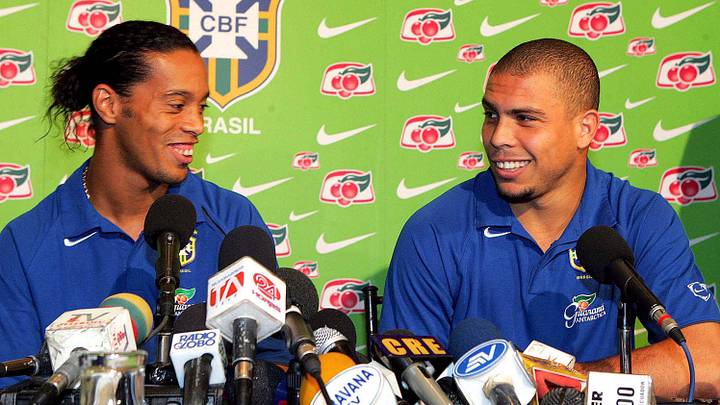
After lifting the 2002 World Cup, Brazil arrived at the 2006 tournament as the team to beat.
It’s easy to see why. Ronaldo, Ronaldinho, Kaká, Roberto Carlos, Cafu, Adriano ... the list of talent seemed endless. On paper, it was one of the most gifted rosters ever assembled.
For all its samba flair and world-class quality, however, the Seleção ultimately fell short of expectations. Brazil cruised through the group stage with victories over Croatia, Australia and Japan, before comfortably dispatching Ghana in the Round of 16. But in the quarterfinals, old rival France once again proved its undoing, with Thierry Henry’s strike sealing a 1-0 victory and ending Brazil’s hopes of glory.
Despite the disappointing finish, that Brazilian side—the face of Nike’s beloved Joga Bonito era—remains one of the most fondly remembered teams in World Cup history, whether you support Brazil or not.
So where are the members of that star-studded 2006 squad today? Let’s take a look.
Goalkeepers
Dida

The 2006 World Cup was Dida’s third appearance at the tournament with Brazil, but it was the first time he held the role of first-choice goalkeeper. He started every match in Germany and even captained the Seleção in the final group game against Japan.
Across his international career, he earned 91 caps for Brazil, retiring in 2015 after a glittering spell that included winning the 2002 World Cup. At club level, he enjoyed major success with AC Milan, where he spent over a decade and lifted the Champions League trophy twice.
Following his playing days, he returned to Milan in a coaching capacity as goalkeeping coach from 2020 to 2022, and he continues to be associated with the club as an ambassador.
Rogério Ceni

Famed as the highest-scoring goalkeeper in soccer history with 127 goals, free-kick specialist Rogério Ceni carved out a truly unique legacy in the game. Despite his remarkable and rare skill set, he was never a regular fixture for Brazil, finishing his international career with just 17 caps.
At the 2006 World Cup, his involvement was limited to a brief appearance in the 4–1 group stage win over Japan.
After retiring in 2015, the São Paulo legend transitioned into management, going on to lead several clubs, including São Paulo itself, as well as Flamengo and Bahia, among others.
Júlio César

Júlio César arrived at the 2006 World Cup on the back of a standout breakthrough season with Inter Milan, but it wasn’t enough to dislodge Dida as Brazil’s first-choice goalkeeper, leaving him without any minutes on the pitch during the tournament.
He would, however, go on to establish himself as Brazil’s undisputed No. 1 in later years, eventually earning 87 caps for his country. At club level, he enjoyed a highly decorated spell with Inter, winning five Serie A titles as well as the Champions League.
Since retiring in 2014, Júlio César has worked primarily as a soccer ambassador, maintaining close ties with UEFA, while also appearing regularly as a media pundit.
Defenders
Cafu

Brazil’s most-capped player of all time, Cafu brought his international career to a close after the 2006 World Cup, finishing with an impressive 142 appearances for his country.
A true icon at both AS Roma and AC Milan, he is widely regarded as the greatest right back in soccer history. Cafu officially retired from playing in 2008 and has since devoted much of his life to charitable work—notably through his Fundação Cafu, which focuses on providing education and creating sporting opportunities for underprivileged children.
Lúcio

Just as he had been during Brazil’s 2002 World Cup triumph, Lúcio once again started every match in the heart of the Seleção defense in 2006, playing every minute of the tournament.
At the competition, he also set a remarkable FIFA record by going 386 consecutive minutes without committing a foul—a streak that eventually came to an end in Brazil’s quarterfinal defeat to France.
One of the most underrated defenders of his era, Lúcio spent much of his peak years at Bayer Leverkusen, Bayern Munich and Inter Milan, where he won the treble in 2010. Since retiring, he has largely stepped away from the spotlight to enjoy a quieter family life, though he still makes the occasional media appearance.
Juan

Lúcio’s central defensive partner in 2006, Juan was also part of the Brazil rosters that won Copa América in both 2004 and 2007.
He retired from international duty in 2010, finishing his Brazil career with 79 caps and an impressive seven goals, while continuing to play domestically until 2019, eventually bringing his club career full circle back at boyhood side Flamengo.
The former Bayer Leverkusen and AS Roma defender is now working as a coordinator within the Brazil national team setup.
Roberto Carlos

Like Cafu on the opposite flank, Real Madrid icon Roberto Carlos called time on his international career after the 2006 World Cup.
He initially retired from club soccer in 2012, before briefly coming out of retirement for a spell in India with Delhi Dynamos in 2016, only to hang up his boots again soon after.
A short and ultimately unsuccessful move into management followed, but these days he is better known as a media personality and is regularly seen lacing up his boots for charity matches around the world.
Cicinho

Cicinho, who was representing Real Madrid at the time of the 2006 World Cup, started in Brazil’s group-stage win over Japan and also came on as a late substitute in the defeat to France.
Since retiring in 2016, he has become a pastor, speaking openly about his struggles with alcoholism and depression. At his lowest point, while still playing for Real Madrid, he revealed the extent of his battle with addiction, telling Gazzetta dello Sport: “In one day, I drank 70 beers, 15 caipirinhas and smoked two packs of cigarettes.”
Luisão

Benfica legend Luisão did not feature at all during the 2006 World Cup—a pattern that would repeat in 2010 as well. Despite that, he still built a strong international career, earning 44 caps for Brazil and playing a role in squads that won the 2004 Copa América and the 2005 and 2009 FIFA Confederations Cups.
Since retiring in 2019, Luisão has moved into media work while also pursuing ambitions in soccer administration through the Federação Paulista de Futebol (FPF).
Cris

Cruzeiro and Lyon cult hero Cris earned 17 caps for Brazil during his career, although none came at the 2006 World Cup, where he remained an unused substitute throughout the tournament.
After retiring, he moved into management, taking charge of several lower-league clubs in France including GOAL FC, Le Mans and Versailles.
Gilberto

Gilberto, the first Brazilian to feature for Tottenham Hotspur’s senior team, made only a small number of appearances for the north London side but is more fondly remembered for his spells with Grêmio, Flamengo and Hertha Berlin—the latter of which made him something of a cult figure among fans.
At the 2006 World Cup, he started at left back in Brazil’s group game against Japan, delivering an eye-catching performance with both a goal and an assist.
In 2018, he spoke to ESPN about plans to open a soccer academy in Rio de Janeiro and explore a possible partnership with a European club, though he has since largely stepped away from the spotlight.
Midfielders
Emerson

At the 2006 World Cup, Emerson played in three of Brazil’s five matches—featuring in group-stage wins over Croatia and Australia, before appearing again in the Round of 16 victory over Ghana.
He stepped away from international soccer shortly after the tournament.
Emerson built an impressive club career across Europe, representing Bayer Leverkusen, Roma, Juventus, Real Madrid and AC Milan, and collecting major domestic and European honors along the way.
After retiring in 2009, he briefly returned to the game with American lower-league side Miami Dade FC. These days, he appears occasionally in the media and has also invested in Florida-based construction company Arbor Build Group.
Kaká

Widely considered one of the greatest midfielders of his generation, Kaká was a key figure for Brazil at the 2006 World Cup, notably scoring the only goal in a 1–0 opening win over Croatia.
Although he couldn’t lead the Seleção all the way to the title, the following year he was awarded the Ballon d’Or after a brilliant season with AC Milan, capped by a Champions League triumph.
Later moves to Real Madrid and Orlando City followed, before he retired in 2017. Since then, he has worked as a global soccer ambassador, brand representative and strategic partner for international academies such as the Right To Dream Academy in San Diego. He also still occasionally turns out for the odd seven-a-side match in London.
Ronaldinho

Ronaldinho started every game for Brazil at the 2006 World Cup, earning five of his 97 caps during the tournament.
The Barcelona legend retired in 2015 and has certainly stayed busy ever since. Alongside a brief and bizarre spell in a Paraguayan prison for using false documents, he has explored a range of ventures from cryptocurrency to Hollywood projects, while also turning up at charity matches across the globe to remind everyone how good he is.
Zé Roberto

Zé Roberto was the only Brazilian player named in FIFA’s All-Star team at the 2006 World Cup, with the Bayer Leverkusen and Bayern Munich cult hero featuring in every match and also scoring in the 3–0 win over Ghana.
He retired from international soccer in 2017 with 84 caps for Brazil, and has since reinvented himself as a fitness influencer, building a huge following on social media.
Mineiro

Carlos Luciano da Silva, better known as Mineiro, was a late addition to Brazil’s 2006 World Cup squad, drafted in to replace the injured Edmílson, but he did not feature in any matches.
During his club career, he represented sides including São Paulo, Schalke 04 and briefly Chelsea, before retiring in 2008. Since then, he has settled into a quieter life in Australia with his family, having relocated there in 2019.
Gilberto Silva

Part of Arsenal’s legendary “Invincibles” squad of the 2003–04 season, Gilberto Silva played a key role for Brazil at the 2006 World Cup, featuring in all but the opening match of the tournament. After Brazil’s exit against France, he even faced calls from teammate Juninho to consider retirement—advice he ultimately ignored, continuing on with the Seleção until 2010.
He retired from professional soccer in 2013 and has since worked as a pundit, served as technical director at Panathinaikos and currently acts as an ambassador for both Arsenal and FIFA.
Juninho Pernambucano

Lyon legend and free-kick specialist Juninho Pernambucano took his own advice and retired from international soccer after the 2006 World Cup, ending his Brazil career with 40 caps and six goals.
He continued playing at club level until 2013, retiring after spells with the New York Red Bulls and Vasco da Gama. After hanging up his boots, he moved into soccer administration, later becoming technical director at Lyon before leaving the role in 2021.
Ricardinho

Ricardinho made substitute appearances against Japan and Ghana at the 2006 World Cup, providing an assist in the latter—his final outing for the Seleção.
At club level, he featured for Corinthians, São Paulo, Santos, Beşiktaş and Bordeaux, among others, before retiring in 2011. He then moved into coaching, taking charge of several lower-division sides in his home country.
Forwards
Adriano

Once regarded as one of the most feared strikers in world soccer, Adriano scored twice at the 2006 World Cup against Australia and Ghana, adding to his tally of 27 goals for Brazil.
However, after the tournament, his career sadly began to unravel. A combination of injuries, struggles with alcohol and mental health challenges—deeply affected by the loss of his father in 2004—derailed what many believed could have been a truly legendary trajectory.
These days, Adriano lives a quieter life back in his hometown of Vila Cruzeiro. In a candid Players’ Tribune reflection, he admitted to “drinking to oblivion” with friends in the favela, offering a raw and honest glimpse into his life after soccer.
Ronaldo

After starring at both the 1998 and 2002 tournaments, Ronaldo delivered once again in 2006, scoring three goals to become the World Cup’s all-time leading scorer with 15 goals at the time—a record later surpassed by Miroslav Klose.
After the tournament, injuries gradually caught up with him, and his career wound down with AC Milan and Corinthians before he retired at 34.
Since then, Ronaldo has taken on a variety of ventures. He became a majority owner of Spanish side Real Valladolid, a role he held for seven years before selling his stake in May 2025 after a mixed reception from supporters. He has also explored interests in motorsport as a team owner, played professional poker and even made a cameo appearance on The Simpsons.
Fred

Before the Fred who had an underwhelming spell at Manchester United, there was the Fred who shone for Lyon, Fluminense and Brazil, finishing his career with over 400 goals across club and country, including 18 for the Seleção and one at the 2006 World Cup.
He retired in 2022 and has since been working towards UEFA coaching qualifications.
Robinho

Once regarded as one of the most gifted talents in world soccer, Robinho’s legacy has taken a stark and deeply troubling turn.
The former Brazil international is now serving a nine-year prison sentence in Brazil after being convicted of involvement in the 2013 rape of a 22-year-old Albanian woman at a Milan nightclub.
Manager: Carlos Alberto Parreira

Carlos Alberto Parreira had three separate spells in charge of Brazil—first in 1983, then from 1991 to 1994, when he stepped down after World Cup success, and again between 2003 and 2006, leading the Seleção at another tournament.
He also holds the rare distinction of managing four different nations at World Cups: Kuwait in 1982, the United Arab Emirates in 1990, Saudi Arabia in 1998 and South Africa in 2010.
A title-winning coach with Fluminense, Fenerbahçe and Corinthians, Parreira retired from management in 2010 and is now enjoying life in his 80s.
READ THE LATEST WORLD CUP NEWS, ANALYSIS AND INSIGHT FROM SI FC
 Add us as a preferred source on Google
Barnaby Lane, better known as Barney, is a soccer writer for SI FC. With nearly a decade of experience in the industry, he has worked for a range of household-name publications in both the United States and the United Kingdom, and has interviewed some of the world’s biggest athletes—from Usain Bolt and Rafael Nadal to Christian Pulisic (though his favorite interview remains Adebayo Akinfenwa). Barney specializes in Premier League soccer, covering everything from the nostalgia of years gone by to the modern, vastly different landscape of today’s game. He also has experience reporting on La Liga and Major League Soccer, the latter of which he developed a particular affinity for during his university days at Virginia Commonwealth University in Richmond.