%20%20--%3E%0A%3Csvg%20version%3D%221.1%22%20id%3D%22Layer_1%22%20xmlns%3D%22http%3A%2F%2Fwww.w3.org%2F2000%2Fsvg%22%20xmlns%3Axlink%3D%22http%3A%2F%2Fwww.w3.org%2F1999%2Fxlink%22%20x%3D%220px%22%20y%3D%220px%22%0A%09%20width%3D%2239px%22%20height%3D%2240px%22%20viewBox%3D%220%200%2039%2040%22%20enable-background%3D%22new%200%200%2039%2040%22%20xml%3Aspace%3D%22preserve%22%3E%0A%3Cpath%20fill%3D%22%23FFFFFF%22%20d%3D%22M38.5%2C7H28.2v26h10.3V7z%22%2F%3E%0A%3Cpath%20fill-rule%3D%22evenodd%22%20clip-rule%3D%22evenodd%22%20fill%3D%22%23FFFFFF%22%20d%3D%22M26.1%2C25.5c0%2C5.8-4.1%2C7.5-12.9%2C7.5C3.9%2C33%2C0%2C31.2%2C0%2C25.2v-1.1h11.6%0A%09v2.4c0%2C0.7%2C0.1%2C1.4%2C1.2%2C1.4c1%2C0%2C1.2-0.4%2C1.2-1.3v-0.9c0-1.6-0.9-1.6-3.5-2.2C2.2%2C21.7%2C0%2C19.7%2C0%2C15.3v-0.9C0%2C9.3%2C5.5%2C7%2C12.9%2C7%0A%09c10.2%2C0%2C12.8%2C2.6%2C12.8%2C7.4v1.8h-11v-2.9c0-0.6-0.4-1.1-1.2-1.1c-0.6%2C0-1.2%2C0.4-1.2%2C1.1v0.9c0%2C1.5%2C0.9%2C2%2C3.3%2C2.5%0A%09c8%2C1.6%2C10.5%2C3.3%2C10.5%2C7.5V25.5z%22%2F%3E%0A%3C%2Fsvg%3E%0A)
England vs. Argentina: Complete Head-to-Head Record
England vs. Argentina is one of international soccer’s greatest rivalries, but despite their long and animosity-driven feud, they have met relatively few times over the years.
Their first-ever collision came all the way back in 1951 and a flurry of battles followed over the next few decades. However, since the turn of the 21st century, they have seldom locked horns.
That’s not to say there haven’t been some seismic clashes between them, though, with the most recent delivering the drama and fireworks expected of such a titanic affair.
Here’s the full head-to-head record between the bitter adversaries.
The Last Time England and Argentina Faced Off

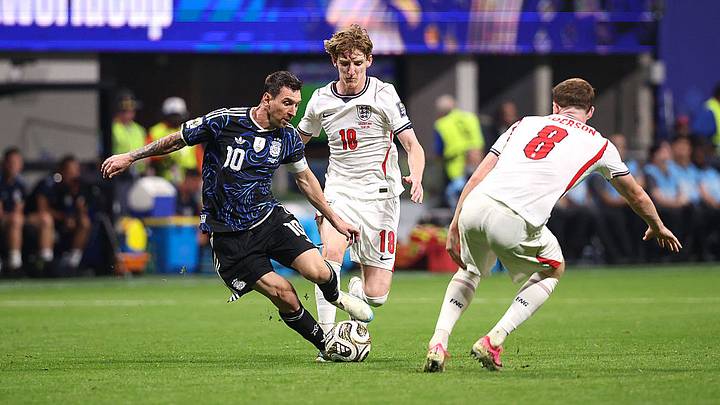
One must only glance back to the 2026 World Cup for the most recent meeting between these historic foes. After both riding their luck en route to the semifinal of the competition, they locked horns at the Mercedes-Benz Stadium in Atlanta for a place in the showpiece event.
Argentina, who contested the tournament as defending champions, had leaned heavily on Lionel Messi’s genius to reach the final four, but Lionel Scaloni decided his side would take an extremely aggressive approach to this particular affair.
Blue jerseys were flying into challenges from the first minute with reckless abandon, but their combative style backfired as England went ahead 10 minutes into the second half via Anthony Gordon’s close-range finish.
Then it was England’s turn to make the match an ugly scrap as Thomas Tuchel ordered his players to sink deeper and deeper. Inviting pressure is never the wisest strategy, however, especially when Messi is lurking.
The eight-time Ballon d’Or winner produced another seismic international display as he turned the match on its head with two last-gasp assists. Enzo Fernández and Lautaro Martínez were the goalscorers as Argentina stunned the Three Lions to edge into the final.
England vs. Argentina at the World Cup
Bad Blood As England Edge Early Encounters

The aforementioned clash in North America was the fifth meeting between the two sides at the World Cup.
The first took place in Chile during the group stage of the 1962 tournament, with England winning 3–1 thanks to goals from Ron Flowers, Bobby Charlton and Jimmy Greaves.
The pair met again four years later in England, with Geoff Hurst’s goal the difference between them in an ill-tempered quarterfinal that helped escalate bad relations between the teams.
Antonio Rattín refused to leave the pitch after being sent off—having reportedly failed to understand the German referee. This incident helped lead to the introduction of yellow and red cards at the next tournament.
England manager Sir Alf Ramsey told his players not to exchange shirts with their opponents after the win and said in a post-match press conference “our best football will come against the right type of opposition—a team who will come to play football, and not act as animals.”
It was an incendiary remark that would harm England’s relationship with not just Argentina but much of South America.
Maradona’s Moment
One of the most iconic goals in #WorldCup history.#OnThisDay in 1986, a moment of pure genius from 🇦🇷 Diego Maradona✨ pic.twitter.com/iVR9upkgYW
— FIFA World Cup (@FIFAWorldCup) June 22, 2019
By far the most famous encounter between the two—and perhaps the most famous match in international soccer history—took place in the quarterfinals of the 1986 World Cup, just four years after the Falklands War.
Diego Maradona opened the scoring by beating England goalkeeper Peter Shilton to a high ball into the box, punching it into the net. The Tunisian referee Ali Bin Nasser, unaware that the Argentina star had used his hand, allowed the goal to stand. The goal became known as the “Hand of God.”
Maradona then claimed a second, this time running half the field and rounding the goalkeeper with an effort that is widely regarded as the best goal in World Cup history. The shirt he wore during the 2–1 victory was later sold at auction for over £7 million ($9.3 million).
Maradona described the 1986 win as “revenge” for the Falklands, though he praised the English players for not resorting to roughhousing during the match.
Beckham Goes From Zero to Hero

Twelve years later, Argentina eliminated England on penalties at the round of 16 stage of the 1998 tournament, after a match that featured a wonder goal from then-18-year-old Michael Owen and David Beckham getting sent off for kicking out at Diego Simeone.
After the match, one English tabloid ran the headline, “Ten heroic lions, one stupid boy,” in reference to Beckham’s dismissal.
The fourth meeting at the World Cup between England and Argentina came in the group stages of the 2002 tournament, with Beckham earning redemption as he scored the game’s only goal from the penalty spot.
England vs. Argentina: Complete Head-to-Head Record
- Matches Played: 15
- England Wins: 6
- Argentina Wins: 4
- Draws: 5
Top Goalscorers in England vs. Argentina
Player | Nation | Goals |
|---|---|---|
Michael Owen | England | 3 |
Mario Kempes | Argentina | 2 |
David Johnson | England | 2 |
Diego Maradona | Argentina | 2 |
Gary Lineker | England | 2 |
 Add us as a preferred source on Google
Andy Headspeath is a Real Madrid correspondent for Sports Illustrated FC. Originally from the UK, the weather, culture and soccer lured him to Spain over a decade ago where he lives with his wife, son and two untrainable dogs. A player of unspeakably limited talents and only one fully functional knee, he has more than a decade's experience in a wide variety of editorial roles within sports media, from match reporting to in-depth feature writing and interviews. He specializes in soccer history and culture, as well as—of course—La Liga.