%20%20--%3E%0A%3Csvg%20version%3D%221.1%22%20id%3D%22Layer_1%22%20xmlns%3D%22http%3A%2F%2Fwww.w3.org%2F2000%2Fsvg%22%20xmlns%3Axlink%3D%22http%3A%2F%2Fwww.w3.org%2F1999%2Fxlink%22%20x%3D%220px%22%20y%3D%220px%22%0A%09%20width%3D%2239px%22%20height%3D%2240px%22%20viewBox%3D%220%200%2039%2040%22%20enable-background%3D%22new%200%200%2039%2040%22%20xml%3Aspace%3D%22preserve%22%3E%0A%3Cpath%20fill%3D%22%23FFFFFF%22%20d%3D%22M38.5%2C7H28.2v26h10.3V7z%22%2F%3E%0A%3Cpath%20fill-rule%3D%22evenodd%22%20clip-rule%3D%22evenodd%22%20fill%3D%22%23FFFFFF%22%20d%3D%22M26.1%2C25.5c0%2C5.8-4.1%2C7.5-12.9%2C7.5C3.9%2C33%2C0%2C31.2%2C0%2C25.2v-1.1h11.6%0A%09v2.4c0%2C0.7%2C0.1%2C1.4%2C1.2%2C1.4c1%2C0%2C1.2-0.4%2C1.2-1.3v-0.9c0-1.6-0.9-1.6-3.5-2.2C2.2%2C21.7%2C0%2C19.7%2C0%2C15.3v-0.9C0%2C9.3%2C5.5%2C7%2C12.9%2C7%0A%09c10.2%2C0%2C12.8%2C2.6%2C12.8%2C7.4v1.8h-11v-2.9c0-0.6-0.4-1.1-1.2-1.1c-0.6%2C0-1.2%2C0.4-1.2%2C1.1v0.9c0%2C1.5%2C0.9%2C2%2C3.3%2C2.5%0A%09c8%2C1.6%2C10.5%2C3.3%2C10.5%2C7.5V25.5z%22%2F%3E%0A%3C%2Fsvg%3E%0A)
FIFA Referee Chief Issues Strong Response to Accusations of Bias Towards Lionel Messi’s Argentina
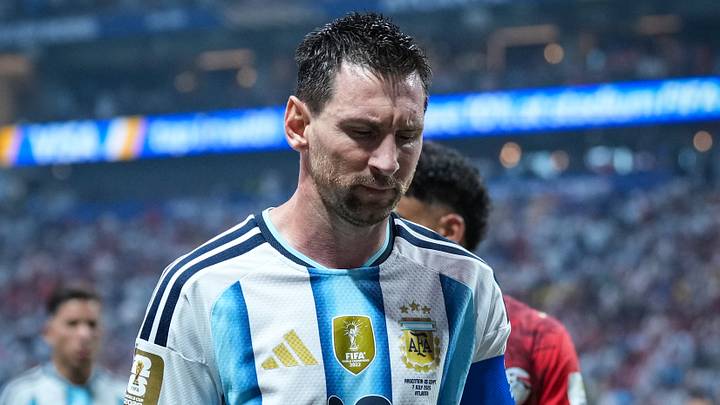
FIFA chief refereeing officer Pierluigi Collina has blasted accusations that officials can be influenced by outside factors following allegations of bias towards Argentina.
The reigning World Cup champion survived an enormous scare in the round of 16 against Egypt, entering the final 11 minutes of the match 2–0 down and with a VAR decision to thank for a decision to rule out a third goal for Egypt.
The Egyptian Football Association filed a formal complaint after the game, accusing referee François Letexier of discriminating against Egypt and echoing claims from manager Hossam Hassan, who claimed “pressures from the Argentina side” and the financial incentive of keeping Lionel Messi in the tournament had seen FIFA intentionally sabotage the match.
“Of course, constructive discussion about decisions will always be part of football, but unfounded allegations have no place in our sport,” Collina bit back.
“Nobody can question the integrity of the FIFA World Cup match officials. When this happens, it may provoke reactions that lead to threats against them and their families. This is not right.
“Equally, nobody can claim that FIFA Refereeing can be influenced by anyone, not even by the FIFA President [Gianni Infantino]. He has always shown his full support for FIFA Team One while trusting us to work with complete independence. Match officials make honest decisions and, just like players and coaches, they always try to do their best.”
FIFA Defends Controversial Decisions in Argentina’s Favor

Egypt’s frustrations appeared to center around two specific incidents during the defeat to Argentina.
Mostafa Ziko, the scorer of Egypt’s second goal, thought he had accomplished that feat nine minutes earlier than he did after finishing off a move that began with some delightful individual play from Haissem Hassan and involved a Mohamed Salah assist.
The goal was, of course, reviewed by VAR and a foul from Marwan Attia on Lisandro Martínez was identified in the build-up, which ultimately saw the goal ruled out.
“After every goal is scored, the VAR checks the attacking possession phase (APP),” Collina continued. “If a foul is identified in the build-up and is deemed to have had an impact on the goal, the VAR will recommend an on-field review. There is no defined limit regarding either the distance from goal or the amount of time between the incident and the goal.
“An example of this came in the Argentina vs. Egypt game where Egypt No. 19 Marwan Attia clearly treads on the foot of Argentina No. 6 Lisandro Martínez.
“We believe that a foul is a foul. Regardless of whether the foul appears ‘obvious,’ if the referee did not see it on the field of play, the VAR can intervene.”
WIN FIFA WORLD CUP 2026™ FINAL TICKETS & OTHER PRIZES

Egyptian fury boiled over in stoppage time when appeals for a penalty were brushed off at the start of the move that led to Enzo Fernández’s 92nd-minute winner.
“If no foul is identified in the build-up to a goal, the VAR will advise the referee accordingly,” Collina concluded. “Stepping on an opponent’s foot is a foul, whereas a defender who touches the ball first and then makes normal football contact has not committed a foul.
“Again, an example of this came at the end of the same game. The referee and the VAR deemed it normal football contact between Egypt No. 10 Mohamed Salah and Argentina No. 10 Julián Álvarez.”
READ THE LATEST WORLD CUP NEWS, ANALYSIS AND INSIGHT FROM SI FC
 Add us as a preferred source on Google
Tom Gott is an associate editor for SI FC, having entered the world of soccer media in early 2018 following his graduation from Newcastle University. He specialises in all things Premier League, with a particular passion for academy soccer, and can usually be found rebuilding your favorite team on Football Manager.
Follow tomgott2