%20%20--%3E%0A%3Csvg%20version%3D%221.1%22%20id%3D%22Layer_1%22%20xmlns%3D%22http%3A%2F%2Fwww.w3.org%2F2000%2Fsvg%22%20xmlns%3Axlink%3D%22http%3A%2F%2Fwww.w3.org%2F1999%2Fxlink%22%20x%3D%220px%22%20y%3D%220px%22%0A%09%20width%3D%2239px%22%20height%3D%2240px%22%20viewBox%3D%220%200%2039%2040%22%20enable-background%3D%22new%200%200%2039%2040%22%20xml%3Aspace%3D%22preserve%22%3E%0A%3Cpath%20fill%3D%22%23FFFFFF%22%20d%3D%22M38.5%2C7H28.2v26h10.3V7z%22%2F%3E%0A%3Cpath%20fill-rule%3D%22evenodd%22%20clip-rule%3D%22evenodd%22%20fill%3D%22%23FFFFFF%22%20d%3D%22M26.1%2C25.5c0%2C5.8-4.1%2C7.5-12.9%2C7.5C3.9%2C33%2C0%2C31.2%2C0%2C25.2v-1.1h11.6%0A%09v2.4c0%2C0.7%2C0.1%2C1.4%2C1.2%2C1.4c1%2C0%2C1.2-0.4%2C1.2-1.3v-0.9c0-1.6-0.9-1.6-3.5-2.2C2.2%2C21.7%2C0%2C19.7%2C0%2C15.3v-0.9C0%2C9.3%2C5.5%2C7%2C12.9%2C7%0A%09c10.2%2C0%2C12.8%2C2.6%2C12.8%2C7.4v1.8h-11v-2.9c0-0.6-0.4-1.1-1.2-1.1c-0.6%2C0-1.2%2C0.4-1.2%2C1.1v0.9c0%2C1.5%2C0.9%2C2%2C3.3%2C2.5%0A%09c8%2C1.6%2C10.5%2C3.3%2C10.5%2C7.5V25.5z%22%2F%3E%0A%3C%2Fsvg%3E%0A)
Soccer Formations: The Best, Most Commonly Used, Styles of Play
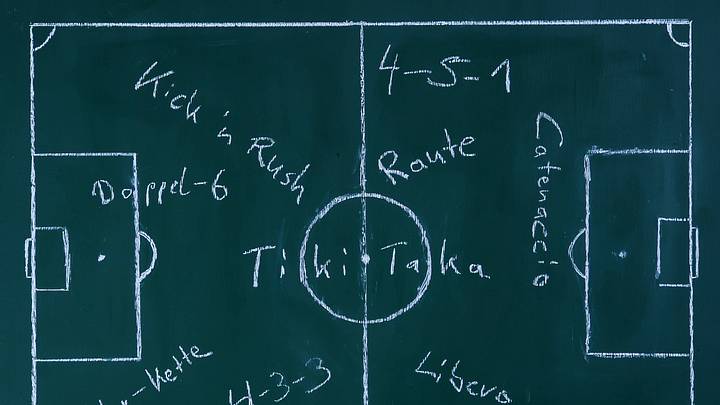
At the top level, the numbers we call “formations” are just one part of a manager’s tactical thinking.
For fans, though, they provide a basic way to understand the ideas and strategies that coaches have been refining since modern soccer began in the late 19th century.
Soccer has always been about getting the most out of individual talent, but teamwork has always been key to winning. Managers have tried countless setups to get the best from ten outfield players. Once-revolutionary systems like Herbert Chapman’s 2-3-5 and W-M have mostly given way to modern back-fours and libero roles, depending on the region.
Today, formations act as a starting point for how teams organize both with and without the ball. Players are constantly moving, and different game situations demand adjustments.
Still, formations remain important for translating a manager’s ideas onto the pitch, and debates over which setup is best will always continue.
Here’s a look at some of the most popular and effective soccer formations.
4-3-3

Synonymous with “Total Football” and Pep Guardiola, the 4-3-3 has come to represent progressive, possession-based soccer.
The system was pioneered by Rinus Michels’ daring 1970s Netherlands team, led on the field by Johan Cruyff. Coaches like Michels and, later, Guardiola have used the formation to dominate midfield. Guardiola isn’t strictly tied to the 4-3-3—he experiments with other setups—but much of his career has focused on controlling opponents through the central midfield supremacy the formation provides, especially with legends like Sergio Busquets, Xavi and Andrés Iniesta in support.
Jurgen Klopp also adapted the 4-3-3 during his later years at Liverpool, moving away from his trademark gegenpressing 4-2-3-1. His version helped Liverpool win the 2018-19 Champions League and the Premier League the following season.
There are many ways to play a 4-3-3. Michels favored structured fluidity, Klopp emphasized overlapping fullbacks and half-space wingers, and Guardiola’s Manchester City has differed from his Barcelona teams by using inverted fullbacks in midfield.
In possession, teams can shift into a 3-2-5 or 2-3-5 shape, while defensively, wingers press high. The formation offers balance and central control, making it a favorite of progressive managers.
4-2-3-1

The romance of the classic No. 10 arguably peaked in the ’90s, coinciding with the rise of the 4-2-3-1 (or 4-4-1-1). The main difference between the two is the depth of the wingers relative to the midfield pivot.
To maximize the creative genius of the No. 10, teams moved away from 4-4-2 formations, allowing their masterful playmaker to operate between the lines—the space between an opponent’s midfield and defense.
Today, the system isn’t necessarily built around a single star, but to facilitate the high-pressing ideals of modern managers. Guardiola’s former City assistant, Juanma Lillo, is credited with playing a key role in Spanish soccer’s shift from 4-4-2 to 4-2-3-1. Ironically, the 4-2-3-1 can easily morph into a 4-4-2 or 4-2-4 pressing structure, with the attacking midfielder joining the striker in the first line of defense.
Marco Silva did impressive work with the 4-2-3-1 at Fulham, creating balance across the pitch. The sturdy double pivot covers for fullbacks when they advance, while dynamic links form between a marauding No. 10 and the wide areas—connecting with wingers and overlapping fullbacks.
The No. 10 can also run off the center forward, as Dele Alli did at Tottenham under Mauricio Pochettino—positioned close to Harry Kane up front to initiate combinations and enable more effective counter-pressing.
3-5-2

Former Argentina manager Carlos Bilardo is credited as the pioneer of the 3-5-2. The 1986 World Cup-winning coach transformed a free-spirited Argentina team from the days of Cesar Luis Menotti into a rugged, hard-nosed outfit built entirely around Diego Maradona.
Bilardo’s system freed Maradona by moving to a back three, allowing him to roam from a central attacking position. Argentina’s number ten dropped from a traditional forward role to maximize touches on the ball—and he dazzled in Mexico, guiding an unfancied Albiceleste side to World Cup glory.
The formation quickly fell out of favor after Bilardo’s departure, though Italian coaches appreciated its potential. In recent years, it has seen a revival—most notably under Antonio Conte at Inter Milan, who used it to secure the 2020–21 Serie A title.
The 3-5-2 gives wingbacks freedom and facilitates classic combinations between the front two, but it can be vulnerable to quick switches of play. Teams often surrender territory and control, and the system is not ideal for high pressing, which has led many managers to approach it cautiously.
4-4-2

Long associated with the traditional English game, the 4-4-2 actually has its roots in Russia. Viktor Maslov adapted the 4-2-4 used by Brazil’s 1958 World Cup-winning side and made it his own. Guiding Torpedo Moscow to the Soviet league title in 1960, Maslov deployed two banks of four that offered defensive stability, zonal marking and a cohesive pressing system.
Maslov’s 4-4-2 later helped turn Dynamo Kyiv into both a domestic and continental powerhouse in the late 1960s, and his ideas undoubtedly inspired better-known revolutionaries like Arrigo Sacchi and Valeriy Lobanovskyi. He valued the formation’s balance and its ability to combine defensive solidity with attacking fluidity.
When the system reached England, it wasn’t adopted with the same tactical sophistication. It became a tool for direct possession play: Teams focused on getting the ball wide and sending crosses into two strikers in the box, with physical forwards deployed to dominate aerial battles against center backs.
Despite its vulnerability to midfield overloads, the 4-4-2 remains a respected pressing structure. Mikel Arteta, in particular, has adapted it with great success at Arsenal, transforming the Gunners into one of the Premier League’s most fearsome teams without the ball.
3-4-3

The 3-4-3 is built around wingbacks and wingers—or inside forwards—supporting a central striker.
Antonio Conte became the first manager in 50 years to win an English league title with a back three, doing so at Chelsea in 2016-17, sparking a brief tactical revolution in the Premier League. Conte had previously relied on three elite center backs at Juventus to win three consecutive Scudetti, though in Italy, back threes were traditionally tied to defensive catenaccio.
Alberto Zaccheroni also won Serie A with AC Milan in 1998 using a 3-4-3, while Walter Mazzarri’s Napoli in the early 2010s combined defensive stability with attacking flair. Though often viewed as defensively oriented, the 3-4-3 can unleash attacking stars—think Zvonimir Boban under Zaccheroni, Marek Hamšík under Mazzarri or Eden Hazard under Conte.
Wingbacks are vital, providing width in both attack and defense, while a balanced central midfield pair anchors the middle. Inside forwards exploit the half-spaces, opening passing lanes and creating room for the center forward.
Viktor Gyökeres thrived as the focal point of Ruben Amorim’s 3-4-3 at Sporting CP—though the Portuguese manager struggled to replicate similar success with the formation during his ill-fated spell at Manchester United, while Gyökeres also initially struggled outside of that system at Arsenal.
READ THE LATEST SOCCER NEWS, TRANSFER RUMORS AND MORE
 Add us as a preferred source on Google
Barnaby Lane, better known as Barney, is a soccer writer for SI FC. With nearly a decade of experience in the industry, he has worked for a range of household-name publications in both the United States and the United Kingdom, and has interviewed some of the world’s biggest athletes—from Usain Bolt and Rafael Nadal to Christian Pulisic (though his favorite interview remains Adebayo Akinfenwa). Barney specializes in Premier League soccer, covering everything from the nostalgia of years gone by to the modern, vastly different landscape of today’s game. He also has experience reporting on La Liga and Major League Soccer, the latter of which he developed a particular affinity for during his university days at Virginia Commonwealth University in Richmond.