%20%20--%3E%0A%3Csvg%20version%3D%221.1%22%20id%3D%22Layer_1%22%20xmlns%3D%22http%3A%2F%2Fwww.w3.org%2F2000%2Fsvg%22%20xmlns%3Axlink%3D%22http%3A%2F%2Fwww.w3.org%2F1999%2Fxlink%22%20x%3D%220px%22%20y%3D%220px%22%0A%09%20width%3D%2239px%22%20height%3D%2240px%22%20viewBox%3D%220%200%2039%2040%22%20enable-background%3D%22new%200%200%2039%2040%22%20xml%3Aspace%3D%22preserve%22%3E%0A%3Cpath%20fill%3D%22%23FFFFFF%22%20d%3D%22M38.5%2C7H28.2v26h10.3V7z%22%2F%3E%0A%3Cpath%20fill-rule%3D%22evenodd%22%20clip-rule%3D%22evenodd%22%20fill%3D%22%23FFFFFF%22%20d%3D%22M26.1%2C25.5c0%2C5.8-4.1%2C7.5-12.9%2C7.5C3.9%2C33%2C0%2C31.2%2C0%2C25.2v-1.1h11.6%0A%09v2.4c0%2C0.7%2C0.1%2C1.4%2C1.2%2C1.4c1%2C0%2C1.2-0.4%2C1.2-1.3v-0.9c0-1.6-0.9-1.6-3.5-2.2C2.2%2C21.7%2C0%2C19.7%2C0%2C15.3v-0.9C0%2C9.3%2C5.5%2C7%2C12.9%2C7%0A%09c10.2%2C0%2C12.8%2C2.6%2C12.8%2C7.4v1.8h-11v-2.9c0-0.6-0.4-1.1-1.2-1.1c-0.6%2C0-1.2%2C0.4-1.2%2C1.1v0.9c0%2C1.5%2C0.9%2C2%2C3.3%2C2.5%0A%09c8%2C1.6%2C10.5%2C3.3%2C10.5%2C7.5V25.5z%22%2F%3E%0A%3C%2Fsvg%3E%0A)
Why Dream Meeting of Lamine Yamal vs. Lionel Messi Has Been Canceled
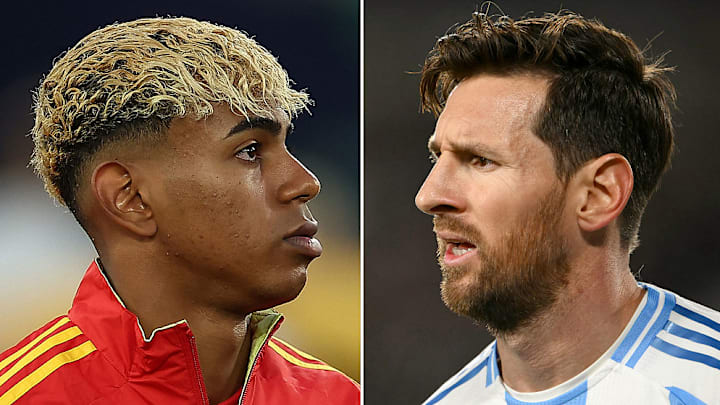
UEFA have solely blamed Argentina for the cancelation of the Finalissima against Spain later this month. In response, the South American giant claimed that its proposal of a new date was rejected.
This new-fangled fixture between the reigning champions of Europe and South America has been a logistical nightmare. Argentina manager Lionel Scaloni was not alone in hoping that it would be swept under the rug after repeated delays over its scheduling before a date of March 27 was eventually set back in December.
Both nations had settled on Qatar as a suitable neutral venue, yet the ongoing conflict in the Middle East has quashed any plans of Lamine Yamal and Lionel Messi meeting for the first time in Doha. This inevitability gave way to a series of offers and counteroffers between Spain, Argentina and the governing bodies of Europe (UEFA) and South America (CONMEBOL).
There are some telling differences in the series of events laid out by UEFA and Argentina’s soccer federation (AFA) behind this failed fixture.
Why Has the 2026 Finalissima Been Canceled?

Once it became clear that Qatar was no longer a viable option, UEFA claim that they “explored other feasible alternatives but each ultimately proved unacceptable to the Argentinian Football Association.”
The statement lists the three alternatives UEFA put forward:
- Host the match at Real Madrid’s Bernabéu Stadium with an even split of supporters
- Split the final across two legs, the first in Real Madrid’s Bernabéu on March 27 and the second at a later date in Buenos Aires
- Host the match at a neutral venue in Europe on March 27 or March 30
Spain’s soccer federation (RFEF) released their own statement backing up this sequence of events, insisting: “From the beginning, the RFEF worked closely with UEFA to reach an agreement and offered all possibilities.” Diplomatically, there was no mention of Argentina.
An offer from Argentina to play the fixture after the World Cup was rejected—there was no room in Spain’s calendar—and so UEFA claim that the reigning global champions “declared its availability to play exclusively on March 31, a date which proved to be unworkable.”
A statement released by the AFA acknowledged the rejection of a one-off match in Madrid, justifiably arguing that it “would violate the principle of sporting fairness, since it would not be a neutral venue.”
However, Argentina then claimed that it received and accepted a proposal to play the match in a neutral venue in Italy (reported to be Rome’s Stadio Olimpico). This would suffice but only on March 31. UEFA claim that they were willing to move the fixture to March 30 yet the refusal to shift it back another 24 hours is why this agreement fell apart.
Quite why both parties were so fixed on those specific dates is not elaborated upon.
Messi’s availability is not thought to have been a decisive factor, with Fabrizio Romano one of several outlets reporting that the Argentine superstar would have been available. Now, he will have to wait at least four months until a potential meeting with Yamal.
When Can Lamine Yamal Play Lionel Messi?

Without this glorified friendly, the World Cup will be the next stage on which Messi can take on the teenager billed as his great successor. The pair have famously crossed paths before—a bizarre twist of fate ensured that Messi was the Barcelona first-team player randomly assigned to pose with a young Catalan baby for a club calendar in 2007. That well-behaved infant would grow up to inherit Messi’s No. 10 shirt at Barça.
Since leaving the continent, Messi has been spared any meetings with his former employers. However, as the two highest-seed nations in the world, Argentina and Spain are set to meet in the 2026 World Cup final if they both top their groups and make it through the knockouts.
Should one of the nations finish as runner-up in its group while the other tops the mini-standings, they would be scheduled to meet as early as the round of 32.
READ THE LATEST SOCCER NEWS, ANALYSIS AND INSIGHT FROM SI FC
 Add us as a preferred source on Google
Grey Whitebloom is an Associate Editor for SI FC. He has more than half a decade of experience in sports media across all its various guises, from the fast-paced demands of news articles and match reports to in-depth research required for features. Whitebloom graduated with a First Class Honours from University College London and found himself named on the Dean’s List—which, despite his initial fears, was a form of praise rather than a punishment. He specialises in the Premier League and Champions League, while also boasting an extensive track record of La Liga coverage.