%20%20--%3E%0A%3Csvg%20version%3D%221.1%22%20id%3D%22Layer_1%22%20xmlns%3D%22http%3A%2F%2Fwww.w3.org%2F2000%2Fsvg%22%20xmlns%3Axlink%3D%22http%3A%2F%2Fwww.w3.org%2F1999%2Fxlink%22%20x%3D%220px%22%20y%3D%220px%22%0A%09%20width%3D%2239px%22%20height%3D%2240px%22%20viewBox%3D%220%200%2039%2040%22%20enable-background%3D%22new%200%200%2039%2040%22%20xml%3Aspace%3D%22preserve%22%3E%0A%3Cpath%20fill%3D%22%23FFFFFF%22%20d%3D%22M38.5%2C7H28.2v26h10.3V7z%22%2F%3E%0A%3Cpath%20fill-rule%3D%22evenodd%22%20clip-rule%3D%22evenodd%22%20fill%3D%22%23FFFFFF%22%20d%3D%22M26.1%2C25.5c0%2C5.8-4.1%2C7.5-12.9%2C7.5C3.9%2C33%2C0%2C31.2%2C0%2C25.2v-1.1h11.6%0A%09v2.4c0%2C0.7%2C0.1%2C1.4%2C1.2%2C1.4c1%2C0%2C1.2-0.4%2C1.2-1.3v-0.9c0-1.6-0.9-1.6-3.5-2.2C2.2%2C21.7%2C0%2C19.7%2C0%2C15.3v-0.9C0%2C9.3%2C5.5%2C7%2C12.9%2C7%0A%09c10.2%2C0%2C12.8%2C2.6%2C12.8%2C7.4v1.8h-11v-2.9c0-0.6-0.4-1.1-1.2-1.1c-0.6%2C0-1.2%2C0.4-1.2%2C1.1v0.9c0%2C1.5%2C0.9%2C2%2C3.3%2C2.5%0A%09c8%2C1.6%2C10.5%2C3.3%2C10.5%2C7.5V25.5z%22%2F%3E%0A%3C%2Fsvg%3E%0A)
Why Was the World’s Oldest Soccer Ball on Display at Scotland vs. Brazil?
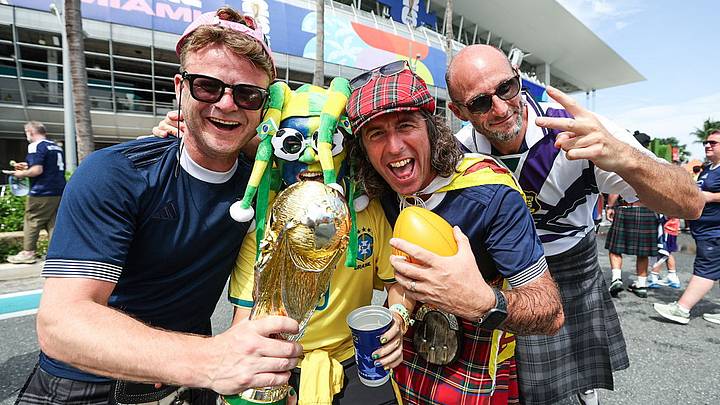
Scotland’s World Cup Group C meeting with Brazil in Miami on Wednesday featured a special guest. But not a person, rather an artefact that is at the very heart of soccer history.
The world’s oldest soccer ball made the 4,300-mile journey from Stirling in central Scotland—the Stirling Smith Art Gallery—to the Coral Gables Museum in South Florida.
The ball dates from the mid-16th century and, in addition to being part of the Diplomacy and the Beautiful Game: From Scotland to Brazil to Haiti exhibition in the museum, a 20-minute ride west of downtown Miami, it was shown at Scotland vs. Brazil at Hard Rock Stadium.
Close to 500 years old, the ball—a melon-sized sphere around half the size of a modern equivalent—is made from cow hide stitched together surrounding a pig’s bladder used to inflate it.
This earliest surviving example of a soccer ball was lost for centuries, only accidentally unearthed from its hiding place behind paneling during building work at Stirling Castle in the 1970s. Nobody knows how or why it got there and likely never will.
The ball dates from the time of Mary, Queen of Scots, a great-granddaughter of Tudor English King Henry VII and later an enemy and rival to Queen Elizabeth I—her first cousin, once removed. The Scottish Queen, eventually executed after years of imprisonment by Elizabeth, was a known fan of sports—particularly golf and soccer—as noted in her diary entries.
“The timeline aligns with Mary, Queen of Scots residing in the castle and of course it was discovered in the Queen's Chambers,” Stirling Smith curator Aoife McKenna told the BBC. “We couldn’t say for certain, but we like to think that Mary played with this ball.”

Why Is Scotland vs. Brazil Significant?
For starters, the Stirling ball is Scottish. And while the Football Association in England formalized the sport, Scotland was an early superpower, producing many of the best players of the Victorian era and participating in the first official international match—against England—in 1872.
But Scotland has clear ties to Brazil as well, which made this World Cup match—a repeat of the opening fixture from 1998—a fitting occasion for the ball to be celebrated.
The modern sport of football or soccer was taken around the world by English and Scottish pioneers in the late 19th and early 20th century, including Charles Miller. Born to a Scottish father in São Paulo in 1874, Miller traveled to England to study from the age of 10, excelling in the burgeoning sport of soccer, and taking two balls and a rulebook with him back to Brazil a decade later.
Soccer was known—although just barely—in Brazil at the time, but Miller was responsible for laying the foundations of its eventual explosion among more than just a small number of British expats.

When Was Soccer Invented?
Modern soccer, as we know it today, came into existence in 1863 in London, when the Football Association set out the first official rulebook, bringing together all the different versions of the game that had been developing—primarily in private schools—all over the country.
But the basic idea existed long before, with different roots traceable to Ancient Greece and Ancient China. Other similar games sprang up independently all over the world.
Games beginning to resemble modern soccer were played across Europe from the Middle Ages onwards and the sport was well established by the time the Stirling ball was being used in around 1540. The word ‘soccer’ itself is a shortening of ‘Association Football,’ the unifying code and basic set of 1863 rules by which all future versions would be governed.
READ THE LATEST WORLD CUP NEWS, ANALYSIS AND INSIGHT FROM SI FC
 Add us as a preferred source on Google
Jamie Spencer is a writer and editor for SI FC. Jamie grew up in Manchester, England, in the 1990s and fell in love with the game at the same time as the Premier League was taking off. With more than a decade of experience behind him in sports media, he specializes in Manchester United and the overall Premier League, still living in England’s north-west soccer hotbed. Jamie is also an expert on the women’s game and enjoys old school nostalgia, telling stories from soccer’s rich history and culture.