%20%20--%3E%0A%3Csvg%20version%3D%221.1%22%20id%3D%22Layer_1%22%20xmlns%3D%22http%3A%2F%2Fwww.w3.org%2F2000%2Fsvg%22%20xmlns%3Axlink%3D%22http%3A%2F%2Fwww.w3.org%2F1999%2Fxlink%22%20x%3D%220px%22%20y%3D%220px%22%0A%09%20width%3D%2239px%22%20height%3D%2240px%22%20viewBox%3D%220%200%2039%2040%22%20enable-background%3D%22new%200%200%2039%2040%22%20xml%3Aspace%3D%22preserve%22%3E%0A%3Cpath%20fill%3D%22%23FFFFFF%22%20d%3D%22M38.5%2C7H28.2v26h10.3V7z%22%2F%3E%0A%3Cpath%20fill-rule%3D%22evenodd%22%20clip-rule%3D%22evenodd%22%20fill%3D%22%23FFFFFF%22%20d%3D%22M26.1%2C25.5c0%2C5.8-4.1%2C7.5-12.9%2C7.5C3.9%2C33%2C0%2C31.2%2C0%2C25.2v-1.1h11.6%0A%09v2.4c0%2C0.7%2C0.1%2C1.4%2C1.2%2C1.4c1%2C0%2C1.2-0.4%2C1.2-1.3v-0.9c0-1.6-0.9-1.6-3.5-2.2C2.2%2C21.7%2C0%2C19.7%2C0%2C15.3v-0.9C0%2C9.3%2C5.5%2C7%2C12.9%2C7%0A%09c10.2%2C0%2C12.8%2C2.6%2C12.8%2C7.4v1.8h-11v-2.9c0-0.6-0.4-1.1-1.2-1.1c-0.6%2C0-1.2%2C0.4-1.2%2C1.1v0.9c0%2C1.5%2C0.9%2C2%2C3.3%2C2.5%0A%09c8%2C1.6%2C10.5%2C3.3%2C10.5%2C7.5V25.5z%22%2F%3E%0A%3C%2Fsvg%3E%0A)
World Cup Knockout Stage Red and Yellow Card Rules Explained
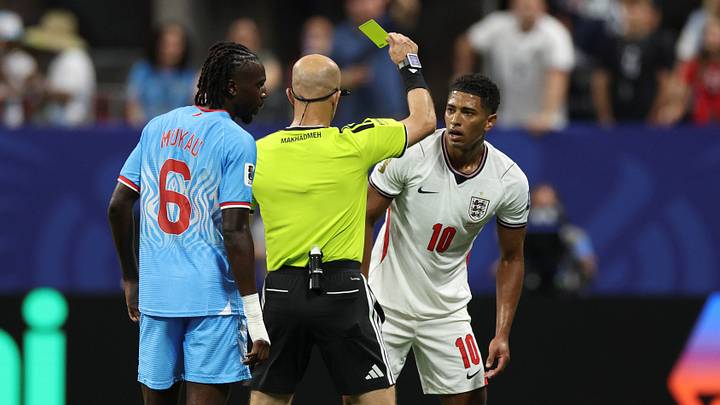
Yellow and red cards carry even greater significance once the World Cup reaches the knockout stage, where every match is win-or-go-home and a single suspension can have a huge impact.
A mistimed challenge or moment of ill-discipline can leave teams without key players for crucial matches, but FIFA’s disciplinary rules also include points where yellow cards are wiped, allowing players to avoid carrying bookings all the way to the final.
Here’s everything you need to know about how yellow and red cards work in the 2026 World Cup knockout stage, including suspension rules, when bookings are cleared, and what happens after a sending off.
How Yellow Cards Work in the World Cup Knockout Stage

In the group stage, a player who receives two yellow cards is suspended for the next match. For example, South Africa’s Teboho Mokoena and Cabo Verde’s Sidney Lopes Cabral were both booked across their opening two World Cup games, which resulted in them missing the final group fixture.
If that second yellow comes in the final group match, the suspension carries into the Round of 32. In practical terms, a player booked on Matchday 1 and again on Matchday 3 would sit out the first knockout round.
There is also a tactical element to this. England’s Declan Rice, for instance, was widely expected to be carefully managed in the final group game against Panama to avoid a second booking that would have ruled him out of the Round of 32 clash with DR Congo.
Once the knockout stage begins, the same accumulation rule applies but only within that phase. From the Round of 32 through to the quarterfinals, two yellow cards trigger a one-match suspension. So a booking in the Round of 32 followed by another in the Round of 16 would mean missing the quarterfinal.
When Yellow Cards Are Wiped Clean
All yellow cards are cleared after the group stage, meaning every player starts the Round of 32 with a clean slate.
They are then wiped again after the quarterfinals. For example, a player who has one yellow card in the Round of 16 does not carry it into the semifinal stage. This system ensures no player can miss the final due to accumulation.
WIN FIFA WORLD CUP 2026™ FINAL TICKETS & OTHER PRIZES

What Happens If a Player Gets a Red Card?

A red card means a player is immediately sent off and must leave the pitch, with their team forced to play the remainder of the match with 10 players. The standard punishment is then a one-match suspension, meaning the player misses the next game.
However, depending on the severity of the incident, FIFA’s disciplinary panel can extend the ban beyond a single match. Serious foul play, violent conduct or dangerous challenges can all lead to additional games being added to the suspension.
For example, Qatar’s Assim Madibo received a significantly extended ban after a challenge that injured Canada’s Ismaël Koné in a group-stage match, with his suspension increased to five games. That effectively ended his tournament early and would have kept him out for most of the competition regardless of Qatar’s progression.
These rules apply throughout the tournament, including the knockout stages.
Can Players Miss the World Cup Final Through Suspension?
Yes—but only through a red card.
A player sent off in the semifinal would miss the final, for example after a dangerous tackle or professional foul. However, yellow card accumulation cannot lead to a final suspension because all bookings are cleared after the quarterfinals, resetting disciplinary records before the final match.
READ THE LATEST WORLD CUP NEWS, PREVIEWS & ANALYSIS HERE
 Add us as a preferred source on Google
Barnaby Lane, better known as Barney, is a soccer writer for SI FC. With nearly a decade of experience in the industry, he has worked for a range of household-name publications in both the United States and the United Kingdom, and has interviewed some of the world’s biggest athletes—from Usain Bolt and Rafael Nadal to Christian Pulisic (though his favorite interview remains Adebayo Akinfenwa). Barney specializes in Premier League soccer, covering everything from the nostalgia of years gone by to the modern, vastly different landscape of today’s game. He also has experience reporting on La Liga and Major League Soccer, the latter of which he developed a particular affinity for during his university days at Virginia Commonwealth University in Richmond.