%20%20--%3E%0A%3Csvg%20version%3D%221.1%22%20id%3D%22Layer_1%22%20xmlns%3D%22http%3A%2F%2Fwww.w3.org%2F2000%2Fsvg%22%20xmlns%3Axlink%3D%22http%3A%2F%2Fwww.w3.org%2F1999%2Fxlink%22%20x%3D%220px%22%20y%3D%220px%22%0A%09%20width%3D%2239px%22%20height%3D%2240px%22%20viewBox%3D%220%200%2039%2040%22%20enable-background%3D%22new%200%200%2039%2040%22%20xml%3Aspace%3D%22preserve%22%3E%0A%3Cpath%20fill%3D%22%23FFFFFF%22%20d%3D%22M38.5%2C7H28.2v26h10.3V7z%22%2F%3E%0A%3Cpath%20fill-rule%3D%22evenodd%22%20clip-rule%3D%22evenodd%22%20fill%3D%22%23FFFFFF%22%20d%3D%22M26.1%2C25.5c0%2C5.8-4.1%2C7.5-12.9%2C7.5C3.9%2C33%2C0%2C31.2%2C0%2C25.2v-1.1h11.6%0A%09v2.4c0%2C0.7%2C0.1%2C1.4%2C1.2%2C1.4c1%2C0%2C1.2-0.4%2C1.2-1.3v-0.9c0-1.6-0.9-1.6-3.5-2.2C2.2%2C21.7%2C0%2C19.7%2C0%2C15.3v-0.9C0%2C9.3%2C5.5%2C7%2C12.9%2C7%0A%09c10.2%2C0%2C12.8%2C2.6%2C12.8%2C7.4v1.8h-11v-2.9c0-0.6-0.4-1.1-1.2-1.1c-0.6%2C0-1.2%2C0.4-1.2%2C1.1v0.9c0%2C1.5%2C0.9%2C2%2C3.3%2C2.5%0A%09c8%2C1.6%2C10.5%2C3.3%2C10.5%2C7.5V25.5z%22%2F%3E%0A%3C%2Fsvg%3E%0A)
Amid the Horrors of 9/11, Sports Became the Cultural Force That Brought Us Together
It’s a central tension of sports, maybe the central tension of sports. Even in the best of times, it can be hard to escape the fundamental silliness of it all. Grown adults hitting balls with sticks? Bouncing balls and then projecting them into hoops? Kicking spheroids and zinging rubber discs into nets? Come on. Really. What could be less consequential?
At the same time, it’s no less hard to escape the fundamental power of sports. Here’s this cultural force that knits communities—even countries—together. This Knicksian June in New York or July in soccer-mad Spain are just recent examples. Sports provide an opportunity for generations and families to bond; to chart time; to witness human excellence. Especially now, in an age of curation and spin, sports is, truly, reality programming. Here is the raw and unscripted entertainment that is competition, flush with a scoreboard that leaves no room for gloss and spin and subjectivity. And sports provide escapism, a chance to be captivated and invested by something that, ultimately, yields low stakes for humanity.
The paradox of sports—all that levity, all that gravity—was thrown into vivid relief in the drama of 9/11, the national tragedy that played out 25 years ago this week.

It started as a conventional Tuesday morning in the early innings of fall. Warm weather. A bright blue, cloudless sky. A few miles from lower Manhattan, the U.S. Open had concluded two days before. A Monday Night Football game in Denver between the Broncos and Giants played out the night before. The college football season was revving up; the Major League Baseball season was winding down. And reports of Michael Jordan coming out of retirement were set to dominate the day’s news cycle.
In the span of 17 minutes, two planes, guided missiles of death, hit the Twin Towers in Manhattan. Another struck the Pentagon in Washington, D.C. A fourth crashed in a Pennsylvania field. Almost 3,000 Americans died in the terror attacks. It seemed that Western civilization itself was under attack. And, suddenly, nothing could have been less trivial than sports.
As my colleague Richard Hoffer wrote poignantly in a special 9/11 edition of Sports Illustrated: “The crawl on the bottom of our screens, reserved in better days for pitching matchups, leader boards and starting times, now announced building failures, death tolls, the discovery of flight recorders. It was disorienting to see this shorthand of catastrophe so suddenly replace the familiar ticker of our SportsCentered lives. Where BONDS 3 HR once provided the comfortable minutiae, there was now a creeping ribbon of deepening disaster: MAYOR REQUESTS 6,000 BODY BAGS.”
So, appropriately, the games stopped. Some of this was simply practical. With air travel suspended, there could be no road games, no flights to Seattle or Starkville. But there also was a reading of the national mood. The last time there was a national tragedy of this magnitude? The Nov. 22, 1963 assassination of President John F. Kennedy. Two days later, the NFL decided to hold games, one involving the Dallas Cowboys, the team representing the city where the shooting occurred. Pete Rozelle would later call it the biggest regret of his 29-year NFL commissionership.
So sports took a collective timeout after 9/11. And then returned. First, at a recreational level. Buildings and cars around Manhattan may still have been coated with residual dust from the fallen towers, but New Yorkers began biking and running on the ribbons of paths around the city. Gyms opened early and closed late. Rec league basketball and softball games persisted. Unspoken: the nourishment of sports—the community, the sweating, the teamwork—was going to help us cope. At their essence, sports are acts of play. And in this horrid, earnest, adult time, so many of us needed simply to play.
Sports played a practical role in our recovery. The day after the Twin Towers collapsed, the Mets may have been idle, but the parking lot of what was then Shea Stadium was used as a base for distributing disaster relief items. Athletes, too numerous to name here, donated generously. Maybe more significantly, they also gave up their time and celebrity. One example of many: Derek Jeter calling, then meeting, the families of pilots who died aboard the hijacked planes.

As stories of that horrific day eventually surfaced and were told in full, sports loomed large. There was Mark Bingham, 6'5", former NCAA rugby champion, who led the counterattack against the hijackers of United Airlines Flight 93, causing the plane to crash in a field before it could hit its intended target in Washington, D.C., saving Lord-knows-how-many lives. (A few months later, Kwame James, a pro basketball player from France heading home to the U.S., would help tackle and subdue Richard Reid, the notorious “shoebomber.”) What were the firefighters, almost unfathomably brave, if not athletes who made the ultimate sacrifice?
By the weekend, the games resumed, yes as competitions, but also as sites for national communal mourning. Stadiums and arenas were as good a place as any to hold memorials and vigils and acknowledge the horrors of that Tuesday. In countless ways and in countless places, sports reflected and also reinforced our shared humanity. The rituals reminded us of cohesion, and not division. Any too-soon ambivalence was quickly laid to rest.
When the St. Louis Cardinals, for example, resumed play on Sept. 17, the team’s venerable broadcaster Jack Buck addressed the crowd. “Should we show others how to demonstrate our resolve? Yes. And we shall do it here this evening. Good evening, ladies and gentlemen. Welcome back to baseball. Welcome back to Busch Stadium.” And the fans went as wild as they would for any home run or triple play.
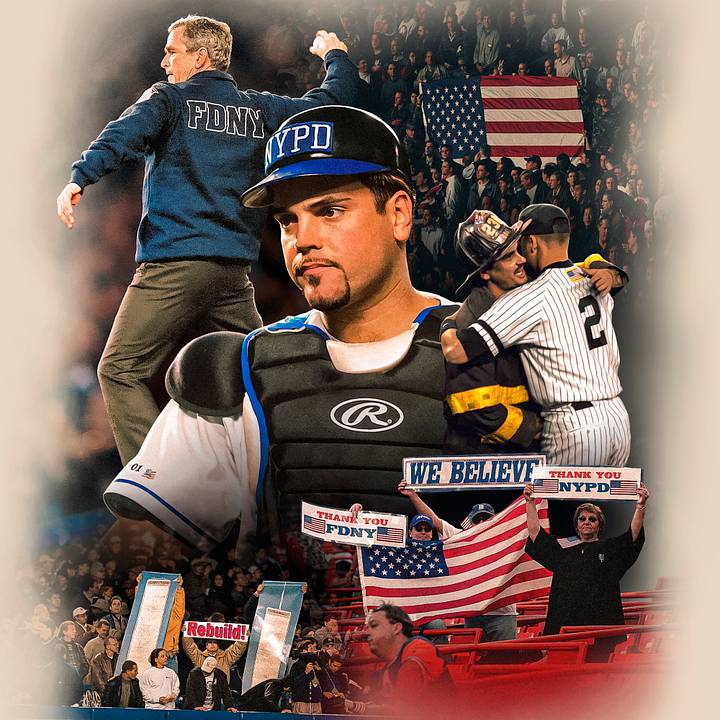
Teams from New York, not surprisingly, received special dispensation, and a special level of “Are-you-O.K.?” scrutiny. When the Mets resumed playing, Mike Piazza cut out the letters from an NYPD cap and glued them onto the catcher’s helmet he wore during the game. In a 2001 kind of way, the image went viral. On Sept. 21, when the Mets returned to Shea Stadium for their first home game since the tragedy, they trailed the Atlanta Braves 2–1 in the eighth inning. Then Piazza came to bat and, as if scripted by the Fates, smote a go-ahead, two-run homer, delighting far more than the 41,000-plus fans that attended.
In the first major sporting event in New York City after the 9/11 attacks, Mike Piazza hit a go-ahead home run at Shea Stadium that helped bring the city and our country together.#NeverForget 🇺🇸 pic.twitter.com/saYbqdKB5G
— FOX Sports: MLB (@MLBONFOX) September 11, 2024
A month later and a borough away in the Bronx came perhaps the seminal sports-9/11 overlap moment. President George W. Bush came to New York to throw out the first pitch before Game 3 of the World Series. Wearing a bulletproof vest under his FDNY windbreaker, he reared back and fired a perfect strike, laced with a surprising amount of velocity, and an unholy amount of symbolism.
Reflecting a quarter century later? The flags no longer fly half-mast at venues. The flyovers have long since stopped. You see fewer of those NYPD and NYFD ballcaps. Sadly there have been more recent national tragedies and pandemics and general instabilities and, in sports terms, they’ve pushed 9/11 down in the standings of our memory.
But so many earmarks endure. Yes, heightened security and surveillance. But also a sense of sports as a cultural force, one of the few that resist polarization and pack powers well beyond play. The slogan of 9/11 was, and is, Never Forget. Sports looms large in that recall.
 Add us as a preferred source on Google
Jon Wertheim is a senior writer for Sports Illustrated and has been part of the full-time SI writing staff since 1997, largely focusing on the tennis beat, sports business and social issues, and enterprise journalism. In addition to his work at SI, he is a correspondent for “60 Minutes” and a commentator for The Tennis Channel. He has authored 11 books and has been honored with two Emmys, numerous writing and investigative journalism awards, and the Eugene Scott Award from the International Tennis Hall of Fame. Wertheim is a longtime member of the New York Bar Association (retired), the International Tennis Writers Association and the Writers Guild of America. He has a bachelor’s in history from Yale University and received a law degree from the University of Pennsylvania. He resides in New York City and Paris with his wife, who is a divorce mediator and adjunct law professor. They have two children.
Follow jon_wertheim