%20%20--%3E%0A%3Csvg%20version%3D%221.1%22%20id%3D%22Layer_1%22%20xmlns%3D%22http%3A%2F%2Fwww.w3.org%2F2000%2Fsvg%22%20xmlns%3Axlink%3D%22http%3A%2F%2Fwww.w3.org%2F1999%2Fxlink%22%20x%3D%220px%22%20y%3D%220px%22%0A%09%20width%3D%2239px%22%20height%3D%2240px%22%20viewBox%3D%220%200%2039%2040%22%20enable-background%3D%22new%200%200%2039%2040%22%20xml%3Aspace%3D%22preserve%22%3E%0A%3Cpath%20fill%3D%22%23FFFFFF%22%20d%3D%22M38.5%2C7H28.2v26h10.3V7z%22%2F%3E%0A%3Cpath%20fill-rule%3D%22evenodd%22%20clip-rule%3D%22evenodd%22%20fill%3D%22%23FFFFFF%22%20d%3D%22M26.1%2C25.5c0%2C5.8-4.1%2C7.5-12.9%2C7.5C3.9%2C33%2C0%2C31.2%2C0%2C25.2v-1.1h11.6%0A%09v2.4c0%2C0.7%2C0.1%2C1.4%2C1.2%2C1.4c1%2C0%2C1.2-0.4%2C1.2-1.3v-0.9c0-1.6-0.9-1.6-3.5-2.2C2.2%2C21.7%2C0%2C19.7%2C0%2C15.3v-0.9C0%2C9.3%2C5.5%2C7%2C12.9%2C7%0A%09c10.2%2C0%2C12.8%2C2.6%2C12.8%2C7.4v1.8h-11v-2.9c0-0.6-0.4-1.1-1.2-1.1c-0.6%2C0-1.2%2C0.4-1.2%2C1.1v0.9c0%2C1.5%2C0.9%2C2%2C3.3%2C2.5%0A%09c8%2C1.6%2C10.5%2C3.3%2C10.5%2C7.5V25.5z%22%2F%3E%0A%3C%2Fsvg%3E%0A)
Mailbag: Is College Tennis at an Inflection Point?
Submissions have been lightly edited for brevity and clarity
As it is written, Wednesday is mailbag day.
• Here’s this week’s Served podcast:
• Note: We will be in London for the Laver Cup this week, entertaining tennis nation prior to matches.
• It’s the saga of Shergar the Irish racehorse:
• Your read of the week comes from William Weinbaum.
• Good soldiering: I appeared on this week’s Songversations podcast.
• Comedian Aziz Ansari with an A+ tennis bit:
• All hail retiring Rajeev Ram! (And not just because he is from Indiana.)
Onward …
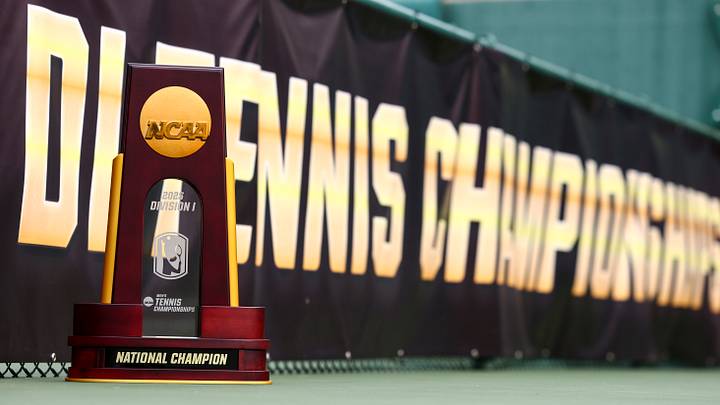
There were a number of questions this week about Patrick McEnroe’s appearance before Congress. Patrick’s crusade to limit overseas players being awarded college tennis (and sports) scholarships has won him favor with certain lawmakers.
A) Let’s be clear: this is not jingoism. Having athletes from overseas on college teams is a win-win. Nobody—including Patrick—wants an outright ban on international athletes. Foreign athletes add to a team culture and fabric and should be totally welcome. The question is one of quantity and quality. As for quality, when schools can recruit top 200 ATP players in their 20s, as Texas recently did, it perverts competition and flies in the face of fairness. Likewise, when teams stack their entire roster with international players, in the eyes of many (myself included), it violates the spirit of college sports.
B) At a time when nonrevenue sports are on the chopping block, this recruiting “strategy” seems especially short-sighted. If athletic directors tasked with cutting sports must choose between programs filled with taxpayers’ kids and this roster, the choice is easy.
C) I heard that zero top college coaches went to Kalamazoo this year. Why? When you can recruit top-200 ATP players, why spend time luring 16-year-old Americans? This is brutal for American tennis. What a chilling effect this could have on U.S. junior tennis.
D) Legal challenges aside, the obvious solution is a cap. Either a set number of scholarships per team (maybe two?) or a roster that must mirror the school’s demographics. Take Lander University in South Carolina: International students make up 2% to 3% of the student body. Yet here’s its tennis roster. Can anyone honestly make a good-faith case that this aligns with the values of college athletics?
E) The Intercollegiate Tennis Association has been toothless when it should be ruthless. It’s disappointing that a governing body has allowed this situation to spiral without taking a meaningful stand.
F) College coaches want to win to protect their jobs. Fair enough. And college coaches have enough pressure with NIL and transfer rules. Fair enough. It’s also unclear whether a cap would survive a legal challenge. Which is why …
G) I offer a proposal to address this issue. Full disclosure: I recently mentioned this to Patrick, and he can even call it the “McEnroe Pledge.” Quite simply—and this is similar to what Dario Amodei proposed re: AI— draft some sort of informal, unenforceable covenant: I eagerly recruit international players. They add to the culture of a team. They introduce the entire roster to different customs and parts of the world. But international players cannot be X% of the roster. Some coaches would sign. Others wouldn’t. But there would be some accountability, and coaches would have to take a stand, one way or the other.

Given tennis’s general love of representation ([Alexandra] Eala, [Ons] Jabeur, [Frances] Tiafoe/[Ben] Shelton U.S. Open semi), the lack of attention for good news: [Mika Brunold]/[João Lucas Reis da Silva] is puzzling and disappointing. Any idea why the ATP didn’t clap it? The New York Times, Yahoo and HuffPo did.
Megan F.
• A few of you asked about this. Brunold and Reis da Silva’s Tulln Challenger final marked the first pro men’s tennis final played between two out gay players. Giving grace: This match occurred during the same weekend as the U.S. Open final. Otherwise, I suspect it would have gotten more attention. As you note, it’s historic, significant and meaningful to many that two gay men met in a tournament final and spoke openly and poignantly about the experience. The good news for the ATP: Brunhold is only 21, and there is still plenty of time for the ATP to feature this story.
Jon, if you are going to beat the Hall of Fame drum for [Kateřina] Siniaková, can you please add [Daniel] Nestor to the list. His omission is glaring.
Rich Gannon
• I am going to bang the Hall of Fame drum for Siniaková, darn it. As for Nestor, are you daring to imply that a man who won 91 doubles titles, 12 majors and Olympic gold (and once beat Stefan Edberg in singles) is worthy of entry into the same Hall of Fame that enshrined, say, Leander Paes, who won 55 titles and eight majors?
A) Some media outlets, including the New York Times, don’t allow their staff to vote on Hall of Fame ballots. Sports Illustrated does, but I feel duty-bound to disclose my choices. (I voted for Nestor when he was on the ballot.)
B) Maybe we need some sort of conversion rate for doubles. No one is arguing that winning a major title in doubles comes anywhere close to a major in singles. But even if there’s, say, a 10:1 ratio—which, roughly, reflects the prize money breakdown—Nestor gets in. Siniaková, too.
C) There is a lot of disagreement, inconsistency and bad precedent regarding the Hall of Fame. But it’s a real triumph that so many tennis people—fans, yes, but also players—have suddenly taken this intense interest.
Hi Jon, I was doing some reminiscing lately and remembered the incredible doubles duo of Paola Suárez and Virginia Ruano Pascual. They were great fun to watch. With eight major titles and 44 tour titles together, do you think they should be in the Hall of Fame? Currently, in the hall we have: the Bryan brothers with 16 slams and 119 tour titles together; the Woodies with 11/61; Leander Paes with 18/55; and Martina Navratilova with approximately 734 bajillion. Maybe I missed some other doubles players, but it seems like the standard for the doubles hall of fame is incredibly high!
Cheers,
Mike R
Corvallis, OR
• You’re right to consult precedent because that’s the driving force. Our pal Pam Shriver is in the Hall of Fame—same for Helena Suková. Clearly, that induction was based on doubles, or a composite, because singles wouldn’t have met the bar. Again, consider that Nestor did not get in. He won 95 (!) titles, including the career Grand Slam (eight majors total) and an Olympic gold medal. With that as the bar, Ruano Pascual and Suárez (who I enjoyed as well and also recall as lovely, accessible players) have no chance.
Jon, have we reached the point where constantly identifying the “first Black,” “first Asian,” “first Hispanic,” “first Pacific Islander,” etc. player to achieve some particular tennis milestone may actually be becoming counterproductive.
When groups have historically been excluded or underrepresented, recognizing a genuine breakthrough can be meaningful and important. But when virtually every accomplishment is filtered through race or ethnicity, are we instead reinforcing the very distinctions we ultimately hope will matter less. The long-term goal is to reach a point where a player’s achievement is noteworthy because of the achievement itself, rather than because of the player’s racial or ethnic classification. Continually sorting athletes into racial and ethnic categories can begin to feel less like celebrating diversity and more like emphasizing separation,
Fernand
• Last month I noted that if Learner Tien and Brandon Nakashima had met in the Canada final, it would have marked the first all-Asian-American Masters 1000 final. Reading the comments (always a mistake), I got blasted for wokeness, for not acknowledging two blue-eyed finalists, etc.
A) These firsts may not be resonant for you, but they might be meaningful for others. Why deprive them of that pride or acknowledgment?
B) Certain groups represent distinct communities or distinct minorities (or historically mistreated groups) in a way that “blue-eyed” does not.
I am open to the reality that this isn’t an uncommon belief. Karen Crouse made a similar point in her column while taking a swipe at ESPN’s coverage of the Shelton-Tiafoe U.S. Open semifinal.
Two Black players in a Masters 1000 final? Two openly gay men’s players in a final? Two Czech women in a Wimbledon final? Those are significant achievements. They speak well of tennis. And I don’t quite get why your instinct would be to deprive a subset of fans of the chance to take pride in celebrating that.
Hi Jon,
After the Russian invasion of Ukraine, Russian players were banned from Wimbledon in 2022 and even now there is a blank space beside their names where other players’ flags are shown. (Like any sane person who cares about human rights and democracy, I support Ukraine 100%.)
In 2026, the United States has kidnapped the leader of a country (granted, a very bad and corrupt dude) and installed a puppet regime to gain access to that country’s oil (Venezuela); created a humanitarian crisis in another country with a cruel embargo (Cuba); and attacked a third country, murdering its leader (again, a very bad dude) and dropping a missile on a school and murdering 120 children (Iran). If the world were fair and just, wouldn’t American players get the same treatment as their Russian counterparts?
Charles Kroeker, Winnipeg, Canada
• I would caution against false equivalencies. An unprovoked attack against your sovereign neighbor—provoking a war that caused more than a million casualties—is not quite the same as a surgical strike to remove a corrupt foreign leader. But your point is well taken. It’s easy to head down the slippery slope. Russia is not the only pariah nation. Like you, I have strong feelings about Ukraine and Vladimir Putin, but I’m not sure that withholding the flag when Daniil Medvedev plays is the most effective form of resistance and dissent.
Jon,
Disappointed to see the [Alexander] Zverev allegations take center stage in the mailbag. These cases were settled some time ago with the agreement of the court and accusers.
The reason for the prices dropping for the U.S. Open semi is neither Zverev nor Karen [Khachanov] are a gate draw and likely never will be. I would note my co-workers and friends that attended the U.S. Open via free corporate seats have little to no idea who either player is. I watched Novak [Djokovic] practice with Zverev two years back and when leaving, not a single person asked Zverev for an autograph.
I also recall you defending [Justin] Gimelstob to the end when facing similar allegations…
Regards, George
• First, I went back and looked at what I wrote about Justin Gimelstob (who was accused of assault, not multiple allegations of domestic abuse—a critical difference) in 2019. You can judge for yourself whether I am being consistent or inconsistent.
My overarching point about Zverev is that if you believe in due process and basic presumptions, you cannot lobby for a ban or suggest he shouldn’t be allowed to compete. He may not be “innocent,” as he contends, but no guilty resolution is on the books.
But due process does not pertain to perception. Zverev himself doesn’t seem to grasp that the absence of a guilty determination doesn’t foreclose opinions (or questions) about his circumstances. It’s also naive to suggest there is no problem. Ignore the social media chatter if you want, but when tickets to his semifinal matches drop to less than the price of a movie, the market has spoken, and tennis has an issue to confront.
Hi Jon, I know you’ll probably be recovering from the U.S. Open. I don’t know if you have access to the Australian newspaper for the original article, it’s paywalled, but here is a Yahoo Sports reference to John Newcombe’s comments for your benefit.
Russell, Melbourne.
• Further proof that hosting a major and slurping from that revenue trough doesn’t guarantee success in minting players.
HAVE A GOOD WEEK, EVERYONE!
 Add us as a preferred source on Google
Jon Wertheim is a senior writer for Sports Illustrated and has been part of the full-time SI writing staff since 1997, largely focusing on the tennis beat, sports business and social issues, and enterprise journalism. In addition to his work at SI, he is a correspondent for “60 Minutes” and a commentator for The Tennis Channel. He has authored 11 books and has been honored with two Emmys, numerous writing and investigative journalism awards, and the Eugene Scott Award from the International Tennis Hall of Fame. Wertheim is a longtime member of the New York Bar Association (retired), the International Tennis Writers Association and the Writers Guild of America. He has a bachelor’s in history from Yale University and received a law degree from the University of Pennsylvania. He resides in New York City and Paris with his wife, who is a divorce mediator and adjunct law professor. They have two children.
Follow jon_wertheim