%20%20--%3E%0A%3Csvg%20version%3D%221.1%22%20id%3D%22Layer_1%22%20xmlns%3D%22http%3A%2F%2Fwww.w3.org%2F2000%2Fsvg%22%20xmlns%3Axlink%3D%22http%3A%2F%2Fwww.w3.org%2F1999%2Fxlink%22%20x%3D%220px%22%20y%3D%220px%22%0A%09%20width%3D%2239px%22%20height%3D%2240px%22%20viewBox%3D%220%200%2039%2040%22%20enable-background%3D%22new%200%200%2039%2040%22%20xml%3Aspace%3D%22preserve%22%3E%0A%3Cpath%20fill%3D%22%23FFFFFF%22%20d%3D%22M38.5%2C7H28.2v26h10.3V7z%22%2F%3E%0A%3Cpath%20fill-rule%3D%22evenodd%22%20clip-rule%3D%22evenodd%22%20fill%3D%22%23FFFFFF%22%20d%3D%22M26.1%2C25.5c0%2C5.8-4.1%2C7.5-12.9%2C7.5C3.9%2C33%2C0%2C31.2%2C0%2C25.2v-1.1h11.6%0A%09v2.4c0%2C0.7%2C0.1%2C1.4%2C1.2%2C1.4c1%2C0%2C1.2-0.4%2C1.2-1.3v-0.9c0-1.6-0.9-1.6-3.5-2.2C2.2%2C21.7%2C0%2C19.7%2C0%2C15.3v-0.9C0%2C9.3%2C5.5%2C7%2C12.9%2C7%0A%09c10.2%2C0%2C12.8%2C2.6%2C12.8%2C7.4v1.8h-11v-2.9c0-0.6-0.4-1.1-1.2-1.1c-0.6%2C0-1.2%2C0.4-1.2%2C1.1v0.9c0%2C1.5%2C0.9%2C2%2C3.3%2C2.5%0A%09c8%2C1.6%2C10.5%2C3.3%2C10.5%2C7.5V25.5z%22%2F%3E%0A%3C%2Fsvg%3E%0A)
Meet Julieta Pareja: The American Teenager Taking Tennis by Storm
Hey, everyone…
• Here’s this week’s Served podcast.
• Congrats to former top-30 ATP player Dan Goldie on his new book.
• In this week’s edition of plug a friend’s book: The Game by Peter King.
• Come for a get-to-know-you session with 17-year-old American prospect Julieta Pareja and stay for some Q&A.
Onward …
Julieta Pareja
One of you suggested we cover junior tennis more. I’m always ambivalent and cautious here. Forecasting greatness and following prospects are core exercises of sports fandom. But especially in an individual sport, there’s a fine line between reporting on promise and unduly burdening teenagers with hype. “The next blank” or “the great blank hope” is a storyline that seldom ends happily.
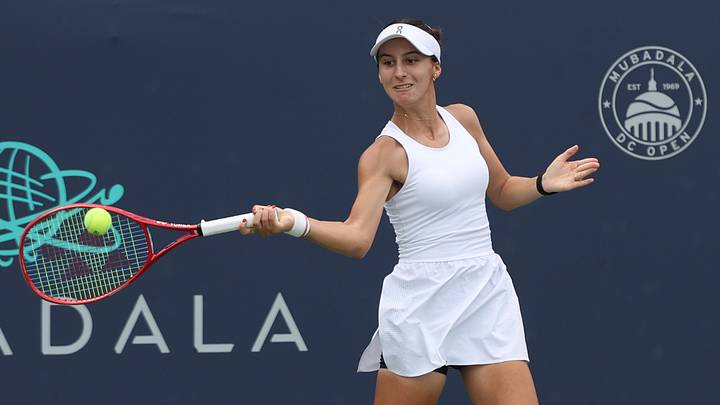
But then there are players whose promise is undeniable. Consider 17-year-old Julieta Pareja, of Carlsbad, Calif., a year removed from the Wimbledon girls’ final, who has already won many WTA-level matches and is fresh off a run to the Edmond Open semifinals, where she lost 7–6 in the third set to Sloane Stephens. She has already joined Ben Shelton, Iga Świątek and João Fonseca as part of On’s foray into tennis. Pareja has two older sisters who played college tennis and projects maturity beyond her years. Already in the top 250, she’s one to watch.
The following has been lightly edited for brevity and clarity.
Sports Illustrated: Fans will hear about you soon enough, but as you build your ranking, give us an overview. How did you come to the sport?
Julieta Pareja: Since I opened my eyes, tennis has always been a part of my life. My mom was always a big tennis fan. My earliest memories were going to watch my sisters compete and spending time with them on court. If I couldn’t play, I would just be chasing balls or swinging my racket around, waiting for my time. I was always watching tennis since I was little on the TV or at tournaments. I competed from an early age, and playing points was always the best part.
SI: Plenty of other people can and will do it from afar, but how do you describe your game?
JP: I would describe myself as an all-court player with the intention of constructing the point, opening up the court and looking for the opportunity to be aggressive. I’m able to change the rhythm with a different shape, speed and angles, but it’s all a work in progress. I’m learning to become the best competitor, regardless of how I feel or play that day.
SI: You went from Wimbledon girls’ finals to playing Elena Rybakina at the U.S. Open. In terms of tennis, what is the single biggest difference between juniors and pros?
JP: My experience at the U.S. Open showed that the serve consistency and quality of the ball are at another level. There’s a difference in the size of their teams and how well organized they are. At tournaments, you can tell with their routines that everything is being taken care of. Also, their mental strength is shown.
SI: For some fans, you first came onto the radar when you qualified and then won three main draw matches in 2025 at the Bogota event. You’d just turned 16. A year plus later, how do you make sense of that result?
JP: Playing in Bogota is very difficult because of the high altitude. I think I did well because I took the time to understand the conditions and really be patient many days in practice to learn what you can and can’t do under those circumstances. The confidence I gained from Bogota, I take it to other tournaments like Wimbledon, where I played on grass for the first time.
SI: Help or added pressure or both that you have Colombian heritage?
JP: I have a very strong connection with Colombia. I have been visiting since I was born. I love spending time in Bogota with my family. I love and miss their traditions, food and sense of humor. There isn’t any pressure, just gratitude for having their support. I have already played in Colombia before for junior and professional tournaments. They have always been very welcoming and are very big tennis fans.
SI: We’ve seen a number of young players—Iva Jovic and Victoria Mboko spring to mind—whose older siblings played at a high level. Yours too. How did this impact you?
JP: I’m very grateful to my sisters for the amount of time I spent on court with them. They were always up for playing, and they always gave me their best. I think the competitiveness that is built with siblings pushes you in a very unique way.
SI: What were your plans for the next four to five years? College is obviously an increasingly popular pathway, as you know from your sisters.
JP: My dream has always been to become a professional tennis player. I’m going to put my heart into it and make it come true.
SI: Favorite OG player to watch on YouTube?
JP: I love watching older matches. Players like [Rafael Nadal, [Federico] Coria and [Ash] Barty were some of the players I looked up to. I really liked how they competed and how smart they were on the court.
Q&A
Hi Jon,
Not really a question, but an observation.
As the French was rolling around this year, there was the usual talk about “the best player never to win ...”, but then, my goodness, he won! That got me thinking about who might be the best player never to win a title of any kind, and the picture of Davidovich Fokina, moved to tears after losing … yet again … in Washington last year came to mind. Surely this is the guy. Five-time loser, squanderer of match points.
But then, just a couple of weeks later he breaks through! And then again. and then, his first biggie, the Shanghai 1000! This is a real feel-good story to me. Good guy, solid player, 27 years old, finally takes home the hardware, and not just once, but three times. What a year he has had. Very happy to see it.
O.K., let’s make it a question. Who, now, is the best men’s player who has yet to win a title. (And let’s limit it to over 23. The young guys still have time.)
All the best, Gavin
• On the men’s side, it’s a no-brainer. When Arthur Rinderknech played his cousin Valentin Vacherot in the Shanghai final last fall, one of the bullet points was that for the winner, it would mark a first ATP title. Vacherot, of course, was the unlikely champion. Rinderknech didn’t win, and hasn’t won since. That means that, even as a top-25 player with a strong game and several quality wins (in 2025 Shanghai he beat Daniil Medvedev, Zverev and Félix Auger-Aliassime), Rinderknech is sans title. Alex Michelsen is high on the list, too, though note he is only 22. As for women, Anna Kalinskaya has a career-high ranking of No. 11 but no titles.

Re: Rybakina and the binary choices you posited: There are any number of players who’re both silent (or, relatively so) (see: [Maja Chwalińska, [Karolína] Muchová), reasonably demonstrative, and accessible. Given the extremes at the other end of the spectrum (at least in terms of decibels/shot), I think the WTA has nothing to moan about regarding Rybakina’s demeanor and press conferences. There’s a broad spectrum of on and off court personalities. My 2¢.
Skip Schwarzman, Philly
• You’re right. I was thinking back to our U.S. Open postmortem discussion on Served. Aryna Sabalenka has no tongue editor and is a shiny beacon of uninhibitedness, and she gets scolded. Rybakina is stony in the extreme, giving no tells. Rybakina says and emotes little in victory, and less in (rare) defeat, and she is scolded for not being sufficiently demonstrative. And we should all be O.K. with both women.
Hi, Jon. Don’t forget that JMDP [Juan Martín del Potro] was the player with the most wins against the world No. 1 who never managed to reach the top of the ATP rankings, and that he delivered a cinematic performance in securing Argentina’s first (and only) Davis Cup title. Adiós!
@sebatorok
• True. Note that Del Potro won the fan vote—curiously, finishing ahead of three-time major winner Ash Barty. As for credentials, you’re right. And we have talked about how tennis doesn’t (but perhaps should?) account for the quality of the opponent. Should a win over Carlos Alcaraz or Jannik Sinner count for the same points as a win over Artie Fufkin? Should a major beating zero top-10 players count the same as a major that entails beating Nadal and Roger Federer back-to-back? Writ large, should winning a major (and achieving many other feats) in the teeth of the Federer/Nadal/Novak Djokovic era not count for more than winning a major in the Thomas Johansson/Albert Costa/Lleyton Hewitt era?
Hi Jon. You are going to hate my opinion here, but I don’t think Del Potro is a Hall of Famer. Everyone liked him (and I really do too, despite him beating Federer in 2009). He was one of the most popular players amongst the other players. Having said all of that, you would be voting for him based on emotion and one amazing major in 2009. As a comparison:
Player 1: one major win, two other major final appearances, three other major semifinal appearances (reached every major grand slam semi), 21 total titles, one of them a Masters 1000.
Player 2: one major win, one other major final appearance, four other major semifinal appearances (did not reach the Australian Open semi), 22 total titles, one of them a Masters 1000.
Player 1 is Marin Cilic and player 2 is Juan Martín del Potro. You know that Marin Čilić is a fringe Hall of Fame candidate at best. Del Potro would only be going in because of how bad we feel about the hand he was dealt (literally, unfortunately). The Hall of Fame is not for the really good guys.
I totally agree about Ash Barty. [Svetlana] Kuznetsova is a really tough one. Two majors, two other major final appearances, four WTA 1000s, and two major doubles is pretty hard to overlook. I really think she should be considered before Del Potro. I think the fact she was not a flashy player is going to hurt her chances.
Shlomo
• I disagree, but I don’t hate it.
A) The Hall of Fame choices often come down to this: Do we want a proper Hall of Fame, or a Hall of Really Good Players and Nice People? If it’s the former, it means departing from precedent and being comfortable saying (sorry for the strays) Michael Stich is in, but Del Potro is not? Me, I err on the side of a big tent.
B) I’m not sure tennis compares so unfavorably to other sports. The 2025 NBA Hall of Fame class included Dwight Howard and Sylvia Fowles. The most recent baseball ceremony included Andruw Jones and Jeff Kent. Isn’t that about the same status and stature as Del Potro and Kuznetsova? Was Howard a better or more impactful basketball player, or was Andruw Jones a better baseball player than Del Potro was a tennis player? I’d argue no.
C) Especially with the ATP event no longer on the calendar, the Hall of Fame relies on the induction ceremony for revenue so it can remain operational throughout the year. We are never not going to have a Hall of Fame class.
D) Look at the NBA this year. Note how many inductees were non-players. Why wouldn’t tennis be more open to inducting coaches, officials, broadcasters, etc.? They only induct contributors every other year. Why wouldn’t you be more open to inducting the Dick Goulds and Brad Gilberts?
The WTA player you’d most expect to see front row at a cage fight is definitely Aryna. But SabalenkO? UFC stays poorly naming stars in the crowd.
William T.
• Good catch.
A) Do we not think, charitably, it is a pun, rather than a sloppy typo? Sabalenko, emphasis on the KO? Probably not, but we try to give the benefit of the doubt.
B) Every time I see UFC and tennis overlap my thoughts go here.
Shots
• Greg Sharko alerts us to First Serve New Mexico.
• Rafael Nadal will return to the hard courts for the first time since retiring from professional tennis to headline the The MGM Slam in February in Las Vegas.
• Jordan Lee won the boys’ title at the 2026 World Tennis Tour Junior Finals in Chengdu, China, defeating Slovenia’s Ziga Sesko 6–3, 7–5. He is the first American boy to win the event since Brandon Nakashima in 2018.
 Add us as a preferred source on Google

Jon Wertheim is a senior writer for Sports Illustrated and has been part of the full-time SI writing staff since 1997, largely focusing on the tennis beat, sports business and social issues, and enterprise journalism. In addition to his work at SI, he is a correspondent for “60 Minutes” and a commentator for The Tennis Channel. He has authored 11 books and has been honored with two Emmys, numerous writing and investigative journalism awards, and the Eugene Scott Award from the International Tennis Hall of Fame. Wertheim is a longtime member of the New York Bar Association (retired), the International Tennis Writers Association and the Writers Guild of America. He has a bachelor’s in history from Yale University and received a law degree from the University of Pennsylvania. He resides in New York City and Paris with his wife, who is a divorce mediator and adjunct law professor. They have two children.
Follow jon_wertheim