%20%20--%3E%0A%3Csvg%20version%3D%221.1%22%20id%3D%22Layer_1%22%20xmlns%3D%22http%3A%2F%2Fwww.w3.org%2F2000%2Fsvg%22%20xmlns%3Axlink%3D%22http%3A%2F%2Fwww.w3.org%2F1999%2Fxlink%22%20x%3D%220px%22%20y%3D%220px%22%0A%09%20width%3D%2239px%22%20height%3D%2240px%22%20viewBox%3D%220%200%2039%2040%22%20enable-background%3D%22new%200%200%2039%2040%22%20xml%3Aspace%3D%22preserve%22%3E%0A%3Cpath%20fill%3D%22%23FFFFFF%22%20d%3D%22M38.5%2C7H28.2v26h10.3V7z%22%2F%3E%0A%3Cpath%20fill-rule%3D%22evenodd%22%20clip-rule%3D%22evenodd%22%20fill%3D%22%23FFFFFF%22%20d%3D%22M26.1%2C25.5c0%2C5.8-4.1%2C7.5-12.9%2C7.5C3.9%2C33%2C0%2C31.2%2C0%2C25.2v-1.1h11.6%0A%09v2.4c0%2C0.7%2C0.1%2C1.4%2C1.2%2C1.4c1%2C0%2C1.2-0.4%2C1.2-1.3v-0.9c0-1.6-0.9-1.6-3.5-2.2C2.2%2C21.7%2C0%2C19.7%2C0%2C15.3v-0.9C0%2C9.3%2C5.5%2C7%2C12.9%2C7%0A%09c10.2%2C0%2C12.8%2C2.6%2C12.8%2C7.4v1.8h-11v-2.9c0-0.6-0.4-1.1-1.2-1.1c-0.6%2C0-1.2%2C0.4-1.2%2C1.1v0.9c0%2C1.5%2C0.9%2C2%2C3.3%2C2.5%0A%09c8%2C1.6%2C10.5%2C3.3%2C10.5%2C7.5V25.5z%22%2F%3E%0A%3C%2Fsvg%3E%0A)
Tennis Mailbag: Serena Williams’s Respectable Return, Player Protest and More From Wimbledon
Submissions have been lightly edited for brevity and clarity.
Hey everyone, welcome back to the tennis mailbag.
The Served podcast is your daily destination for Wimbledon audio gold:
Serena Williams
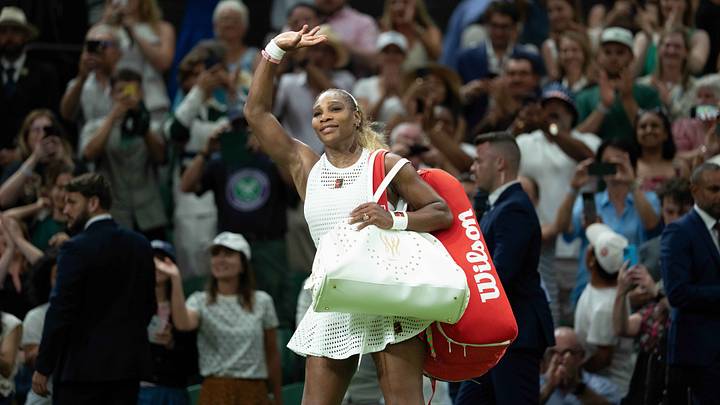
Let’s start with the topic that has generated loads of chatter: Serena Williams, who—and you may have heard this—returned to competitive singles at 44.
Serena played more than respectably in her return to the Wimbledon singles draw—surely one of the world’s all-time best players north of 40 years old. She served well, moved respectively, and, at times, did a convincing Serena impersonation. But in the end, the mighty Serena Williams lost to Maya Joint, a game 20-year-old from Australia, 6–3, 6–7, 6–3. And with that, considerable amounts of air left the tournament.
I dug into what we learned from Williams’s return in my Tuesday column.
Player media protest
There were a lot of questions about the player protest before the tournament, the decision to limit media time and then the decision to delimit the limit. Ah, tennis.
Some scattered points:
A) The PTPA wasn’t (note: past tense) the right answer. But it’s good to see players finding their voice and realizing that the sport’s structure and power dynamics favor management over labor.
B) As for Wimbledon, the event is wildly profitable and will become galactically profitable when the expansion is approved. The players want to lock in what is effectively an equity stake before that. A 20% wage increase is nice, but the players really want some ownership and some locked share of the upside before the entity explodes in growth.
C) The U.S. Open had better be prepared for a battle. Wait until you see these U.S. Open finances when the “facility upgrade” (i.e., profit maximization) is complete.
D) The tournaments’ response that they are nonprofits and invest in the sport is a losing argument. Why should, say, Jannik Sinner care if the USTA is using U.S. Open revenue to subsidize court resurfacing in Topeka, Kans., or coaching at Lake Nona? Not my monkey; not my circus. Pay me what I’m worth.
E) On the flip side, when people cheerily say, Know your value!, the implication is that you are short-selling yourself. The inverse holds as well. At this year’s Wimbledon, there’s no Carlos Alcaraz, Emma Raducanu, Jack Draper, etc. in the draw, and we’re all doing fine. People come to Wimbledon because it’s Wimbledon. Suzie the Bartender could play Barb the Fishmonger and Centre Court would be filled.
F) At some level, this is all healthy labor-management negotiation. If the players speak with a united voice, it helps the sport overall.
Q&A

Hola Jon!
Best wishes for a fabulous Wimbledon journey, always appreciating your wonderful column.
As much as I want Novak Djokovic to finally win Grand Slam No. 25 and reach this summit for good (he deserves it, so fingers crossed), I guess we have to concede that, besides this year’s defending champions, Jannik Sinner and Alexander Zverev, there are other very strong candidates to be first-time Grand Slam conquerors. This, of course, because Carlos Alcaraz is out.
My list is short though: Ben Shelton, Rafael Jódar, and João Fonseca.
We’ll see. Take care!
Carlos Acosta.
• I am fascinated and ambivalent about Djokovic. If Serena, at 44, has the flavor of happy whimsy (Hey, let’s give this a try!), Djokovic, five years her junior, is in a different time and place. He is a legitimate contender, and part of the challenge is the opposition. A larger part, I’d argue, is managing the variables that stack up with age: time on court, recovery, flexibility (long a strong suit), avoiding injury and even sleep. This is more about Djokovic trying to hack time and biology than about breaking down Stefanos Tsitsipas’s backhand. If he can, well, No. 25 is, for sure, a possibility.
Am I the only one who didn’t appreciate Markéta [Vondroušová] invoking Petra’s [Kvitova’s] horrific stabbing in her defense? I mean, I KINDA get the similarities—Czech Wimby champs? But that felt like a desperate reach for terror to pull sympathy and increase her “panic.” Would Marketa say that if she were from another country? Are home invasions of tennis stars a uniquely Czech thing? (No, we remember Russia’s Chakvetadze.) Especially since Pliskova, another Czech, said she’d never decline a random test, when asked about Marketa’s situation. I don’t believe Marketa is a doper, but it feels like she didn’t want to be inconvenienced that night and pulled the doctor’s note like we did as kids at school to get out of gym class. Too harsh?
Bill T.
• There’s been a lot of residual chatter about Markéta Vondroušová and her four-year doping ban after refusing an anti-doping test in December 2025. Some quick thoughts:
A) First, to your question, I’d like to think Vondroušová ran this name-check by Kvitová before invoking her horrific, harrowing situation when she was attacked in her home in 2016. Otherwise, yes, this was regrettable. One player was stabbed in her home by an intruder, and the other was briefly scared and then walked her dog.
B) I’m inclined to give grace to athletes and take mental health claims seriously, but Vondroušová’s story has shape-shifted a bit. Rather than cowering in fear, she had an interaction with the doping officer and even signed a form acknowledging that she declined to provide a sample. Was she scared/surprised/annoyed? Sure. Did her response comport with the panic attack she alleged? No.
C) There has to be a penalty for athletes declining to take an unannounced test. WADA and the ITIA differentiating—wisely—between “missed whereabouts” (i.e., a logistics mix-up, ships passing in the night) and an outright refusal to test when confronted by an official? Yes. If players could simply decline to test, citing mental health or anything else, the entire system collapses.
D) That said, there has to be proportionality. Give Vondroušová the median penalty, not the max. I was debating this with a friend who said, “Doesn’t she deserve the same penalty as someone who doped?”
My response: “Sure. Yes. Now find me the tennis player who doped and got four years.” Look at, say, the facts of Simona Halep’s case. There were not only positive results but “irregularities in the composition of her biological passport.” On appeal, her penalty was knocked down from four years to nine months.
E) Every doping case is different. Every case comes with its own bad facts and mitigating circumstances. But giving Vondroušová four years when players affirmatively testing positive seldom receive anything close to that penalty? It seems patently unfair to me.
F) Anti-doping is annoying, invasive and unpleasant … and deeply necessary. If you want honest competition, you need inconvenient rules, and it is incumbent on players to learn those rules and, one hopes, abide by them. In the best reading, Vondroušová was wildly indifferent/ignorant and—to borrow a phrase from this realm—authored her own misfortune. That said, give her the median sentence, not the maximum.

Jon, I understand Serena Williams, obviously. I understand Stan Wawrinka, a three-time major champ. I don’t like it but I understand British. But why oh why would Grigor Dimitrov get a wild card to Wimbledon?
SusieGee
• Ah, the imprecise science of wild card distribution. I would direct my outrage at the questionably deserving players who, by accident of birth, happen to be local products.
As for Dimitrov, he was a top player not long ago, and at last year’s Wimbledon, he was up 2–0 sets on the eventual champion (Sinner), before sustaining a fluke injury. Surely, that impacted the decision. This is also perhaps a reward for a player who has been an A-plus tennis citizen for nearly 30 years.
Story time: In late May, I was walking around my neighborhood in Paris when I bumped into Dimitrov on the street. We had a nice chat. He was meeting family for dinner. There was no tennis talk, and honestly, I’d forgotten he had been denied a wild card and had to qualify for the Roland Garros main draw. I got back home and saw he had not only played that afternoon but had lost 7–6 in the third set. This marks the kind of loss that leaves other players despondent or turning to the bottom of a bottle of Wild Turkey. Here was Dimitrov, amiably chatting on the street. This is a window into his disposition, but also a portal into why he is so well-liked in this community, and, as such, tournaments might favor him when given the chance.
Dear Jon
I think the ITF seeding policy for Grand Slams is unfair for those seeded 25-32. They have to face seeds 1-8 in the third round. But those seeded 17-24 are protected because they only have to meet seeds 9-16. Surely, it would be fairer if there was a random draw of seeds 17-32 against seeds 1-16 in the third round. Else those who finally get into top 32 will always get the tough third rounds and Radacanu will always meet Aryna Sabalenka in the Wimbledon third round until the end of time.
Peter Latham
Uxbridge, London, UK
• Fair point, though, as with most tennis quirks, is there a better alternative? As it stands, I’m not sure players grasp the profound difference between a No. 16 seed and a No. 17 seed. Assuming you beat the players you are supposed to—hardly a given, we realize—it’s like a $250,000 bonus.
Andrew Lachow of Larchmont, NY, take us out!
Perhaps not exactly a mailbag question but I thought you (and/or your readers) might find this interesting.
Last weekend, Frances Tiafoe beat Taylor Fritz in an all-American final to win the title at Halle. That same day, Francisco Cerúndolo defeated Tommy Paul to win Queen's Club. What surprised me was to learn that for both Tiafoe and Cerúndolo, it was their first 500 level titles of their career. And it made me realize, upon further research, that it is not only incredibly difficult for even the very top players to win a major but it is almost as difficult and rare for them to win a 1000 or even a 500 title.
Let’s start with 1000 titles. Based on my research and apart from the obvious candidates—Novak Djokovic (an insane 40 1000s and 15 500s, plus 24 majors), Carlos Alcaraz (eight 1000s, nine 500s plus seven majors), Jannik Sinner (10 1000s, seven 500s, plus four majors), and Alexander Zverev (seven 1000s, six 500s to go along with his French Open), the only active players with three or more 1000 titles are Daniil Medvedev (6), Stefano Tsitsipas (3) and, surprisingly, Arthur Fils (3). I could be missing some but the only other active players I found with even two 1000s are Andrey Rublev and Hubert Hurkacz. Taylor Fritz, Ben Shelton, Casper Ruud, Jakub Menšík, Karan Khachanov, Grigor Dimitrov, Cameron Norrie, Holger Rune and Marin Čilić have each won a single 1000. Many top players have never won a 1000 title, including Félix Auger-Aliassime, Alex De Minaur, Alexander Bublik, Lorenzo Musetti, Matteo Berrettini, Tiafoe, Cerúndolo and Paul.
How about 500s then? The results were surprisingly similar. Again, apart from Sinner, Alcaraz, Djokovic and Zverev, the only active players I found with more than three 500 titles were Medvedev (8), Rublev (6), Kei Nishikori (6) and De Minaur (4). Shelton, Auger-Aliassime and Stan Wawrinka followed with three each. Only a handful of active players have won two 500s: Bublik, Flavio Cobolli, Ugo Humbert, Berrettini and Čilić. Fritz, Ruud, Dimitrov, Musetti, Tiafoe, Paul, Rune, Tsitsipas, Norrie, Denis Shapovalov, Hurkacz, Sebastian Korda and a few other active players have won a single 500 title.
In short, in the era of dominance by a very few top players, it isn’t just winning a major that is exceedingly difficult, winning a 1000 or even a 500 is a huge and rare achievement for anyone not named Sinner, Alcaraz, Djokovic and Zverev.
ENJOY WEEK 1 OF WIMBLEDON, EVERYONE!
More Tennis from Sports Illustrated
 Add us as a preferred source on Google
Jon Wertheim is a senior writer for Sports Illustrated and has been part of the full-time SI writing staff since 1997, largely focusing on the tennis beat, sports business and social issues, and enterprise journalism. In addition to his work at SI, he is a correspondent for “60 Minutes” and a commentator for The Tennis Channel. He has authored 11 books and has been honored with two Emmys, numerous writing and investigative journalism awards, and the Eugene Scott Award from the International Tennis Hall of Fame. Wertheim is a longtime member of the New York Bar Association (retired), the International Tennis Writers Association and the Writers Guild of America. He has a bachelor’s in history from Yale University and received a law degree from the University of Pennsylvania. He resides in New York City and Paris with his wife, who is a divorce mediator and adjunct law professor. They have two children.
Follow jon_wertheim