%20%20--%3E%0A%3Csvg%20version%3D%221.1%22%20id%3D%22Layer_1%22%20xmlns%3D%22http%3A%2F%2Fwww.w3.org%2F2000%2Fsvg%22%20xmlns%3Axlink%3D%22http%3A%2F%2Fwww.w3.org%2F1999%2Fxlink%22%20x%3D%220px%22%20y%3D%220px%22%0A%09%20width%3D%2239px%22%20height%3D%2240px%22%20viewBox%3D%220%200%2039%2040%22%20enable-background%3D%22new%200%200%2039%2040%22%20xml%3Aspace%3D%22preserve%22%3E%0A%3Cpath%20fill%3D%22%23FFFFFF%22%20d%3D%22M38.5%2C7H28.2v26h10.3V7z%22%2F%3E%0A%3Cpath%20fill-rule%3D%22evenodd%22%20clip-rule%3D%22evenodd%22%20fill%3D%22%23FFFFFF%22%20d%3D%22M26.1%2C25.5c0%2C5.8-4.1%2C7.5-12.9%2C7.5C3.9%2C33%2C0%2C31.2%2C0%2C25.2v-1.1h11.6%0A%09v2.4c0%2C0.7%2C0.1%2C1.4%2C1.2%2C1.4c1%2C0%2C1.2-0.4%2C1.2-1.3v-0.9c0-1.6-0.9-1.6-3.5-2.2C2.2%2C21.7%2C0%2C19.7%2C0%2C15.3v-0.9C0%2C9.3%2C5.5%2C7%2C12.9%2C7%0A%09c10.2%2C0%2C12.8%2C2.6%2C12.8%2C7.4v1.8h-11v-2.9c0-0.6-0.4-1.1-1.2-1.1c-0.6%2C0-1.2%2C0.4-1.2%2C1.1v0.9c0%2C1.5%2C0.9%2C2%2C3.3%2C2.5%0A%09c8%2C1.6%2C10.5%2C3.3%2C10.5%2C7.5V25.5z%22%2F%3E%0A%3C%2Fsvg%3E%0A)
One Week After Rupturing ACL, Lindsey Vonn Is Ready to Push for Olympic Glory
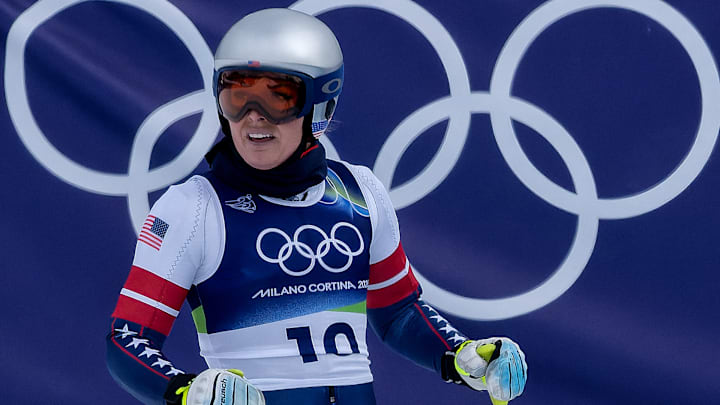
CORTINA d’AMPEZZO, Italy — From Friday to Friday, Lindsey Vonn’s Olympic return became a comeback within a comeback. Having overcome the preposterously long odds against regaining elite form at age 41, after a six-year retirement, Vonn had to rebuild again in a week’s time—from a ruptured anterior cruciate ligament in her left knee to getting back on skis, back on snow and back down a mountain.
She did that today, adding another layer of extreme resilience and determination to a career brimming with both. She appears good to go for a run at a fourth career Olympic medal on Sunday, something that seemed remote a week earlier. There is, quite simply, nothing that can stop her, not even one of the most feared injuries in sports.
“She’s tough, let’s put it that way,” said her coach, Aksel Lund Svindal. “She’s tough.”
Wearing a brace but making no other overt concessions to her damaged knee, Vonn cruised through a 1.6-mile downhill training run on the Olympia delle Tofane course. She recorded the 11th-fastest time out of 43 competitors who finished and may attempt another training run Saturday, but it’s not mandatory. Friday’s run at least established that a return to competition was possible.
Scheduled to race 10th, Vonn had to wait out an hour-plus weather delay as fog shrouded the top of the course. With a vertical drop of about 2,500 feet, the weather at the top did not match the sunny and warm early conditions at the bottom.
Svindal said she was calm while the skiers killed time around the start house—at one point, she joined her fellow U.S. downhillers in doing a line dance. That’s not the easiest thing to do in ski boots and lacking an ACL, but Vonn did a passable impersonation of a dancer.
When it was her time to race, Vonn navigated, with control, what she says is her favorite downhill course. She was wide on a couple of turns and lost some time at the end, but she forced the viewing public to swallow the lump of anxiety in its collective throat. Calamity did not strike.
Vonn did what she needed to do. There was no reason to risk much today when it will be necessary to risk everything Sunday.
“I think she was smart,” Svindal said. “She didn’t go all-in. She made a mistake on the bottom, but the rest looked like just good skiing, No big risk. It looked symmetrical, like I didn’t see any differences, right and left. And I think that’s kind of what we’re looking for today.”
Welcome to #MilanoCortina2026, @LindseyVonn 🙌 pic.twitter.com/MXmzABjh2l
— The Olympic Games (@Olympics) February 6, 2026
When Vonn finished, American teammate Breezy Johnson was there to greet her with a congratulatory fist bump. (Johnson had the sixth-fastest run of the day, while fellow American Jacqueline Wiles logged the fastest time. Vonn yelled praise to Wiles after she crossed the finish line.) Johnson, who is making an Olympic comeback of her own after crashing in training runs and withdrawing from the Beijing Olympics, said significant recent snowfall in Cortina made for a slow course.
“It was very soft and even slushy on the bottom,” Johnson said, referring to the terrain as “soap” at one point.
Vonn did not speak to the media after her run, but had a lengthy press conference Monday. That’s when she revealed the ruptured ACL suffered in Switzerland. While the outside world assumed that would end her comeback, Vonn vowed to compete.
“I will do everything in my power to be in that starting gate,” Vonn said. “I’m not letting this slip through my fingers. I’m going to do it.”
Friday, she did it.
Vonn made a entire career out of courting risk like no other downhiller, which led to a ghastly list of career injuries—broken bones and torn ligaments all over her body. That’s why the skiing world was full of doubters when her initial comeback began—largely because of the state of her other knee, the right one. It had been partially replaced with titanium in April 2024, with no intention of returning to racing. But she felt good enough to give it a try, becoming a medical experiment on skis.
The experiment went so well that she rocketed from Olympic long shot to favorite in less than a year. Vonn made the podium in her final World Cup race of the 2024–25 season, then won two races earlier this season. After an eight-year absence from the Winter Games, her first gold medal since 2010 appeared to be within reach. Then she was being airlifted away from the course at Crans-Montana. The timing of this one was acutely bad.

Still, there was some precedent for competing without a repaired ACL—especially in sports that don’t require planting and cutting, like football, basketball or soccer. Skiers have done it before, and Iowa wrestler Spencer Lee won an NCAA championship eight days after blowing out an ACL in 2021. Lee didn’t even tell anyone about it until after he’d won.
“Whatever, man,” he said on ESPN. “I didn’t want to tell anyone, because F excuses. Excuses are for wusses.”
Bravado aside, doctors have said that an athlete with Vonn’s extreme level of fitness and muscle strength gave her a chance.
“The key to functioning in an ACL-deficient knee is hamstring and quadricep strength and control,” said Kevin Farmer, chief of the sports medicine division at the University of Florida department of orthopaedic surgery and sports medicine.. “Also, as it was a previously placed graft, swelling may be less than if it were a native ACL, which is important for muscle control. There are ‘copers’ who have developed the ability to use their muscle strength to offset the instability caused by the ACL deficiency. That is rare, but if any group could manage, it would be Olympic-level athletes.”
Added Dr. Jason Zaremski from Florida: “There are two major challenges—one is physical and one is mental. From the physical standpoint, the ACL provides stability to your knee, particularly when you’re twisting and turning, which skiers need. From a mental standpoint, when you just had an injury, there is a little bit of a fear factor. High-level athletes are typically able to overcome this.”
If there is a shred of fear inside Vonn, nobody has seen it in years.
On Thursday, Vonn posted social media video of herself doing dry-land exercises. That indicated she was ready for the training run. Still, Svindal took some butterflies with him to the top of the mountain Friday.
“I said, ‘this felt like race day to me,’ ” he said. “Very important. Her history, she’s gone hard at times when people have told her she shouldn't probably be in the start going. So I have no doubt that she will go hard and attack on Sunday. But it's a lot better doing that from a base where you felt safe instead of having a bad experience.”
More Winter Olympics on Sports Illustrated
 Add us as a preferred source on Google
Pat Forde is a senior writer for Sports Illustrated who covers college football and college basketball as well as the Olympics and horse racing. He cohosts the Others Receiving Votes podcast for SI and is a regular contributor to the Tony Kornheiser Show podcast. He previously worked for Yahoo Sports, ESPN and The (Louisville) Courier-Journal. Forde has won 28 Associated Press Sports Editors writing contest awards, has been published three times in the Best American Sports Writing book series, and was nominated for the 1990 Pulitzer Prize. A past president of the U.S. Basketball Writers Association and member of the Football Writers Association of America, he lives in Louisville with his wife. They have three children, all of whom were collegiate swimmers.
Follow ByPatForde