%20%20--%3E%0A%3Csvg%20version%3D%221.1%22%20id%3D%22Layer_1%22%20xmlns%3D%22http%3A%2F%2Fwww.w3.org%2F2000%2Fsvg%22%20xmlns%3Axlink%3D%22http%3A%2F%2Fwww.w3.org%2F1999%2Fxlink%22%20x%3D%220px%22%20y%3D%220px%22%0A%09%20width%3D%2239px%22%20height%3D%2240px%22%20viewBox%3D%220%200%2039%2040%22%20enable-background%3D%22new%200%200%2039%2040%22%20xml%3Aspace%3D%22preserve%22%3E%0A%3Cpath%20fill%3D%22%23FFFFFF%22%20d%3D%22M38.5%2C7H28.2v26h10.3V7z%22%2F%3E%0A%3Cpath%20fill-rule%3D%22evenodd%22%20clip-rule%3D%22evenodd%22%20fill%3D%22%23FFFFFF%22%20d%3D%22M26.1%2C25.5c0%2C5.8-4.1%2C7.5-12.9%2C7.5C3.9%2C33%2C0%2C31.2%2C0%2C25.2v-1.1h11.6%0A%09v2.4c0%2C0.7%2C0.1%2C1.4%2C1.2%2C1.4c1%2C0%2C1.2-0.4%2C1.2-1.3v-0.9c0-1.6-0.9-1.6-3.5-2.2C2.2%2C21.7%2C0%2C19.7%2C0%2C15.3v-0.9C0%2C9.3%2C5.5%2C7%2C12.9%2C7%0A%09c10.2%2C0%2C12.8%2C2.6%2C12.8%2C7.4v1.8h-11v-2.9c0-0.6-0.4-1.1-1.2-1.1c-0.6%2C0-1.2%2C0.4-1.2%2C1.1v0.9c0%2C1.5%2C0.9%2C2%2C3.3%2C2.5%0A%09c8%2C1.6%2C10.5%2C3.3%2C10.5%2C7.5V25.5z%22%2F%3E%0A%3C%2Fsvg%3E%0A)
Lindsey Vonn Understands Better Than Most the Risks That Came With Her Comeback
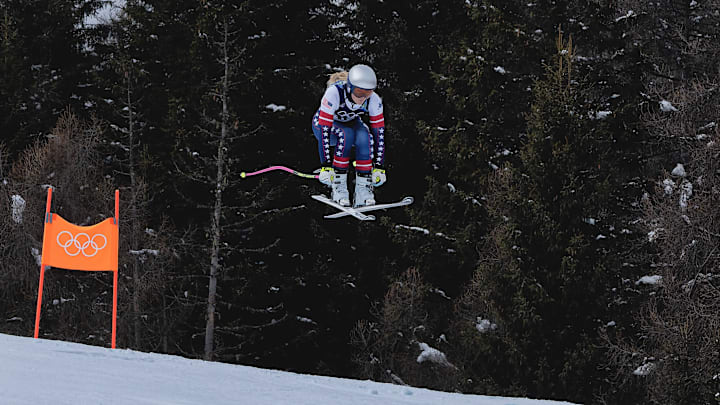
CORTINA d’AMPEZZO, Italy — Lindsey Vonn is hospitalized in Treviso, bedridden and broken, while the Winter Olympics carries on without her. That is the harsh reality of sports, especially at an event as vast as this one. A star goes down, and a galaxy of others fills the vacuum.
Vonn is posting through it, congratulating other Olympians on their performances via social media, while providing updates on her condition. They are not for the faint of heart: a complex fracture of her left leg; three surgeries, with more to come; external stabilization of the leg with a bulky contraption that looks like it might be used to hold up a retaining wall. The recovery will be long.
A little update from me…❤️ thank you for all the love and support. Helps me so much🙏🏻 pic.twitter.com/ui0lfSS064
— lindsey vonn (@lindseyvonn) February 13, 2026
“I’m finally feeling more like myself,” she said in a video posted to X on Friday afternoon, Italy time, followed by a sigh. “But I have a long, long way to go.”
Vonn says she’s scheduled for a fourth surgery Saturday. If that is successful, she’s hoping to go back to the United States—where she will face at least one more surgery. She thanked her fans for the outpouring of support and said watching her American teammates compete has “really lifted my spirits.”
It is a terribly sad, sobering chapter in a previously galvanizing comeback story. Back in October, when Vonn was making the media rounds in advance of her bid for a fifth Olympics at the age of 41, she seemed completely in command. She was happy, confident and fully ready to be the American face of the Milan Cortina Games. Then she backed it up on the slopes with a highly successful start to the World Cup season—winning two races and placing on the podium in seven of eight.
What happened next is what happens almost inevitably in Alpine skiing—crashes and injuries. The sport grinds up even its best athletes, who surely know the risks and choose to accept them. Hopefully the younger ones coming up through the ranks are aware as well.
The injury rate on the U.S. Alpine women’s top group alone would daunt an NFL team. It is 100%.
Of the 12 women listed on the Olympic roster and/or the Alpine “A” team for the 2025–26 season, all of them but Vonn had suffered at least one major injury since 2020. Of course, she’d been retired since 2019.
Lauren Macuga tore an ACL in late November, putting her out of action for the season, including the Olympics.
Katie Hensien suffered a fractured tibia in November. That came after a serious knee injury in May 2023, in which she tore the ACL and MCL in one knee. She missed the entire 2023–24 season.
Nina O’Brien endured multiple leg fractures in the giant slalom at the 2022 Beijing Olympics, including a compound tibia fracture.
Breezy Johnson, winner of the gold medal in the downhill here Sunday, tried to ski through a torn ACL to get to Beijing. The injury forced her out of those Olympics.
Bella Wright broke her ankle in December 2021, but still willed herself to the ’22 Olympics just a couple of months later. That came after an ACL tear in 2016.
AJ Hurt missed most of the 2022–23 season due to ligament damage in her ankle. She also missed the start of 2024–25 season with back and shoulder pain.
Keely Cashman endured a crash in January 2021 that, according to her Team USA bio, resulted in eight days in the hospital with a traumatic brain injury, concussion, strained MCL, hematomas in both hips and temporary loss of feeling in her foot. She somehow returned to racing in the spring but had a crash in May that left her with “severe facial cuts.”
Mary Bocock tore a knee ligament in December 2021.
Mikaela Shiffrin, the most decorated female alpine skier in history, suffered a puncture wound from a crash in Killington, Vt., in late 2024 that led to PTSD.
At the same event in Killington, Paula Moltzan endured a broken hand and dislocated shoulder. Moltzan won a bronze medal here this week in the team combined with Jackie Wiles.
And speaking of Wiles: She had two surgeries during the 2020–21 season, one for a broken clavicle and the other for a knee injury. That followed a severe crash in 2018 in which she tore her ACL, MCL, LCL and PCL, injured her lateral meniscus, broke her fibula and suffered nerve damage. That trauma resulted in three surgeries and 18 months out of action.
Of course, Vonn’s injury history alone is nearly as lengthy as the list above. Yet she remained determined to accept the everyday risks in pursuit of the speed it would take to win a comeback medal. In a sport of danger-courting daredevils, Vonn is an outlier.
“I need to be able to push the limits in a way that the other women are not willing to,” she said in October.

Still, some ski legends didn’t want to see her compete at her age, after that long a layoff, on a partially replaced right knee.
Austrian men’s downhill icon Franz Klammer, whose daredevil gold medal run in 1976 is the stuff of legend, declared that Vonn had “gone completely mad.” Another legend of the sport, Pirmin Zurbriggen, told a Swiss media outlet that “there is a risk that Vonn will tear her artificial knee to pieces. And in such a way that she will never be able to do any sport properly for the rest of her life.” Michaela Dorfmeister, winner of two Olympic gold medals 20 years ago, said “Vonn should see a psychologist,” and wondered, “Does she want to kill herself?”
Vonn defied all the doubts during her comeback … until she crashed in Switzerland a week before the 2026 Games, rupturing the ACL in her left knee. That put her Olympic comeback at extreme risk, but she went through with it anyway, navigating two training runs on the Olympia delle Tofane course. The world was ready to cheer her on.
She lasted 13 seconds, clipping the fourth gate of her run and crashing gruesomely. That resulted in the injuries from which she’s now in the early stages of recovery.
If you’re wondering whether there’s something wrong with U.S. skiing, or Vonn herself, don’t. It’s not an American thing. Injuries are a distressingly regular part of the world landscape in the sport.
Look at Italy’s Federica Brignone, winner of Thursday’s Super-G. Her victory happened 10 months after she broke multiple bones and tore the ACL in her left leg and was unable to walk for three months.
After two surgeries, 42 stitches and months of rehab, she didn’t compete again until Jan. 20. Brignone was one of four flag bearers for Italy during the opening ceremony, but the pain in her leg caused her to ask curler Amos Mosaner to carry her on his shoulders to help her make it through the event.
Andrea Panzeri, chief physician for the Italian Winter Sports Federation’s medical commission, declared Brignone’s gold medal “unthinkable.”
Among those who were quick to congratulate Brignone on fighting through the pain to race and win: Lindsey Vonn.
"Congrats Fede,” Vonn posted on X from the hospital. “What an incredible comeback!!”
More Winter Olympics on Sports Illustrated
 Add us as a preferred source on Google
Pat Forde is a senior writer for Sports Illustrated who covers college football and college basketball as well as the Olympics and horse racing. He cohosts the Others Receiving Votes podcast for SI and is a regular contributor to the Tony Kornheiser Show podcast. He previously worked for Yahoo Sports, ESPN and The (Louisville) Courier-Journal. Forde has won 28 Associated Press Sports Editors writing contest awards, has been published three times in the Best American Sports Writing book series, and was nominated for the 1990 Pulitzer Prize. A past president of the U.S. Basketball Writers Association and member of the Football Writers Association of America, he lives in Louisville with his wife. They have three children, all of whom were collegiate swimmers.
Follow ByPatForde