%20%20--%3E%0A%3Csvg%20version%3D%221.1%22%20id%3D%22Layer_1%22%20xmlns%3D%22http%3A%2F%2Fwww.w3.org%2F2000%2Fsvg%22%20xmlns%3Axlink%3D%22http%3A%2F%2Fwww.w3.org%2F1999%2Fxlink%22%20x%3D%220px%22%20y%3D%220px%22%0A%09%20width%3D%2239px%22%20height%3D%2240px%22%20viewBox%3D%220%200%2039%2040%22%20enable-background%3D%22new%200%200%2039%2040%22%20xml%3Aspace%3D%22preserve%22%3E%0A%3Cpath%20fill%3D%22%23FFFFFF%22%20d%3D%22M38.5%2C7H28.2v26h10.3V7z%22%2F%3E%0A%3Cpath%20fill-rule%3D%22evenodd%22%20clip-rule%3D%22evenodd%22%20fill%3D%22%23FFFFFF%22%20d%3D%22M26.1%2C25.5c0%2C5.8-4.1%2C7.5-12.9%2C7.5C3.9%2C33%2C0%2C31.2%2C0%2C25.2v-1.1h11.6%0A%09v2.4c0%2C0.7%2C0.1%2C1.4%2C1.2%2C1.4c1%2C0%2C1.2-0.4%2C1.2-1.3v-0.9c0-1.6-0.9-1.6-3.5-2.2C2.2%2C21.7%2C0%2C19.7%2C0%2C15.3v-0.9C0%2C9.3%2C5.5%2C7%2C12.9%2C7%0A%09c10.2%2C0%2C12.8%2C2.6%2C12.8%2C7.4v1.8h-11v-2.9c0-0.6-0.4-1.1-1.2-1.1c-0.6%2C0-1.2%2C0.4-1.2%2C1.1v0.9c0%2C1.5%2C0.9%2C2%2C3.3%2C2.5%0A%09c8%2C1.6%2C10.5%2C3.3%2C10.5%2C7.5V25.5z%22%2F%3E%0A%3C%2Fsvg%3E%0A)
With Compassion and Grit, Mikaela Shiffrin Is Carrying the U.S. in More Ways Than One
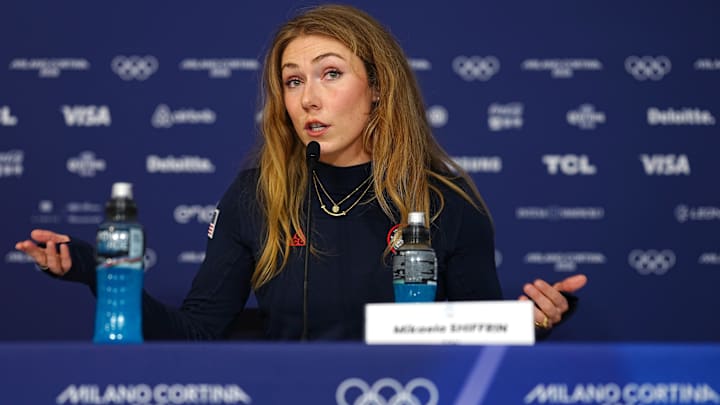
CORTINA d’AMPEZZO, Italy — In accordance with her superstar status in the skiing world, Mikaela Shiffrin has some heavyweight sponsors. Some of them had signage ready for her press conference ahead of her Milan Cortina debut.
When Shiffrin sat down at the podium, a Visa-branded photo to her right showed her in action from the Beijing Olympics in 2022.
“It’s a very cool picture,” Shiffrin noted. “Like pulling the picture where I was on my feet.”
She waited a beat, then added, “Sorry. That deserved a bigger laugh.”
It was a deft moment of self-deprecation, an acknowledgment of the amount of time she spent splattered in the Chinese snow in an Olympics gone all wrong. The most accomplished World Cup skier in history brutally bombed in Beijing, crashing three times in six races and failing to win a single medal. It was like watching Michael Jordan go scoreless in an NBA Finals game or Tom Brady throw five interceptions in a Super Bowl.

At the time of the Beijing debacle, Shiffrin told NBC that it “makes me second-guess the last 15 years, everything I thought I knew about my own skiing and slalom and racing mentally.”
The frustration for Shiffrin is that her stunning failure was just a blip in a continuum of excellence stretching more than a decade. She’s been the best ever, but so much of that has happened when mainstream sports fans weren’t paying attention. That’s the unyielding reality that Olympic athletes must deal with.
The 30-year-old Colorado native has experienced Olympic success—gold medals in 2014 and ’18, plus a silver in ’18 as well—but the most recent five-ring experience was disastrously bad. Skiing on an unfamiliar mountain, on artificial snow, amid a still-stringent COVID-19 lockdown in Asia, the circumstances piled up and she went down.
That was the elephant in the room at her Saturday press conference, and it’s the pachyderm that will accompany her up the mountain for these Winter Games. With three events on tap—the team combined, giant slalom and slalom, the first of which is contested Tuesday—she’s ready to carry the weight.
“I think it’d be impossible not to take my experiences from previous Olympics, including Beijing, and sort of have those be somehow relevant in this Games,” she said. “But I feel like sitting here right now, I feel so much gratitude to be here. It’s like excitement, there’s adrenaline, I’m certainly nervous at times, but really a lot of a sense of gratitude. I’m excited to take that with me for the entire time that we’re here.”
Shiffrin is a thinker. She pauses as she talks, considering her words. She carries a high degree of awareness with her, which has assuredly helped her win a record 108 World Cup races but might also be an occasional nemesis. She came back successfully from Beijing, but then disappeared down a dark hole after a serious injury in Killington, Vt., in November 2024.
A crash in a Super-G run there left her with a puncture wound in her abdomen, one that came within a millimeter of perforating her colon. She described the ordeal in detail in The Players Tribune last May, including the post-traumatic stress disorder that accompanied her recovery.
Expecting to power through rehab and bounce back quickly in competition, Shiffrin wrote that she instead encountered a strange sort of disconnect between mind and body. She felt like she was living out the familiar nightmare scenario of being stuck in a quagmire that prevents a person from moving quickly, when speed is needed.
“Molasses, basically,” she wrote. “… It was almost like I was no longer in control of my body.”
Through counseling, Shiffrin said she was diagnosed with PTSD from her crash and injury. That helped her understand what was happening, and in turn provided a baseline for crawling out of the hole she was in. One key: simple repetition. Going back up the mountain and back into the start gate and working through practice runs without chasing perfection.
Two months later, she was back in competition. Shortly thereafter, she was back on the podium. On Feb. 23, 2025, she became the first skier to record 100 career World Cup victories. The wins have continued to pile up this season.

Asked about the PTSD journey Saturday, Shiffrin gave a nuanced response. (Remember: thinker.) She did not want to equate her trauma with what soldiers and others experience in warfare.
“When people talk about PTSD, I think oftentimes the cases are referring to really war veterans and that’s the context we know it in for the most part,” she said. “I do want to be careful—there are a lot of eyes on this event and I want to be aware to not say that my experiences are anything like that. … Having said that, I also believe that a lot more people experience this kind of a trauma response than you might imagine. If even teammates who didn’t necessarily have words to it, have sort of brought that up and said, ‘This encouraged me to go and explore my own [traumatic] experience.’ ”
Shiffrin can get granular about transferring the mental work into the technical process of skiing. In the mostly turn-dominated slalom world, as opposed to the bomber approach of downhill, going through gates with proper weight distribution is vital. What Shiffrin didn’t do well enough in Beijing is something she might have done too well in Vermont.
“I would like to be more committed to my outside ski,” Shiffrin said. “In skiing, outside ski is the boss. If you’re on your outside ski, you’re in the driver’s seat. And that has been an ongoing task for me because it’s also one of the things that played a role in my crash in Killington. And I will tell you, I would take Beijing any day over crashing in Killington and getting a puncture wound to the abdomen. So there are many reasons to be on the outside ski, but that is one of the sole purposes of my skiing every single day when I go out on the mountain.”
While concentrating on the details, Shiffrin is well aware of the larger context of athletic performance within the Winter Games. Media representatives from around the world care less about her outside ski than her innermost thoughts—specifically about representing the United States at a time when the country is arguably at its lowest level of popularity globally.
It’s a tricky line to walk, and most athletes here are responding to questions as opposed to volunteering their opinions. There aren’t a lot of easy answers in a heightened political climate that can be a tinder box of anger ready to catch fire. Nobody wants to be the next American athlete castigated by Donald Trump on social media for insufficient patriotism, but a lot of them have opinions they’re willing to share.
Like a skier plotting the path through a set of gates, Shiffrin chose a nuanced line of approach. She was ready for the question.
“It’s always an honor and privilege to represent Team USA and to represent your country,” Shiffrin said. “And then in our sports, to be able to come together in this Olympic venue and spirit, that’s quite a gift and it’s truly an honor to be here. I think there’s a lot of hardship in the world globally and there’s a lot of heartbreak, there’s a lot of violence. It can be tough to reconcile that when you’re also competing for medals in an Olympic event.”
At that point she reached for her phone and referred to notes she had typed before arriving in Cortina. Shiffrin noted what actress Charlize Theron said at the opening ceremony in quoting Nelson Mandela: “Peace is not just the absence of conflict, peace is the creation of an environment where we can all flourish regardless of race, color, creed, religion, gender, class, cast or any other social markers of difference.”
Then she provided her own perspective: “For me, as this relates to the Olympics, I’m really hoping to show up and represent my own values—values of inclusivity, values of diversity and kindness and sharing, tenacity, work ethic, showing up with my team every single day. I’m hoping to represent those who have been supporting me this entire time and I’m really thankful to be here, and my greatest hope for this Olympic Games from a broader perspective is that it is a beautiful show of cooperation and of competition.”
More Winter Olympics on Sports Illustrated
 Add us as a preferred source on Google
Pat Forde is a senior writer for Sports Illustrated who covers college football and college basketball as well as the Olympics and horse racing. He cohosts the Others Receiving Votes podcast for SI and is a regular contributor to the Tony Kornheiser Show podcast. He previously worked for Yahoo Sports, ESPN and The (Louisville) Courier-Journal. Forde has won 28 Associated Press Sports Editors writing contest awards, has been published three times in the Best American Sports Writing book series, and was nominated for the 1990 Pulitzer Prize. A past president of the U.S. Basketball Writers Association and member of the Football Writers Association of America, he lives in Louisville with his wife. They have three children, all of whom were collegiate swimmers.
Follow ByPatForde