%20%20--%3E%0A%3Csvg%20version%3D%221.1%22%20id%3D%22Layer_1%22%20xmlns%3D%22http%3A%2F%2Fwww.w3.org%2F2000%2Fsvg%22%20xmlns%3Axlink%3D%22http%3A%2F%2Fwww.w3.org%2F1999%2Fxlink%22%20x%3D%220px%22%20y%3D%220px%22%0A%09%20width%3D%2239px%22%20height%3D%2240px%22%20viewBox%3D%220%200%2039%2040%22%20enable-background%3D%22new%200%200%2039%2040%22%20xml%3Aspace%3D%22preserve%22%3E%0A%3Cpath%20fill%3D%22%23FFFFFF%22%20d%3D%22M38.5%2C7H28.2v26h10.3V7z%22%2F%3E%0A%3Cpath%20fill-rule%3D%22evenodd%22%20clip-rule%3D%22evenodd%22%20fill%3D%22%23FFFFFF%22%20d%3D%22M26.1%2C25.5c0%2C5.8-4.1%2C7.5-12.9%2C7.5C3.9%2C33%2C0%2C31.2%2C0%2C25.2v-1.1h11.6%0A%09v2.4c0%2C0.7%2C0.1%2C1.4%2C1.2%2C1.4c1%2C0%2C1.2-0.4%2C1.2-1.3v-0.9c0-1.6-0.9-1.6-3.5-2.2C2.2%2C21.7%2C0%2C19.7%2C0%2C15.3v-0.9C0%2C9.3%2C5.5%2C7%2C12.9%2C7%0A%09c10.2%2C0%2C12.8%2C2.6%2C12.8%2C7.4v1.8h-11v-2.9c0-0.6-0.4-1.1-1.2-1.1c-0.6%2C0-1.2%2C0.4-1.2%2C1.1v0.9c0%2C1.5%2C0.9%2C2%2C3.3%2C2.5%0A%09c8%2C1.6%2C10.5%2C3.3%2C10.5%2C7.5V25.5z%22%2F%3E%0A%3C%2Fsvg%3E%0A)
‘Quad God’ Ilia Malinin Comes Down to Earth With Epic Olympic Collapse
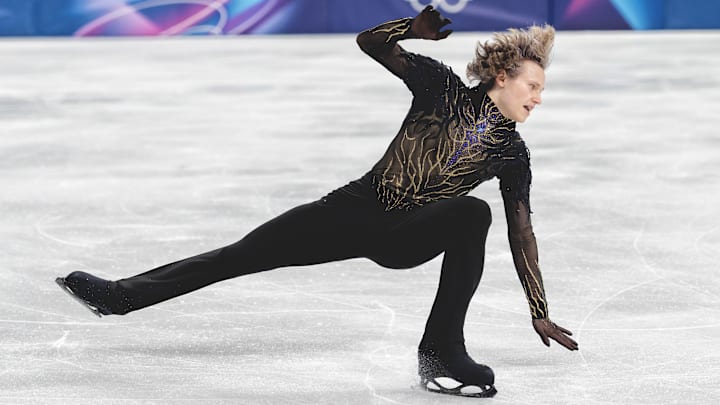
MILAN — Well, Ilia Malinin came here to do what no man had ever done before. He did it. He arrived at these Olympics as a heavy favorite, and by the time he skated out for his free skate Friday night, he had the gold medal on a silver platter. France’s Adam Siao Him Fa had stumbled his way to seventh place. Japan’s Yuma Kagiyama was uneven and plopped down in second. Kazakhstan’s Mikhail Shaidorov was in first place, and even he couldn’t believe it—when Kagiyama’s score posted, a stunned Shaidorov looked like he wanted to drug-test himself.
As Malinin got into his starting pose, all he had to do was …
“All the traumatic moments of my life really just started flooding my head,” he said later.
… not that.
The best thing you can say about Malinin’s performance was that he did not injure any animals. He was shaky from the start, somehow managed to land a quad flip and quad Lutz, and then melted down so completely that the ice turned to water. Malinin was devastated before he was done.
There has never been anything in the long history of Olympic figure skating quite like it. If you want to make comparisons, you have to do what Malinin looked like he wanted to do before he was halfway through: leave the rink.

Don’t tell me about the Falcons blowing a 28–3 lead in the Super Bowl. There was no Tom Brady on the other side of this. All the 2004 Yankees did was lose four games in a row. Almost every baseball team has done that. Greg Norman at the Masters? Golfers choke all the time. This was like LeBron James spending all of Game 7 dribbling with his knuckles.
This was painful to watch. Imagine having Malinin’s view.
He said “the nerves just went so overwhelming.” He finished 15th in the free skate, eighth overall. Then he became the only athlete in Olympic history to go down to the media mixed zone with more questions than answers.
“Honestly, I can’t understand what it was now,” he said.
Before you say that the Olympic pressure got to Malinin: Don’t even bother. He said it himself.
“I just thought that all I needed to do is go out there and trust the process that I’ve always been doing with every competition,” he said. “But of course, it’s not like any other competition. It’s the Olympics, and I think people only realize the pressure and the nerves that actually happen from the inside. So it was really just something that overwhelmed me, and I just felt like I had no control.”
Let’s all give Malinin a perfect score for how he handled the fallout. He is 21 years old. This is his first Olympics. He owned his collapse. Anyone who did not root for him before should pull hard for him now.
Simone Biles was in the house Friday; maybe she would understand. But when Biles got the twisties in Tokyo, she was already an individual Olympic champion. The Tokyo Olympics were a weird, COVID-19, no-fans event. Nobody in Tokyo really felt normal.
Malinin took reporters’ questions for four minutes. He will keep them for four years. Part of being a professional athlete is rebounding from failure. But in this case, what would moving on even look like? His name is an anagram for “Ilia in Milan.”
Malinin doesn’t understand why this happened, so maybe the rest of us have no shot. But let’s try.
Start last weekend, with the team event. Malinin was uncharacteristically shaky in his short program, and he spent a few hours trying to figure out why. His conclusion: “I didn’t really understand the impact of the Olympic environment,” he said later. By the last night of the team event, which ended with the men’s free skate, he decided that he wanted the gold medal to come down to his performance. That is exactly what happened. He came through, and the Americans won.

Looking back, he probably tricked himself with that performance. The figure skating team event is not like the gymnastics team event. It’s relatively new and still feels like a novelty. No matter what skaters say publicly, the team event just does not mean nearly as much as the individual event. It does not mean nearly as much to Malinin. He told himself (and the media) he had handled Olympic pressure. But what he encountered Friday was always going to be a much larger beast.
“The noise itself is just a lot to handle, no matter what, you know, favorite you are,” he said. “Social media has its ups and it really has its downs. So I think that’s obviously something that I felt right now. It just happened, and I can’t explain exactly what happened.”
As the last group of skaters was introduced, Malinin looked like the confident badass he usually is. He walked out, faked like he was going to do a backflip, then smiled and wagged his finger, as if to say: Not yet. Those backflips on the ice, as breathtaking as they are, don’t really affect the scoring. They are exclamation points.
Malinin knew he was going last and had a five–point cushion from the short program. What do athletes in that situation expect? Like the rest of us, Malinin probably figured Kagiyama or another top skater would turn in an exemplary performance, and he would top it or at least equal it—which, with that five-point cushion, would mean he would win gold.
But then France’s Siao Him Fa and Japan’s Kagiyama both skated poorly. Shaidorov leapt from fifth to first. It all happened in a relatively short period of time. Malinin barely had time to process what it meant, and what it meant was this:
The event that Malinin expected had vanished. The storyline had changed. He could still be the gold medal winner, but he could not really win gold in the active-verb sense of that word. Siao Him Fa and Kagiyama had handed it to him.
Mikhail Shaidorov's excellent performance gives him the Gold in Men's Figure Skating! pic.twitter.com/7HXLhp2W6U
— NBC Olympics & Paralympics (@NBCOlympics) February 13, 2026
All Malinin could do was blow it.
That wasn’t quite true or fair, of course. But that might have been how it felt to him. It would help explain why every negative thing that ever happened to him popped into his head. Losing to an epic Kagiyama performance would have been disappointing, of course, but it would not have been awful.
Losing to a poor Kagiyama performance? Now that would be awful.
It was. It is. There is no escaping the awful. It will follow him home, climb in his bed and sit on his shoulder when he starts training again. The awful will be there when he goes back to national and world championships, waving to get his attention. By the time Malinin arrives in France for the 2030 Olympics, the awful will be screaming in his ear.
That is a lot to overcome. But Malinin is great enough to overcome it.
He had no time to adjust Friday. Now he has four years. Anyone who watched this, anyone who listened afterward—anyone with a heart—would love to see Malinin go to France four years from now and deliver one hell of an exclamation point.
More Winter Olympics on Sports Illustrated
 Add us as a preferred source on Google
Michael Rosenberg was a senior writer for Sports Illustrated, covering any and all sports. He writes columns, profiles and feature stories and has covered almost every major sporting event. He joined SI in 2012 after working at the Detroit Free Press for 13 years, eight of them as a columnist. Rosenberg is the author of “War As They Knew It: Woody Hayes, Bo Schembechler and America in a Time of Unrest.” Several of his stories also have been published in collections of the year’s best sportswriting. He is married with three children.
Follow rosenberg_mike