%20%20--%3E%0A%3Csvg%20version%3D%221.1%22%20id%3D%22Layer_1%22%20xmlns%3D%22http%3A%2F%2Fwww.w3.org%2F2000%2Fsvg%22%20xmlns%3Axlink%3D%22http%3A%2F%2Fwww.w3.org%2F1999%2Fxlink%22%20x%3D%220px%22%20y%3D%220px%22%0A%09%20width%3D%2239px%22%20height%3D%2240px%22%20viewBox%3D%220%200%2039%2040%22%20enable-background%3D%22new%200%200%2039%2040%22%20xml%3Aspace%3D%22preserve%22%3E%0A%3Cpath%20fill%3D%22%23FFFFFF%22%20d%3D%22M38.5%2C7H28.2v26h10.3V7z%22%2F%3E%0A%3Cpath%20fill-rule%3D%22evenodd%22%20clip-rule%3D%22evenodd%22%20fill%3D%22%23FFFFFF%22%20d%3D%22M26.1%2C25.5c0%2C5.8-4.1%2C7.5-12.9%2C7.5C3.9%2C33%2C0%2C31.2%2C0%2C25.2v-1.1h11.6%0A%09v2.4c0%2C0.7%2C0.1%2C1.4%2C1.2%2C1.4c1%2C0%2C1.2-0.4%2C1.2-1.3v-0.9c0-1.6-0.9-1.6-3.5-2.2C2.2%2C21.7%2C0%2C19.7%2C0%2C15.3v-0.9C0%2C9.3%2C5.5%2C7%2C12.9%2C7%0A%09c10.2%2C0%2C12.8%2C2.6%2C12.8%2C7.4v1.8h-11v-2.9c0-0.6-0.4-1.1-1.2-1.1c-0.6%2C0-1.2%2C0.4-1.2%2C1.1v0.9c0%2C1.5%2C0.9%2C2%2C3.3%2C2.5%0A%09c8%2C1.6%2C10.5%2C3.3%2C10.5%2C7.5V25.5z%22%2F%3E%0A%3C%2Fsvg%3E%0A)
SI:AM | Why You Need to Watch the Newest Olympic Sport, Ski Mountaineering
Good morning, I’m Dan Gartland. It’s been a tough Olympics for Team USA’s top figure skaters, huh? First, Ilia Malinin bombed out of the men’s singles event, then Amber Glenn placed 13th in the women’s short program yesterday.
In today’s SI:AM:
🏀 AJ Dybantsa’s unusual path
👎 Purdue falls in big game
🇺🇸 USWNT roster analysis
If you’re reading this on SI.com, click here to subscribe and receive SI:AM directly in your inbox each morning.
Time to fall in love with skimo
Consider this a public service announcement: One of the most compelling events of these Winter Olympics will take place on Thursday.
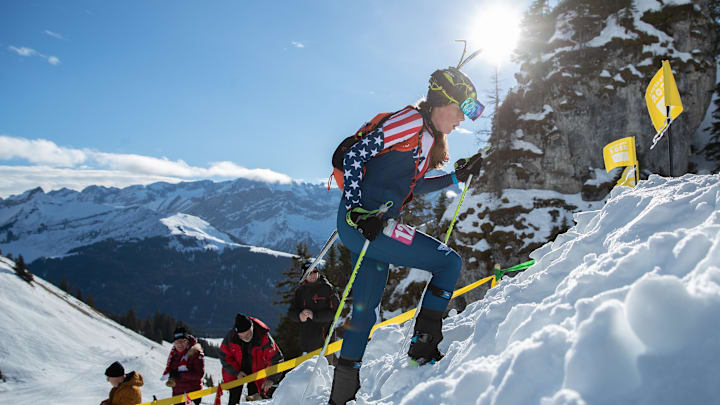
Ski mountaineering (or skimo for short) is the newest sport on the Olympic program. Even though you probably haven’t heard of it, skimo may just become your new favorite Olympic event..
In the simplest possible terms, skimo involves skiing up a mountain and then skiing back down. But there’s a lot more to it than that. Let’s get into all of it.
What does the competition look like?
The race consists of two segments: the ascent and the descent. The ascent is divided into multiple sections. Skiers begin by climbing the mountain on their skis until they reach the first transition zone, at which point they remove their skis, throw them in their backpack and continue up the mountain on foot. This is known as “boot packing” and involves athletes trudging uphill either through loosely packed snow or, in some cases, up stairs.
After the boot-packing portion, competitors reach another transition zone, where they put their skis back on and continue climbing until they reach the summit and prepare for the descent.
This is where things get really crazy. Skiers use strips of fabric known as “skins” on the bottom of their skis that allow them to easily glide uphill without sliding back down. (The skins are made of mohair, the delicate fur of the Angora goat.) Before proceeding downhill, the skiers must remove their skins. And in a sport where every second counts, they must do so as quickly as possible. The fastest technique is known as a “double rip”, which involves bending down to grab the skins on the bottom of both skis at once. The skier then jumps in the air while pulling the skins off, stuffs them in the front of their suit and proceeds down the mountain. The first one to reach the bottom wins.
What’s the competition format?
The ISMF World Cup circuit includes multiple styles of races, but the two chosen for the Olympics are the sprint and mixed relay.
Sprint races take about two-and-a-half to three-and-a-half minutes to complete, compared to about 30 minutes for the relay. The sprint race consists of one ascent and one descent, while the relay requires each athlete (a man and a woman from each nation) to complete multiple loops of the course. Because skiers must climb the mountain again after descending the first time, the relay race includes a difficult transition where skiers must put their skins back on the bottom of their skis.
Both sprint competitions will take place entirely on Thursday (beginning at 3:50 a.m. ET). The day begins with heats, followed by semifinals and then the final. The medal races are at 7:55 a.m. ET for the women at 8:15 a.m. for the men.
Who are the medal favorites?
European athletes dominate skimo, particularly those from central Europe. The top spots in the current men’s and women’s world rankings are occupied primarily by athletes from France, Spain, Switzerland and Italy. France’s Emily Harrop is the defending world No. 1 on the women’s side and has won three gold medals at the World Championships. Oriol Cardona Coll of Spain has the top spot in the men’s rankings and is the defending world champion. (He’s also a competitive mountain runner.)
The U.S. will send two athletes to compete in the event: Cam Smith and Anna Gibson. Smith is a 13-time national champion, while Gibson is a former Team USA mountain runner who was recruited by Smith to try skimo. The pair qualified for the Olympics in one of their last opportunities to do so, winning a World Cup event in Utah in December.
Why should I watch?
Just to reemphasize, the skiers are going up a mountain—not a moderate slope like in cross-country skiing. The climb is steepand the action is frantic. It’s a sight to behold. In such a short race, every fraction of a second is crucial. That means those transitions are critical. Any minor error can be the difference between a gold medal and falling off the podium. It should create some fantastic drama.
Most importantly, the races are quick. The IOC isn’t asking you to invest two hours in watching some obscure sport that no one has ever seen before. Skimo’s inclusion follows the trend of the IOC adding sports to the Olympic program that favor short attention spans. When it added rugby in 2016, it wasn’t the 15-a-side version with two 40-minute halves; it was the seven-on-seven version that takes 15 minutes to play. Competition in skateboarding, breaking and snowboarding also takes place in quick bursts. Skimo will be no different. And the entire competition will take place over a couple of hours. There’s no need to spend multiple days following storylines and keeping up with standings. You can tune in for the women’s semifinals at 6:55 a.m. ET and see two medals awarded in the following 90 minutes. Give it a shot. You won’t be disappointed.
The best of Sports Illustrated

- In today’s Digital Cover, Bryan Fischer goes inside how AJ Dybantsa’s unconventional decision to lift BYU basketball to unprecedented heights.
- Fischer also argues that North Carolina has much bigger problems than making a decision on coach Hubert Davis’s future, which could save his job.
- Preseason No. 1 Purdue has failed to live up to expectations Kevin Sweeney explores where things have gone wrong for the Boilermakers.
- In his preview of the 2026 offseason QB carousel, Conor Orr writes that Kyler Murray and the Jets feel destined for one another.
- Ben Steiner analyzes the upcoming 2026 MLS season, starting with a comprehensive preview of how things will play out in the Western Conference.
- Theo Lloyd-Hughes breaks down the latest USWNT roster announcement, headlined by the return of Naomi Girma and Alyssa Thompson.
- Amanda Langell reports on Trent Alexander-Arnold and Kylian Mbappe’s support for Real Madrid teammate Vinícius Júnior after he was the target of alleged racist abuse on Tuesday night.
The top five…
… things I saw yesterday:
5. Michigan State forward Coen Carr’s emphatic block. I’ve featured some amazing dunks by Carr here before, but his athleticism pays off on the defensive end as well.
4. Speaking of which, here’s a great slam by Carr.
3. The court storming after Rhode Island upset No. 18 Saint Louis for the Rams’ first victory over a ranked team since 2017 (when Dan Hurley was the coach).
2. Oregon forward Dezdrick Lindsay’s ridiculous dunk.
1. The men’s big air ski final. It was amazing to watch the athletes continue to outdo each other. There were nine scores of at least 95 over the three rounds, including a 98.50 by Norway’s Tormod Frostad to win gold.
 Add us as a preferred source on Google
Dan Gartland writes Sports Illustrated’s flagship daily newsletter, SI:AM, and is the host of the “Stadium Wonders” video series. He joined the SI staff in 2014, having previously been published on Deadspin and Slate. Gartland, a graduate of Fordham University, is a former Sports Jeopardy! champion (Season 1, Episode 5).
Follow Dan_Gartland