%20%20--%3E%0A%3Csvg%20version%3D%221.1%22%20id%3D%22Layer_1%22%20xmlns%3D%22http%3A%2F%2Fwww.w3.org%2F2000%2Fsvg%22%20xmlns%3Axlink%3D%22http%3A%2F%2Fwww.w3.org%2F1999%2Fxlink%22%20x%3D%220px%22%20y%3D%220px%22%0A%09%20width%3D%2239px%22%20height%3D%2240px%22%20viewBox%3D%220%200%2039%2040%22%20enable-background%3D%22new%200%200%2039%2040%22%20xml%3Aspace%3D%22preserve%22%3E%0A%3Cpath%20fill%3D%22%23FFFFFF%22%20d%3D%22M38.5%2C7H28.2v26h10.3V7z%22%2F%3E%0A%3Cpath%20fill-rule%3D%22evenodd%22%20clip-rule%3D%22evenodd%22%20fill%3D%22%23FFFFFF%22%20d%3D%22M26.1%2C25.5c0%2C5.8-4.1%2C7.5-12.9%2C7.5C3.9%2C33%2C0%2C31.2%2C0%2C25.2v-1.1h11.6%0A%09v2.4c0%2C0.7%2C0.1%2C1.4%2C1.2%2C1.4c1%2C0%2C1.2-0.4%2C1.2-1.3v-0.9c0-1.6-0.9-1.6-3.5-2.2C2.2%2C21.7%2C0%2C19.7%2C0%2C15.3v-0.9C0%2C9.3%2C5.5%2C7%2C12.9%2C7%0A%09c10.2%2C0%2C12.8%2C2.6%2C12.8%2C7.4v1.8h-11v-2.9c0-0.6-0.4-1.1-1.2-1.1c-0.6%2C0-1.2%2C0.4-1.2%2C1.1v0.9c0%2C1.5%2C0.9%2C2%2C3.3%2C2.5%0A%09c8%2C1.6%2C10.5%2C3.3%2C10.5%2C7.5V25.5z%22%2F%3E%0A%3C%2Fsvg%3E%0A)
USA Hockey’s Olympic Gold Medal Win Was Decades in the Making
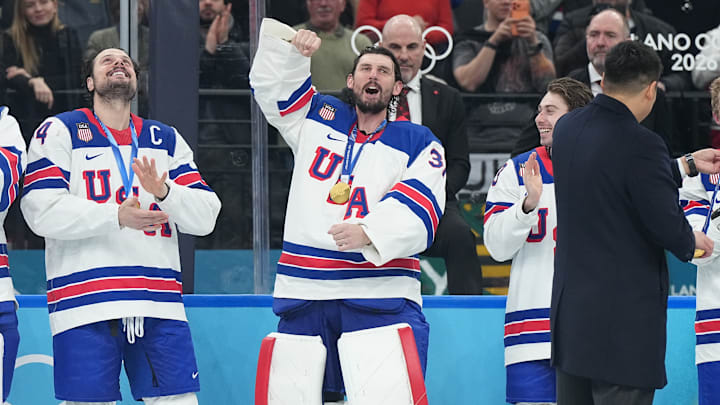
MILAN — A 46-year wait will end in two seconds, but nobody knows that, least of all Zach Werenski. He has the puck on his stick—“kind of a broken play,” he’ll say later, but it’s not what he is thinking at the moment, and why should he? For this United States men’s hockey team, nothing really breaks. Canada should have broken this game open by now, but hasn’t. A series of brutal high-stakes losses should have broken American spirits by now, but didn’t.
Werenski sees a flash of white on the far ice.
The game is supposed to be over. The Olympics are supposed to be over. It is overtime of the final event of the Milan Cortina Games. Canada and the U.S. are playing 3-on-3 hockey for a gold medal. It’s as if International Olympic Committee leaders kept checking their watches and decided to remove a few hockey players at a time until nobody was left.
Putting only six skaters on the ice gives American goalie Connor Hellebuyck something he has not had all afternoon: A view. Canada has dominated play for almost the entire game, one high-quality scoring chance after another, 42 shots in all, yet the game is somehow tied 1–1, and if Canadians think there is something mystical working against them, they are correct: “The second I woke up this morning,” Hellebuyck will say later, “I felt like I was doing everything right. Every step I took, it felt right.”
Werenski sends the puck toward the white flash: “I just tried to throw it over there as quick as I could,” he will say.

The puck finds Jack Hughes. But USA Hockey got to him first. In the 1990s, USA Hockey created a talent incubator, the National Team Development Program, with games like this in mind. Hughes is here, in so many ways, because he is a product of the program.
Seven years ago, Hughes sat at the NTDP facility in Plymouth, Mich. He was about to be the No. 1 pick in the NHL draft, and he knew it. But he was in no rush.
“It’s my last year playing here at the program, playing with all my best buddies,” Hughes said, “because then we go our separate ways.”
When the U.S. first sent NHL players to the Olympics, in 1998, it was a debacle, and there were real questions about how much American stars even wanted to be there. Nobody has to convince Hughes. He has had so many positive experiences playing for the national team, and made so many friends, that it is ingrained in him.
Everybody who has ever watched hockey knows how much this game means to Canada. It means just as much to the U.S.

Not the country. The team.
Hughes’s older brother Quinn was crushed to miss last year’s 4 Nations Face-Off because he was injured—and as great as that event was, it wasn’t the Olympics. In November, Jack Hughes injured his finger, putting his Olympics in doubt. He got here and started the tournament on the U.S.’s fourth line. Hughes never grumbled, never lost confidence. In two weeks at the most pressurized hockey tournament in the world, his talent incubated again.
Quinn scored the game-winning goal against Sweden on Wednesday.
Jack’s former NTDP teammate, Matt Boldy, scored the U.S.’s first goal against Canada on Sunday, sneaking past Devon Toews and flipping the puck over goalie Jordan Binnington’s right skate.
Now, with the puck on his stick, Jack Hughes has half a moment to decide what to do.
Binnington thinks Hughes will shoot high on his glove side. On the U.S. bench, forward Matthew Tkachuk sees Hughes use his half a moment to manipulate Binnington, “make the goalie slide and then put it five-hole. Only the best of the best think like that.”

Binnington is sliding. The puck goes between his legs and into the net.
Canada is speechless.
Not the team. The country.
When voices come back—and in the most extreme cases, it could take a few months and many hours of therapy—the two words everybody will say are “What if?”
If Nathan MacKinnon had not missed a wide-open net in the third period, Canada wins.
If Connor McDavid or Macklin Celebrini scored on breakaways, Canada wins.
If Sidney Crosby was healthy enough to play … well, who can say? But Canada is certainly more likely to win.

If gold medal overtime were 5-on-5 instead of 3-on-3, Canada probably dominates the extra period, the way it did for most of the afternoon.
All of this is true and none of it matters. The Canadians are so talented and deep that at times they seem immune to the vagaries of the game. When Crosby scored his golden goal against the U.S. in 2010, he did so seven minutes into four-on-four overtime. Dating back to 2010, Canada had won four straight Olympic overtime games—including a quarterfinal 3-on-3 overtime win last week against Czechia. In the 4 Nations Face Off last year, Canada went 2–0 in overtime games. Canada was not going to win every overtime game for eternity.
Crosby is one of the best players ever, and it’s unfortunate that he couldn’t play, but he is not the first star to miss a huge game with an injury. It’s not even the first time for him. When Crosby’s Pittsburgh Penguins won the Stanley Cup, in 2009, he left Game 7 with an injury.
Three-on-three is a weird form of hockey, but these were the rules for everyone, and overtime rules only take effect if you let the game go to overtime. MacKinnon had one of the easiest scoring chances of his life and missed a wide-open net. Celebrini and McDavid didn’t even get good shots off on their breakaways.
Toews came breathlessly close to giving Canada the lead in the third period, but Hellebuyck reached behind him and made one of the great stick saves in hockey history: “When I’m rolling back and the puck’s not in the net,” he said, “it’s just an over overwhelming feel of ‘I got this.’ ” Every step felt right because every step was right—including the ones from the rink to the dressing room at the end of regulation.
THAT WAS ONE HELLE-BUYCK OF A STOP. 😳 pic.twitter.com/N3wCimdBGw
— NBC Olympics & Paralympics (@NBCOlympics) February 22, 2026
“He was asking, ‘Is it five-on-five? Three-on-three?’ ” Matthew Tkachuk said of his goaltender. “He was just shooting the s---. You would have never thought that it was gold medal overtime.”
American defenseman Jaccob Slavin said, “If he didn't play the way he played today, we don’t win that game.”
Tkachuk said, “It’s going to go down as one of the best performances of all-time. It has to.”
Forty-six years for the United States. Thirty years for the development program. Three gold medal games against Canada since 2002. Sixty-one minutes and 41 seconds for gold. The Americans finally did it. They broke Canada.
More Winter Olympics on Sports Illustrated
 Add us as a preferred source on Google
Michael Rosenberg was a senior writer for Sports Illustrated, covering any and all sports. He writes columns, profiles and feature stories and has covered almost every major sporting event. He joined SI in 2012 after working at the Detroit Free Press for 13 years, eight of them as a columnist. Rosenberg is the author of “War As They Knew It: Woody Hayes, Bo Schembechler and America in a Time of Unrest.” Several of his stories also have been published in collections of the year’s best sportswriting. He is married with three children.
Follow rosenberg_mike