%20%20--%3E%0A%3Csvg%20version%3D%221.1%22%20id%3D%22Layer_1%22%20xmlns%3D%22http%3A%2F%2Fwww.w3.org%2F2000%2Fsvg%22%20xmlns%3Axlink%3D%22http%3A%2F%2Fwww.w3.org%2F1999%2Fxlink%22%20x%3D%220px%22%20y%3D%220px%22%0A%09%20width%3D%2239px%22%20height%3D%2240px%22%20viewBox%3D%220%200%2039%2040%22%20enable-background%3D%22new%200%200%2039%2040%22%20xml%3Aspace%3D%22preserve%22%3E%0A%3Cpath%20fill%3D%22%23FFFFFF%22%20d%3D%22M38.5%2C7H28.2v26h10.3V7z%22%2F%3E%0A%3Cpath%20fill-rule%3D%22evenodd%22%20clip-rule%3D%22evenodd%22%20fill%3D%22%23FFFFFF%22%20d%3D%22M26.1%2C25.5c0%2C5.8-4.1%2C7.5-12.9%2C7.5C3.9%2C33%2C0%2C31.2%2C0%2C25.2v-1.1h11.6%0A%09v2.4c0%2C0.7%2C0.1%2C1.4%2C1.2%2C1.4c1%2C0%2C1.2-0.4%2C1.2-1.3v-0.9c0-1.6-0.9-1.6-3.5-2.2C2.2%2C21.7%2C0%2C19.7%2C0%2C15.3v-0.9C0%2C9.3%2C5.5%2C7%2C12.9%2C7%0A%09c10.2%2C0%2C12.8%2C2.6%2C12.8%2C7.4v1.8h-11v-2.9c0-0.6-0.4-1.1-1.2-1.1c-0.6%2C0-1.2%2C0.4-1.2%2C1.1v0.9c0%2C1.5%2C0.9%2C2%2C3.3%2C2.5%0A%09c8%2C1.6%2C10.5%2C3.3%2C10.5%2C7.5V25.5z%22%2F%3E%0A%3C%2Fsvg%3E%0A)
Unfazed and Unbelievable, Milan Didn’t Need the Olympics to Know How Good Life Can Be
MILAN — The official motto of the 2026 Winter Olympics, chosen through the traditional process of listing 100 candidates and eliminating the best 99, is “IT’s Your Vibe.” As soon as I saw that IT was capitalized, I prepared for two weeks of spotty Wi-Fi. But the IT is for Italy.
After spending the fortnight in Milan, I concluded that the locals had their own theme:
“It’s YOUR Vibe.”
The Milanese, at least in my experience, have been quite nice. But they have been nice in the way that you might be nice to somebody who asks to use your restroom. They are fine with us doing whatever it is that we have to do while we’re here. They don’t really care what we think of the place.
This is not a criticism of the people as much as it is a compliment of the city. If I lived here, my primary thought, upon leaving my apartment every morning would be: I live here! It would not be “Gosh, I hope if a bunch of Dutch speedskating fans visit someday, they are impressed.” An Olympics in Milan is similar to the one Super Bowl that was held in the New York area. I don’t even think New Yorkers remembered they were hosting a football game. They seemed to wonder why the confused tourists were all wearing the same uniforms that week.
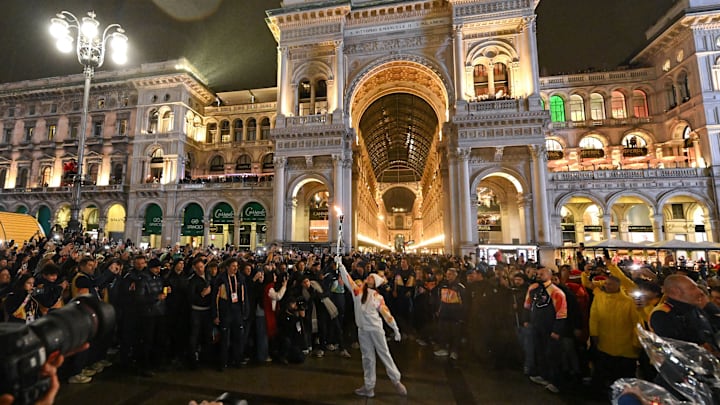
Milan is a preposterously gorgeous place, in the way that makes Americans gawk: There are certainly some beautiful old buildings in the United States, but you could place them all in the urban area and Milan still might have them beat. Everywhere you turn, there is another one.
Piazza Cordusio is breathtaking. One building, an old post office, is now home to a Starbucks, of all things—and inside, as you might expect, is probably the nicest Starbucks on the planet. Yet visitors who arrive at Piazza Cordusio and gape end up feeling like Sam Neill’s character early in the first Jurassic Park, gaping at a leaf. Unimaginable giants await: Piazza Duomo, and the Castello Sforzesco, and Pinacoteca di Brera, and we could go on. If you lived among them, you also would probably not get all that excited about Sweden playing Latvia in hockey.
This might explain why, for at least one event I attended, spectators wandered around 35 minutes before the event, waiting for concession stands to open: With so many great restaurants, who would eat that?

I remain convinced that organizers hired one company to make the signs and another company to put the arrows on the signs; once you accepted that all signage had a 30% margin for error, the Olympics became more navigable.
It was all a small price to pay for the privilege of waking up every day in Milan—and the locals seemed to know it.
This is not what the International Olympic Committee (IOC) wants to hear. When IOC leaders bring their “movement” somewhere, they want the citizenry to be moved. The Olympics are supposed to help redefine the host city to the world, convincing other cities to line up with bids for their own.
But in recent cycles, bids have been hard to drum up. Responsible governments, and the people who elect them, have come to understand that spending a few billion dollars on a two-week sporting event is utterly reckless. Calling everything an “infrastructure improvement” is a stretch, and venues have been abandoned with disturbing frequency. The Olympics have not peaked—audience is still enormous—but the IOC has.

Russia and China went all-out to host recent Olympics, but that is a consequence of one-party rule.
Italy is supposed to represent the new model: use existing facilities as much as possible, for both economic and environmental reasons.
That also contributed to the, um, vibes. Cortina, Livigno, Bormio, Predazzo, Anterselva and Tesero all appear to be wonderful places, but they might as well have been in Oklahoma City. Getting to any of them from Milan was a haul.

The Olympics don’t really convince the world of how to see a city. Sometimes, they help us understand how a city sees itself. In the case of Milan, the Games mostly told us how a city sees the Olympics.
Los Angeles has next, and while that city is obviously quite different from this one, there are some commonalities: Most of the required facilities already exist, and the locals do not much care what the world thinks. There is too much traffic as it is.
More Winter Olympics on Sports Illustrated
 Add us as a preferred source on Google
Michael Rosenberg was a senior writer for Sports Illustrated, covering any and all sports. He writes columns, profiles and feature stories and has covered almost every major sporting event. He joined SI in 2012 after working at the Detroit Free Press for 13 years, eight of them as a columnist. Rosenberg is the author of “War As They Knew It: Woody Hayes, Bo Schembechler and America in a Time of Unrest.” Several of his stories also have been published in collections of the year’s best sportswriting. He is married with three children.
Follow rosenberg_mike