%20%20--%3E%0A%3Csvg%20version%3D%221.1%22%20id%3D%22Layer_1%22%20xmlns%3D%22http%3A%2F%2Fwww.w3.org%2F2000%2Fsvg%22%20xmlns%3Axlink%3D%22http%3A%2F%2Fwww.w3.org%2F1999%2Fxlink%22%20x%3D%220px%22%20y%3D%220px%22%0A%09%20width%3D%2239px%22%20height%3D%2240px%22%20viewBox%3D%220%200%2039%2040%22%20enable-background%3D%22new%200%200%2039%2040%22%20xml%3Aspace%3D%22preserve%22%3E%0A%3Cpath%20fill%3D%22%23FFFFFF%22%20d%3D%22M38.5%2C7H28.2v26h10.3V7z%22%2F%3E%0A%3Cpath%20fill-rule%3D%22evenodd%22%20clip-rule%3D%22evenodd%22%20fill%3D%22%23FFFFFF%22%20d%3D%22M26.1%2C25.5c0%2C5.8-4.1%2C7.5-12.9%2C7.5C3.9%2C33%2C0%2C31.2%2C0%2C25.2v-1.1h11.6%0A%09v2.4c0%2C0.7%2C0.1%2C1.4%2C1.2%2C1.4c1%2C0%2C1.2-0.4%2C1.2-1.3v-0.9c0-1.6-0.9-1.6-3.5-2.2C2.2%2C21.7%2C0%2C19.7%2C0%2C15.3v-0.9C0%2C9.3%2C5.5%2C7%2C12.9%2C7%0A%09c10.2%2C0%2C12.8%2C2.6%2C12.8%2C7.4v1.8h-11v-2.9c0-0.6-0.4-1.1-1.2-1.1c-0.6%2C0-1.2%2C0.4-1.2%2C1.1v0.9c0%2C1.5%2C0.9%2C2%2C3.3%2C2.5%0A%09c8%2C1.6%2C10.5%2C3.3%2C10.5%2C7.5V25.5z%22%2F%3E%0A%3C%2Fsvg%3E%0A)

01:07:38 |
Up Next

In the Corner: Cutman Stitch Duran Reflects on His Iconic Career
Jul 20, 2026

J Balvin Ranks 2026 World Cup Stars, Teases His Next Jordan Sneaker and Settles Messi vs. Ronaldo
Jul 19, 2026

Is Patrick Mahomes Ready For Early Season Hits?
15 hours ago

The Packers Could Compete For A Division Title
14 hours ago
In the Corner: Cutman Stitch Duran Reflects on His Iconic Career
Jul 20, 2026
J Balvin Ranks 2026 World Cup Stars, Teases His Next Jordan Sneaker and Settles Messi vs. Ronaldo
Jul 19, 2026
Is Patrick Mahomes Ready For Early Season Hits?
15 hours ago
The Packers Could Compete For A Division Title
14 hours ago

One of These QBs Will Start All 17 Games for Minnesota
14 hours ago

Extend CJ Stroud or Wait for Loaded 2027 QB Class?
Feb 25, 2026

Tom Verducci Explains What Makes Konnor Griffin’s Swing Elite
Feb 27, 2026

UFC Middleweight Reinier de Ridder Calls for Major Weight Cutting Reform
Mar 5, 2026

The Biggest WINNERS of NFL Free Agency
Mar 10, 2026

Welcome to The Pit: College Basketball’s Loudest Underground Arena
Mar 11, 2026

The Lakers Are Better Without LeBron James
Mar 11, 2026

Pistons Have Big Challengers in the East
Mar 11, 2026
Transcript
Hello and welcome to Sports Illustrated's Daily Rings, SI's Daily Olympics podcast.
I'm Mitch Golddi here as always with Dan Gartland.
GAT day 15, our final full day of the Olympics is in the books.
It is, you can, you can see the finish line, is the same thing yesterday, but I'm really looking forward to that finish line.
Uh, you know, I've enjoyed this, um, but I'm ready, I'm ready to, to finally get to that men's hockey game.
Talk about that later.
But yeah, that's the finish line for me.
So I'm excited to see that.
But we had, you know, a lot of great action today also worth discussing.
Yeah, it's, uh, it's crazy.
It's the last full day and they really did pack it in there.
We got a little bit of help from the scheduling gods moving one big event from today to tomorrow, um, although very early in the morning, we'll get to that.
But, uh, yeah, this was, this was really like gold zone said goodbye today.
That's like a major milestone.
Tomorrow, uh, just a couple of things left.
But, uh, listen, let's run through the tape.
Let's, uh, let's go hard and, uh, and let's talk about a full day 15.
So what, uh, where do you want to go first here?
Oh, I, I think we should start with what I watched first.
I know there were events earlier in the day that frankly, I did not catch.
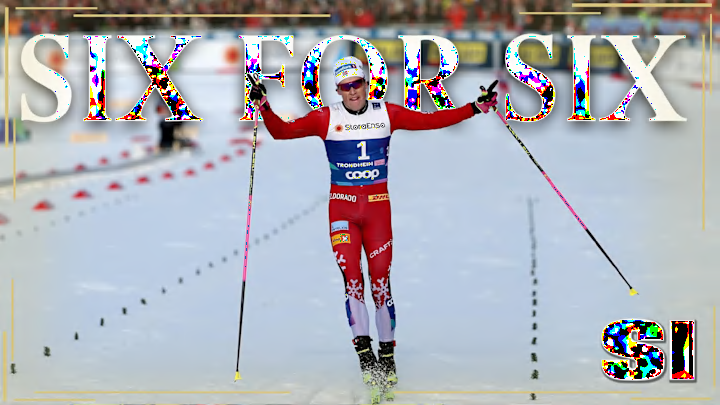
I was up bright and early, about 6, 6:15 in the morning to watch our good friend Johannes K Clavo complete the gold medal sweep, his 6th of the games in that 50 kilometer classical style , um, a really interesting race, I thought, cause when I turned it on.
Uh, it was, it was Clabo and two other Norwegians, right, you know, way ahead of everybody else, and so I sat down , I said, all right, let's see, let's wait to see when he's gonna make his move and obviously it was on that, that final hill.
Yes, the Clabo climb, which they named after him, and I actually, I feel bad.
They said during the race that the hill was like previously named after somebody else, and I meant to write that down and didn't realize until right now that I forgot.
So apologies to that person, uh, who, who at one point had a hill named after them, and now the hill is named after Clabo forever.
Um.
Yeah, I, uh, so I think I tuned in around the same time as you and, and the three Norwegians, there was really very little drama there, uh, once they had separated themselves from the pack.
I think there was like a 3 minute difference, um, between, uh, whoever's in 4th place and, uh, and the top.
Yeah, I was kind of wondering what the attitude for Clabo is like, if that's, uh, either easier or more difficult when it's just your two countrymen and.
pack with you and you're the final three, cause you get so amped up at the Olympics to take everyone else out and then it, it's got to feel a little bit strange when it's like you and your teammates and, and truly this is a sport where they have like relays and, and they actually are teammates, um, and then it's just those guys and, and you wonder if those guys were thinking, OK, I'm gonna get a gold medal here.
I'm gonna beat Clava, or if they're like, well, it's just a matter of time before he kicks it into high gear and passes us, which of course is what happened at the end.
Yeah, I think they're just kind of pacing each other and then, you know, got to the end of it, then Clabo did his thing, but yeah, so I, I went back and I looked, I wanted to see, all right, when did they separate from the pack.
So I went back and I was looking at some of the splits at the 21, yeah, 21.6 kilometer split, so a little bit less than halfway through the race, uh, it's those three Norwegians, Clabo, Emil Iverson, and Martin Ninge Ninge, um, they were up ahead, right, and then right behind them.
There was an independent, uh, Russian athlete, Saveli Kurostilov, a Frenchman named Victor Lovara.
They were right behind that trio.
Uh, Korosilov was only about 4 seconds back.
They're talking about him.
He's, he's a young guy.
He's kind of, you know, an upward comer.
He was, they were surprised to see him hanging with the Norwegians.
So yeah, 21.6, they were right there, one of them within 4 seconds.
Then, uh, about 7 kilometers later, but then the 28.8 mark, this.
Norwegian trio had moved way, way ahead, a minute and a half, and then, as you said, it got up to like 3, and then, you know, it, it, it just, the lead really got insurmountable and it became on that final couple of laps, you know, a row, just a race to see who was gonna be, you know, how that Norwegian order was gonna shake out.
Obviously Claba won, uh, and then it was Ninge who got silver and Iverson bronze.
Iverson fell back a lot earlier than than Dinge did.
Ninge was right there again, like I said, until that final climb where Clabo just kind of said, all right, hey man, see you later, or however, whatever you say in in Norwegian, the equivalent, uh, and then, you know, got to the finish line first, he had that nice kind of leisurely, you know, slide up to the up to the finish line and got his, his crowning moment.
Yeah, so there was one really interesting, um, strategy decision that they made, which is that you're allowed to change your skis one time during this race.
And the broadcasters compared it to like a pit crew changing out your tires, where, you know, it takes time, you got to pull over and do this.
Uh, and they said in this race, it can take like 35 to 40 seconds to change your skis, but then I guess the idea is you go much faster.
Once you're in the new skis, um, we've talked about like how important waxing the snowboards is and, and all that and the technology involved.
Well, the three Norwegians made the decision not to change their skis, and the broadcasters were talking about that, like, kind of shocked that they had done that.
They just powered through the entire race.
And so I'm not sure, um, that might have been around the time that you were checking splits, and that would make sense why they're, if they're Leads ballooned at one point, it could be when the other competitors had to stop for, you know, 35 or 40 or whatever seconds it was to change out their skis.
And then I guess the, the trade-off is if you do that, you're hoping, OK, well, we're gonna catch these guys either, either when they change their skis later or just, you know, we'll have better tech now the second half of the race and go catch them, and then they just never did and, and probably never even saw them again.
Yeah, well, you wonder, like, maybe, you know, maybe this was a, maybe it's because the Norwegian skis were superior, right?
Like, you know, we've talked about, yeah, the the the importance of the technical teams.
Um, there was actually a story I read earlier about how the Swedish biathlon team was irate that their skis were not up to snuff.
They had a really, uh, underperforming day at the, the men's biathlon event yesterday.
Um, so you wonder maybe they just had such better skis, they didn't need to be changed.
Uh, yeah, that is possible.
And then also helpful working with teammates who are that close because you can draft off of each other, like, you know, almost like the team pursuit on the, we're gonna talk about drafting and the speed skating today, I know in this episode, um, but yeah, if you've got a teammate that can help you, two teammates.
Um, in you and a trio is, is getting to the front, then, uh, that can also help, uh, you know, I don't know as much as, as new skis, but, uh, certainly quite a bit we saw.
So we should finish the stats here.
Um, Clabo, his 6th gold medal of these games, giving him 11 total gold medals, uh, 13 total Olympic medals, because I believe he had 2 bronzes earlier.
Um, Eric Haydn was the guy who had 5 golds in 1 game, uh, a speed skater, so he broke that record.
He has the record for most golds in a Winter Olympics by anybody.
He already had the record for most, uh, lifetime gold medals in the Olympics.
He has 6 golds in these Olympics alone, and only 8 other people have 6 in their lifetimes, and he did it here.
I feel like we've been repeating versions of this same stat every day, every time he wins one and.
They just get, uh, you know, increasingly impressive, but just unbelievable.
Obviously, you've got the caveats that this is a sport that gives you many more opportunities and, you know, if you're a hockey player, you can only get 1 gold medal per Olympics, and, and there are other sports like that, or, or somewhere there's a maximum of 2, and, you know, a lot of Olympians would love to go out and have the opportunity to compete in 6 different medal events.
Um, but still, that's the sport he's in.
He, he's a legend, he's probably the best ever, and And, uh, and a dominant showing and, and, and we should say this is, did we say the distance?
This was a 50k race.
This is 31 miles and his sixth event.
So that's a full program.
Um, and some of those events had like heats, uh, that like sprint event.
So this is a full two weeks of skiing.
And, um, you know, his legs didn't slow down at all.
He was still awesome out there and the best in this marathon event.
So just a very, very cool story to follow throughout these games and, and getting to watch him every time was awesome.
Yeah, I think we'll talk tomorrow about like things we'll remember from these Olympics, and Clabo for me is like easily a number one.
Well , you know, look, there's some great, some great hockey moments as well, and we'll see what happens in the US Canada men's game, but like, Clabo was like, I think it takes, it takes a really special athlete at the Olympics to break through on like a global level, um, you know, like the, the, when you look at NBC and their coverage and, you know, I load up Peacock in the morning and I see the, the faces of the athletes they're promoting and they're mostly American.
But then, like, you know, a couple days, maybe a week into the games, I sort of seeing Clabo's face promoting a lot of their coverage and, you know, he was clear he was becoming a star that uh NBC thought they could use to market the rest of these games.
And I just think, yeah, it's so great.
We saw it with Leon Marchand, the, the French swimmer in Paris, you know, it takes a really special athlete to become, um, you know, uh, uh, somebody who people in other countries are really excited to see.
Yeah, I was, um, you said Leon Mohand, uh, Usain Bolt was like the first person I thought of where he's like, he was so electric that Americans were almost rooting for him, no matter whether there were Americans in the race or not, cause you just want to see how fast Bolt is gonna run the 100 , um, and he was always like a face of the.
Games, um, as a non-American.
But yeah, that's a good point too about Clabo sort of being one of the guys up on the billboard.
And, and again, part of that is also just that we saw him compete 6 different times.
And so, uh, a lot of these folks, you know, you get more familiar with them as the games progress, and that was definitely the case here.
And it's a sport that, like, you know, honestly, like, I think without him I wouldn't really be watching that much cause it's just, you know, it's basically just guys on skis for extended periods of time.
It's not really the most riveting unless, unless you're trying to see some guy make history.
So yeah, congrats to him and what an amazing achievement.
I don't know.
The women's cross country skiing has been great too, and, and it too because we've got another.
I, I definitely have come away.
This might be the sport that I'm now, uh, like I had the, the greatest increase in my interest in it over time, like compared to how I felt.
This is definitely this is the, uh, most I have followed it during a single Olympics, and I am now much more interested in it in 2030, even if Clabo is not back around.
Yeah, there's some, some great.
Drama on the women's side too.
I've been really invested in that Swedish dominance on that side.
And of course, Jessie Diggins, the American battling through that rib injury.
I wonder how that's affecting her.
I haven't heard much about it, but maybe we'll find out tomorrow in her 50K.
Yes, all right, we will get to that, uh, at the end of the show with our day 16 preview.
Moving right along.
I already talked about the, uh, drafting issue.
Should we get to the speed skating?
Because this, yeah, this has to be a weird one.
This feels like the.
The thing I'm most animated about today, it was like, just a strange event, uh, not just the format, but like how it played out in particular, but also like a little bit the format and how they set it up.
So let's talk for anyone who missed it.
This was the, um, speed skating mass start.
We have seen all of the other speed skating events on the Big oval have just been two people at a time racing against each other, like one on the inside loop, one on the outside.
Side and then they um switch in the middle and, and it'll be like 30 competitors and they'll do it in 15 pairs.
This is the first one that we just had a ton of people out on the ice together and um it was, it was uh 16 laps, do I have that right, or on the track, um, which is 6400 m.
Um, so a long race, and they, uh, they broke it up so that we had the semi-finals in the morning.
And uh both the men's and women's races were today.
So we had like 2 men's semifinals, 2 women's semifinals, and then the 2 finals.
The You'd think like, OK, speed skating, probably the fastest person across the finish line is going to be the winner here, and for the final, you would be correct, but not for the semifinal.
They have like an unusual points system where the first lap is like a neutral lap, where you're not allowed to attack is the way they described it, which I assume means like pass anybody or like go, I don't know these specific rules on what you can't do.
But the strange thing is that they had um various laps that were like checkpoints where they would.
Have, like, this lap is going to be a sprint and there's going to be a point system.
And if you win this sprint, you get 3 points and you have to get X number of points.
The top points getters in the semifinal qualify for the final where it is actually a timed race, and they had, I think it was like 13 or 12 and 12 or 13 in the men's semis and leading up to a 12-person field, just like already a bizarre format before they even get to how this actually unfolded.
Do I, I heard a Do you want to, do you want to jump in here?
What was even weirder is how the, the, the, I mean, it's kind of like Whose Line Is Anyway, right, the points don't matter.
But the points actually, so they said in the, in the, in the medal race , the points don't matter.
And they're like, well, actually, the points do matter, but not for the medals, only for determining placement below that.
So like, yeah, like, it wasn't just pure time, it was pure time only for the top 3 spots.
And then when it came to deciding , you know, Uh, 4th through whatever 20th or however many ski skaters there are, then the points mattered on those, on those sprint laps.
There's like this weird like race within a race.
It was, it was bizarre to follow, um, and like, I, I think, you know, like the announcers did their best to, to educate us, but I think if you're not, you know, you're not familiar with the sport, you're just kind of what you're going like, wait, why are they like all skating so slow and some of them are way up here and some are way back there.
It was, it was a really confounding viewing experience for me.
Yes, OK, so during the 2nd men's semifinal, the announcer made an interesting point about how there are a lot of countries where there are 2 skaters, and what they'll do in the semis is split them up, so you'll have like 1 in each instead of having 2 people from the same country in the race.
And he said, the reason that's important is cause they don't want people like teaming up and having like group tactics in the semifinals.
And I thought, OK, that makes total sense, and I sort of just like filed that one away and thought, all right, well, let's see what happens in the finals when you have teammates who could potentially work together, which does happen.
So, um, watching the men's final, and it was just very bizarre.
There were two skaters who just like tore out to a very early lead, of course, not during the first, the neutral lap when you can't, but, but soon after that, at like the first moment that they could, it was uh Jori Bergsma of Norway and uh Victor Haldthorpe of Denmark, and the two of them.
Just break away from the group and everybody else is in this lovely little peloton that's like waving back and forth across the ice in a very pleasing way, almost like, uh, just a much longer, uh, train, uh, as like when we saw the three people in the team pursuit.
There was one race where I actually saw people were like touching each other in the back, sort of like that.
Uh, that might have been in the women's final.
But anyway, they're just going lap after lap, and they're not getting any closer, and they're not making an effort to catch these two leaders, and they're falling farther and farther behind , and it became clear that like, nobody in that back group wanted to be the first person to lead the charge.
And again, all this drafting is important and they have done all sorts of science on why you don't want to be first, but They just, they waited so long that nobody had a chance to catch him, and so it's like there were two different races.
There was this race at the front between the two guys for gold and silver, and then eventually, uh, there was a race for bronze that heated up, uh, once a few guys decided to go for it, including, we should say Jordan Stowles, we have not mentioned his name yet, uh, the American who won gold in his first two races at these Olympics.
And then followed that up with a silver and was definitely a medal favorite here.
Um, and he didn't want to be the guy who led the charge, I guess I didn't read any quotes from him, but it, it seems like he didn't, and nobody else was willing to do that.
There was not a second American in the final, so I think , um, you know, there was, I think it was two guys from Belgium were in there.
What really would have helped that whole back peloton.
As if there was somebody who was like working with a teammate who was willing to say, OK, I'll take the hit here, I'll, I'll be the leader, and then perhaps you would have seen the whole pack move up toward those first two guys more quickly, but it just kind of didn't happen.
And then at the very end, like the final lap that that big group finally broke, and I think Jordan Stowes eventually was in 3rd, uh, for a little bit toward the end there, but then did get passed by uh Andrea Giovanni of Italy, who took the bronze medal.
Um, Bergsma took the gold.
It was just like a bizarre race that it felt like it never got started, and they, they just, you know, I, I said this on social media, I am not a speed skating strategist, but, uh, it seemed clear that that's the strategy that most of the field took did not pay off.
Like at some point they had to get going, and I understand like you might lose, but, uh, but it was just like a bizarre race to follow.
It was really weird and it was, I believe one of the rules is that um if you get lapped, you're eliminated.
And so it, it got pretty close.
I mean, like, Bergsma and , and, and the, um, the, the Danish guy, they were so like they were really extending the lead and the announcer to kind of like, OK, like, when are they gonna make their move?
When are they, it's that, you know, it's getting close to the point where it's, it's insurmountable, and at one point they were like 3/4 of a lap ahead, and I'm like, they're about to lap this entire peloton and like eliminate everybody else.
Like, it was, it was so strange.
They got so like so far ahead.
Um, like you said, yeah, nobody was making a move.
I think, like, There was actually, there was a viral video from the, um, it was a short track race from like the, maybe the Junior Olympics in 2024, and it was, you know, it was a short track race where this one woman like the, you know, they, it's the short track is kind of similar in that they, they occasionally in the longer races, you know, uh, kind of take it easy and kind of strategize and wait to make their move at the right time.
And this one woman, she made the move sooner and then, like, basically skated a whole lap and got right back to where everybody else was and was able to draft off everybody else, uh, but was in first place, but, like, at the back of the pack.
And so, like, I, I appreciate that kind of, uh, you know, the, the game theory at play there and the strategy involved, but, um, You know, it just seems like everybody this weird, they had like a literal pack mentality in this peloton, where nobody was able to make to, to, you know, like you said, be brave enough to make the first move and try to close that gap.
And what it led to was just like a really boring race where you said, all right, it's going to be one of those two guys.
Let's just keep the camera on them.
Yeah, well, I'm, I'm literally, I know some people were not happy with the camera angles of the end of that race.
They were focused on the, the Dutch guy, uh, coming home and, and barely even showed souls.
Now I, I mentioned I am not a, uh, speed skating strategist, as I think it's clear to people, um, but I, I, I am aware of someone who is, and that is, uh, Apollo Anton Ono.
He is in short track, uh, was his specialty, but he certainly knows more about speed skating than either of us.
So anyway, I, I tweeted out about the strategy and somebody responded to.
me and said, if you want to win, you have to be willing to lose, which is just like a, you know, a great sports truism, like, absolutely, you got to put yourself out there.
And he said, uh, potentially everyone afraid of stools and didn't want to be beat.
Uh, but one of the teams with two skaters needed to bring it back together so their teammate could attack before the sprint.
And Apollo Anton Ono responded to that guy and just said, yes!mation point.
So I don't know if he was responding specifically to the first part or maybe the second part.
But yeah, just at some point, somebody's got to take a risk there.
Um.
You know, who am I to say that, but, uh, but that's how it played out.
Um, I do want to give some credit to Bergsma.
He is, uh, the Dutch guy who won gold .
He is 40 years old, and he won gold in 2014 in the 10,000 m.
And this was, uh, his fifth Olympic medal lifetime and second gold.
Um, so, uh, pretty cool.
We've, we've seen some older athletes have some success, and, uh, pretty cool for a 40-year-old to go out with a gold here after a long and decorated career.
All right, quick shout out to one of my favorite things in my closet right now, Cozy Earth.
First off, their bamboo pajamas, ridiculous.
These are hands down the softest pants I own, like unbelievably soft.
I wear them when I'm working from home, running errands, even just lounging on the couch.
They somehow feel cozy without being too warm, and they actually look good enough to leave the house in, which is rare for pajamas.
Whether it's for someone special or just for yourself, Cozy Earth makes it easy to bring comfort and care into your everyday life.
This Valentine's Day season, we are offering a buy one, get one pajama deal you won't see any other time of the year.
Share a little extra love this February and wrap yourself or someone you care about in comfort that truly feels special.
Head to cozyEarth.
com and use my code Daily Rings BOGO, Daily Rings B O G O for up to 20% off.
And if you get a post-purchase survey, be sure to mention you heard about Cozy Earth right here.
Celebrate everyday love with comfort that makes the little moments count.
And speaking of kind of elder statesmen winning in this event, so in the women's side, a much norm, much more normal race, by the way , but on the women's side.
Um, so it was, it was the podium this way, this one went with Marria Grindwald of, of the Netherlands, Eny Blondin of Canada got gold and silver, and then the bronze medal, Mia Manginello of the US.
Uh, she was, I mean, I, so I watched this one and I was really just moved by the, Her show of emotion after winning bronze.
We've talked about, um, you know, we've talked about how gold is not, you know, gold is the ultimate prize, but not the only prize at these Olympics or in the Olympics.
Um, and that really showed in this instance, Manginello, you know, just for to catch her up on catching people up on her story.
So she's 36 years old.
She has previously announced that this is going to be her last Olympics.
Uh, she'd be retiring.
This was going to be her last race, right, the final day of the, of the speed skating program.
Um.
She had a really interesting story here.
So, she's 36, she started inline skating, like on, on wheels at age 8 in Florida.
She then fell in love with speed skating uh during the 2002 Olympics, and she moved to Utah to pursue that more, more seriously.
Uh, the family packed everything up in an RV and moved out to Utah, uh, when she was about 13.
Uh, she nearly made the 2010 Olympic team, but when she didn't, she decided to retire and then become a professional cyclist.
Uh, she'd spent about 5 or 6 years doing that, came back to skating in 2016, made the 2018 Olympic team, won bronze in the team pursuit, and then finished fourth in the mass start in Beijing.
Beijing was the first time they did the mass start, and she began to specialize in that event.
Um, you do it performing pretty well at world championships, obviously, you know, getting close to the podium in Beijing, um, and then came here and won in her last shot.
She won that bronze medal and you can see just the, the joy that it brought her.
Yeah, that was awesome.
Um, cool story.
We, uh, yeah, I, I mentioned her at the end of last night's show, but didn't get into the full story, and so I'm glad that she got a lot more attention and, and yeah, going out with the bronze.
That's, that's amazing and, and good for her and, and so many people like the goal is just to get on the podium at all, and so to do that is, is a huge achievement.
And uh yeah, I also, my notebook, I just wrote normal race for the for the women.
It did get more like wide open at the end with people, um, you know, like frantically trying to get to the finish line.
Um, but yes, nor normal race, which unfortunately for us means we have less to talk about in a, in a strange way.
Right.
Um, I'd like to move on to the schemo, I think that so I, I was really excited for this mixed relay event after we saw the kind of appetizer with the sprint events the other day.
Um, and we, we were saying, Mitch and I both that we were thinking that the relay event was going to be more entertaining because it's a longer race, there's more chances for, for, you know, uh, narratives to develop and boy did a narrative develop there with the, uh, the Span.
team, but, did you catch this one?
I did.
And, and yeah, I, I was hopeful that this would be more interesting, fun, exciting, whatever than the sprints.
The, I don't, I don't know, it's, it's the experience of watching it, uh, the sprints were just so like frantic and hectic, and maybe part of that was just cause it was the literally the first time in the first debut, but I thought this was like a better event, and I think I enjoyed it.
More as like a test of what the athletes were doing out there.
Um, and the experience of watching, I think the, uh, winning time, I believe was 26:57, uh, over 4 laps.
And I think that just made for a more satisfying viewing experience than like the very quick 3 minute relays or the the 3 minute sprints.
Right.
And those, uh, those 4 laps, each lap contained 2 ascents and 2 descents.
So, um, you know, the second half of the lap was the very same course as the sprint.
The first half of the lap was a different course.
Um, and so it was really interesting to watch, you know, and, and I had, I had mentioned that this was going to be happening, that once, so they, they go up, then they go down.
We talked about the transitions where they rip the skins off these little, uh, strips of, of, uh, goat fur they put on the bottom of the ski to maintain traction going uphill.
They rip them off, they go down, then they have to put them back on to go back uphill, go downhill, and then here's where it got into trouble for Spain.
Once you're gonna transit, once you're gonna tag your relay partner, you get to the bottom of the hill, and then there you, you, uh, they make you put your skins back on the bottom of the skis.
Even just to ski those necks, it's like, you know, 20 ft to where your partner's waiting, but you have to make that last transition as part of the, the sport is really like all about the transitions in a way that can get get annoying.
But, so, as the Spanish woman is going to uh tag her partner for his final leg.
Um, she, she skis to the bottom and you also, you have to do this in a very specific area that's marked on the course, and it's not very large, and it's right at the bottom, you have to make a tight turn to get there.
And she skied way out of this area, did the transition there, while, you know, there were a couple of competitors behind her, uh, did the transition there, then went and tagged her partner.
At which, so, uh, at which point, you know, they showed the, the camera showed her and she was like, she looked really upset and we were not really sure what's happening, so we go, the, the, they show us a replay, you see, oh wow, she did this transition outside of the designated zone, and then the announcer talking about, oh, like, like they, what was annoying here is they didn't know exactly what the rule was.
I guess it depended on what the judges ruled, but it was either gonna be an automatic disqualification, a 32nd penalty, or a 3 2nd penalty.
And so, the whole rest of this lap as as her teammate is, you know, in medal contention, there's this cloud hanging over like, oh my God, he's he's doing very well, but is he going to get disqualified because his teammate overskied the transition area.
Yeah, and, and also I think the, uh, 4th place team, which by the way, was the United States, so anyone who, who was rooting strictly with rooting interests for the US was particularly interested in this, um, but they were within 27 seconds of the lead.
And so it's not just will they be disqualified, but the difference between a 3.
Second penalty or a 32nd penalty would have been enough to put the US on the podium.
And yeah, our, our buddy, the announcer who was back with many of his, uh, same lines, uh, was absolutely had no idea which was going to happen.
He made it sound like they were going to be disqualified at one point, um.
But yeah, I will say though, um, and, and no, so the, the resolution, it ended up, did you say this, it ended up being only a 3 2nd penalty, and so, OK, yeah, so, so the podium went France, Switzerland, Spain, uh, Spain, the team that was penalized, did hang on and win the bronze.
Um, I will say though, our biggest concern about the, uh, sprint, or not concern, maybe complaints, whatever.
You want to call it, uh, was that the transitions really felt like they were the entire race.
And I did like that in this event, the transitions were still clearly very important and not just to avoid, uh, you know, penalty deductions and whatnot, um, but important to, uh, have a fast race.
But I did think that the actual ski mountaineering, the, the run, the Running up and the skiing down, I thought had a bigger impact.
You can see how tired they were.
So, um, there's like a period of the course that is, um, diamonds, and in the, um, they have to go like they choose a side, like some people go to the right and some people go to the left, and it sort of helps spread them out in the sprint race.
And in the sprint race, they are like sprinting up the diamonds.
Here, there were stretches where people were just like, it looked like they were walking, maybe they were going faster than that, but clearly like they were just tired from the event, and it was just a lot longer and a lot more grueling.
And so I think for that reason, the endurance and the strength, I thought had a, uh, you know, took on a bigger percentage of your final time, uh, relative to the transitions than was the case in the sprint events.
Yeah, it, it, it, it was, it was had an impact, but it was not the only thing.
Um, I was just looking back at my notes and I remembered you, as you mentioned, uh, Max Val Verde, the color commentator.
I had written down a line of his.
So the first half of this is going to sound, uh, familiar to you or to anybody who watched the race, but the second half is what, what really got me.
This is explaining, um, you know, the, the, the error that Spain's, um, Alonso Rodriguez, Ana Alonso Rodriguez had made in that transition era and trying to, you know, describe, you know, what's, what's going through her mind at that moment.
So he says, Imagine covering a course, the length of 3 football fields and the height of the Statue of Liberty.
Yeah, we know, Max, you've said it, you know, only about 12 times every day.
And then you have to carve the Thanksgiving turkey in front of your father-in-law.
So he said, you know, it's like, I understand what he's saying there, like, you're, she just gets to the bottom of the hill, um, you know, she, her heart's going crazy, she's, you know, in, in the Olympics, and then she has to do this high pressure thing, um, you know, in a very specific way, uh, and, and then, you know, obviously, she, she did it the wrong way, but luckily it was only penalized 3 seconds and didn't really end up making a difference.
I also wrote down the same line.
He really gave us a, uh, a unique window into his particular insecurities, I believe.
I don't know the details of his relationship with his father-in-law, but that is, yeah, that is the nightmare scenario that he pulled out.
That, and then he also talking about the skins at one point, uh, and he said this in the sprints too , he said, oh, it's like running your hand.
Along a horse, you know, it's going to be different in one direction than the other.
It's like, all right, buddy.
He also likened it to, uh, because, you know, I guess we're saying they have to put the skins back on.
This looked really, I mean, they made it look a lot easier than I'm sure it is.
But he was describing it like, and I thought this was good too.
I mean, look, the guy is obviously a very unique character.
Uh, this is a good comparison, I thought.
Uh, he said it was like trying to put a, a roll of duct tape on a 2x 4 in a in a windstorm.
And I was like, you know what, like , yeah, like, you know, that's you're, it's basically the same motion and you're out there in nature, so I, I get it.
Not that anybody, I think has experience putting duct tape on a 2x 4, but at least you, uh, you understand the visual.
Yes, that was maybe his most helpful metaphor, I'd say.
All right, what's do next?
Um, well, let's talk about the curling.
I'd say this is probably, um, I feel like I've been giving a lot of the curling updates here.
Um, a disappointing end to, uh, what started out as a very promising run, and I think still is, well, I don't know how, how many people would consider this a success or not.
Sometimes, uh, you know, your, your barometer for that changes, uh, your expectations can change based on how the tournament starts.
But, um, the headline here is that the US lost.
In the US women lost in the bronze medal game, um, got out to a very good start in this tournament, uh, and then it's gonna end up with a 4th place, uh, finish.
So still, uh, the US women are looking for their first medal ever in Olympic curling.
They've been in, uh, I've said this a couple of times now, but they've been in, uh, the tournament every time that curling has been around, and this was only their 2nd time making it to the semifinals, uh, finished in 4th place, um, with a loss to Canada today.
Um.
I, you know, sometimes I try to give like the, the play by play or talk about the most interesting shots.
I don't have a ton of specifics here, but sort of the big picture, they were up early, US was up 1-0, 2-1, 3-2, and really what it came down to is just there were 3 ends in particular where they gave up big points.
Uh, they gave up 3 in the sixth, and that, uh, they were down 5-3, they gave up 3 in the eighth, and then they gave up 2 in the 10th to officially lose it.
Um, I don't know that there was like a specific moment I circled as like, this was the shot they had to have, or this is the one that would have changed it.
It just felt like there were, um, some opportunities that they left out there.
Um, Rachel Homan, we should say from Canada, I don't know if we've given her enough credit, uh, as we've been talking about curling throughout the Olympics, um, but she is like incredible.
They, I think they were comparing.
her to like Nick Saban at one point.
Maybe we did mention that.
I mentioned the thing at least, yeah, but not, not too much detail, but like just a ton of like World Cup wins, uh, I think 20 World Cup wins, um, and she just has had like an amazing career and so, um, picks up a bronze medal here for Canada.
Um, so yeah, I think, you know.
Again, it's hard to say like that's a disappointment finishing in 4th, cause we did know coming in that they weren't necessarily like a favorite to win a medal, but they were a contender.
But I think given the start that they had, uh, and then taking on the 2nd seed with 4 teams moving on, um, you know, you've got to feel like, OK, we've got 2 chances, just win 1 game and get a medal, and unfortunately couldn't get into the gold medal final and then couldn't win a bronze here.
Yeah, those 23 spots are really tough to come back from.
I mean, I, I said you're not going to talk about specific shots.
I will just say Tabitha Peterson made a great shot at the end of that 9th and to get a double for the US and keep him in it.
And then, you know, obviously not, not able to come back in the 10th when, when Britain or Canada had the hammer and uh that, that's what what solidified it.
But yeah, you know, a good result for them, you know, at least, you know, they made it out of the, out of the preliminary round and, you know, the US men didn't do that.
Uh, we knew the women were the stronger metal bet.
And uh they got pretty close.
I think, you know, I, I, I feel like the curling, there's a great momentum behind curling, you know, if people seem to get more and more interested in it.
I keep seeing things on Instagram about local curling clubs I can go to and, you know, so I think people are going to be, there's all you hear every year with the Olympics, every, every Olympic cycle, there's always somebody, uh, like me and Maninello who sees speed skating, gets inspired to pick up that sport.
There's people who saw this US team get close to a medal and go, all right, I want to be on, on the next team that, that finally breaks through and gets a gets a medal.
Yeah, and, and it, it maybe, uh, you know, it feels like forever ago , but it does bear repeating.
The US did win a medal in the, uh, mixed doubles.
They took a silver, um, including Corey TC who was playing for her second to try to win two medals here.
Um, but when you talk about momentum, I think that's the big thing to take away from these games for anyone in the US interested in curling, man or woman, um, that, uh, you know, not just the 4th place finish here and getting out of group play, but, you know.
They did take home some hardware, uh, 11 team of two.
So yeah, I would love to see that momentum.
You, you see all the people who get serious about it and are interested, and then you also see, um, all the people who are like, oh, I could probably be an Olympian in 4 years if I just try this, and, and all of you are wrong, uh, even if you are a professional athlete, uh, it will take you a while to master the nuances and get good at it.
Uh, so I'm sorry to say, but get out there and practice, prove me wrong.
Um, and then, uh, remember there is gonna be like that, the, uh, the Rock Curling League, some professional curling, um, in the US.
So there will be some chances for people to, to watch more curling and maybe get into it.
And so yeah, go, uh, all of you out there, go find a club and, and maybe give it 8 years before you're on the Olympic stage.
To the point about the training, I was listening to John Cullen, who we had on one of our preview episodes.
He was on the Defector podcast, they call it the Distraction.
Um, he was on there talking about curling, and he made the point that Jared Allen, the former Vikings defensive end, uh, after he retired from the NFL, he said, All right, I wanna, I wanna try to make the Olympics in a sport.
He picked curling, and he's been going at it about 8 years now.
And this is a guy inducted this year into the Pro Football Hall of Fame, a tremendous, tremendous athlete, but he's nowhere close to being a curler.
It's just a different set of skills, but, you know, Don't let that stop you.
If you're out there, you're young, you're you're dedicated to it.
Or if you look, even if you're not trying to make the Olympics, it seems like a very fun sport.
I actually did it one time, like, it was probably, if I had to guess, 8 years ago, given the, uh, when the cycles of when curling is popular.
Um, but, you know, it's great.
They, uh, every, every club, I think has a bar in it too.
So you go, you do your match, you go have a beer afterwards, and , you know, it's a, it's a good time.
Um, speaking of John Cullen, I was looking for this note, um, when I was talking about Rachel Homan earlier, but he posted that, uh, Rachel Homan played 7 must-win games in a row and won 6 of them.
So an impressive showing and the one they lost was, uh, you know, it must have been that semi-final, which, you know, they would have, would have put them in the gold medal game.
But, uh, yeah, an impressive win for, uh, for Canada, and, uh, and yes, we'll, uh.
We'll talk about the Canadian men also.
Uh , should we, I guess we should do that here, right?
Um, oh, yes, of course.
Yeah, I guess for a lot of people that that was the headline of the day.
But also, yes, the men's gold medal game, uh, was sort of the headlining curling game.
Um, I didn't watch a ton of this just because there was a lot of other stuff going on.
But, um, the final result for anyone who's wondering, it was Canada over Great Britain.
Um, and so yes, that Canadian men's team is the one that was, uh, accused of cheating and doing a little double touch on the stone, giving it the little boops.
Uh, they did go on and win the gold medal.
Um, I did see it came down to the 10th, and I saw they got the like climactic final shot to clinch it and final celebration, which I think is, is a little more, uh, exciting of an ending when that happens in the 10th and just like, you know, conceding the match in the 8th.
Uh, it seems like they got their like nice fun walk off kind of moment.
Yeah, I did catch the end of that.
It was, it was, it was, it was a good, you know, good finish, like you said, um, and a great, you know, like that team is really, really good.
I talked yesterday in our preview preview segment about how, um, you know, a lot of former medal winners on that team who came back and now broke that streak and I've been, I think, what, 2014 is the last time that Canada won a men's, uh, you know, 44 man medal.
So, uh, yeah, breaking that streak, getting back on the board, and that's a big deal for Canada.
That's always really high expectations for them on the curling side.
And uh Great Britain's streak of no gold since 1924 rolls on into its second century here, yeah.
Um, I have a, a, I want to talk very briefly about the mixed aerials, which, um, I was super early in the morning, but I did catch some replays and, um, so the US won, defended their gold medal, I should say, but not what I wanted to bring up because so it was the US got gold, Switzerland silver, China bronze.
OK, so here's what happened with China.
Um, the, the Chinese team had two skiers fall on their tricks.
So it was, um, The female member was Zu Mintao.
She won the gold in the women's individual event.
She nailed her trick in the final.
Perfect, perfect job, you know, nicely done, a little bit of a stumble, but, you know, good, good score.
Uh, Wang Jindi, who by the way, is Zu Mintao's husband, uh, he had won gold in the men's event, he fell, and then afterwards, the third and final competitor, Li Qianma, he also fell.
This is the bronze medal winner in the men's event.
So, Jia Ma was, he was in tears after his fall, he was really disappointed.
He had a chance with a, with a, a good trick there to get into first place and maybe get a gold medal.
So he falls.
I feel like, and then as I'm watching the, the commentary, they're saying, OK, like, you know, let's wait till the score comes in, um, you know, it, it still may be enough to, to get on the, on the podium .
Australia had landed all three of its tricks, but Didn't wasn't awarded enough points to get above China.
I just feel like there should be a bigger penalty for falling because these falls , these were not, you know, little, you know, bend of the knee, a little skid here and there .
These guys went like literally head over heels, both of them.
Their, their ski, one of them had one ski pop off, one of them had both skis pop off, like, these are like real wipeouts in a serious.
And I feel like, you know, they still got very high scores cause the tricks they were attempting were difficult, but I feel like you gotta land it to get, to, to get a medal.
If you, if you get a bronze medal because, and only one of your 3 competitors actually completed the task, while there was another team that finished in 4th and had all 3 land safely, I, that doesn't, doesn't sit right with me.
Yeah, it, it would have to be like a truly massive difference in like trick difficulty.
Like, do you remember, I think it was 8 years ago, there was um a skier in the halfpipe who did no tricks at all.
And literally just it was a big story that like she qualified and just like wanted had this dream of being an Olympian and just like skied down the halfpipe with like no tricks that I understand, sure, like, OK, congratulations, uh, you know.
You didn't fall, but we're not giving you a medal.
But yeah, I, I agree.
It's got to be a huge, huge difference in, uh, in the quality of the tricks because that, that is the whole thing is you're trying like the riskiest, uh, trick you can do and still land successfully.
And if you're not worried about landing successfully, then it just changes everything.
And, and I, I'm with you 100% that that just has to be a more important part of the, of, you know, the entire jump.
I think part of the case here is that, so Australia was the only team that had 2 women and 1 man on its team.
This is a 3 person team.
Um, and so the, the judges, they score the, they, they don't give like, uh, women, you know, they don't, they don't grade on a curve because the women don't jump as high or or spin as quickly, generally speaking.
Um, you know, like they, they really treat them the same, and they're just like, OK, like, you know, this person, you know, didn't do as many rotations, didn't jump as high, and so, uh, you know, we're gonna score them, you know, the same as, as everybody else.
So, I think there's, that's part of it where like the base scores because they picked the two women.
I don't know if they, if what the call was there, if there, you know, if there was an injury or if they just didn't have two men.
I don't know.
I didn't look into this.
I'm not familiar with the Australia ski aerials team, but I, I just feel like, you know, so that, that was part of it, I think.
But yeah, you, you have to, like, cause otherwise the incentive is.
Because you can go up there and do, you know, the craziest trick anybody's ever seen, and as long as you land, you know, safely enough not to break your neck, you can get a big score.
I, I, I don't know, it's a, it's an odd quirk of the scoring that I think, um, obviously, it's the way that they do it in the sport, so maybe.
Yeah, but I feel like, you know, a lot of times it takes an outsider to come in and say, hey, why are you doing things that way, right?
And I feel like if somebody went up to the uh International Ski Federation said, hey, what gives, you know, and they explained, like, why are, why are they not, they don't have to land it, you know, and explain how, you know, I think normal people watching these events are, you know, disappointed or confused.
I think maybe that might, uh, you know, maybe it might change their mind.
I love the idea of you in the French Alps 4 years from now just going up to the judges and asking what gives.
That is, that's the perfect way to settle this.
Um, I did want to say, uh, you mentioned the Americans won gold.
That is Team USA's 11th gold medal of these Olympics, which is the most, uh, that the US has ever had at a Winter Olympics.
Um, they had 10 in Salt Lake City in 2002.
We've talked about there's often like a home team bump that Italy is definitely.
Benefited from.
Part of that is also, I mean, they've added so many events.
I mean, uh, it feels like so many sports have just like squeezed in a new team relay this or that or whatever, and that definitely helps pad the total.
Um, 11, despite some of the gold medals that were probably expected, uh, not coming to pass, um, but a bunch of them, um.
Yeah, so the US is now uh alone in 2nd place behind Norway in both gold medals and total medals, and this is the first time they've been, uh, alone in 2nd in both of those categories since 1952.
Um, 2006, they were tied for second in gold and second alone in total, but, uh, yeah, it's been a very, very, very long time since they were, uh, alone and second in both of those categories.
And, uh, I wanted to shout out, um, Chris Rillis is the, uh, you mentioned that the team that the US went back to back in the Aerials.
He is the one person who was on both of those teams and, uh, repeated, uh, winning gold in this event both times.
Very nice.
Glad you shouted him out.
Where should we go to next?
Um, let's do, let's do the bobsled update cause we did have an American medal here also.
Um, I mentioned yesterday that the, uh, the Germans went 123.
so we picked up, this is the, uh, two women bobsled, um, with some familiar names we saw from the mono Bob, um, and the Germans were, uh, had a podium sweep going into the day.
We had heats 1 and 2 yesterday, 3 and 4 today.
Um, I thought that Ilana Meyers-Taylor was, uh, out of medal contention after yesterday when she was in 12th, but she actually gave it a good go, uh, cause in heat 3, she moved up from 12th place into 6th place, which put her, you know, it would have to be like a perfect run and maybe have a couple of mistakes from the people ahead of her, but she did make it a little more interesting just sliding down that starting position line.
Uh, in heat 4, but she ended up, uh, not on the podium.
Um, and then there was the other team, the, uh, the two, Nevada track stars, uh, running together with Keisha Love.
This is another one where they sort of, um, even though it's two people, um, they sort of like the names on the screen were just like the one person who I think was the main pusher, um, similar to like how they named the curling teams after the skip.
Um, but anyway, Keisha Love, her team was in, uh, 5th place and moved into 1st after their, uh, 4th run, and so then it's that long wait for the 4 teams after you, and you're sort of like, you know, rooting for the other team to crash a little bit, so you can get on the podium, uh, did not come to pass, but, uh, Kayle Humphries, uh, who we saw win bronze in the Monobo, and she's been around for a long time in the Olympics, um, she was in 3rd and held onto that position.
Um, and, uh, yeah, she was, I think she was in first place after she went, uh, not, which.
Means you know you're going to be on the podium, and then the two German teams uh after her both uh then also stayed on the podium.
But a bronze for her, it's now her 6th career Olympic medal.
She has 3 golds and 3 bronzes, including 2 bronze in 2026.
Remember she had the bronze, um, sharing the podium with Ilana Meyers-Taylor and the Moobbo.
So, uh, very cool for her that she's now up to 6 lifetime medals with, uh, 2 of them at these games.
Yeah, it's crazy to me the US and Germany have won every bobsled medal at these Olympics thus far.
It's it's 6 for Germany, 3 for the US.
Um, the US now with that, that win today, that bronze now tied with Switzerland for the 2nd most bobsled medals of all time with 31 behind only obviously Germany, you know, they got, they got them all, but Switzerland could theoretically break that tie tomorrow.
They have a contender in the 4 man.
OK.
Although Germany also, uh, yeah, well, Germany might sweep the four man too, even.
Oh yeah, but break the tie, yeah, Switzerland could break the tie with the US for a second, yeah, yes, I'm saying Germany is the team playing spoiler preventing anyone from breaking the tie of the measly teams behind them if they, they could just gobble them all up for themselves.
Yeah, um, I want to mention the ski cross just for a second, um, and I bring this up primarily all the, all the drama happened in the quarterfinal round.
Um, the finals, you know, whatever, but the quarterfinal, pretty interesting.
So, um, there was a really, or I'm sorry, there was actually 11 of the quarterfinals, one of the semis.
So in the quarterfinals, it was Reese Howden of Canada, so he's been the fastest in, uh, in the seeding round, but he went out in the quarters, uh, you know, he only won, he won that 1/8th final race, and then he got, went out the next, the next round.
And he was complaining, uh, said this to the CBC, quote, it's snowing so hard and the track is dead slow.
This is a joke.
At this point, I'm happy I'm not involved in this race because this is ridiculous.
This is not ski cross, and it's like, come on, man, like everybody else is on the same track as you.
Yeah, guess what, it is ski cross, like you're, it's, it's snowing, the event takes place on snow.
Sorry.
Yeah, if you wanted a cross sport where snow was on an impact, you could do the BMX one in the summer, but this, this is the way it goes, man.
Sometimes it snows in the mountains of Italy in February.
Um, yeah, and then in the semifinal, uh, this was a little, you know, more controversy.
So, uh, this guy named Ryan Regges of Switzerland, he's the defending gold medalist in this event.
He was in the lead for much of the second semi-final that he was racing in.
Uh, but he had, he lost some speed, he had a bad, they have those, um, the bumps, they call them knuckles, and he landed kind of on the, the crest of the knuckle rather than on the downhill, and so it really robbed him of his speed.
He slows up as he's trying to recover, uh, there's a German skier named Tim Harroni, who comes up alongside him, uh, with a head of steam, you know, as, as Regis is trying to regain his, his speed.
And Regic just throws an arm out and basically knocks him out of the race.
They would slows up Reggas as well.
This allows, uh, the Japanese skater, uh, skier Satoshi Funu to come from behind and finish 2nd, where this is where the top two, finalists, the top two finishers in the semi-final, they advance to the next round, so .
Um, you know, it was, we've, we haven't seen very many, um, disqualifications.
He ended up being disqualified even though he did finish out of the running, but, um, haven't seen that many disqualifications in the cross sports thus far, and I, I believe maybe the only one, only other one that we saw was, um, the American snowboarder Nathan Pere, who, uh, but that was kind of like an iffy call, but this one was like obvious like he likes, he basically closed on clotheslined the guy.
Um, did you share the, the, uh, podium here?
That was the, uh, Italians took gold and silver.
Italians, yes, yeah, so that was fun.
I saw their reaction after the race was nice, uh, when, you know, winning, winning is great.
Winning together is cool, sharing a podium with your countrymen, always cool.
And then it was, um, someone from Switzerland took the Alex Fva, um, cool story too with that, that, uh, silver medalist from Italy, Federico Tomassoni.
Uh, his girlfriend, they were, they mentioned this , like, you know, everybody's got their, their inspirational story, right?
So his story here is, uh, his girlfriend, an Italian alpine skier named Matilda Renzi, she died in a training crash in 2024.
And so he had been kind of, you know, he'd been really looking forward to potentially being with her at these Olympics, you know, obviously she, she's no longer with us.
And so, uh, he won and, you know, that was a great moment for him.
Yeah, I missed that.
I'm glad you shared that story.
Jeez, um, awful news.
Um.
All right, well, I'm guessing you will probably have more to say about this game than I do, but at some point we should mention the, uh, men's hockey, uh, bronze medal game was today.
I kind of thought you were gonna bring this one up earlier, but, um, yeah, Finland 6, Slovakia 1.
So, uh, pretty big result.
It was, they sort of poured it on late.
I think it, it was a closer.
Game for a while, it was 2 to 1.
Um, I think like midway through the second period and then they eventually just sort of opened the floodgates.
Um, I'm happy for Finland here.
I didn't have a real rooting interest going into the game, but Finland is the team that, uh, was up 2-0 on Canada in the semi-final.
And so, um, you know, that was like, that's so close to winning a medal, you can taste.
It, um, and, and we were wondering how both of these teams would bounce back.
Slovakia obviously losing to the US, uh, in their semi.
Um, and so, uh, I thought it was nice to see Finland, uh, good for them, go, uh, go put up 6 goals and, and get on the medal podium, and, uh, they'll be standing there with their bronze medals tomorrow when the US and Canada are in 1st and 2nd place in, uh, we'll see what order.
Yeah, the reason I didn't bring it up is because, like I said, not very close.
Uh, it was close for a while, but then it got kind of out of hand and, you know, there was not really all that much to say about it, other than, you know, like, like you said, yeah, I think it's, it's good for Finland to rebound from a really disappointing semifinal against Canada and at least, you know, get out of Milan with, with the bronze, but, um, I mean, I, I, frankly, I wanted Slovakia, you know, look, Finland would have felt terrible if they blew two in a row, but Slovakia was like they were that great Cinderella.
Everybody, everybody loves that kind of story.
And especially, you know, like the gulf in NHL talent between Slovakia and everybody else is, is not, I mean, not everybody else, but these other medal contenders, you know, pretty evident.
Um, but yeah, they, you know, they look, they upset Finland in the, in the preliminary round and just couldn't get the best of them here.
But, Um, yeah, it's, you know, look, they're a, they're a fun team, uh, the both of them, uh, it's, it is what it is, like, I think Slovakia didn't expect to be there and then maybe was kind of surprised hanging with them as long as they, as long as they did, and, um, yeah, just didn't have, didn't have a full 60 minutes of hockey in them to, to get that medal.
Yeah, I should say I, I did not have a strong rooting interest.
I could have talked myself into either team winning bronze.
I would have been happy for Slovakia too, and, and happy for them winning 4th, right.
Does that cover it?
Um, biathlon is a biathlon, yes, yes, yes, which I think you were, uh, pretty jazzed about if I, if I, if I know you, which I think I do at this point.
Yeah, so I, uh, yeah, I mean, I, I caught the end of this was, it was pretty interesting.
Um, we've talked about how the French have dominated the biathlon at these games.
A couple of notes on that in a second, but, but first, um, it was at the finish, it was really exciting.
You had a Czech athlete named Teresa Vornikova.
She left the final shooting segment in 1st place.
Um, and she, uh, she had a, I think, a perfect shooting round.
She missed one shot, I think in the very first round of shooting, they do 4 of them at this distance.
Um, and she had, um, just an incredible story.
So she was never in contention, really, um, at any, at any biathlon race in a, at a world, a world class level.
So she had never had a podium finish in a World Cup event.
Her best finish was 5th, 2 years ago.
In her three other individual events this year, she finished 5th, I'm sorry, at these Olympics, she finished 15th, 18th, and 19th.
But then has the race of her life today, ends up winning bronze, um, spoiler.
She's, you know, first leading the, the, you know, leading the race after this final shooting segment.
There's two French women behind her.
It's Ocean Michelin and of course, Julia Simone, who we've talked about at length here.
Um, they're right behind her.
Michelo passes her first, uh, pretty, you know, pretty far before the finish line, and then Simone much closer to the finish line, but, um, Veronnikova, she's able.
To, to hold on and get that bronze.
But yeah, I, I really, you know, a, a real Cinderella story there.
At one point, the, uh, the announcer says, oh, it looks like she's about to get passed and I don't think she's gonna be able to hang on to, to that silver medal position.
And he says, unless she has, um, a, a, a sprinting gear that I'm not aware of.
Well, I wouldn't be aware of it because I've never seen her at near the podium in a world-class event.
So I don't know what she has.
So it was a real surprise to everybody, even the experts on commentary.
That's good.
Love that.
Um, it's nice.
It's nice when the people who are actually broadcasting, um, sort of, uh, admit the same way you and I have to on a bunch of these sports, their, what their level of preparation was.
So, uh, happy to see that on, on the big stage for them.
We have 2 more medals for France.
Uh, they now have 13 total in biathlon at these Olympics, the most of any nation.
Uh, Norway finished with.
11, I think primarily on the men's side for Norway.
Um, but they had never before led the medal count in biathlon and got on the top of that, that list that this that these Olympics and we're really excited.
We talked about they're going to be hosting the next Olympics in 2030.
And they seem to really invest in biathlon training in preparation for that.
And they're already the best in the world.
And you can imagine they're only going to be even better next time around.
Yeah, just, uh, one of those, if you'd asked me a month ago, you know, who's good at biathlon, I don't know that I would have said France, but now, now we will remember for, for 4 years, we will remember the French were dominant, uh, in this, uh, effort as long as they all, you know , stick to it to their own credit cards, uh, nothing can stop them 4 years from now.
Yeah, so for tomorrow, I was gonna say very last thing, did you watch any of the figure skating exhibition?
I did not.
I think there were like competitive events on at the same time, so I didn't catch it.
I saw some screenshots online.
I saw a panda costume.
I wasn't quite sure what what the deal was here.
I caught a little, I, we don't have to spend too much time on it, but I, I was sort of there, there seems to be a groundswell of support for this, that a lot of people love it, which makes sense that that's the only reason it exists is cause people love it, but I don't know, it was, it was nice to see.
And get back to like the, the US team had like a whole skating routine with like all of them on the ice together, not just like chalk and Bates doing like their dancing, um, but like actually like yeah, Ilya Malinin and uh Alyssa Liu are out there and they're doing a whole like routine and he does his backflip and everything and, uh, you know, it was, it was fun.
I think people love it that like figure skating feels like it's such a high pressure.
Event, uh, you know, so much of the time, and this is like a rare environment when everybody is just like loose and having a good time, and like some of them are in crazy costumes and people are doing crazy funny things and acting out scenes and whatever, and, uh, so I don't know, I, I went in a little bit cynical and I was like, all right, I'll watch a little bit of it and, and I enjoyed it.
It felt strange, the timing was a little weird.
There was like a lull in the middle of the day when there wasn't much happening.
And it feels like they could have put it there or like found a different time slot instead of having it go up against, like you said, real live competition for medals and stuff.
But, uh, I don't know, nice little event.
I, I think I saw some, like reporters who were there for today, and I don't really blame anyone for like choosing to spend their day there.
Uh, you know, I think there was plenty of interesting stuff to write about with some of these figure skaters who we've really gotten to know so well from following them, you know, almost every day in the last two weeks and um.
So, I don't know, fun, fun little day at the, the skating rink.
Yeah, it sounds like a nice way to let their hair down after, like you said, a really pressure packed couple of weeks on the rink, they get to go out there and have some fun to show off their skills.
Sounds like a a really enjoyable time for everybody involved.
Yeah, Scott Scott Hansen on Gold Zone, um, said it was like a closing ceremony before the closing ceremony, and it did kind of have that feel that it was like a, a goodbye tour for all of those skaters.
Yeah.
All right, who's gonna lead us off with with the tomorrow's preview, a short one, mercifully.
Yeah, not much going on , uh, but, well, a little more than we expected, but yeah, 5 events.
I think we usually sort of ping pong back and forth, um, on what we're excited about, but I think we should do these just sort of in chronological order to help it, uh, keep straight for people.
So I'll start.
I , I mentioned earlier the bobsled, and it's the 4-man bob is the final event.
On the, uh, sliding track that we've got here still.
So it's an early start.
Uh, if you want to catch heat 3, which starts at 4 a.m., um, the 4-man, the, uh, heat 4 is not until 6:15.
Look, I said we're gonna go chronological order and I'm, I'm already screwing that up, but I think it, it makes sense to tell people when the two different heats are.
Uh, but first heat at 4, 2nd at 6:15.
Um, yeah, Germany is in, uh, position 123 on the medal, uh, in medal position right now, going into heat 3, and then, uh, Switzerland is in 4th and 6th.
There are two teams from the US that are in 9th and 12th, so it seems, uh, unlikely that they'll be able to make that big jump, uh, especially knowing those, those German teams are at the top.
They're always, uh, they're gonna be tough to catch.
And a couple of real legends on those German teams, uh, Francesco Friedrich, he.
He won gold in the two-man and the 4 man in both 2018 and 2022.
He's in second place here.
He's about, uh, about 4/10 of a second behind.
He won silver and the two men this year are hoping to get another gold.
The leader is a sled piloted by another German, Johannes Lochner, who was the runner up behind Friedrich in 2022 in both the two and 4 man, but did win gold in the two-man.
So a chance for him to, to get another gold and best his countryman there, uh, Friedrich.
Um, also at that same time, also at 4 o'clock is the women's 50 kilometer mass start cross country.
So, uh, it's the same race you saw the men do today.
This is interesting, though, it was the first time in Olympic history, the women are going to be racing at this distance.
In fact, by quite a, quite a wide margin.
The 2022, the longest race was 30 kilometers.
So like, you know, more than nearly double the distance here.
Uh, 31 miles is a long, long way.
Um, but this is a chance to see.
We mentioned Jesse Diggins earlier in the show.
American cross country legend.
She's got that coveted number one bib as like the, the, the top dog in this race.
Um , so she'll be, she'll be able to watch, especially if we, you know, if, if her rib is feeling better, she had that rib injury, if you remember, that was really impeding her ability to breathe.
Um, I hope it's healed by now.
It happened very early in the game.
So hopefully it's at least improved, if not fully healed.
Um, among other contenders, as I said, we talked about Sweden just dominating here, and Norway's got a bunch of women wearing those single digit bib numbers as well.
Um, yeah, doesn't that feel like a year ago that Jessie Higgins was like, there was that crash, uh, like in front of her in that first race.
Um, but yeah, remember the Swedish women were like amazing winning everything those first few races.
Um, Frida Carlsson, Ebba Anderson, if people remember those names, they are, uh, two of the top competitors, um, here in this one.
So, um, we alluded to this earlier, but I don't know if we actually like said it.
It's the, the.
Women's, uh, freestyle skiing halfpipe, which was, we've had so many of those, uh, uh, events up in the, in the mountains got moved and delayed and pushed around because of the snow.
This one was supposed to go on Saturday.
They moved it, unfortunately to 4:40 a.m. Eastern time.
I think a lot more people would have seen it if it was at 1:30 p.m. on Saturday instead of 4:40 in the morning Sunday, but Uh, what can you do?
That's, it's 10:40 a.m. in Italy and they want to be able to get the event finished and, and get everybody to the, uh, closing ceremony.
But, uh, some big names in this one, Eileen Goo, we've talked about plenty, the two Americans, uh, Svea Irving and Kate Gray.
So, yeah, this is, it's really like a big event that I know a lot of people get very excited about and it's kind of a shame that it's so early, but they're gonna do 3 runs, so it's not like you have to tune in right at 4:40.
Um, I would, I don't know exactly how long it's gonna take, but I would guess you've got it, you know, 90 minutes, you know, if you tune in around 6, I think you'll still be able to see them.
Um, and, and listen , Sunday we're ending early, so you can, you've got, uh, 4 years to catch highlights and then see what you missed, uh, if you're not up super early.
Yeah, if you tune in at 6, you'll catch at least the second half of that final run.
The final run starts at 5:38 a.m. in terms of the exact time.
How about that?
I got, I got the exact time.
My notes are thorough.
That's why I asked for extra time before we started recording.
Um, no, the, the, the name I'm watching here is Indra Brown from Australia.
She's 16.
I think that's like, I, I think it's always amazing when these teenagers perform well in the extreme sports.
It's, it's crazy to me.
Um, yeah, she'll, she'll be fun to watch.
Um, the next event also early, they're, they're all very, very early, like you said, they can make those closing ceremonies.
It's the women's gold medal curling match, um, that's at 5:05 a.m. Sweden versus Switzerland.
Mitch, I know you've been looking forward to this for 20 years as a rematch of the 2006 gold medal match.
Yeah, I know we were waiting for this.
Forever.
I definitely know who won that one too.
Yeah, absolutely.
And, and I'm gonna, I'm gonna tell you because it began a bit of a run of Swedish dominance there.
They won three gold medals, the most in history, uh , in 2006, 2010, and then 2018.
Sweden, uh, sorry, Switzerland has never won gold.
They have two silvers, 2002 and the aforementioned 2006.
OK, well that'll be good, and that will, uh, that'll be going into the 7 o'clock hour, I would think, uh, taking us, uh, almost up to the final event of the Olympics, I guess weather permitting on that halfpipe, but the last 1, 8:10 a.m. the men's hockey gold medal game.
USA, Canada, I feel like we don't have to say a ton to uh preview this cause everybody knows it's a big deal.
Everybody knows why it's a big deal.
We've talked about these teams.
I think this is the matchup we wanted.
I think especially after we saw USA Canada in the women's gold medal match, um.
You know, to see the sort of getting the double of, of, uh, you know, both versions of that rivalry in the gold medal game is awesome.
I will say there are a lot of people, I, I might go on a little rant here.
There are a lot of people who are complaining about what time this game starts, and they were like mad that NBC couldn't get the IOC to put it at night or something, and I , all of that is just so ridiculous.
Like this is always, this is the last.
Event before the closing ceremonies.
It has to be at 8:10 Eastern because, uh, that is because there are time zones and that's how they do it.
The closing ceremony is at, uh, 2:00 p.m. Eastern time, um, which is like 8:00 p.m. local time.
This is 8:10 a.m., which is what, 4:10 in the afternoon there if my quick math is correct.
Uh, it's not correct.
It's 2:10 in the afternoon.
Uh, too, yep, but, uh, I've been, the problem is I've been subtracting.
I haven't been doing it, adding the last couple of weeks.
But yeah, like, this is what time the game is, and sorry , like we've got an awesome game at 8 o'clock in the morning on a Sunday.
Uh, you know, there's such a lore around the Miracle on Ice, and I feel like everybody talks about how that was, um, you know, this amazing upset, and then like the second thing everybody always says is, oh, you know, the game.
It wasn't even on TV, you know, they, it was tape delayed and some people who phone I was like, OK, that's just like the lore of like that game.
And so like, OK, yeah, the game's at 8 o'clock in the morning.
Sorry, I understand people on the West Coast being annoyed that it's at like 5:10 in the morning, but like, that's what time the game is.
It is what it is.
Like, I'm sure when the Olympics were in Vancouver, it was in a wonderful time slot for everybody.
They're not gonna move the game just because uh the US and Canada are in it.
Um, I think I could probably, uh, Wind down this rant at this point, um, but yeah, that's anyway, that's all I got.
I'm not gonna rant, but I have a couple of, uh, of stats and figures to just inform people ahead of this game.
I know like you said, doesn't really need any introduction, but a couple of things to watch.
Um, will Sidney Crosby play?
The Canadian captain, 38 years old, a legend, scored that famous goal in 2010, like you said , probably in a good time slot.
Um, he's been, he injured his, his, uh, his leg, I believe, in the, um, in the semi-final against Finland, or was it the quarterfinal.
Either way, he's hurt.
It was the quarter, yeah, it was the quarter, yeah.
So, uh, right, he did not play in the semi-final.
I can't imagine the Penguins would want him to play in the, in the final here, but, um, it's, you know, there's some decisions there for the Canadian team to make.
They had TJ Oshie, the former Capitals player, on the intermission during the bronze medal game today, and he was saying, uh, he thought it was important for, for Crosby, even if he didn't play very much just to be on the bench because of his leadership value.
I think that's a good point, you know, they're, they have plenty of depth, and I believe in the Olympics.
The teams are allowed to carry an extra forward.
Uh, they're allowed to carry 13 instead of 12 as they do in the NHL.
So you can basically run NHL style lines and keep Crosby as a, as a mascot on the bench, just providing, um, inspiration.
So, um, and in terms of like the, the results, the US, like you said, Mirha I seeking its first gold medal since 1980.
Canada is first since 2014.
Uh, Canada has won three of the five tournaments at which the NHL players participated.
So, uh, looking to extend that streak here.
All right.
Big, big game and it's the final one.
And then, uh, and then we're off and running.
We are, we've got two more podcasts coming.
We will be with you, uh, tomorrow doing our full day 16 recap.
We also have a little interview, a bonus segment that we're gonna have at the end of that episode.
And then, uh, stay tuned because after day 16 is over, we will also have like a full Olympics rewind, talking about all of our favorite, uh, moments and things we'll remember and sort of touching on every sport.
Uh, we put out the call a couple of times, but this is probably the final, final call that you'll hear us with time to respond.
But, uh, we want to touch on some stories that we failed to mention on this podcast, uh, failed as if, you know, was it a failure.
There's just like so much, it's impossible to do everything.
But if you've got like a favorite under the radar story or something.
Out there that you just thought was interesting or something we didn't uh mention at all.
We would love to hear from you.
You can email both of us, uh, Mitch.
golditch@ SI.
com, Dan.
Gartland@SI.
com.
You can find us on social media pretty easily.
But, uh, yeah, we would love to hear those stories.
It's been very fun hearing from our, uh, listeners.
We, we did really throughout the games and we have a few of those, uh, saved up that we will, uh, hit on in that final show .
So we're looking forward to those couple of shows to, uh, drive us home here.
All right, Mitch, let's get out of here so we can go to bed before some 40 a.m. cross country skiing.
How about that?
All right, sounds good.
Talk to you tomorrow.
All right, see you.