%20%20--%3E%0A%3Csvg%20version%3D%221.1%22%20id%3D%22Layer_1%22%20xmlns%3D%22http%3A%2F%2Fwww.w3.org%2F2000%2Fsvg%22%20xmlns%3Axlink%3D%22http%3A%2F%2Fwww.w3.org%2F1999%2Fxlink%22%20x%3D%220px%22%20y%3D%220px%22%0A%09%20width%3D%2239px%22%20height%3D%2240px%22%20viewBox%3D%220%200%2039%2040%22%20enable-background%3D%22new%200%200%2039%2040%22%20xml%3Aspace%3D%22preserve%22%3E%0A%3Cpath%20fill%3D%22%23FFFFFF%22%20d%3D%22M38.5%2C7H28.2v26h10.3V7z%22%2F%3E%0A%3Cpath%20fill-rule%3D%22evenodd%22%20clip-rule%3D%22evenodd%22%20fill%3D%22%23FFFFFF%22%20d%3D%22M26.1%2C25.5c0%2C5.8-4.1%2C7.5-12.9%2C7.5C3.9%2C33%2C0%2C31.2%2C0%2C25.2v-1.1h11.6%0A%09v2.4c0%2C0.7%2C0.1%2C1.4%2C1.2%2C1.4c1%2C0%2C1.2-0.4%2C1.2-1.3v-0.9c0-1.6-0.9-1.6-3.5-2.2C2.2%2C21.7%2C0%2C19.7%2C0%2C15.3v-0.9C0%2C9.3%2C5.5%2C7%2C12.9%2C7%0A%09c10.2%2C0%2C12.8%2C2.6%2C12.8%2C7.4v1.8h-11v-2.9c0-0.6-0.4-1.1-1.2-1.1c-0.6%2C0-1.2%2C0.4-1.2%2C1.1v0.9c0%2C1.5%2C0.9%2C2%2C3.3%2C2.5%0A%09c8%2C1.6%2C10.5%2C3.3%2C10.5%2C7.5V25.5z%22%2F%3E%0A%3C%2Fsvg%3E%0A)
Caitlin Clark Is Owed Some Nuance Amid All the Noise
In this story:
There is room for almost everything in the Caitlin Clark Discourse. You will find rumors, arguments, conspiracy theories, extended culture wars, and snippets of body language on film analyzed with an intensity that could awe Zapruder. You will find a little bit of basketball discussion, some pursued in good faith, some very much not. You will find just one thing missing. That would be nuance.
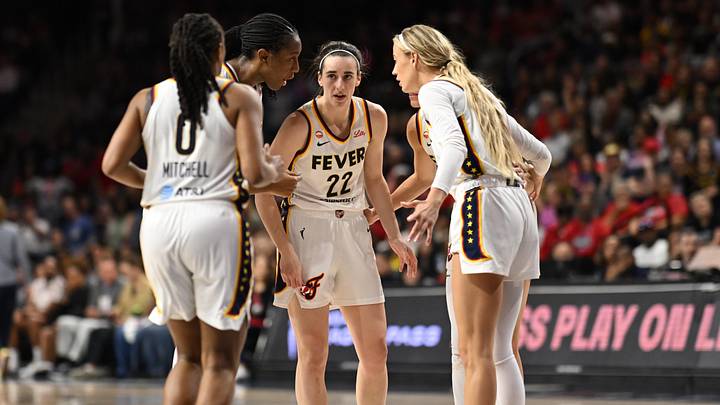
Clark hit a game-winner on Monday. It was the first of her pro career, a deep three with the clock winding down, the kind of shot that makes highlight reels and sparks confidence. Her bucket gave the Fever a much-needed win over the Mystics: After dropping three of its previous four games, Indiana is now back over .500, having stopped its ugly skid and pushed itself back up the standings. It felt like this might be a turning point. Should the Fever eventually be asked when their season changed, how they pulled out of this early funk, Clark from deep on June 8 may very well be the answer.
Or it very well may not. Here’s some of that aforementioned nuance: The Fever won despite showing plenty of their flaws on Monday. This is a team with considerable work to do in figuring out its core identity and maximizing its strengths. This game did not offer much that would qualify as inspiring basketball. But maybe it offered just enough.
CAITLIN CLARK FROM 30 IN THE CLUTCH OMGGGGG pic.twitter.com/7xVnmcoonC
— Shabazz 💫 (@ShowCaseShabazz) June 9, 2026
You can reasonably say that the Fever should never have gone down to the wire against the Mystics. (If that’s generally true, it was especially so on Monday, with All-Star forward Kiki Iriafen missing the second half with an injury.) You can reasonably say that Indiana should never have been in a position to lose this game. (The Fever were up by 14 at halftime and still had led by as much as six with as little as three minutes to play.) You can reasonably say that it felt like a rehash of their late collapse against the Liberty on Saturday. (That it ended differently had just as much to do with the weaknesses of the Mystics as the strengths of the Fever.) You can reasonably say that Clark missed a pair of free throws right before her big shot. (A game-winner may not have been needed had she made them.) You can reasonably say, too, that Washington blew its defensive coverage with rookie forward Cotie McMahon going for the potential steal on that final Indiana possession and instead leaving Clark laughably open right in front of the logo.
But you can also reasonably say this: Clark took the shot and made it.
The first point there is arguably as significant as the second. In this much-discussed, hyper-analyzed third season of hers, Clark is taking more shots than she ever has in the WNBA. (She’s averaging 15.4 field goal attempts per game.) But increasingly fewer of those have been her signature threes. Clark took 8.9 threes per game as a rookie. She is now taking 7.8, and she is sinking them at a less frequent clip, too. And those deep shots now look somewhat different. Clark puts up fewer of them in transition: There are no longer quite so many designed to make the crowd gasp, “She’s pulling up from here?” Nearly half of her rookie threes were unassisted: 48.4%. That number currently sits at 30.8%. Beyond that blunt-force metric, Clark now takes more shots that come from getting into an established offensive set, and she takes fewer that feel audacious or unpredictable in the way they once did. There is unquestionably a difference here.
Yet all of this is fluid. (Here, again, is some nuance.) Clark is not far removed from the first major injuries of her basketball career—the soft-tissue problems that plagued her last season, maddening in a way that can be just as difficult mentally as physically, designed to make a player overthink every fractional movement of every action. That comeback is more than shaking off rust. It can trigger a complete overhaul in how a player thinks about her shot. (It can require thinking about her shot in the first place—what previously felt automatic can now feel like a series of discrete motions that must be forced into place.) That is no small thing. And the aftermath here is, again, deserving of some more nuance: Clark is broadly less efficient than she was in her rookie season before the injuries, and her scoring, assisting and rebounding have all fallen, though only slightly. But the fact that her numbers are still as high as they are—18.7 ppg, 7.9 apg, 4.5 rpg—is a testament to her skill. A compromised, slumping Clark is still a very good player, as it turns out, if occasionally a frustrating one to watch. Then, of course, there is all the rest.
There is the discussion of how the Fever play under coach Stephanie White, and what it means for Clark, and whether there is some kind of deliberate and elaborate sabotage happening in Indianapolis. (Welcome to the “conspiracy theory” portion of this discourse.) It’s certainly true that the Fever have been struggling this season more than they should. The roster does not have the kind of post depth that you would like from a bona fide contender. Some of these rotations have been puzzling, and a more structured, methodical style of play does not seem to maximize the potential offensive firepower here. (Though it’s worth noting that Indiana still leads the league in pace despite its recent struggles: The Fever average 84.9 possessions a game.) But all of this can be fluid, too. White can tinker. She is more than capable of making adjustments—that was on full display last season during her team’s onslaught of injuries. There have certainly been shortcomings here. But those can also be opportunities for growth.
Monday was a fairly rough showing for the Fever. It was a game they very easily could have lost. And it was still a game they won. It required some luck, yes, but it nearly always does. There is some nuance to parse in all of that. But the next part is straightforward. The Fever had a chance to win, and it went to Clark, and she made it happen. Maybe this will not be a turning point. But it feels like as good a candidate for it as anything.
More WNBA from Sports Illustrated
 Add us as a preferred source on Google
Emma Baccellieri was a staff writer focused on women’s basketball for Sports Illustrated. She previously covered MLB. She has also written for Baseball Prospectus and has been honored with multiple awards from the Society of American Baseball Research. A graduate of Duke University, she lives in Washington, D.C.
Follow emmabaccellieri