%20%20--%3E%0A%3Csvg%20version%3D%221.1%22%20id%3D%22Layer_1%22%20xmlns%3D%22http%3A%2F%2Fwww.w3.org%2F2000%2Fsvg%22%20xmlns%3Axlink%3D%22http%3A%2F%2Fwww.w3.org%2F1999%2Fxlink%22%20x%3D%220px%22%20y%3D%220px%22%0A%09%20width%3D%2239px%22%20height%3D%2240px%22%20viewBox%3D%220%200%2039%2040%22%20enable-background%3D%22new%200%200%2039%2040%22%20xml%3Aspace%3D%22preserve%22%3E%0A%3Cpath%20fill%3D%22%23FFFFFF%22%20d%3D%22M38.5%2C7H28.2v26h10.3V7z%22%2F%3E%0A%3Cpath%20fill-rule%3D%22evenodd%22%20clip-rule%3D%22evenodd%22%20fill%3D%22%23FFFFFF%22%20d%3D%22M26.1%2C25.5c0%2C5.8-4.1%2C7.5-12.9%2C7.5C3.9%2C33%2C0%2C31.2%2C0%2C25.2v-1.1h11.6%0A%09v2.4c0%2C0.7%2C0.1%2C1.4%2C1.2%2C1.4c1%2C0%2C1.2-0.4%2C1.2-1.3v-0.9c0-1.6-0.9-1.6-3.5-2.2C2.2%2C21.7%2C0%2C19.7%2C0%2C15.3v-0.9C0%2C9.3%2C5.5%2C7%2C12.9%2C7%0A%09c10.2%2C0%2C12.8%2C2.6%2C12.8%2C7.4v1.8h-11v-2.9c0-0.6-0.4-1.1-1.2-1.1c-0.6%2C0-1.2%2C0.4-1.2%2C1.1v0.9c0%2C1.5%2C0.9%2C2%2C3.3%2C2.5%0A%09c8%2C1.6%2C10.5%2C3.3%2C10.5%2C7.5V25.5z%22%2F%3E%0A%3C%2Fsvg%3E%0A)
Everything to Know About Each WNBA Team Ahead of the 2026 Season
In this story:
The WNBA’s 30th season finally kicks off on Friday, and it took quite a bit to get here. Since the 2025 season wrapped up in October, a new collective bargaining agreement was negotiated (with threats of strikes and lock-outs along the way), an expansion draft for two teams took place, free agency was condensed to just a couple weeks and, of course, a new batch of rookies entered the fold.
Last offseason already saw some record movement. But with all but two players not on rookie contracts at the start of free agency, there was quite a bit to get done in a short span after the CBA was signed in March and it felt like even more of a whirlwind than last year. So much so, it may have been hard to keep track of everything that happened. To make it simple, we wanted to create a snapshot of each team’s offseason. What better way to do that than to quantify it?
We calculated a “continuity score” to roughly measure how much of a team’s post-trade deadline roster remains (don’t fret, we still dig into the expansion rosters too). It’s a weighted score that combines lost starts, minutes, points, rebounds and assists from departing players, and it includes penalties if a team saw one of its top three players leave or underwent a head coaching change. Here’s what these scores essentially translate to:
- 0–25: Rebuild-level upheaval.
- 26–50: Significant changes.
- 51–75: Similar with some tweaks.
- 76–100: Pretty much the same.
With all of that out of the way, let’s dive in:
Las Vegas Aces: 92.6
Biggest Departures: Megan Gustafson, Kiah Stokes
Biggest Addition: Chennedy Carter
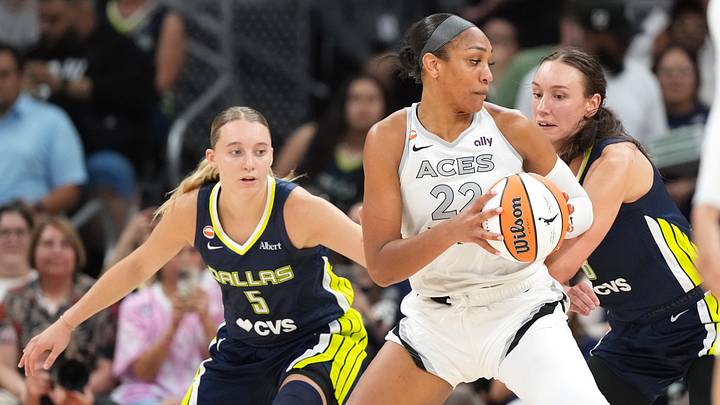
If it ain’t broke, don’t fix it. After winning their third WNBA title in four seasons, the Aces locked up A’ja Wilson, Chelsea Gray and Jewell Loyd with a trio of three-year deals. They also brought back Jackie Young, NaLyssa Smith and Kierstan Bell on one-year deals, ensuring the team’s championship core will remain intact.
What will change is the texture of the Aces’ rotation. Carter, back from her one-year hiatus from the league, gives Vegas the type of downhill scorer at guard that it has lacked. Cheyenne Parker-Tyus replaces the defensive stoutness of Stokes and the floor spacing of Gustafson with more craft in the paint. (Parker-Tyus had only played limited minutes last season after giving birth.) Both join a lineup ready to double down on last year’s success. –Dan Falkenheim
Atlanta Dream: 78.1
Biggest Departures: Brittney Griner, Maya Caldwell
Biggest Addition: Angel Reese
Griner, Caldwell, Nia Coffey and Shatori Walker-Kimbrough have all moved on, and the Dream’s rotation will look different. It’s easy to see Naz Hillmon, the reigning Sixth Player of the Year, stepping into a larger role with Brionna Jones working her way back from knee surgery. Newly acquired Reese will round out the frontcourt, drawing attention and creating space for Rhyne Howard and Allisha Gray, who averaged 18.4 points and 17.5 points per game last season, respectively. Atlanta led the league in rebounds last year, and with the addition of Reese, who paced the league in rebounds per game in 2025 (12.6), expect it to be all over the boards again this season.
Off the court, the Dream got a bit of a boost as well. With Reese came her 5.2 million Instagram followers, as the 23-year-old is the league’s most-followed player. Reese knows how to market herself and is a charismatic crossover pop culture figure, attending the Met Gala three times since 2024. A star is born in Atlanta. –Clare Brennan
Phoenix Mercury: 71.2
Biggest Departures: Satou Sabally, Lexi Held
Biggest Addition: Valériane Ayayi
The Mercury lost a major piece of their 2025 Finals core when Sabally signed with the Liberty during free agency. Sabally led Phoenix in scoring last season (16.3 points per game), and the team’s front office did little to make up for the drop in firepower over the offseason. The Phoenix brass brought in some international talent, including French forward Ayayi, to bolster the frontcourt and boost production. However, for the most part, the Mercury seem to be relying on stars Alyssa Thomas and Kahleah Copper to carry most of the load, along with a veteran supporting cast of Sami Whitcomb and DeWanna Bonner. A lot will depend on the health and form of Bonner, who is 38, and Whitcomb, who will be out for four to six weeks to start the season after undergoing knee surgery.
Perhaps Phoenix didn’t feel pressured to go shopping during free agency, as it re-signed one of the best players in the league, Thomas. She recorded eight triple-doubles during the 2025 season, more than the rest of the league combined (seven). The six-time All-Star also led the team in rebounds (8.8 per game) and assists (9.2 per game), while averaging 15.4 points per game. Thomas’s fingerprints are all over every aspect of the game, and her dominance alone may be enough to lift the Mercury back to the postseason. –C.B.

Indiana Fever: 60.7
Biggest Departures: Natasha Howard, Aari McDonald and Odyssey Sims
Biggest Additions: Monique Billings, Myisha Hines-Allen, Raven Johnson
The Fever made a surprising semifinal run in the 2025 playoffs despite the roster being decimated by injuries. This year, Indiana hopes to stay healthy and stay in title contention. Coach Stephanie White lost a key contributor to last year’s postseason charge, with veteran guard Sims signing with the Wings this offseason. Howard also left during free agency, with the 34-year-old forward joining the Lynx. To make up for the veteran exodus, Indiana acquired experienced post players Billings and Hines-Allen to bolster the Fever’s frontcourt.
Kelsey Mitchell, who Indiana retained on a supermax one-year deal, and Caitlin Clark make up one of the most fearsome backcourt duos in the league. If Clark can stay healthy after appearing in just 13 games last season, the two can really build on their chemistry. And don’t forget about Aliyah Boston, who anchored the Fever amid their injury woes last year and ranked sixth in the league in rebounds per game (8.2). Indiana could use some help on defense, but that is where the rookie Johnson comes into play. The No. 10 pick in the 2026 draft, Johnson is a dogged perimeter defender who can get stops. –C.B.
Golden State Valkyries: 57.2
Biggest Departures: Monique Billings, Temi Fágbénlé, Carla Leite
Biggest Addition: Gabby Williams
Golden State is seeking a replacement contract for Iliana Rupert, who is pregnant, and her absence this season is a key loss for the Valkyries. It leaves … checks notes … Kiah Stokes as the team’s starting center? Coach Natalie Nakase will have to figure out how to maximize her frontcourt—Billings and Fágbénlé are also gone—but the Valkyries are well-equipped with plenty of positional versatility.
That starts with Williams. After a career-best year in Seattle, she’ll harden the Valkyries’ already staunch defense alongside Veronica Burton and Kayla Thornton (now healthy after tearing her meniscus last summer). Throw in Kaila Charles and the eventual arrival of Justė Jocytė, and Golden State has enough reinforcements to build on last season’s success. –D.F.
Los Angeles Sparks: 48.5
Biggest Departures: Azurá Stevens, Rickea Jackson
Biggest Additions: Nneka Ogwumike, Ariel Atkins
Out with the new, and in with the old: The Sparks set the time machine back to 2021 and returned with Ogwumike and Erica Wheeler. They also sent Jackson, the No. 4 pick in 2024, to Chicago for Atkins, and will likely have Cameron Brink, the No. 2 pick in ’24, come off the bench. All told, the projected starting five contains exactly one player (Rae Burrell) without at least eight WNBA seasons on her résumé.
Speaking of Burrell, that decidedly veteran-laden roster will feature shifting roles compared to a year ago. Burrell will become a consistent starter for the first time in her career, and she appears primed for a breakout season. Coach Lynne Roberts has also said that Kelsey Plum would start at point guard and may have less pressure to create with Atkins in the backcourt. But, offense has never been the question. The additions of Ogwumike and Atkins could be just what the Sparks needed to shore up their defense. –D.F.

Connecticut Sun: 48.2
Biggest Departures: Marina Mabrey, Tina Charles
Biggest Additions: Kennedy Burke, Brittney Griner
Mabrey and Charles are both gone, and gone with them is 36% of the Sun’s scoring from 2025. Who will fill the void? Don’t count out Griner just yet. After scoring 14 points in 15 minutes in a preseason game against the Liberty, the 35-year-old center said, “[People] want to call me old, want to say I need to retire and s---, but I’m not. I got a lot to go.” The Sun need that to be true. They also need free-agent acquisition Burke to bring her experience, toughness and competitiveness to a roster filled with young talent.
Enough about the veterans, though. As much as Connecticut’s sunset season will honor the franchise’s legacy, this year will foreshadow what to look forward to in Houston. Start at the point. Second-year guard Leïla Lacan was quietly one of the most impactful players down the stretch last season. Saniya Rivers, a rangy, athletic wing and a game-wrecking defender, and Aneesah Morrow, a tenacious rebounder, will also continue to play key roles for the Sun. Aaliyah Edwards, now in year three, may finally have a runway to more consistent playing time. That’s a list of four young, ascending talents without mentioning the team’s first-round picks, Nell Angloma and Gianna Kneepkens.
Expect the Sun to be scrappy and not to leave their fans without something to root for. –D.F.
Washington Mystics: 47.2
Biggest Departures: Sug Sutton, Jade Melbourne, Stefanie Dolson
Biggest Additions: Lauren Betts, Michaela Onyenwere
Somehow, the Mystics got even younger, so much so that Onyenwere (the team’s most experienced player) was coaching two of Washington’s first-round picks (UCLA’s Betts and Angela Dugalić) just last month. The positive? There is a lot of opportunity to be had. Georgia Amoore, who tore her ACL in 2025, will jump right into starting point guard duties. Sonia Citron and Kiki Iriafen will garner all the minutes they can handle after promising rookie seasons. Betts will play understudy to Shakira Austin, and there’s more than enough playing time to hand out across the rotation. Just keep expectations in check as Washington eyes the future. –D.F.
New York Liberty: 45.5
Biggest Departures: Natasha Cloud, Isabelle Harrison, Nyara Sabally, Kennedy Burke
Biggest Addition: Satou Sabally
As one Sabally sister entered New York, another left. The Liberty landed star forward Satou during free agency, luring her from the Mercury. Meanwhile, her sister, Nyara, followed former Liberty coach Sandy Brondello to the Toronto Tempo, with the 26-year-old selected during April’s expansion draft. Also moving to Toronto from New York is veteran forward Harrison, who averaged 10.6 minutes per game for the Liberty last season. Cloud has departed the Big Apple as well, with the veteran guard joining the Sky.
While there were some key departures, New York retained its Big Three of Breanna Stewart, Sabrina Ionescu and Jonquel Jones. With Cloud gone, Ionescu will take over as the primary ballhandler in new coach Chris DeMarco’s overhauled offense, which emphasizes simplicity and spacing the floor. But New York will have to make do without Ionescu for at least the first two weeks of the regular season after sustaining an ankle injury in the Liberty’s preseason game against the Sun. When New York finally gets all of its stars healthy and on the court together, it will have a significant size advantage. If Leonie Fiebich joins Ionescu, Stewart, Jones and Sabally in the starting five, the lineup will be big. Not to mention the potential jumbo rotation of Han Xu ( 6'11"), Jones (6'6") and Stewart (6'4"). –C.B.

Chicago Sky: 43.1
Biggest Departures: Angel Reese
Biggest Additions: Skylar Diggins, Azurá Stevens, Natasha Cloud, Rickea Jackson
Win now? How about win immediately? The pressure is on second-year coach Tyler Marsh as general manager Jeff Pagliocca went out and acquired two 2025 All-Stars (Diggins and Cloud) and two players who averaged more than 28 minutes and 12 points per game last season (Stevens and Jackson).
On the court, the Sky should look much different. Reese’s departure means that the paint will be Kamilla Cardoso’s to own. Diggins’s arrival (and Cloud’s) also means that Cardoso will finally have a consistent pick-and-roll partner, too. With Jackson and Stevens, who is working her way back from a knee injury, the Sky will also be more capable of spacing the floor. Whether or not the sudden influx of talent will fix last year’s league-worst defense is an open question, but the Sky should be back in the playoff picture for the first time since 2023. –D.F.
Minnesota Lynx: 38.3
Biggest Departures: Alanna Smith, Jessica Shepard, Bridget Carleton
Biggest Additions: Natasha Howard, Olivia Miles
Right as the Lynx had become a perennial powerhouse, teams plucked players from their roster like it was nobody’s business. Frontcourt depth? Gone, with Smith and Shepard both now on the Wings. Three-point shooting? Dampened, with Carleton off to Portland. The StudBudz? Broken up, with Natisha Hiedeman now on the Storm. If that wasn’t enough, Napheesa Collier’s future in Minnesota now seems like a question mark.
Amid all of that change and uncertainty, a Lynx roster that is greener than in recent seasons will give Cheryl Reeve a new challenge. That’s by Reeve’s own admission: After Minnesota’s final preseason game, the coach said they need to figure out the Olivia Miles–Courtney Williams backcourt pairing and that the Lynx will be more of a rim-pressure team. With that being the case, it might take some time for Minnesota to fully come together. But, all is not lost. Miles will dazzle and show why she may have been the best offensive player in the draft. Howard will fill in as Collier works her way back from an ankle injury. European players like Emma Cechova (a rookie), Dorka Juhász (recovering from a foot injury) and Anastasiia Olairi Kosu (in her second year) could step in as important depth pieces and prove the organization’s international scouting prowess. Until Collier comes back, though, the Lynx may struggle. –D.F.
Dallas Wings: 37.5
Biggest Departures: Luisa Geiselsöder, Haley Jones
Biggest Additions: Alanna Smith, Jessica Shepard, Azzi Fudd
Last season was rough. The Wings had one of the league’s worst defenses and the second-worst three-point shooting percentage, and, in general, lacked cohesion. With co-Defensive Player of the Year Smith and new coach Jose Fernandez in town, expect both of those issues to improve.
Dallas played fast in both preseason games and Bueckers hunted pull-up threes against the Fever. (Bueckers has said she and Fernandez have talked about her becoming more aggressive and assertive.) Fudd, Dallas’s No. 1 pick, should provide plenty of three-point shooting prowess, while Smith, Shephard and Awak Kuier will give Dallas substantial frontcourt length next to Li Yueru. There’s every reason to believe the Wings will rise from the bottom and return to the postseason for the first time since 2023.
RELATED: For Veterans Like Alysha Clark, This New WNBA Era Just Means More

Seattle Storm: 13.9
Biggest Departures: Nneka Ogwumike, Skylar Diggins, Gabby Williams, Brittney Sykes
Biggest Additions: Natisha Hiedeman, Awa Fam Thiam, Flau’jae Johnson
The Storm will begin the season with a new coach and without six of the seven players who played in the team’s final playoff game. To put it simply: It’s the start of a rebuild and a new era in Seattle.
Let’s start at the top. Sonia Raman hopped over from the Liberty and brings extensive college coaching experience—as well as player development and analytics chops from her time with the Grizzlies—to her first major WNBA gig. She has said she wants the Storm to push pace and play fast. Between guards Hiedeman and Johnson, she has the backcourt to do just that.
That’s the side plot, though. The story of Seattle’s new era will be written by Dominique Malonga, the 6'6", 20-year-old dunking phenom entering her second season in the league. Malonga will be tasked with more duties in just about every aspect of her game. (New acquisition Stefanie Dolson has said Malonga has been working on her handle.) When Ezi Magbegor returns from a foot injury and No. 3 pick Fam Thiam comes into the fold, the Storm will have a terrifyingly versatile frontcourt—and reason for optimism, even if they are not in the playoff picture. –D.F.
Toronto Tempo
Biggest Additions: Marina Mabrey, Brittney Sykes
The Tempo have a championship-winning coach (Brondello), a 2025 All-Star (Sykes), a consistent scorer and shot creator (Mabrey) and an experienced, well-traveled point guard (Julie Allemand). Toronto bears few marks of being an expansion team outside of the fact of its newfound existence.
With that being said, the names on paper may look better than the team is in actuality. Sykes and Mabrey are both volume shooters and have, at times, struggled with efficiency. Toronto does not have a premier frontcourt player. Instead, Brondello will play a five-out offense and place a premium on versatility. The key, then, may be to squeeze as much juice out of Spanish national team player Maria Conde and No. 6 pick Kiki Rice as possible. –D.F.
Portland Fire
Biggest Additions: Bridget Carleton, Carla Leite
Consider the Fire the inverse of the Tempo: The franchise has been reborn, but the roster does bear the marks of being an expansion team. Portland’s starting five will likely feature only two true starters from last season (Carleton and Sutton), and the rest of the roster is made up of players with potential, but who still have a lot to prove.
That’s not a knock. During the offseason, new coach Alex Sarama said the Fire would be a “good mess” to start. A good mess is apt. In its final preseason tune-up, Portland committed 29 fouls and turned the ball over 24 times. (O.K., maybe that’s more like a straight-up mess.) But the Fire consistently attacked the basket, and Leite exhibited signs of a potentially fruitful pick-and-roll connection with Luisa Geiselsöder. There will be growing pains along the way, but the Fire are playing the long game. –D.F.
More WNBA from Sports Illustrated
 Add us as a preferred source on Google
Clare Brennan is an associate editor for Sports Illustrated focused on women’s sports. Before joining SI in October 2022, she worked as an associate editor at Just Women’s Sports and as an associate producer for WDET in Detroit. Brennan has a bachelor’s in international studies from the University of Wisconsin and a master’s in art history from Wayne State University.

Dan Falkenheim is a fact checker for Sports Illustrated, where he may inundate you with numbers when he writes women's hoops. He joined the SI staff in September 2018 and also produces Faces in the Crowd for print. A graduate of Montclair State, Dan first got hooked on women’s basketball when covering the Red Hawks’ run to the 2015 Division III Final Four for the student newspaper. He lives in New Jersey with his wife and sweet rescue dog, Hari.
Follow thefalkon