%20%20--%3E%0A%3Csvg%20version%3D%221.1%22%20id%3D%22Layer_1%22%20xmlns%3D%22http%3A%2F%2Fwww.w3.org%2F2000%2Fsvg%22%20xmlns%3Axlink%3D%22http%3A%2F%2Fwww.w3.org%2F1999%2Fxlink%22%20x%3D%220px%22%20y%3D%220px%22%0A%09%20width%3D%2239px%22%20height%3D%2240px%22%20viewBox%3D%220%200%2039%2040%22%20enable-background%3D%22new%200%200%2039%2040%22%20xml%3Aspace%3D%22preserve%22%3E%0A%3Cpath%20fill%3D%22%23FFFFFF%22%20d%3D%22M38.5%2C7H28.2v26h10.3V7z%22%2F%3E%0A%3Cpath%20fill-rule%3D%22evenodd%22%20clip-rule%3D%22evenodd%22%20fill%3D%22%23FFFFFF%22%20d%3D%22M26.1%2C25.5c0%2C5.8-4.1%2C7.5-12.9%2C7.5C3.9%2C33%2C0%2C31.2%2C0%2C25.2v-1.1h11.6%0A%09v2.4c0%2C0.7%2C0.1%2C1.4%2C1.2%2C1.4c1%2C0%2C1.2-0.4%2C1.2-1.3v-0.9c0-1.6-0.9-1.6-3.5-2.2C2.2%2C21.7%2C0%2C19.7%2C0%2C15.3v-0.9C0%2C9.3%2C5.5%2C7%2C12.9%2C7%0A%09c10.2%2C0%2C12.8%2C2.6%2C12.8%2C7.4v1.8h-11v-2.9c0-0.6-0.4-1.1-1.2-1.1c-0.6%2C0-1.2%2C0.4-1.2%2C1.1v0.9c0%2C1.5%2C0.9%2C2%2C3.3%2C2.5%0A%09c8%2C1.6%2C10.5%2C3.3%2C10.5%2C7.5V25.5z%22%2F%3E%0A%3C%2Fsvg%3E%0A)
Biggest Questions for the Selection Committee for Women’s March Madness Bracket
In this story:
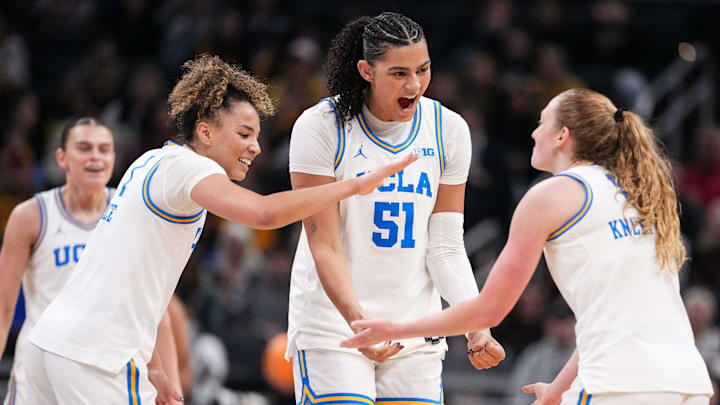
The Power 4 conferences wrapped up their championship weeks on Sunday with UCLA, Texas, West Virginia and Duke securing league titles and bids into the NCAA tournament.
While the rest of the automatic bid spots fill up this week, our writers and editors take a look at what the selection committee must parse through before Sunday’s bracket reveal.
What is the biggest question for the selection committee?
Dan Falkenheim: Who should be the overall No. 1? The easy answer is UConn—28 out of 31 AP voters ranked the Huskies first—but the question is more interesting than it looks. And, of course, it hinges on strength of schedule. The metric doesn’t tell all, but it does help calibrate confidence in a team’s résumé. For UCLA, that confidence should be very high. The Bruins’ 51-point win against Iowa was the largest margin of victory, ever, against an AP top-10 team. They are the first team to finish Big Ten regular season play undefeated since 2014–15. UCLA’s 1.21 points per possession came against the NCAA’s third-toughest schedule; UConn’s 1.20 points per possession came against the 41st-toughest schedule. The Bruins had 18 Quad 1 wins. The Huskies had nine. And so on. Yes, the undefeated Huskies are a more-than-worthy overall No. 1. The Bruins, though, have matched that dominance against tougher competition. (Don’t forget: UCLA’s entire starting five could be selected in the first round of the WNBA draft.)
Emma Baccellieri: How do the No. 2 seeds end up shaking out? There’s no mystery about which programs will get a No. 1. But right behind them… we’ll see. Vanderbilt and LSU are lined up to get two of those spots. Duke seems likely after fixing its early woes and going on to win the ACC tournament. That leaves one more for either Iowa or Michigan. They have the exact same Quad 1 record at 9–6. The AP poll has Iowa ranked No. 7 and Michigan ranked No. 9. (Mark down one figure in favor of the Hawkeyes.) But the NET ranking has Michigan No. 6 and Iowa No. 10. (Mark down one for the Wolverines.) The head-to-head record here easily favors Iowa: The Hawkeyes just beat the Wolverines in the Big Ten tournament, and they beat them in the regular season, too, both times by double digits. But consider their respective performances against top seeds. Iowa got smashed against both UConn (26 points) and UCLA (23 points in the regular season before a 51-point beatdown in the Big Ten championship). Michigan, on the other hand, managed to hang with both of those programs. The Wolverines lost to both the Huskies and the Bruins by just a single possession. (It was the narrowest margin of victory this year for both teams.) So: Iowa or Michigan? Or does the committee decide to make both a No. 2 and come in with a No. 3 for Duke, which did win its conference, but finished with more losses than either Iowa or Michigan? There are valid cases to be made for all three options here.
Clare Brennan: Will Tennessee make the tournament? The answer is likely yes, but for the first time in a long time, it’s not a given. The Lady Vols are the only team to play in every NCAA tournament since the inaugural contest in 1982, so it’s notable that they now find themselves on the bubble. Tennessee capped off its season with a seven-game losing streak, finishing 16–13. The committee tends to exhibit recency bias, favoring recent results over a team’s overall résumé. However, Kim Caldwell’s squad has a couple of things going for it that should boost its case. Strength of schedule is one. The Lady Vols played one of the toughest schedules this year. Eight of Tennessee’s last 10 regular-season games were against ranked opponents, including UConn, South Carolina, Texas, LSU and Vanderbilt. The Vols are 22nd in the NET rankings, holding five Quad 1 wins, which should help push them over the edge and into the tournament. While Tennessee is likely to go dancing, it will almost certainly face a tough draw as a lower seed, which will be a tall task for a team entering March with little momentum. The program’s immediate future may be uncertain, but it is clear that Tennessee is at a crossroads after a season marked by turmoil and lackluster results.

Blake Silverman: Who gets cut from the top 16? The top four seeds in each region are particularly important on the women’s side as those schools get to host first- and second-round games. After winning the Big 12 tournament, West Virginia jumped five spots from No. 17 to No. 12 in a matter of a couple weeks. North Carolina rose into host territory as well with wins in 13 of its last 15 games. The presence of risers means there has to be fallers, too, with a handful of schools hoping to see a four seed on Selection Sunday. Kentucky, Maryland, Minnesota and Michigan State are on the bubble for seemingly the final top-16 spot. The three Big Ten schools all disappointed in the conference tournament as each lost its first game in Indianapolis. At 23–8, the Terrapins are slightly ahead, but the Golden Gophers are ranked highest of the bunch in the NET rankings at No. 9. The Spartans dropped four of their last six games, but beat the Gophers convincingly on the road on Feb. 22. Kentucky had a tough schedule to finish the regular season and a daunting path in the SEC tournament. Kenny Brooks’s Wildcats have two losses to South Carolina and Vanderbilt, plus another loss to Texas over the past month. They don’t have a bad loss on the résumé and have wins over LSU, Oklahoma, Ole Miss and Louisville this year, which gives Kentucky potentially the strongest case despite having the most losses of the bunch.
Who should be worried after conference tournaments?
Falkenheim: Stanford. After their first-round loss to Miami, the Cardinal will likely miss the NCAA tournament for a second straight season. That hasn’t happened in nearly 40 years. So, what went wrong? On the court, Stanford’s offense took a step back. The Cardinal averaged 70.2 points per game, which ranked 11th in the ACC and was the program’s lowest since 2017–18. Leading scorer Nunu Agara missed five games due to an injury right as conference play heated up, and Stanford lost to Virginia Tech and Georgia Tech in that stretch. Off the court, the program’s portal-light approach hasn’t panned out: This season, Stanford had fewer transfers on its roster than any other Power 4 program, and started three freshmen at times. Five-star recruits Hailee Swain, Lara Somfai and Alexandra Eschmeyer should all grow in their sophomore seasons, but it’s unclear how high the Cardinal’s ceiling can actually be with the program’s current roster and approach.
Baccellieri: Richmond. The Spiders are sitting right on the bubble after stumbling in the Atlantic 10 semifinals. Their 15-point loss to George Mason puts their hopes for an NCAA tournament spot in the hands of the Ivy League, which still has its tournament left to play, and which likely will receive two bids if any school wins other than Princeton. And no dancing for Richmond would mean the end of the road for senior forward Maggie Doogan, the most intriguing WNBA prospect this year from a mid-major.
Brennan: Nebraska. The Cornhuskers could be on the outside looking in after coughing up a 20-point lead and falling to Indiana in the opening round of the Big Ten tournament. Their early exit came after losing six of their last eight regular-season games. However, Nebraska does have a NET rating of 26 and a Quad 1 win to bolster its résumé. Amy Williams’s team will likely be on pins and needles on Sunday, sitting firmly on the bubble after a disappointing Big Ten tournament outing.
Silverman: Virginia. The Cavaliers had momentum for their NCAA tournament case after a win over Louisville on Feb. 22. Fortunes quickly turned, however, as the Hoos dropped three straight for an early exit at the ACC tournament. The loss to North Carolina wasn’t horrible, but when you couple it with a one-point defeat to rival Virginia Tech and an opening-round loss to Clemson in the conference tournament, it puts Virginia firmly on the bubble and maybe on the outside looking in. The Hokies and Tigers should get into the 68-team field, but both remain floating near the bubble themselves. Virginia hopes for the program’s first NCAA tournament appearance since 2018 and junior guard Kymora Johnson has been great three seasons in a row, averaging a career-best 19 points per game this year. Nevertheless, Sunday will bring nerves for the Hoos, who await their fate from the selection committee.
Riser of the week
James Madison: The Dukes clinched their March Madness bid on Monday with a win over Troy in the Sun Belt title game. Entering the tournament, James Madison was third in the conference. No matter. The Dukes beat South Alabama by 25, regular-season champion Georgia Southern by 28 and second-seeded Troy by 17, and extended their unbeaten streak to 12 games. They have done so by dominating their opponents down low and on the glass: James Madison ranks eighth in the country in both points in the paint per game (39.2) and total rebounding margin (+306). That’s in no small part due to reigning Sun Belt Player of the Year Peyton McDaniel and senior forward Ashanti Barnes, who have combined to average 35.6 points and 16.3 rebounds per game during the Dukes’ undefeated stretch. Both players also rank in the top 35 in terms of box plus-minus, which uses box score data to quantify a player’s contribution to their team’s performance, in that span. James Madison is on a roll. —Falkenheim
Faller of the week
Iowa State: Few teams in the NCAA lean so heavily on so few players as the Cyclones do, and that becomes a problem when Audi Crooks, Addy Brown or Jada Williams have an off night. Case in point: Brown and Williams shot 8-for-26 from the floor as Arizona State upset Iowa State, 77–68, in the first round of the Big 12 tournament. The Sun Devils are no joke—first-year coach Molly Miller has the program on the precipice of its first NCAA tournament appearance since 2019—but that game also surfaced another issue. The Cyclones’ middling defense leaves too little margin for error for a team trying to avoid a second straight first-round exit in March. –D.F.
Moment of the week
It was a big day for the Vandals yesterday, as the women’s basketball team defeated reigning Big Sky champs Montanta State to secure a spot in the Big Dance for the first time in a decade.
THE VANDALS ARE ON TO THE NCAA TOURNAMENT FOR THE FIRST TIME IN A DECADE 🔥
— espnW (@espnW) March 11, 2026
Idaho takes the Big Sky Championship from the reigning champs 💪 pic.twitter.com/lXakdspYED
Later in the day, the men’s team also took the Big Sky title for its first trip to the NCAA tournament since 1990.
More College Basketball on Sports Illustrated
 Add us as a preferred source on Google
Blake Silverman is a writer at Sports Illustrated, primarily covering the NBA and WNBA. Before joining SI in November 2024 as a breaking/trending news writer, he covered the WNBA, NBA, G League and college basketball for numerous sites, including Winsidr, SB Nation and A10Talk. He’s an alum of both Michigan State and St. Bonaventure University, receiving a master’s degree from the Bonnies’ sports journalism program. Outside of work, he’s a husband, father, yogi and fairly mediocre tennis player who’s open to any tips on how to play defense in EA Sports College Football.
Follow blakesilverman
Dan Falkenheim is a fact checker for Sports Illustrated, where he may inundate you with numbers when he writes women's hoops. He joined the SI staff in September 2018 and also produces Faces in the Crowd for print. A graduate of Montclair State, Dan first got hooked on women’s basketball when covering the Red Hawks’ run to the 2015 Division III Final Four for the student newspaper. He lives in New Jersey with his wife and sweet rescue dog, Hari.
Follow thefalkon
Emma Baccellieri is a staff writer focused on women’s basketball for Sports Illustrated. She previously covered MLB. She has also written for Baseball Prospectus and has been honored with multiple awards from the Society of American Baseball Research. A graduate of Duke University, she lives in Washington, D.C.
Follow emmabaccellieri
Clare Brennan is an associate editor for Sports Illustrated focused on women’s sports. Before joining SI in October 2022, she worked as an associate editor at Just Women’s Sports and as an associate producer for WDET in Detroit. Brennan has a bachelor’s in international studies from the University of Wisconsin and a master’s in art history from Wayne State University.