%20%20--%3E%0A%3Csvg%20version%3D%221.1%22%20id%3D%22Layer_1%22%20xmlns%3D%22http%3A%2F%2Fwww.w3.org%2F2000%2Fsvg%22%20xmlns%3Axlink%3D%22http%3A%2F%2Fwww.w3.org%2F1999%2Fxlink%22%20x%3D%220px%22%20y%3D%220px%22%0A%09%20width%3D%2239px%22%20height%3D%2240px%22%20viewBox%3D%220%200%2039%2040%22%20enable-background%3D%22new%200%200%2039%2040%22%20xml%3Aspace%3D%22preserve%22%3E%0A%3Cpath%20fill%3D%22%23FFFFFF%22%20d%3D%22M38.5%2C7H28.2v26h10.3V7z%22%2F%3E%0A%3Cpath%20fill-rule%3D%22evenodd%22%20clip-rule%3D%22evenodd%22%20fill%3D%22%23FFFFFF%22%20d%3D%22M26.1%2C25.5c0%2C5.8-4.1%2C7.5-12.9%2C7.5C3.9%2C33%2C0%2C31.2%2C0%2C25.2v-1.1h11.6%0A%09v2.4c0%2C0.7%2C0.1%2C1.4%2C1.2%2C1.4c1%2C0%2C1.2-0.4%2C1.2-1.3v-0.9c0-1.6-0.9-1.6-3.5-2.2C2.2%2C21.7%2C0%2C19.7%2C0%2C15.3v-0.9C0%2C9.3%2C5.5%2C7%2C12.9%2C7%0A%09c10.2%2C0%2C12.8%2C2.6%2C12.8%2C7.4v1.8h-11v-2.9c0-0.6-0.4-1.1-1.2-1.1c-0.6%2C0-1.2%2C0.4-1.2%2C1.1v0.9c0%2C1.5%2C0.9%2C2%2C3.3%2C2.5%0A%09c8%2C1.6%2C10.5%2C3.3%2C10.5%2C7.5V25.5z%22%2F%3E%0A%3C%2Fsvg%3E%0A)
Villanova and Notre Dame’s Roman Holiday Shows Why the College Athlete Experience Is Worth Saving
ROME — On Halloween inside the majestic St. Peter’s Basilica, eyes burn from a dense fog of incense. As the sound of an organ soars off the pilasters, a procession of priests pass the Pietà, one of the world’s most iconic sculptures, the one where Michelangelo made cold marble malleable, draping it in waves like a gossamer curtain. It could be any day at the Vatican, but in place of a College of Cardinals there are two colleges and a collage of quarterzips. Rome is besieged by a sea of Villanova and Notre Dame logos.
St. Peter’s, one of the most popular tourist attractions in the world, is closed to all tourists until the afternoon. Few things can shutter the bronze doors to the 12 million annual visitors. College basketball has now joined the list of conclaves and canonizations.
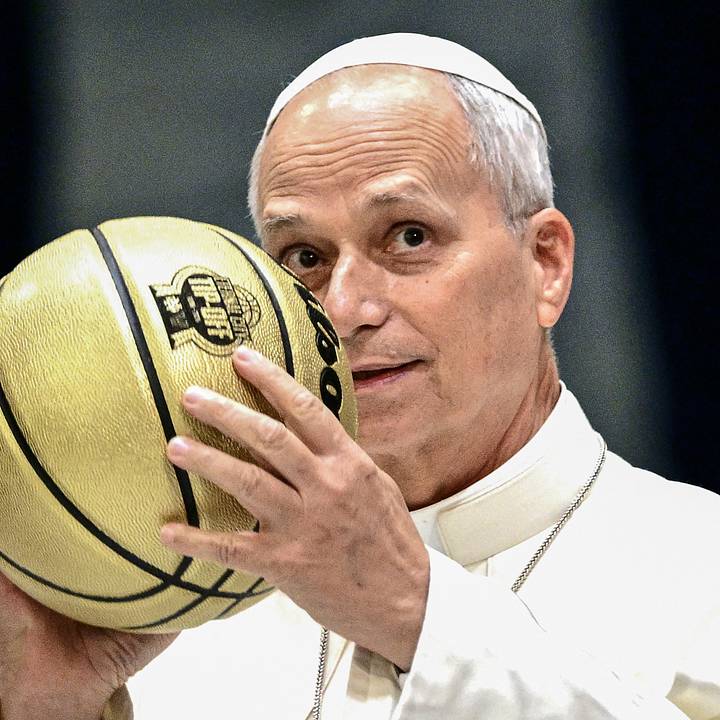
Under St. Peter’s gilded ceilings, Golden Domers and Philly Main Liners come for a celebration, not just of a season’s beginning but also of a commemoration of history’s first American pope. Within hours, the crowd of 6,000-plus packs into an auditorium to meet Chicago native and Villanova alum Robert Prevost, who now goes by the name of Pope Leo XIV. The hall immediately goes silent upon any movement, camera phones at the ready as they wait for their rock star. Finally, the pope emerges from a side door to a standing ovation. He recites the sign of the cross in Italian until he realizes he’s speaking to Americans and laughs while switching to English. For a moment, he’s allowed to go back to being Bob the mathematics major, Villanova class of ’77, and he soon has his audience in stitches.

“Growing up on the southside of Chicago, we sometimes heard ‘Go Irish!’ But as you all know, Prevost graduated from Villanova,” he said, chuckling. “So the pope doesn’t take sides. Prevost has another opinion but we won’t do that now.”
A day after a private tour of the Sistine Chapel, each player and coach share a personal moment with the pope. They present gifts such as customized jerseys, trade jokes and dribble with one of the world’s most powerful men. Then, in a group photo, players get him to hold up the Villanova “V,” a simple peace sign to his usual congregation but much more to his alma mater. It is a moment no one there would soon forget.
Leaving the building, one attendee didn’t mind having to share his status as Villanova’s top sporting celebrity. “This is up there with all the great Final Fours, everything,” says former men’s basketball coach Jay Wright, who led Villanova to two men’s college basketball national titles. “This is bigger than basketball, and it’s two great universities. This ranks up there with everything I’ve done in college basketball.”
It is a moment showing what makes college sports so unique. A measure of college identity, sport and educational field trip mixed into a memory.
“I think of it as a celebration of what we share in common with Villanova,” says Notre Dame president Rev. Robert A. Dowd, “but also just a celebration of all that college sports is and can be.”
It was a celebration that took more than a year to put together.
Villanova athletic director Eric Roedl still remembers where he was when a certain Wildcats alum walked out onto the St. Peter’s loggia for the first time and announced his papacy to the world’s 1.4 billion Catholics in May 2025. Ironically, Roedl was watching the news in the new pope’s hometown of Chicago with Villanova’s president Rev. Peter M. Donohue, a longtime acquaintance of Pope Leo XIV. Mere moments after their celebration—and disbelief—subsided, Roedl and Donahue dreamed up a wild idea that very day: What if we played a game in Rome?

“The wheels started spinning a little bit because it was such an incredible moment for our university,” Roedl says. “And, you know, sports are such a powerful way to bring people together. Wouldn’t it be cool if we brought our basketball teams, which are such a big part of the DNA at Villanova, over to Rome to compete and celebrate the appointment of the first American pope who’s a Villanova grad? It was just an amazing story.”
Notre Dame’s international renown, broad appeal to potential broadcasters and an alumni base that is known as one of college sports’ best traveling fan bases made them the obvious option from the start. “Notre Dame right out of the gates was just the first thought,” Roedl says. “And it never really veered off of that.”
It wasn’t Villanova’s first sporting event in Italy. In 1989, Villanova football played Rhode Island in Milan’s Arena Civica. Built to look like an Imperial Roman amphitheater in 1807 under Napoleon’s orders, the Arena Civica’s archaic dimensions meant the end zones were eight yards rather than 10. This time around, Villanova brought their own court with Eternal City Tip-Off written across it.
Partnering with On Location, the co-founders of the Aer Lingus College Football Classic in Ireland, the universities went to work piecing together a weekend that would become one of college sports’ most iconic experiences. Sunday’s tailgating scene at first baffled fans for its distinctly Italian, soccer-infused peculiarities: no bars or restaurants, just cafeteria trucks blasting disco music while dancing waiters dish out hot porchetta sandwiches and Birra Moretti lager. But once inside the Palazzo dello Sport—thanks to its webbed roof reminiscent of Madison Square Garden, the low Fox camera angles and a lively crowd—both Villanova men’s coach Kevin Willard and Notre Dame women’s coach Niele Ivey said the atmosphere resembled a bigger moment, even March Marchness.

While Notre Dame came away with the sweep of both men’s and women’s games, Roedl called it a “transformational experience with opportunities to learn and grow.” Dowd also immediately recognized the power of this experience for the athletes.
“There’s a basketball game for each team, but for many of them, it's their first time here, their first time outside the United States,” Dowd says. “What a great experience, I mean, just to be here in the Eternal City and all that it has to offer in terms of history and the arts and faith. And so it’s a wonderful opportunity for our students to be introduced to all of that and to think about all of that.”
The weekend proved to be an experience that sets college sports apart despite all the uncertainty over its future. For the 6,000-plus attendees at the St. Peter’s private mass, there was surely a sense of wonder. But the purpose of the mass was still mass; it was a weekly gathering, a sense of belonging and community that can be found at the heart of all religions and even sports. It was people coming together to empty some spiritual vessel filled up by the storms of their week.
It’s clear that the cup of college sports overfloweth, and no one can seem to agree on the right way to empty the vessel. But the parting lesson of this Roman holiday was that the unique identity of universities and college athlete experiences are things worth fighting for as the NCAA’s destiny is decided.
One of Rome’s most famous legends says that in 64 A.D., as Rome burned under a great fire, the emperor Nero climbed to the top of the palace walls to witness the destruction. Rather than mobilize, rather than pull together a plan of action as expected from a leader, he played music and watched the flames rampage.
Is that to be the fate of college sports? Will its leaders continue to fiddle while everything slowly burns?
In this shifting collegiate ecosystem, NIL profit runs rampant with quasi-slush funds and agents preying in the shadows. Fueled by a monopolistic thirst for empire, conference realignment is on the verge of creating a super league that devalues the rivalries and geographic intricacies that keep college sports both peculiar and unique. Meanwhile, the transfer portal has become a façade for professional free agency, making the gap between student and athlete larger than ever before. “Abyssus abyssum,” recites a prominent cardinal in the 2024 film Conclave. The abyss calls unto the abyss.

Notre Dame president Dowd knows that his school has more influence than most when it comes to the state of college sports. He says that universities, including his own, need to band together before college sports crosses the Rubicon and wades further into the world of professional sports.
“We do not want to be a professional league,” Dowd says, reiterating former president John Jenkins’s call to avoid becoming the NFL. “The university is about education and the holistic growth of all of our students, including our student-athletes. I think working together with other universities, I think [Notre Dame] really must lead and do everything we possibly can to keep student-athlete together.”
Pope Leo XIV recently weighed in on the creeping commoditization of sport that has consumed the world. In his “Life in Abundance” letter prior to the 2026 Winter Olympics, he denounced the pay-to-play model as making sport less accessible that undermines sport’s true values.
“Problems arise when business becomes the primary or sole motivation,” he wrote. “When this happens, decisions are no longer based on human dignity or the best interests of the athletes, their integral development and that of the community.”
Leo XIV’s predecessor, Francis, framed the situation more poetically: “Sport is harmony, but if the excessive quest for money and success prevails, that harmony is broken.” Where does that put the harmony of college sports?
“I’d like to think it’s not irreparably broken, but I think it’s damaged significantly,” Dowd says. “And we need to do something about that. When I say we, I mean Notre Dame working together with others. What’s challenging is that this current state of affairs didn’t happen overnight. We knew it was a trainwreck a long time in the making that everyone could see happening.”
Dowd, like many university leaders, openly supports federal legislation like the Protect College Sports Act (PCSA) that recently passed in the U.S. Senate and awaits congressional approval. The PCSA would provide baseline regulation for transfers and eligibility, establish a framework for NIL, enshrine Title IX protections and attempt to reign in conference realignment. Dowd admits the PCSA is not a perfect piece of legislation, but “a huge step in the right direction.”

“Then we have some real soul-searching to do. It’s not going back to what it used to be. But going forward, how can we make sure that we’re preserving student-athlete experience, that we’re helping our student-athletes to grow, that they have the rights they deserve? And at the same time, we know that college sports is about education.”
The weekend in Rome is critical to understanding the core component of what makes college sports special: the student experience. Choosing a university has always been a life-altering decision, for both students and athletes. It’s not free agency; it’s not job hunting. It was, and hopefully still is, charting a path, an idea that in a world that wants total control, the nation’s youth might just have a say at what they want to be.
Study abroad programs have become integral to the modern university experience—when students travel, they take what they learn in the classroom, apply the lessons to this new world they inhabit and craft unforgettable life experiences that allow empathy to blossom and curiosity to inspire. But the year-round rigors of college athletics often prevents athletes from partaking in such a formative collegiate experience.
Immediately after dropping 32 points against Villanova, Notre Dame women’s basketball star Hannah Hidalgo, a two-time first-team All-American, was still marveling at the fact that she got to meet the pope. Immersive experiences like the Eternal City Tip-Off and the educational opportunities at Notre Dame are part of why she chose to go to South Bend in the first place.
“My freshman year I was in Paris. And now to be here my senior year in Rome, [Notre Dame] basketball has just taken me all over,” Hidalgo says. “It’s hard. Especially here at Notre Dame. Doesn’t matter who you are, you gotta go to class. But it’s opened so many doors for me, so many opportunities for me and I’m so thankful.”
While NIL money was involved in the Rome experience as part of Players Era’s first international event, no amount of money could have changed the fact that these two Catholic universities share a common identity and unique connection to the staging of an event at the Vatican and in Rome. This was not an NFL game in Australia or an MLB season opener in Korea. It was relevant; it was immersive.

“We don’t want to become a transactional place,” Roedl says about Villanova. “We’re in a transactional world right now in college athletics. We have to continue to adapt. But what we’ve seen is that retention rates and the reasons that student-athletes are choosing Villanova continue to be because they want to be at Villanova. They have a connection to the university. They value the education.”
It’s not to say the solution is for every school to adopt a religious identity, and it’s not to say every experience will involve the pope or traveling abroad. But perhaps the moral is that each university is unique not just in location but in identity and tradition and scholarship, and these differences are what makes college sports beautiful—and, crucially, what separates it from professional sports.
“Notre Dame athletics ceases to be Notre Dame athletics when it doesn’t matter whether students go to class anymore, when winning is everything and the only thing,” Dowd says. “We want to help [athletes] grow in ways that are going to help them to live a life that's meaningful and rewarding in the long run after their playing days are done.”
Perhaps there is value in knowing that when everything we know about the institution of college sports is upended, one can still hold onto the identities that make each college experience distinct, and allow that to be the guiding force that bring sports back to center, back to a formative educational experience and back to what fans love most about it.
The near future will reveal what will be the rock upon which the new age of college sports is built, be it profit or scholarship. Rome was not built in a day and neither was college sports. But it can all go up in flames, and there will be no music—fight song or emperor’s tune—to mourn it.
 Add us as a preferred source on Google

Andrew Gastelum is an editor and writer at Sports Illustrated who specializes in soccer, the Olympics and international sports. He is a graduate of the University of Notre Dame and lives in Italy.
Follow aogastelum